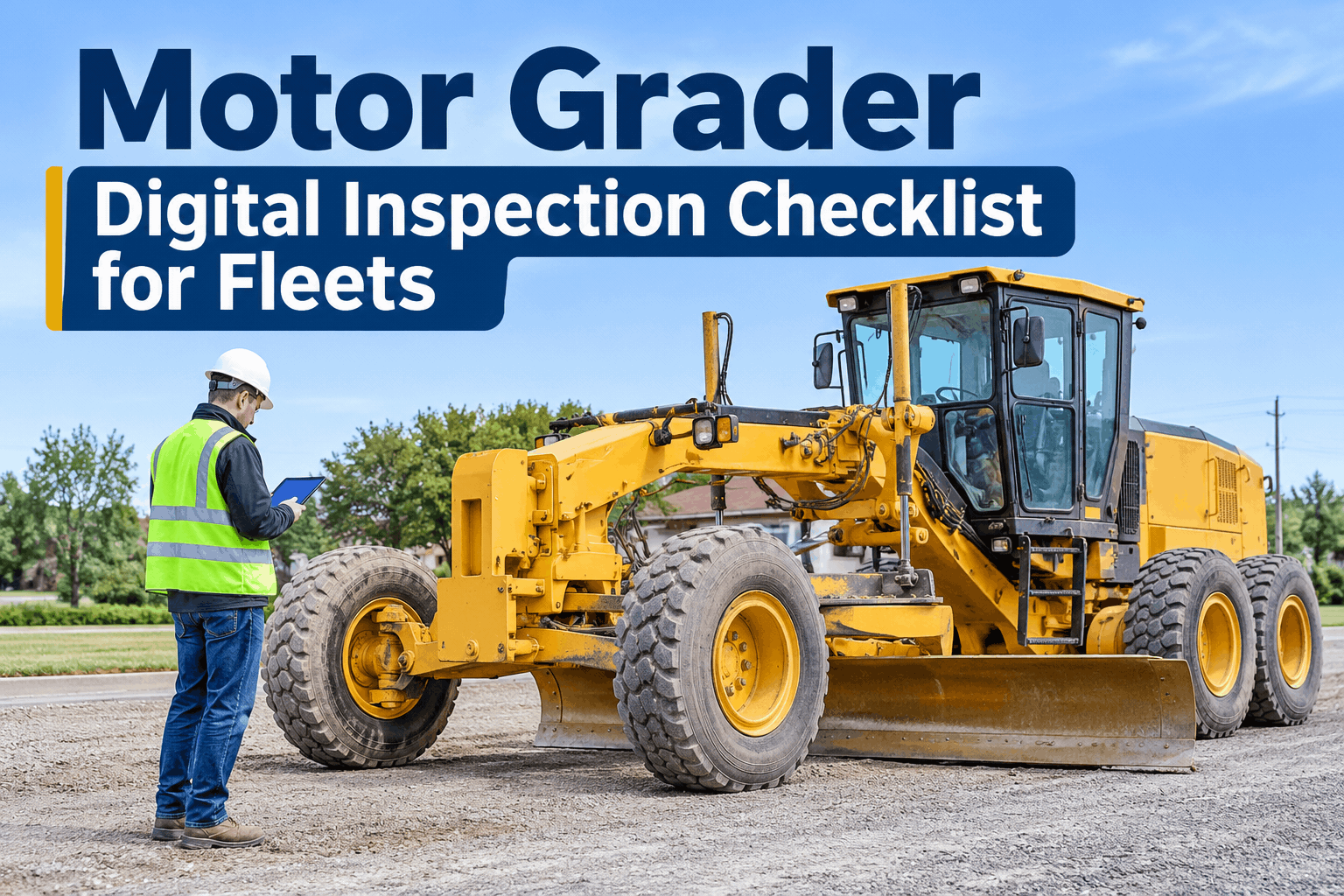
Six graders cover forty miles of gravel road for the county, and in November the same six machines swap moldboards for snow and go back out before the first storm. Nobody owns a single grader full-time — whoever's on shift signs it out, runs the route, and parks it for the next crew. When the circle drive starts binding or a cutting edge wears past its limit, it's anyone's guess who noticed last and whether it got written down anywhere. A motor grader digital inspection checklist fixes that by tying every check to the machine, not the operator's memory, whichever crew has it this week. Book a demo to see it on your road maintenance fleet
One Grader, Two Seasons, One Record That Follows the Machine
A digital pre-operation inspection that travels with the grader across crews, shifts and seasons — gravel-road grading in summer, snow removal in winter — with defects routed straight to a work order.
The same grader, two completely different jobswhy motor grader inspection software has to handle both grading mode and snow mode
A municipal grader doesn't do one job all year. It shapes and crowns gravel roads through summer, then swaps to a snow moldboard and wing in winter — and the checklist that matters changes with it.
- Cutting edge wear and crown-blade angle checked daily
- Circle drive greased and checked for binding under load
- Scarifier teeth condition on washboarded or frozen gravel
- Tire pressure matched for consistent road crown
- Snow wing and moldboard mounting hardware torque checked
- Circle and articulation joints greased more often in cold, wet conditions
- Cab heater, defrost and lighting prioritized for night plowing
- Hydraulic fluid and fittings checked for cold-weather leaks
HVI lets you build a separate inspection template for each mode, so the moldboard swap triggers the right checklist automatically. Book a demo to see grading and snow templates on the same machine
The six systems that decide whether a road gets gradedwhat a motor grader digital inspection checklist needs to cover
Circle drive & moldboard
Grease points, drive gear wear, and binding under load — the most expensive component on the machine to let slide.
Cutting edge & blade
Edge wear measured against a real threshold, not eyeballed — a worn edge is the single biggest cause of a bad-looking road.
Articulation joint
Center-pin wear and grease condition. A loose articulation joint shows up as a grader that won't track straight.
Hydraulics
Hose and cylinder leaks running the blade, circle, and wing controls — most of what the operator does runs through here.
Tires
Tread and sidewall condition on all six, pressure matched for a consistent crown on a graded road.
Steering & brakes
Steering response and play, brake pedal feel and air or hydraulic brake condition — safety items on a machine that works roadside.
For a deeper breakdown of circle grease intervals and cutting-edge wear thresholds, see our construction-focused motor grader inspection guide. Book a demo to see your grader's checklist built for both seasons
From flagged defect to closed work orderhow motor grader inspection software works across a shared road crew
-
1
Operator runs the pre-op check for the grader's unit number
Whoever signs out the grader that shift runs the season-appropriate checklist — circle, blade, articulation, hydraulics — tied to that unit, not that person.
-
2
A defect is logged with photo & severity
A cutting edge past its limit, a circle that's binding, gets flagged and timestamped on that machine's record.
-
3
It becomes a work order in one tap
The flag converts into a work order assigned to the shop before the next crew signs the grader back out.
-
4
Parts, labor & sign-off recorded
Cutting edges and hydraulic fittings pulled from stock deduct against inventory; the tech signs off once it's ready.
-
5
It lands in that grader's permanent history
Every inspection and repair feeds cost-per-unit reporting — one audit-ready record, no matter how many crews touched it.
Maintenance on a shared machine still has to run on schedulepreventive maintenance for a pooled municipal grader fleet
When no one person owns a grader, PM is the easiest thing to let slip — everyone assumes someone else is tracking the hours. Hour-based PM scheduling fires on the machine's actual usage, regardless of which road district had it that week.
Full inspection at the grading-to-snow swap: mounting hardware, hydraulics, lighting for winter visibility.
Circle drive grease, articulation joint service, hydraulic filter check — the interval that protects the costliest component.
Engine and hydraulic fluid service, wheel-end inspection, full brake and steering check.
Full condition and cost history pulled per unit — ready for the capital replacement conversation before it's asked for.
The motor grader pre-operation checklistwhat every motor grader digital inspection should cover before the route starts
This is the walkaround that keeps a grader on the road and out of the shop. In HVI it's a guided digital template — tick, flag, photo — that adjusts to grading or snow mode automatically.
A shared municipal fleet answers to a budget committee or a council audit sooner or later, and "we think it was inspected" doesn't hold up the way a timestamped, per-operator digital record does. This checklist, run digitally every shift across every crew, is the single highest-leverage thing you can put on a pooled grader fleet. Book a demo and see it live on one screen
From a road maintenance supervisor who shares graders across three districts
We've got six graders covering gravel roads for three road districts, and they get shared depending on which area's roughest that week. For years the honest answer to "who checked that grader last" was a shrug — the paper log lived in whichever cab happened to have it, and half the time it didn't get filled out at all.
Now the inspection's tied to the machine's unit number, not whoever's driving it, so I can pull up any grader and see exactly who ran it last and what they flagged. When the circle drive on 214 started binding last spring, we caught it from the inspection log two days before an operator would've noticed it by feel. That's a rebuild we didn't have to explain to the board.
What a per-machine record is actually worththe case for motor grader inspection software on a shared municipal fleet
Frequently asked questions
What is a motor grader digital inspection checklist?
It's a mobile-first inspection built around a grader's circle drive, cutting edge, articulation joint and hydraulics, that flags defects with photos and routes them straight to a work order, tied to the machine's unit number. Book a demo to see it on your fleet.
How is a municipal grader checklist different from a construction one?
A municipal grader typically runs two seasonal modes — gravel-road grading and winter snow removal — and is usually shared across crews or districts, so the inspection and record have to follow the machine rather than one operator.
How often should circle drive grease be checked?
Most manufacturers recommend greasing every shift to every few hundred hours depending on use; for a full breakdown of intervals and wear thresholds, see our construction-focused grader inspection guide.
Can one grader have separate checklists for grading and snow season?
Yes, HVI lets you build a grading-mode and a snow-mode template for the same unit, switched at the moldboard changeover.
Does this help with budget or audit reviews?
Yes. Every inspection, defect and repair ties to the unit's permanent record, giving you a ready cost and condition history for capital planning or a council review. Start a free trial to build that record on your fleet.
Stop losing track of which grader was checked, and by whom
HVI gives every operator a motor grader digital inspection checklist that switches between grading and snow mode, routes flagged defects straight to a work order with photos attached, fires PM on real hours, and keeps one audit-ready record per machine across every crew and district. Live on your fleet in under two weeks.
- Grading-mode & snow-mode checklists
- Defect → work order in one tap
- Hour-based PM, shared-fleet aware
- One audit-ready record per grader