An operator's medical certificate expired four months before an audit found it. Nobody had done anything wrong on purpose — the file just sat there, complete except for one date nobody was tracking. That's how most driver qualification problems actually happen: not a missing file, but one expired document sitting quietly inside an otherwise complete one.
What's Filed Once vs. What Has to Be Renewed
Filed Once
- Employment application
- Initial motor vehicle record (MVR) at hire
- Road test certificate or equivalent
- Safety Performance History (prior employer check)
Renews or Expires
- Medical examiner's certificate
- Annual MVR review
- CDL and any required endorsements
- Equipment-specific certifications (forklift, aerial lift, and similar)
This guide covers what a complete driver qualification file actually contains, why equipment and endorsement qualifications go beyond the CDL itself for most government fleets, why retention isn't governed by a single clock, the two findings that show up in nearly every audit, and how to keep files current without relying on someone remembering renewal dates. The underlying records are usually already being generated somewhere in the organization — the gap is almost always in keeping them attached to the right driver and checked against the right date.
What Belongs in a Complete Qualification Fileunder 49 CFR 391.51, incomplete files are the most common finding
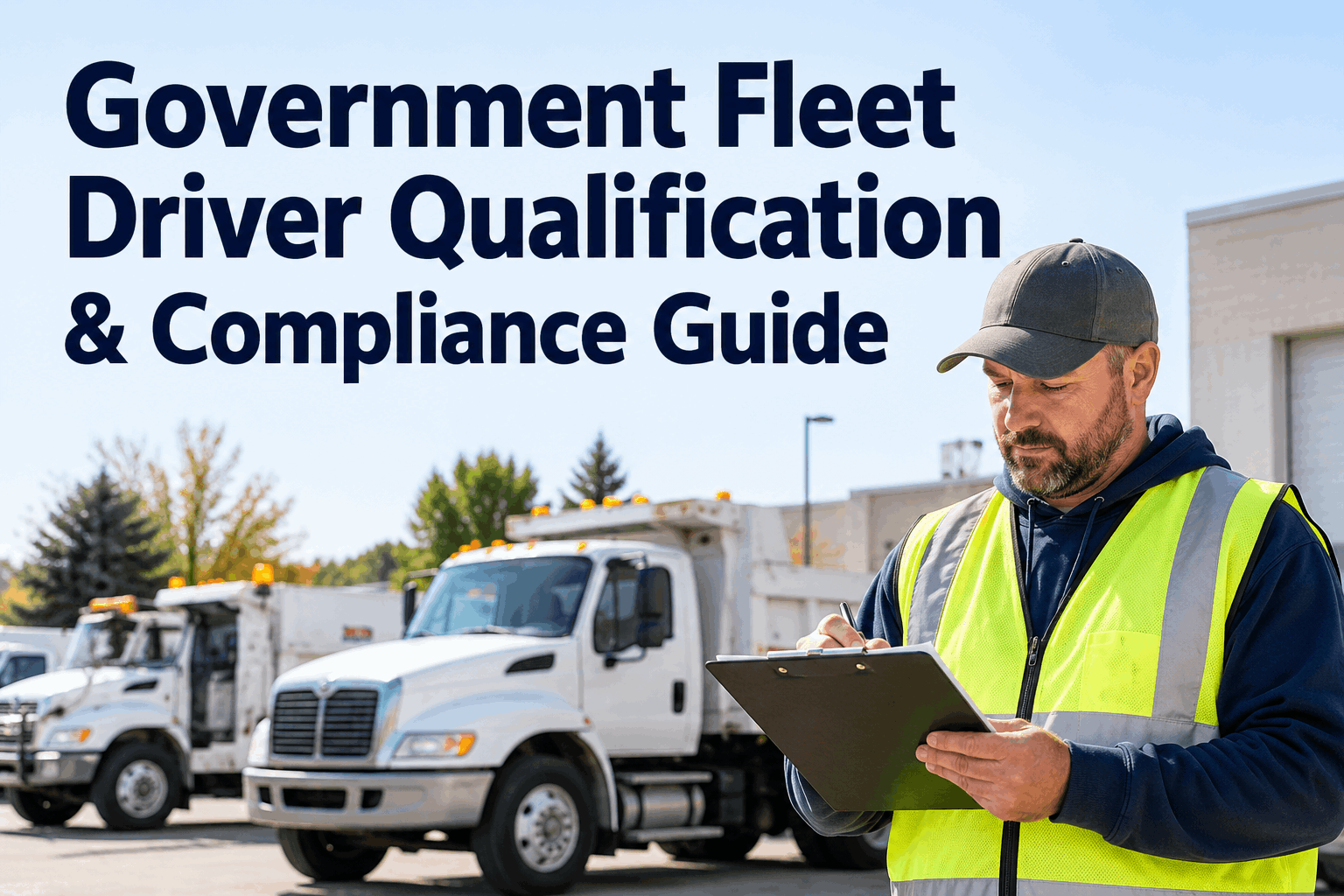
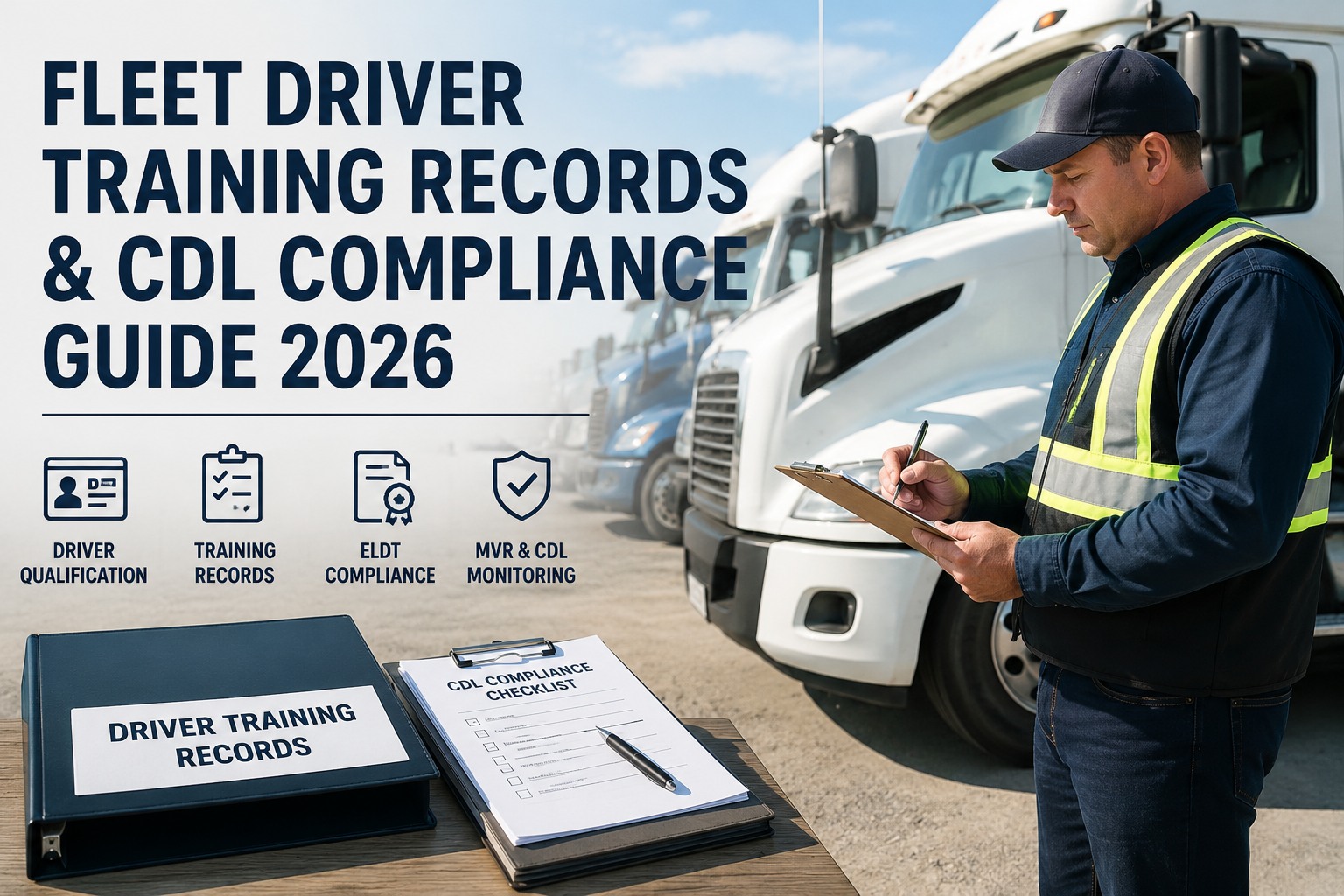
Federal law requires a qualification file for every driver operating a commercial motor vehicle, and incomplete files are consistently cited as one of the most common critical violations in compliance reviews. It rarely takes a lot to trigger a problem — one missing document across enough files is often all it takes. For a government fleet running dozens or hundreds of CDL holders across multiple departments, the file that's 90% complete is functionally no better than the one that's empty, because an auditor evaluates each file against the full list, not a rounded-up average.
Employment application
Completed and signed before a driver ever operates a covered vehicle, capturing the employment history the rest of the file builds on.
Motor vehicle record (at hire)
Pulled from the driver's licensing authority and placed in the file within 30 days of the start date — a hard deadline, not a suggestion.
Road test certificate
Or an accepted equivalent, confirming the driver was actually evaluated behind the wheel of the equipment they'll operate.
Annual MVR & review note
A fresh motor vehicle record pulled every 12 months, plus a documented note that someone actually reviewed it against safety criteria.
Medical examiner's certificate
Current and unexpired — this single document is one of the two most common findings in almost every audit of a driver's file.
SPE certificate, if applicable
Required only for drivers operating under a Skill Performance Evaluation certificate for a specific physical qualification exception.
Book a demo to see every one of these documents attached to the driver's record, not scattered across a filing cabinet and a spreadsheet.
Equipment & Endorsement Qualifications Beyond the CDLa government fleet's real qualification list is usually longer than the license itself
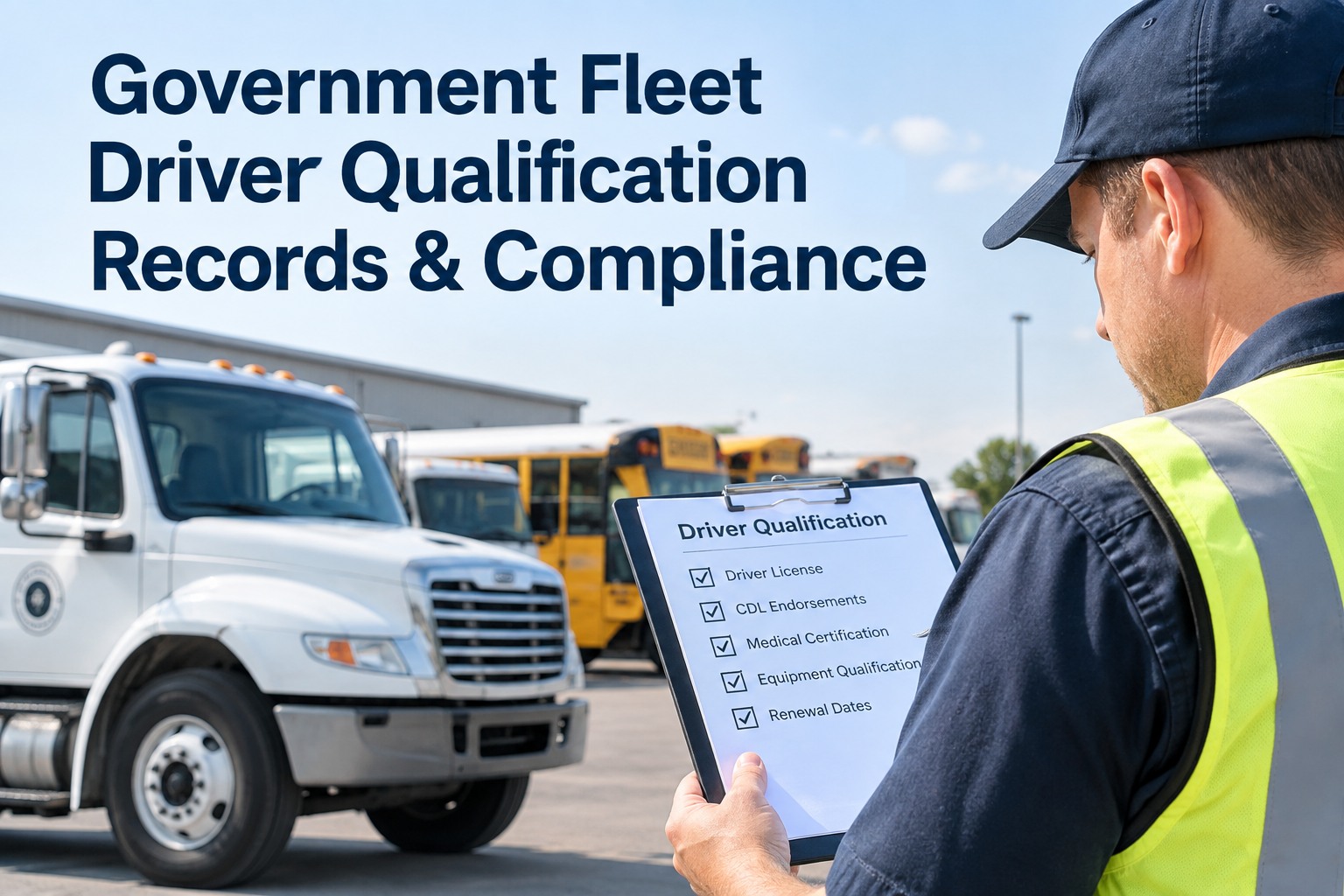
A CDL alone rarely covers everything a municipal or county fleet actually operates. A driver hauling a tanker for water or fuel service typically needs a tanker endorsement; a driver operating a passenger or school bus route needs the applicable passenger endorsement; hazmat-related roles need the hazmat endorsement, which carries its own separate background check and renewal cycle. Layer on top of that the equipment certifications that have nothing to do with a CDL at all — forklift operation, aerial lift, snowplow-specific training for winter operations — and a single operator can be carrying five or six qualifications with five or six different renewal dates, none of which show up if the only thing being tracked is "has a valid license." Tracking a driver's license status alone gives a false sense of complete compliance when it's really only one qualification out of several. Book a demo to see every qualification an operator holds, CDL and beyond, tracked against its own renewal date.
Retention: Two Different Clocks Under One Filethe qualification file and the drug & alcohol file don't run on the same schedule
- Retention: for the driver's entire employment, plus 3 years after they leave
- Applies to: application, MVRs, road test, medical certificate, endorsements
- Common mistake: purging a file immediately at termination instead of waiting the additional 3 years
- Positive results & refusals: retained 5 years, regardless of when employment ends
- Negative & cancelled results: retained 1 year
- Common mistake: deleting drug and alcohol records on the same schedule as the qualification file, when they run separately
Treating these as one retention rule is exactly how a fleet ends up either destroying records too early or holding the wrong ones far longer than required.
The Two Findings in Almost Every Auditboth are date problems, not paperwork problems
Both findings share the same root cause: a document that was correct the day it was filed and wrong by the time anyone checked again. Neither requires new paperwork to fix — it requires knowing the date before it becomes a problem instead of after. Sign up free to see both of these dates tracked automatically across your entire driver roster, not just the ones someone happens to remember to check.
From a compliance officer who stopped chasing expired dates manually
We had 40 drivers and I was tracking medical certificate dates on a spreadsheet with conditional formatting that turned a cell red when it was already too late to matter. An auditor found two expired certificates that had clearly been missed for months, not days. Nothing else in either file was wrong — just that one date. Now every qualification gets an alert 60 days out instead of me hoping I remembered to scroll to the right column.
How HVI Keeps Every Driver's Qualification File Audit-Ready
HVI attaches every required document to the driver's record as a signed PDF — application, MVR, road test, medical certificate, endorsements, and equipment certifications — so a file is never split between a cabinet, an email inbox, and someone's memory. Sign up free to build your first driver qualification file this way and see how quickly the rest of the fleet follows.
Qualification alerts track expiry per document, not just per driver, so a medical certificate, an annual MVR review, and a forklift certification each get flagged on their own renewal clock instead of one generic reminder. When an auditor asks for a specific driver's file, audit-ready retrieval means the complete record — current and historical — comes up in seconds rather than a search through several systems. Book a demo — Audit-Ready Records in HVI to see signed PDFs, qualification alerts, and instant retrieval working together on your own driver roster. This ties into the same records used across a broader safety management program for government fleets, so driver qualifications sit alongside vehicle inspection and maintenance history rather than in a separate system entirely.
Frequently Asked Questions
What documents must be in a driver qualification file?
Under 49 CFR 391.51, a complete driver qualification file generally includes the employment application, a motor vehicle record obtained at hire, a road test certificate or accepted equivalent, an annual motor vehicle record with a documented review, a current medical examiner's certificate, and an SPE certificate if the driver operates under one. Missing any of these is treated as a separate finding during a compliance review.
How long must driver qualification files be retained?
A driver qualification file must be kept for the entire period the driver is employed, plus three years after their employment ends. Drug and alcohol testing records follow a separate retention schedule under 49 CFR 382.401 — positive results and refusals are kept for 5 years, negative and cancelled results for 1 year — and shouldn't be purged on the same timeline as the qualification file.
What qualifications does a government fleet driver need beyond a CDL?
Depending on the role and equipment, a government fleet driver may also need CDL endorsements such as tanker, passenger, or hazmat, plus non-CDL equipment certifications like forklift operation, aerial lift, or seasonal training for equipment such as snowplows. Each of these typically carries its own renewal date, separate from the driver's core license.
What are the most common driver file findings in an audit?
The two most frequent findings are an expired medical examiner's certificate and a missing or overdue annual motor vehicle record review. Both typically involve a file that was complete and correct at some point, with a renewal date that passed unnoticed rather than a document that was never obtained in the first place.
How can a fleet avoid missing qualification renewal deadlines?
Tracking expiry per document rather than relying on a single reminder per driver catches renewals that would otherwise be missed — a medical certificate, an endorsement, and an equipment certification can each expire on a different date for the same person. Automated alerts set well ahead of each deadline, rather than a manual spreadsheet review, are what keep files consistently current rather than caught after the fact.
The Takeaway
Government fleet driver qualification records rarely fail because a document was never collected — they fail because a date passed quietly on a document that was correct when it was filed. Knowing which pieces of the file are one-time and which recur, tracking retention on two separate clocks for qualification versus drug and alcohol records, and catching the two findings that show up in nearly every audit before an auditor does is what turns a qualification file from a liability into a record you can hand over with confidence. None of this requires more paperwork than most fleets are already generating — it requires that paperwork organized around the right dates instead of filed and forgotten.
Never find out about an expired certificate from an auditor
HVI attaches every qualification document to the driver's record, alerts you ahead of every renewal date, and puts the complete file a few taps away when it's requested.