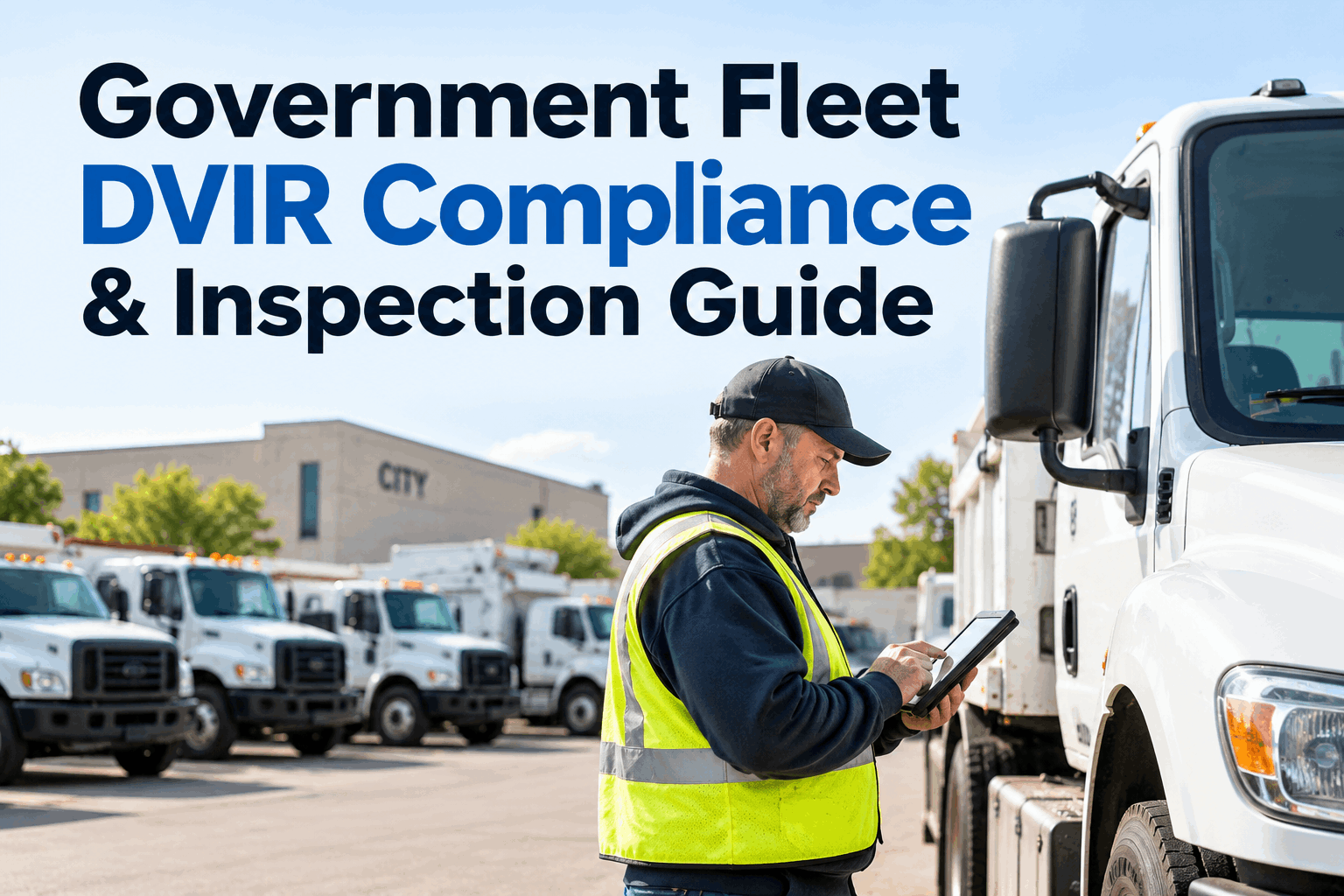
A county fleet runs dump trucks from one yard, transit buses from another, and plows that only move when it snows — and when an auditor asks to see the inspection records, they're in three binders, two glove boxes, and a cabinet nobody's opened since spring. Government fleet DVIR compliance isn't hard because the rules are complex; it's hard because the records are scattered and defects never connect to repairs. Here's what DVIR compliance requires for a public fleet, and how a digital workflow fixes it — book a demo to see it in HVI.
Scattered paper is the compliance risk — not the rules.
Government fleets don't fail DVIR compliance on the regulation; they fail on lost forms and defects that never reach the shop. HVI replaces paper with a digital DVIR that links every reported defect to a work order and keeps audit-ready records across every department.
Public fleets carry a compliance burden most private carriers don't: a single agency might run heavy trucks, transit buses, snow plows, refuse packers, light vehicles and off-road equipment, spread across multiple departments and garages, inspected by drivers who answer to different supervisors. The driver vehicle inspection report — the DVIR — is the thread that's supposed to tie all of that together into a provable record that every vehicle was checked, every defect was caught, and every safety issue was fixed before the vehicle rolled again. When that thread is paper, it frays. This guide walks through what DVIR compliance actually requires, where government fleets specifically trip up, and how a digital DVIR workflow turns a filing problem into a running system.
What DVIR compliance actually requiresthe driver vehicle inspection report rules, in plain terms
The federal framework for DVIRs lives in the FMCSA regulations, and while the full text runs long, the obligations come down to a short, repeatable loop that every covered vehicle has to go through, every day it operates.
Post-trip inspection & report
At the end of each day's work, the driver prepares a written report on each vehicle operated, covering the required components and listing any defect or deficiency that would affect safety or lead to a breakdown.
Pre-trip review
Before driving, the driver reviews the last DVIR and confirms the vehicle is in safe operating condition — and that any defects noted have been certified as repaired or found not to need repair.
Fix before dispatch
The agency must repair any reported defect that affects safe operation before the vehicle is dispatched again, and certify on the report that the repair was made or wasn't necessary.
Retain the records
Completed DVIRs and the related repair certifications are kept on file — typically three months — and have to be produceable if an inspector, auditor or investigator asks.
That's the whole loop: inspect, report, repair, certify, retain. None of it is complicated on paper — the difficulty is doing it consistently across a large, mixed public fleet and proving it later. The detailed federal text is covered in HVI's FMCSA 396.11 guide and the broader DVIR requirements overview. Book a demo to see the loop run digitally →
Does DVIR apply to government fleets?coverage, exemptions, and why most agencies do it anyway
This is the question that causes the most confusion in public fleets, because the answer is "it depends on the vehicle." The honest version:
Commercial motor vehicles — heavy trucks, dump trucks, large transit and school buses, plows and packers above the CMV weight and passenger thresholds — are the vehicles DVIR rules are built around. These are the bulk of a public works or transit fleet.
Federal FMCSA rules apply to CMVs in interstate commerce; many government vehicles operate intrastate and follow state regulations instead, and some government operations have specific exemptions. The obligations for your fleet depend on vehicle type, weight and how it's used.
Even where a vehicle isn't strictly required to have a DVIR, most agencies run them fleet-wide — because the safety, accountability and liability protection a documented daily inspection provides is worth far more than the exemption saves.
The practical takeaway: confirm your specific federal and state obligations for each vehicle class, then standardize on a single inspection process across the whole fleet anyway. A public agency explaining a crash or a failed audit does not want to be arguing about which of its vehicles were technically exempt. Running one consistent digital inspection process across every department removes that argument entirely. Start free and standardize inspections fleet-wide →
Why paper DVIR breaks down in public fleetsthe government-specific reasons compliance slips
Paper DVIRs technically satisfy the rule, and plenty of agencies have used them for decades. But in a government fleet the paper process quietly fails in ways that only become visible during an audit or after an incident.
Records scattered across departments
Public works, transit, parks and utilities each keep their own binders in their own yards. There's no single place to prove the whole fleet is compliant, and no one who can answer for all of it at once.
Defects that never reach the shop
A driver notes a defect on a paper form that sits on a clipboard. The mechanic never sees it, the repair never happens, and the vehicle rolls out again — the single most dangerous failure in the whole process.
No audit trail
When an auditor or attorney asks to see six months of inspections for a specific vehicle, paper means days of digging — and any gap or missing signature becomes a finding or a liability.
Pencil-whipped inspections
A paper form signed in thirty seconds in the cab proves nothing was looked at. There's no timestamp, no location, no photo — nothing that shows the inspection actually happened.
Every one of these is a records-and-workflow problem, not a rules problem — which is exactly why going digital solves it. The point of an electronic DVIR isn't to change what's required; it's to make the required loop impossible to break silently. Book a demo to see the gaps close →
The digital DVIR workflow, step by stephow a reported defect becomes a certified repair
This is the heart of it — and the thing paper can't do. A digital DVIR doesn't just record the inspection; it carries each defect through to the repair and leaves a timestamped trail behind every step.
The defect-to-work-order link is the part that saves lives and passes audits — a reported safety fault can't quietly disappear, because the system won't let the vehicle be certified safe until the work order is closed. That connection between inspections and maintenance is the whole reason to go digital. Start free and connect defects to repairs →
What government fleets gain from digital DVIRbeyond ticking the compliance box
Compliance is the floor, not the ceiling. Once the DVIR loop runs digitally across the whole fleet, a public agency gets a set of benefits that matter well beyond the regulation.
Audit-ready in seconds
Any vehicle's full inspection and repair history pulled up on demand — no binder dives when an auditor or attorney calls.
Fewer breakdowns & incidents
Defects caught and fixed before dispatch mean fewer roadside failures, fewer crashes, and fewer out-of-service vehicles.
One view across departments
Public works, transit, parks and utilities on one platform — fleet-wide compliance status a director can actually see.
Liability protection
Timestamped, photo-backed proof that inspections happened and defects were repaired — the record that defends the agency.
For a public fleet answerable to taxpayers, auditors and risk managers, that documented accountability is often the strongest case for going digital — stronger even than the time it saves. It's the same record that drives your compliance reporting across the government fleet. Book a demo to see fleet-wide compliance status →
DVIR compliance, tracked in HVIinspections, defects and repairs on one compliance view
Here's the payoff: every department's DVIRs on one dashboard, with open defects, their work orders, and a compliance status per vehicle — so government fleet DVIR compliance is something you can see, not something you hope is being done.
A vehicle with an open safety defect shows as held, every DVIR carries its timestamp and signature, and the whole history is one search away per vehicle or per department. That's the difference between hoping you're compliant and proving it. Start free and put every department on one view →
Government fleet DVIR compliance checklistwhat a complete, defensible program looks like
Here's a baseline checklist for a compliant public-fleet DVIR program, grouped the way HVI runs it — the inspection, the defect workflow, and the records.
- Pre- and post-trip DVIR on every covered vehicle
- Required components covered per vehicle type
- Timestamp, location & driver on each report
- One standard process across all departments
- Defects logged with photo & severity
- Safety defects become work orders automatically
- Vehicle held until a safety defect is cleared
- Repairs certified against the reported defect
- DVIRs & certifications retained per the rule
- Any vehicle's history produceable on demand
- Compliance status visible fleet-wide
- Gaps & missed inspections flagged, not hidden
On paper, half of these are aspirations; in HVI they're enforced by the workflow — the inspection is timestamped, the defect becomes a work order, and the record is retained automatically. The detailed daily routine is in HVI's post-trip DVIR checklist. Book a demo to load your fleet's DVIR program →
From a government fleet manager
We failed a records review not because we weren't inspecting — our drivers were — but because the paper was in four different garages and we couldn't produce a clean six-month history for the vehicles they pulled. A couple of defect reports had no matching repair record, and that's all it takes to turn a safety program into a finding.
Going digital fixed the whole thing. Every department inspects the same way, a reported defect becomes a work order the shop can't miss, and I can pull any vehicle's full history in about ten seconds. The next review took an afternoon instead of three weeks of panic, and our risk manager finally sleeps at night.
Government fleet DVIR compliance — FAQs
What is a DVIR and what must it include?
A DVIR — driver vehicle inspection report — is the record a driver completes documenting a vehicle's condition. Under FMCSA rules it covers the required components, lists any defect or deficiency that would affect safety or cause a breakdown, and is signed by the driver. If defects are reported, the agency must repair them before the next dispatch and certify the repair on the report.
Do government and municipal fleets have to do DVIRs?
It depends on the vehicle. Commercial motor vehicles — heavy trucks, large buses, plows and packers above the weight and passenger thresholds — are generally covered, while rules for intrastate and certain government vehicles vary by state and may differ or be exempt. Most agencies run DVIRs fleet-wide regardless, because the safety and liability protection is worth far more than any exemption. Confirm your specific obligations by vehicle class.
How long must DVIR records be kept?
Completed DVIRs and the related repair certifications are typically retained for three months and must be produceable for inspectors, auditors or investigators. In a paper system that retention is where public fleets most often have gaps; a digital system retains every report and certification automatically and makes any vehicle's history searchable on demand.
What's the difference between a paper DVIR and an electronic DVIR?
Both satisfy the requirement to document the inspection, but an electronic DVIR adds what paper can't: a timestamp and location proving the inspection happened, a photo and severity on each defect, an automatic link from a reported defect to a work order, and retained, searchable records. For a multi-department government fleet, that connection and that audit trail are the whole point.
How does HVI help with government fleet DVIR compliance?
HVI runs the full DVIR loop digitally: drivers inspect from a phone with timestamp and location, defects are logged with photos, safety defects become work orders the shop sees immediately, repairs are certified against the defect, and every record is retained and searchable per vehicle and per department. The result is a public fleet that can prove compliance in seconds instead of hoping the paper adds up.
Prove compliance instead of hoping for it
HVI gives government fleet DVIR compliance one workflow — drivers inspect from a phone, defects flow to the shop as work orders, repairs are certified, and every record is retained and searchable across every department. So the next audit is an afternoon, not three weeks of digging. Live on your fleet in under two weeks.
See it on your own fleet · Works offline in the field · Audit-ready records from day one