A municipal dump truck clips a cyclist. Everyone asks the same thing — was it the vehicle, the driver, or the road? Weeks later a lawyer wants proof the brakes were inspected, and your government fleet accident investigation comes down to whether that record exists. A timestamped inspection clears the vehicle in a sentence; a paper form leaves you defending a gap. This guide walks the investigation end to end — and shows where the vehicle evidence comes from. Book a demo of incident evidence records.
A Government Fleet Accident Investigation Is Only as Strong as the Evidence You Can Produce
Driver, vehicle, conditions — the investigation has to weigh all three. The vehicle half is the one you can settle with records, if you have them. Here's the whole process, and where the proof lives.
- Scene photos & diagramSecured
- Driver statementSecured
- Vehicle inspection historyOn file
- Maintenance & repair recordsOn file
- Open-defect trailMissing
Four exhibits secured, one gap. That single missing trail is where an investigation turns into a liability.
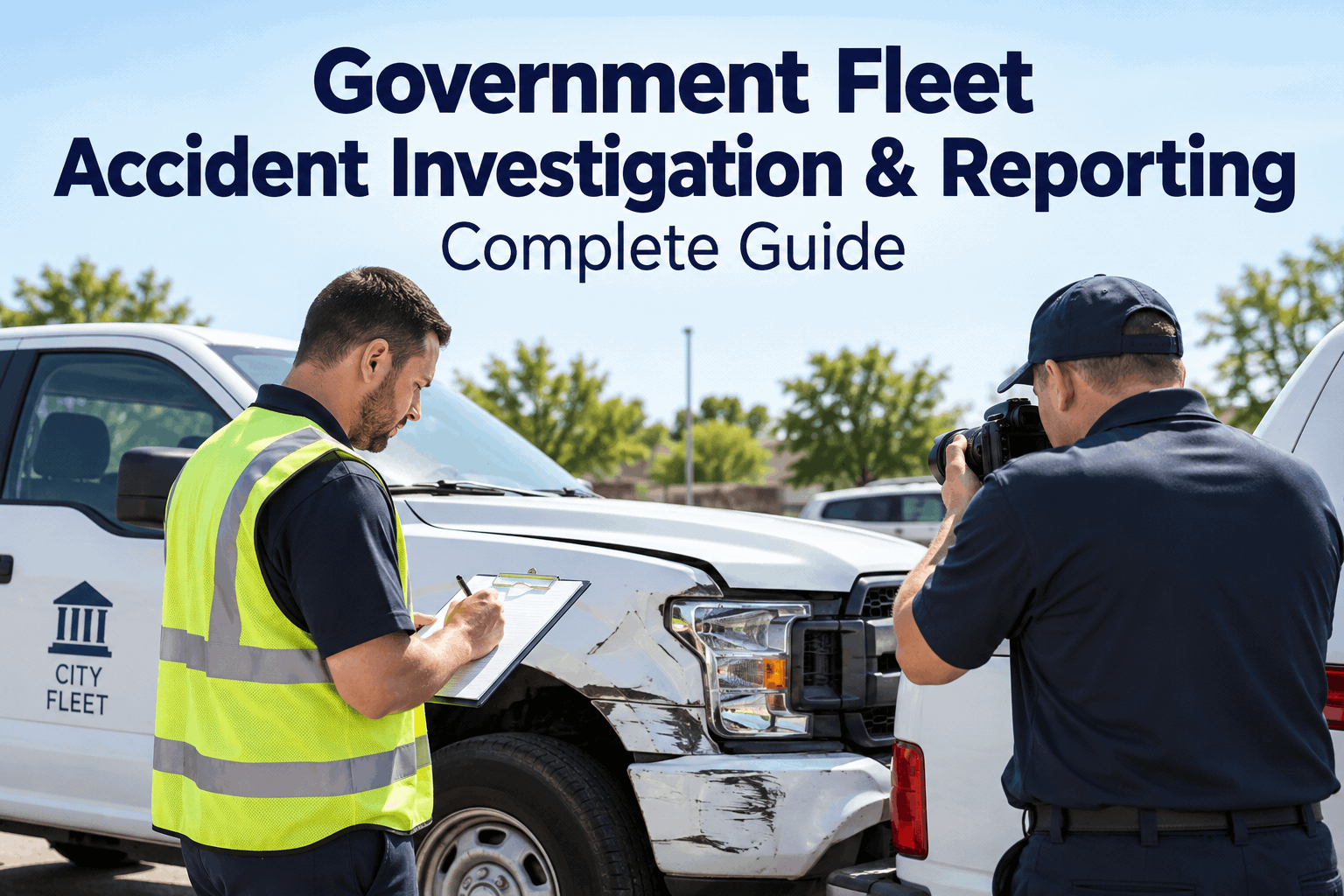
An accident investigation isn't about assigning blame on day one — it's about preserving what happened before it fades, weighing driver, vehicle and conditions fairly, finding the real root cause, and fixing it so the next crash doesn't repeat it. Most of that is procedure. The part that catches public fleets off guard is the vehicle evidence: when the question is "was the truck a factor," memory doesn't hold up, and a record either exists or it doesn't.
Six phaseshow a government fleet accident investigation actually runs
A sound investigation moves through the same six phases every time. Skip one and the conclusion won't hold up — to a regulator, a council, or a court. Here's the arc, start to finish.
Secure the scene
Protect people first, then the scene. Nothing moves until it's recorded.
Preserve evidence
Photos, statements, vehicle condition, and the records — before any of it changes.
Build the timeline
Reconstruct the sequence: what happened, in what order, when.
Weigh the factors
Driver, vehicle, conditions — test each against the evidence, not a hunch.
Find root cause
Not the proximate event — the underlying failure that let it happen.
Corrective action
Fix the cause, assign it, close it, and verify it doesn't recur.
Phases 2 and 4 are where the vehicle records earn their place — and where a paper program leaves you guessing. Book a demo to see the evidence phase handled digitally. This is the investigation that follows the crash — separate from the immediate report and return-to-service inspection, which our fleet accident reporting and post-crash inspection guide covers.
Driver, vehicle, conditionsthe three lanes every fleet incident investigation weighs
Every crash gets analyzed across three contributing-factor lanes. Two of them rest heavily on testimony and reconstruction. The third — the vehicle — is the one you can settle with hard records, which is exactly why it's the lane you don't want to be weak in.
Driver
Fatigue, distraction, speed, training, hours. Established through statements, logs and witness accounts.
Proven by testimonyVehicle
Brakes, tires, steering, lights — was there a known defect? When was it last inspected? Was the repair closed?
Proven by recordsConditions
Weather, road surface, visibility, signage, time of day. Established through scene evidence and reports.
Proven by scene dataThe vehicle lane is the one that most often decides liability — and the one most often lost to a missing record. A dated inspection showing the brakes passed the day before clears the vehicle; its absence invites the assumption it didn't. Sign up free and close the vehicle-evidence gap.
The evidence checklistwhat to secure before anything changes or fades
Evidence degrades fast — memories blur, skid marks wash away, and a vehicle that gets repaired before it's documented loses its story. Work this checklist in the first hours of any fleet accident investigation. The vehicle column is where HVI already holds most of it, timestamped.
Scene evidence
- Wide and close-up scene photos
- Position of vehicles and final-rest diagram
- Road, weather and visibility conditions noted
People evidence
- Driver statement taken while fresh
- Witness names and accounts
- Any injuries and response times logged
Vehicle evidence
- Timestamped photos of vehicle damage
- Last inspection record for the unit
- Open defects and their status at time of crash
Records evidence
- Maintenance & repair history pulled
- Work-order trail for recent faults
- Driver's pre-trip inspection for that shift
Secure these early and the investigation has a foundation instead of a set of holes. Book a demo to see the vehicle evidence pulled in one view.
The evidence packthe vehicle's record trail, pulled for the investigation
This is the moment the vehicle lane is decided. Instead of hunting through a filing cabinet weeks after the crash, the investigator opens the unit and every dated record is already there — inspection, defects, repairs, photos — exactly as they stood on the day.
Brakes cleared with a signed record; the one open defect surfaces honestly with its work order — the investigation gets the truth, documented either way.
Because it's drawn from live digital inspection records and maintenance history, the pack reflects the vehicle as it actually was — not as anyone remembers it. Book a demo to see an evidence pack on your own units.
From a risk officer who's built the file both ways
The first serious crash I investigated, the vehicle question took me nine days to answer — I was calling the shop, digging through paper inspection forms, trying to prove a brake service that I was fairly sure had happened. "Fairly sure" is worthless in a deposition. Now the vehicle's whole history is one export tied to the incident number, timestamped, and it takes about four minutes. The honest part matters too: when there is a defect on file, it shows — but at least I'm working from facts instead of defending a guess.
Government fleet accident investigation — quick answers
What are the steps of a government fleet accident investigation?
Secure the scene, preserve evidence, build a timeline, weigh the contributing factors (driver, vehicle, conditions), determine root cause, then assign and close corrective action. The investigation is distinct from the immediate incident report — it's the deeper analysis that follows and aims to prevent a repeat.
What evidence matters most in a fleet accident investigation?
Scene photos, driver and witness statements, and the vehicle's condition records. The vehicle evidence — last inspection, open defects, maintenance history — is often decisive because it's the one factor you can prove or disprove with a dated record rather than testimony.
How does maintenance history affect an accident investigation?
It answers whether the vehicle contributed. A documented, up-to-date inspection and repair history clears the vehicle quickly; a gap or an unrepaired known defect becomes a serious liability. In litigation, "we maintained it well" means little without the records to show it.
What is root cause versus proximate cause in a crash?
The proximate cause is the immediate event — a vehicle ran a light. The root cause is the underlying failure that allowed it — a brake defect kept in service, or a missed inspection. Corrective action has to target the root cause, or the same crash pattern returns.
How does HVI support fleet accident investigations?
HVI holds timestamped inspection records, geotagged photos, maintenance history and the defect-to-work-order trail, and can pull them as an evidence pack tied to the unit. It supplies the vehicle-side evidence — it doesn't conduct the investigation, assign fault, or replace your risk and legal process.
Make the vehicle side of every government fleet accident investigation a file, not a guess
HVI turns the inspections, photos, repairs and defect trail your fleet already generates into a timestamped evidence pack tied to the incident — so when the investigation asks whether the vehicle was a factor, you answer with proof in minutes. Live across your fleet in under two weeks.
No credit card · No hardware · Evidence trail secured from day one