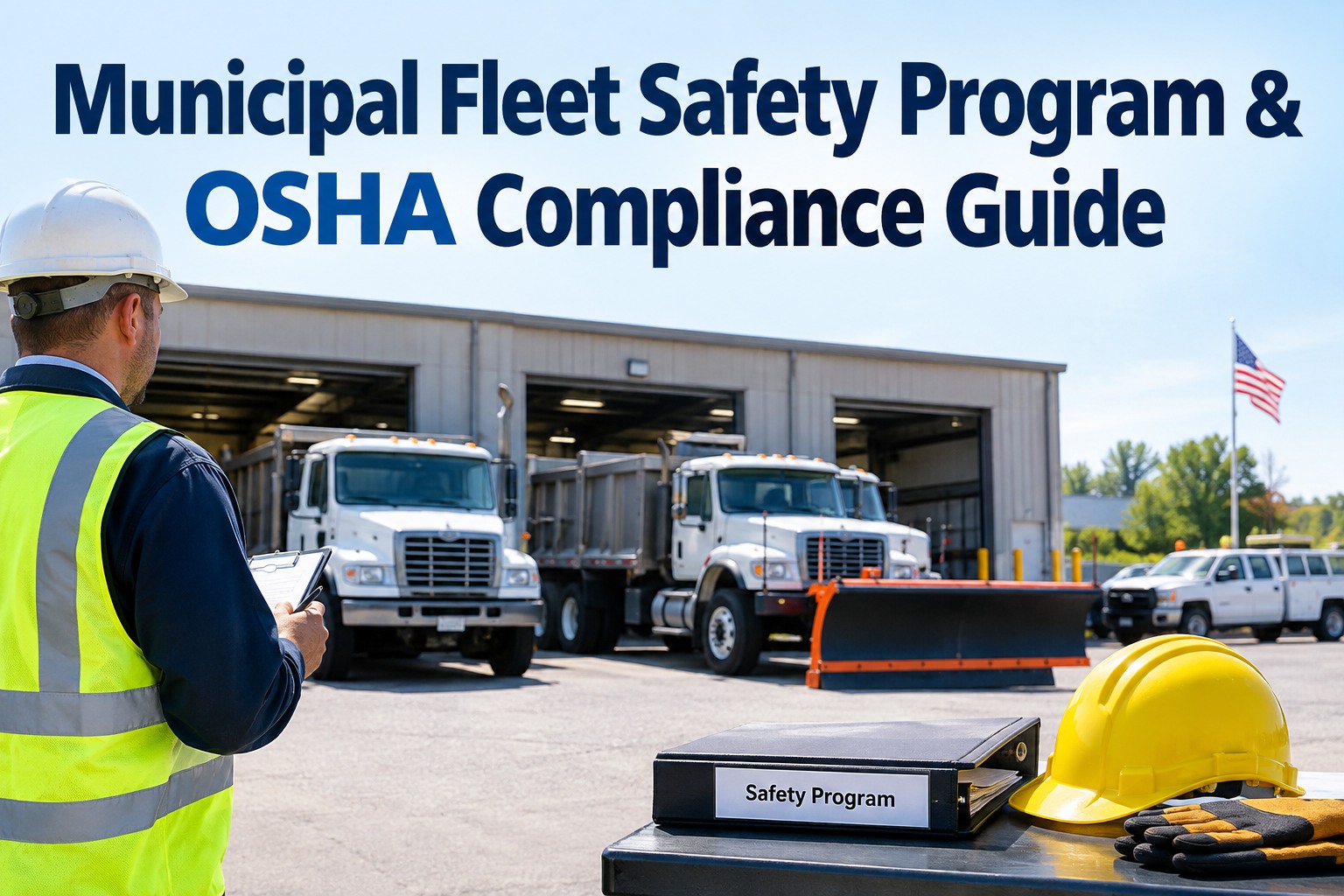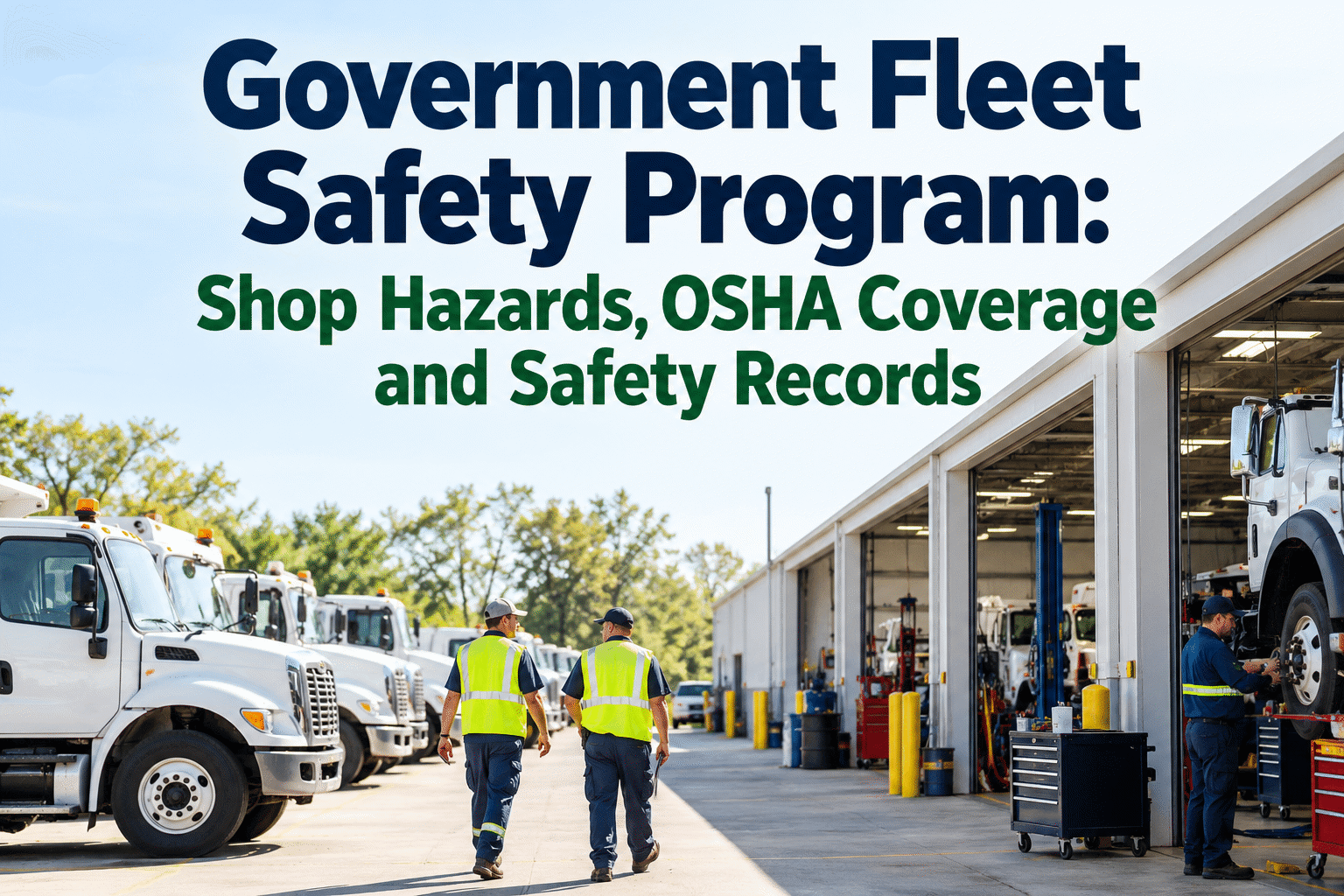
Government fleet safety programs must protect the people who inspect, repair and return public vehicles to service. A municipal garage may handle vehicle lifts, stored energy, fuels, chemicals and increasingly high-voltage equipment in the same workday. The right program connects task-specific hazard controls with training, equipment condition checks and documented follow-up. This guide explains where OSHA coverage differs for public employees and how fleet leaders can organize practical shop safety without treating maintenance software as a substitute for qualified safety oversight. Book a demo to explore HVI equipment safety records.
Safer municipal shops start with hazards you can see—and actions you can close.
Build a government fleet safety program around the work happening in the bays: inspect, isolate, repair, verify and document.
First, establish which workplace safety rules apply
Government ownership changes the jurisdiction question—not the need to manage shop hazards.
State or local government employee? Federal OSHA generally does not directly cover that employee. Private contractors working at the site may have separate OSHA obligations.
OSHA-approved State Plans may extend coverage to state and local government employees. Confirm the applicable state rules and enforcement agency.
Review state occupational safety laws, public-sector requirements, agency policy and contract terms before setting procedures and training.
OSHA’s State Plans directory is an authoritative starting point for checking jurisdiction. Use that information to build your local program, not a one-size-fits-all compliance claim.
Map the shop hazards before choosing controls
Start with actual maintenance tasks, not a generic checklist copied from another facility.
Prevent unexpected movement
Verify lift condition, capacity, positioning, support and technician clearance. Remove defective lifting equipment from use until evaluated.
Control energy before service
Use task-specific isolation procedures for mechanical, electrical, hydraulic, pneumatic and stored-energy hazards. Train authorized personnel.
Manage exposures
Check container labels, safety data sheets, ventilation, spill response and suitable protective measures for fluids, cleaners and exhaust.
Restrict specialized work
Identify EV/high-voltage components, follow manufacturer procedures and use qualified personnel, suitable tools and required protective equipment.
Include mobile service trucks, wash bays, tire work and contractor activities in the assessment. A hazard assessment should document who may be exposed, the potential severity, existing controls and what still needs correction. Book a demo to see how HVI can support equipment inspection records.
Turn a safety finding into a verified correction
The key operational gap is often not identifying a defect—it is knowing whether anyone resolved it.
Operator or technician identifies a defect or unsafe condition.
Describe the equipment, location, risk and evidence.
Create the maintenance work order and determine restrictions.
Confirm repair and safe return to use by an authorized person.
A technician notices a damaged restraint during a pre-use check. The supervisor restricts use, records the condition, arranges qualified repair and documents verification before the lift is returned to operation. HVI can support the maintenance record; the safety decision belongs to responsible personnel.
Use a practical municipal shop inspection checklist
Adjust frequency and responsibility to equipment instructions, risk and applicable requirements.
Before work begins
- Walkways, exits and emergency access clear
- Vehicle supports, lifts and tools visually checked
- Spill supplies and fire protection accessible
- Task hazards and authorized personnel confirmed
During maintenance
- Isolation and blocking procedures followed
- Machine guards and ventilation used as needed
- Chemicals labeled; SDS information accessible
- Defective equipment tagged and escalated
Before closing the job
- Guards, covers and safeguards restored
- Tools and materials removed from work area
- Repair or defect status documented
- Qualified person verifies return to service
A digital equipment checklist can make inspection records easier to retrieve, but it does not replace the task hazard assessment, training, or any legally required safety inspection.
Make training records useful—not just complete
A sign-in sheet is not evidence that every worker can safely perform a specialized task.
Document four things for each safety topic
Prioritize high-risk work
Examples include vehicle lifting, hazardous energy control, chemical handling, welding, tire inflation, confined spaces where applicable, and high-voltage vehicle service.
Use a dedicated HR, learning or safety system for training records where required. HVI’s equipment maintenance records complement that program; do not assume HVI independently manages certifications or OSHA training compliance.
Track a small set of measures that prompt action
A safety scorecard should show whether inspections and corrections are improving, not simply count completed forms.
Open defects past the agreed correction deadline, segmented by severity.
Recurring issues after repair that may indicate an unresolved root cause.
Elapsed time from defect report to verified return to use.
Required equipment checks completed and reviewed on schedule.
Launch the program in four manageable weeks
Use the first month to create a repeatable baseline, then review it as shop conditions change.
Identify applicable rules, shop tasks, high-risk assets and responsible staff.
Define equipment inspection questions, defect severity and escalation owners.
Connect findings to repairs, work orders and documented verification.
Check open issues, repeat defects, training gaps and next improvements.
Start with one garage or vehicle class, review the workflow with technicians, then expand. Start free to organize your public fleet inspection and maintenance records.
Where HVI fits in a government fleet safety program
Use HVI for equipment-focused inspection and maintenance evidence alongside your organization’s safety management procedures.
Digital inspections
Record equipment condition and reported defects using consistent checklists.
Maintenance work orders
Organize repair tasks and document action taken on equipment issues.
Service history
Keep an asset-level record of repairs and recurring maintenance problems.
HVI does not replace hazard assessments, legal determinations, employee training systems, incident investigations or specialized safety certifications. Book a demo to evaluate the inspection-to-repair workflow for your municipal shop.
Government fleet shop safety: FAQs
Quick answers to common public-sector maintenance safety questions.
Does OSHA cover municipal fleet maintenance workers?
Federal OSHA generally does not directly cover state and local government employees. OSHA-approved State Plans may cover those workers, and separate state laws or agency requirements can apply. Check your jurisdiction and employer type.
What should a government fleet safety program include?
At a minimum, evaluate shop hazards, define controls and safe procedures, train affected workers, inspect relevant equipment, document deficiencies, assign corrective actions and verify closure. The exact program depends on tasks and applicable law.
How should a municipal garage manage lockout/tagout hazards?
Assess hazardous energy sources for each task, establish appropriate isolation procedures and train authorized personnel under applicable requirements. Vehicle and equipment manufacturer instructions and competent safety oversight are important.
Can HVI automatically make a municipal shop OSHA compliant?
No. HVI supports equipment inspections, maintenance work orders and repair history. Compliance depends on applicable rules, employer programs, worker training and effective hazard controls.
What safety records should a public fleet keep?
Common records include hazard assessments, inspection findings, corrective actions, training evidence, maintenance history and relevant incident documentation. Retention requirements depend on jurisdiction and record type.