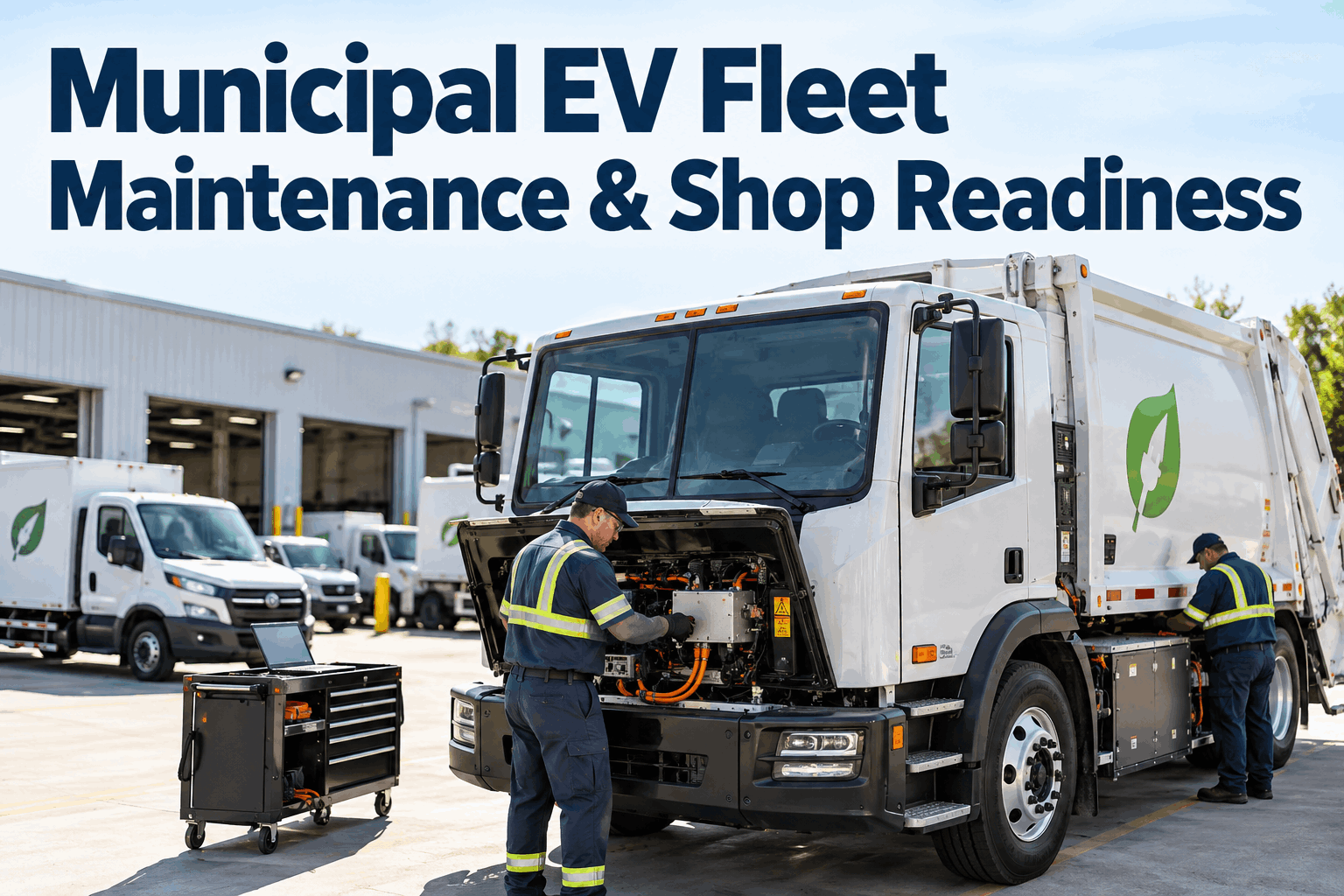
The EVs usually arrive before the shop is ready for them. A city orders them to hit a sustainability target, they show up at the yard, and the diesel techs suddenly own a 400-volt system they were never trained to touch. Municipal EV fleet maintenance isn't just "less oil to change" — it's a different risk profile, different tools, and real high-voltage training before anyone opens a panel. This guide covers what shop readiness takes and how to run EVs and conventional vehicles through one operation — book a demo.
Your fleet is going electric. Is your shop?
EVs change the maintenance — different inspections, different hazards, a lot less routine PM but far higher stakes on the parts that remain. HVI runs conventional and electric vehicles through one operation, each on the right checklist and schedule for its propulsion.
The hardest part of electrifying a municipal fleet isn't buying the vehicles — it's getting the shop ready to keep them running safely. EVs ask for less frequent service but completely different competence: high-voltage safety, battery and thermal awareness, new tools, and techs who are trained and qualified to do the work. A readiness plan covers four things at once. Here's what they are and how a mixed fleet runs through one system while you build them.
The shop-readiness gapwhy municipal EV fleet maintenance stalls in the bay, not the budget
A city can approve the EVs and still not be able to maintain them. Readiness isn't one upgrade — it's four areas that all have to move together, and a program is only as ready as its weakest one.
Technicians trained and qualified for high-voltage work — not just aware of it. The scarcest readiness resource of the four.
Training & qualificationInsulated gloves, HV-rated tools, meters and lockout gear rated for the voltages EVs carry — standard tools don't qualify.
Rated equipmentA safe HV work zone, battery isolation and storage, lift ratings for heavier EVs, and charging the shop can actually use.
Shop upgradesPropulsion-specific inspections and PM schedules, de-energize procedures, and records — so EV work is standardized, not improvised.
Procedures & recordsHVI owns the fourth pillar — the process and records half — by giving EVs their own inspection templates and PM schedules and keeping the service history per vehicle. The first three are your shop's build-out, but the procedures that make them safe live in the inspection and maintenance system. Book a demo to see EV-specific templates alongside your diesel ones →
High-voltage safety is the line that can't be crossedEV technician training runs on a ladder, not a switch
An EV traction system runs at hundreds of volts — enough to be lethal. No technician touches a high-voltage system without the training that matches the task, and that training climbs a ladder from awareness to fully qualified. Skipping a rung is the one mistake a shop can't afford.
Most shops start with everyone at Level 1 and build Level 2 and 3 over time — which means the system has to know which tech is qualified for which EV task. HVI ties work orders and inspections to the right competence, so an EV HV job isn't assigned to a tech who isn't cleared for it. Work order management keeps that boundary visible. Start free and build your EV procedures →
What changes when a vehicle goes electricEV preventive maintenance drops some work and adds different work
The myth is that EVs are maintenance-free. The truth is more useful: a lot of routine engine work disappears, but new propulsion-specific work takes its place — and the new work carries higher stakes. A good program adjusts the checklist and cadence, not just the fluid list.
- Engine oil & filter changes
- Transmission & exhaust service
- Spark plugs, belts, fuel system
- Emissions & DPF work
- Much of the routine engine PM load
- High-voltage system & cable inspection
- Battery health & thermal-system checks
- Regenerative braking & reduced-wear brakes
- Coolant for battery & power electronics
- Software, charging port & connector checks
Because the work is different, the checklist has to be different — an EV inspection that still asks about oil and exhaust is worse than useless, it hides what actually matters. HVI gives each propulsion type its own preventive maintenance schedule and inspection template, so an EV check targets the battery and HV system while the diesel check still covers the engine. Book a demo to see an EV template built out →
One shop, two propulsionshow mixed fleet maintenance runs on a single platform
During the transition — which lasts years — the same shop maintains both. The trick isn't two systems; it's one system that knows each vehicle's propulsion and loads the right everything for it.
Each vehicle carries its propulsion tag, so the system loads the EV or ICE checklist, applies the right PM cadence, and routes an HV job to a qualified tech — all in one register. The fleet director sees the whole operation, electric and conventional, in one place. That unified view is what analytics and reporting builds from, and you can book a demo to see your mixed fleet on one register.
EV pre-work safety checklistthe high-voltage steps before any EV service begins
Before a technician works on an EV, a safety sequence has to be confirmed — it's the difference between routine service and a serious incident. Here's a baseline EV pre-work checklist, grouped the way HVI loads it, with each step confirmed before the job proceeds.
- Technician qualified for the task level
- Insulated gloves & PPE inspected, in date
- HV-rated tools & meter on hand
- Work zone clear, signage posted
- HV system de-energized per procedure
- Service disconnect removed & locked out
- Zero-voltage verified at the terminals
- Discharge wait time observed
- HV cables & connectors — no damage or heat
- Battery & thermal coolant — level, no leaks
- Charging port & connector — clean, intact
- Work & verification logged on the record
On paper this sequence is easy to shortcut on a busy day; in HVI it's a step-gated check where the isolation steps must be confirmed before the job advances, and the whole sequence is logged to the vehicle's record. Start free and load your EV safety checklists →
From a municipal fleet maintenance manager
The buses showed up and I had a shop full of diesel guys and a vehicle that could kill one of them if they treated it like a diesel. That's the part people planning the purchase don't see — the vehicle is the easy part, the shop is where the risk lives.
We staged it: everyone got awareness training first, then a couple of techs went to the full qualification. What held it together was having the EV procedures and the ICE ones in the same system, so a tech couldn't accidentally pull up the wrong checklist. The right form loads for the right vehicle, every time.
Municipal EV fleet maintenance — FAQs
What does EV shop readiness actually require?
Four things together: trained and qualified technicians, high-voltage PPE and insulated tools, facility upgrades like a safe HV work zone and battery storage, and propulsion-specific inspection and PM procedures. A program is only as ready as its weakest of the four — usually technician training.
Do EVs really need less maintenance than conventional vehicles?
Less routine engine work — no oil, exhaust, transmission or emissions service — but different work takes its place: high-voltage and battery inspection, thermal systems, regen braking and software. It's lower frequency but higher stakes, so the checklist and cadence change, not disappear.
What high-voltage training do EV technicians need?
It's tiered: awareness for anyone working near EVs, de-energize-and-service for routine work, and full HV qualification for live diagnosis and battery repair. Not every tech needs the top tier, but no one should touch a high-voltage system above their trained level — EV traction systems run at lethal voltages.
Can one system manage both EV and conventional vehicles?
Yes — that's the point during a transition that lasts years. HVI tags each vehicle by propulsion and loads the right inspection template and PM schedule for it, so EVs and diesels run through one operation with the correct checklist, cadence and technician for each.
Does HVI monitor EV batteries or charging?
HVI is the inspection, PM and service-records layer — it holds EV-specific checklists, schedules and work-order history, and captures battery and HV inspection results your techs record. It isn't a battery-management or charging-network system; pair it with those tools where your program needs live battery telemetry.
Get the shop ready before the EV share gets ahead of it
HVI gives every vehicle the inspection template and PM schedule that fits its propulsion, gates high-voltage work behind the right procedures, and keeps EV and conventional service history on one platform through the whole transition. Live on your fleet in under two weeks.
No credit card · Works across every department · EV and ICE templates on day one