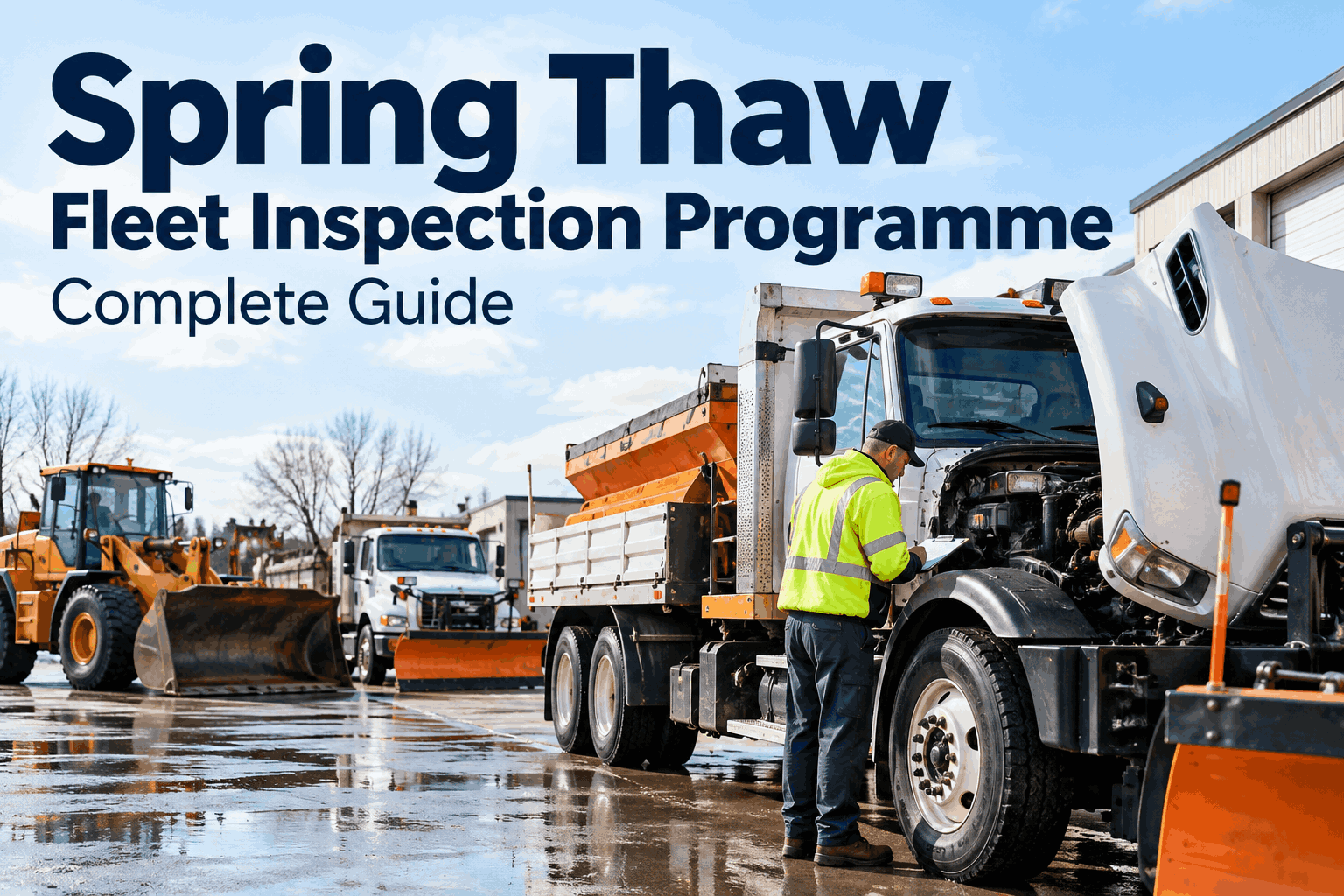
It's the first warm week in April and a technician is under a salt-caked plow truck with a flashlight. The wiring harness looks fine. The connector behind it doesn't: green, swollen, and one good pull from failing. That's the truck that would have thrown an intermittent fault in July and eaten a week of diagnostic time. A planned spring fleet inspection for a municipal fleet is the cheapest hour of the year to find what winter did, and the paperwork you leave behind decides whether it counts. See how HVI schedules and records spring inspections
Winter Damage Costs Least the Day You Find It
Salt keeps working after the last storm. The same defect gets more expensive every month it stays hidden. The bars show the relative cost, not exact dollars.
NHTSA's advice is plain: wash the undercarriage through winter and again thoroughly in spring, and keep inspecting for corrosion. The rest of this guide turns that into a program with an owner, a schedule and a record.
Step 1: Run a corrosion assessment for your post winter inspection fleet
The goal isn't to find what's already broken. It's to find damage that's present but hasn't failed yet, which is visible now and costly later. Six areas take the worst of it.
Electrical connectors
Corrosion behind intact-looking housings
Brake components
Slack adjusters and cam bushings that seize
Air lines & fittings
Chafe, pitting, weeping connections
Frame members
Scale, flaking, cracks near welds
Body mountings
Rusted bolts and brackets, loose bodies
Undercarriage
Crossmembers, hangers, exhaust and tank mounts
Grade each finding (monitor, repair soon, repair now) and photograph it. A "monitor" item with a photo is data. Next April you can see whether it moved. Book a demo to see photo and defect capture on a per-asset basis.
Step 2: Treat the undercarriage wash as maintenance, not cosmetics
A wash bay line-up feels like housekeeping, so it gets skipped when the shop is busy. It's actually a maintenance action: it removes accumulated salt before it keeps working through the warm months, and it makes the inspection that follows possible.
- Salt stays on lines, brackets and connectors
- Defects hide under residue
- Corrosion continues all summer
- Salt removed from critical areas
- Techs can see pitting, cracks and leaks
- Findings logged against the asset
Put the wash on the same preventive maintenance schedule as the inspection, as a task someone signs off, not a favor someone does when there's time.
Step 3: Chase the thaw damage assessment in connectors and brakes
These two areas produce most of the "it only does it sometimes" calls. Intermittent faults eat technician hours because nothing looks wrong. That makes the spring check worth its time.
| Area | What salt does | Record this |
|---|---|---|
| Connectors & wiring | Corrosion inside housings causes intermittent faults | Connector location, condition, photo, action taken |
| Slack adjusters & cam bushings | Seizing and sticking under load | Free movement result, lubrication, replacement |
| Air lines & fittings | External corrosion, chafe, weeping | Leak check result, section replaced, photo |
| Brake lines & hoses | Outside-in corrosion and scaling | Severity grade, pass or replace decision |
Brake findings are safety findings. Anything severe gets a work order, an out-of-service decision if needed, and a verified repair before the truck returns to the route. See defect-to-repair tracking in a short demo.
Step 4: Decommission winter equipment and commission summer gear
Plows (or ploughs, in UK usage), spreaders and ballast come off in spring. Inspect each item before it goes into storage, not after, because damage found in October is damage you've already lost a season on.
- 1Remove Plows, spreaders, ballast
- 2Inspect Mounts, hydraulics, wear
- 3Repair Or schedule before fall
- 4Store With condition on record
At the same time, commission the summer equipment so mowers, sweepers, sprayers and paving gear are ready before the first job. Use min/max parts levels to have connectors, hoses and brake hardware on hand when findings come in, so repairs don't stall waiting on stock.
Step 5: Build a spring fleet inspection municipal programme around your paving window
Spring has a short, busy window between the last storm and the start of the paving season. Without a schedule, the inspection program loses to the work orders that are louder.
| When | Focus | Done when |
|---|---|---|
| Early spring | Undercarriage wash, corrosion assessment | Every unit graded and photographed |
| Mid spring | Brakes, connectors, air lines, repairs | Work orders closed, critical units first |
| Late spring | Winter gear stored, summer gear commissioned | Condition recorded for each attachment |
| Before paving season | Final readiness review | Open items owned, dated and approved |
Start the sequence with critical and seasonal units, since they'll be needed first. If you want the schedule to build itself each year, start free and set up recurring spring tasks.
Records decide the outcome: why documentation is the control
An inspection nobody can prove didn't happen. When a brake line fails in August, or a council member asks why a truck was on the road, the question is what you knew and what you did about it. A solid record answers both. Book a demo to see asset history and inspection records in HVI.
Findings & photos
Every item graded with evidence, not a blanket pass.
Repairs
Work orders linked to the finding that triggered them.
Return to service
Who verified the repair, and when.
History by asset
Compare this April with last April.
From a municipal fleet supervisor
We used to wash trucks when someone had a free hour and inspect them when something broke. Now the wash and the corrosion check are one task on the calendar, with photos. Last spring we found two seized slack adjusters and a bad connector on a spreader before any of them went to work. It's not glamorous, but July got quiet.
Your spring thaw readiness checklist
Undercarriage washed
Salt removed before inspection and recorded.Corrosion graded and photographed
Connectors, brakes, air lines, frames, mountings.Brake findings closed
Verified repair before return to service.Winter gear inspected before storage
Plows, spreaders and ballast on record.Summer equipment commissioned
Ready before the first scheduled job.Parts stocked, schedule dated
Min/max set and the paving window protected.Frequently asked questions
What is a spring fleet inspection for a municipal fleet?
It's a scheduled post-winter inspection that assesses salt corrosion and other winter damage, covers the undercarriage wash, decommissions winter equipment and commissions summer gear. Findings, photos and repairs are documented per asset.
Why is spring the best time to find winter damage?
Damage that is present but hasn't failed is visible and cheap to fix in spring. Left alone, salt keeps working through the warm months and defects tend to emerge as intermittent faults or in-service failures later.
Is an undercarriage wash really a maintenance task?
Yes. Washing removes accumulated salt that would keep corroding components, and it lets technicians see the condition of lines, connectors and mounts. NHTSA's corrosion guidance recommends a thorough spring wash.
Why inspect winter equipment before storage?
Plows, spreaders and ballast removed in spring can have damage that is only discovered in the fall, too late to repair comfortably. Inspecting at removal gives you time to schedule repairs and a condition record for storage.
How does HVI support spring fleet inspections?
HVI supports calendar-triggered readiness tasks, offline field capture of inspections and photos, defect and repair tracking, asset history and parts min/max controls, so each spring inspection is scheduled, documented and verifiable.
Make your spring fleet inspection municipal programme the one that proves itself
When a plow is down in a storm, roads don't get cleared. A strong spring fleet inspection municipal programme finds winter damage while it's still cheap and leaves a record that shows what you knew and what you did. HVI schedules the work, captures it in the field, and keeps the documentation by asset.
No credit card · Offline capture · Asset history · Parts min/max