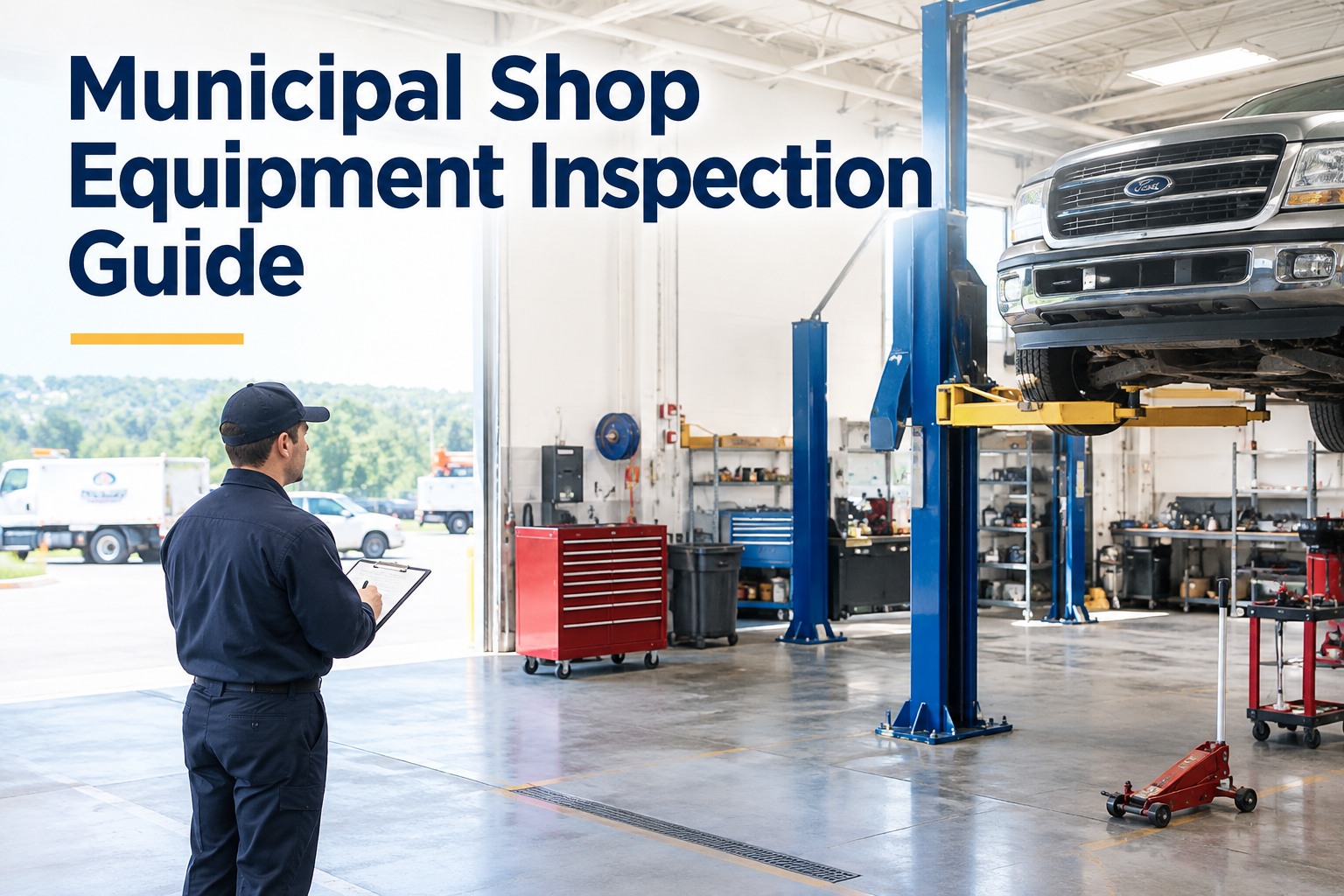
A technician cranks a two-post lift to full height, slides underneath, and never checks the date on the annual inspection sticker — because there isn't one, hasn't been for fourteen months. The safety latch that's supposed to catch the carriage if hydraulic pressure drops has been sticking for weeks. Nobody logged it. This is how a shop lift becomes the most dangerous piece of equipment in a municipal garage, and it's rarely the lift's fault.
Municipal Shop Equipment Inspection: The Program Standards Actually Require
Lifts, jacks, cranes, and hoists don't get the same attention as the trucks they service — even though a failure on one of them can hurt someone faster than almost anything else in the shop. Here's how the standards actually break the inspection work down, by equipment and by frequency.
The Four Layers of a Real Shop Equipment Inspection Program
"Inspect the lift" means something different depending on who's doing it and when. Confusing these four layers is how a shop ends up with daily checks nobody documents and an annual inspection nobody scheduled.
Operator / Pre-Use Check
A quick visual and functional check by whoever's about to use the equipment — controls respond, locks engage, nothing looks obviously damaged.
Periodic Inspection
A more thorough scheduled check of specific components — cables, hydraulic lines, safety latches, capacity markings — at an interval based on use and manufacturer guidance.
Preventive Maintenance
Scheduled servicing — lubrication, fluid changes, adjustment — that keeps the equipment operating within spec between formal inspections.
Formal Examination / Certification
Where a jurisdiction, manufacturer, or standard requires it — vehicle lifts under ANSI/ALI ALOIM being the clearest example — a qualified third-party inspection with a documented, dated result.
What Actually Gets Inspected, by Equipment Type
Always confirm the current edition of the applicable standard and any jurisdiction-specific requirements before finalizing a program.
Book a demo to see this same breakdown configured as ready-made templates for your shop's actual equipment list.
Every Piece of Shop Equipment Needs Its Own Record
A lift that's been in the shop for eleven years should have eleven years of inspection history attached to it — not a folder of loose annual certificates somewhere in a filing cabinet, assuming they were kept at all. Book a demo to see what a complete asset record looks like against your own shop's actual equipment.
Inspection History
Every daily check, periodic inspection, and annual examination, dated and tied to this specific unit.
Defects & Corrective Actions
What was found, what was done about it, and whether the fix was actually verified before return to service.
Responsible Person
Who inspected it, who repaired it, and who signed off — not left to memory when someone asks later.
Next Due Date
Visible before the deadline passes, not discovered the day an inspector or auditor asks for proof.
Defective Equipment: Tag It, Pull It, Prove the Repair
OSHA's jack regulations put it plainly: a jack that's out of order gets tagged and stays out of service until it's actually repaired — not until someone remembers to deal with it. The same principle should apply to every piece of shop equipment, not just jacks. Book a demo to see a flagged defect automatically block that asset from being marked available again.
From a Shop Foreman Who Stopped Trusting the Sticker
We had an annual inspection sticker on a lift that was two years out of date because the vendor who used to handle it stopped servicing our area and nobody picked it back up. Nobody noticed until an insurance audit asked for current certificates on every lift in the building.
Now every piece of shop equipment has its own record with a due date that actually alerts someone — not a sticker we hope stays current. We caught two more lapsed items in other bays within the first month of actually tracking it properly.
A Practical Municipal Shop Equipment Inspection Programme
Put simply, the program comes down to three recurring habits layered on top of each other. Sign up for a free trial to see these three tiers running as automatic recurring schedules against your own equipment list.
Daily & Periodic
- Operator pre-use check before each use
- Controls, locks, and restraints tested functionally
- Visible damage, leaks, or wear flagged immediately
- Capacity markings confirmed legible
- Any defect tagged and reported the same day
Annual & As-Required
- Qualified inspector examination for vehicle lifts
- Full component teardown check per manufacturer schedule
- Load or capacity verification where applicable
- Documentation reviewed for lapsed or missing records
- Repeat-defect history checked across similar equipment
Conclusion: Municipal Shop Equipment Inspection Is a Program, Not a Sticker
A lift, a jack, or a shop crane doesn't fail because nobody cared — it fails because the inspection that should have caught the problem was daily-only, or periodic-only, or relied on a sticker that quietly expired. A real municipal shop equipment inspection program layers all four levels — pre-use, periodic, preventive maintenance, and formal examination where required — against a record that belongs to the specific asset, not a shared spreadsheet or a filing cabinet. Book a demo to see that record built against your own shop's lifts, jacks, and cranes.
Frequently Asked Questions
How often do vehicle lifts need to be inspected?
Under ANSI/ALI ALOIM:2020, the American National Standard for automotive lift operation, inspection, and maintenance, every installed vehicle lift must be inspected at least annually by a qualified lift inspector, regardless of the lift's age, type, or manufacturer. Higher-use lifts may need more frequent inspection based on manufacturer guidance. OSHA does not have a lift-specific regulation but has used this standard as the benchmark under its General Duty Clause when evaluating whether an employer maintained a safe workplace.
What are the OSHA requirements for inspecting jacks and jack stands?
Under 29 CFR 1910.244(a) and the equivalent construction standard 1926.305, jacks must have their rated load legibly and permanently marked, and must be thoroughly inspected at intervals based on service conditions, including immediately before and after handling an abnormal load or shock. A jack found to be out of order must be tagged and kept out of service until it has actually been repaired.
What's the difference between a pre-use check and a periodic inspection?
A pre-use or operator check is a quick visual and functional check performed by whoever is about to use the equipment, confirming controls respond properly and nothing looks obviously damaged. A periodic inspection is a more thorough, scheduled examination of specific components — such as cables, hydraulic lines, safety latches, and capacity markings — performed at a set interval based on manufacturer guidance and how heavily the equipment is used. Both are distinct from a formal annual examination, which is typically required by a specific standard, such as ANSI/ALI ALOIM for vehicle lifts.
What should happen when a piece of shop equipment is found defective?
The defect should be reported immediately, the equipment should be physically tagged and removed from service so it isn't mistakenly used, the repair should be logged against that specific asset's record with parts and work performed, and the fix should be verified before the equipment is returned to service. This mirrors OSHA's own tag-out requirement for defective jacks and applies just as well to lifts, cranes, and other shop equipment.
What records should a municipal shop keep for its inspection equipment?
Each piece of equipment should have its own asset record containing its full inspection history, any defects found and the corrective actions taken, the person responsible for the inspection or repair, and the next due date for periodic or annual inspection. This level of detail is what allows a shop to demonstrate compliance during an audit or insurance review and to catch lapsed inspections before they become a safety incident.
Track every lift, jack, and crane the same way you track your fleet
HVI gives municipal shops asset-level inspection records, configurable templates for lifts, jacks, cranes, and hoists, recurring daily-to-annual schedules, and offline field inspections — so the next audit or insurance review is a search, not a scramble.
No credit card · Works offline in the shop · Live in under two weeks