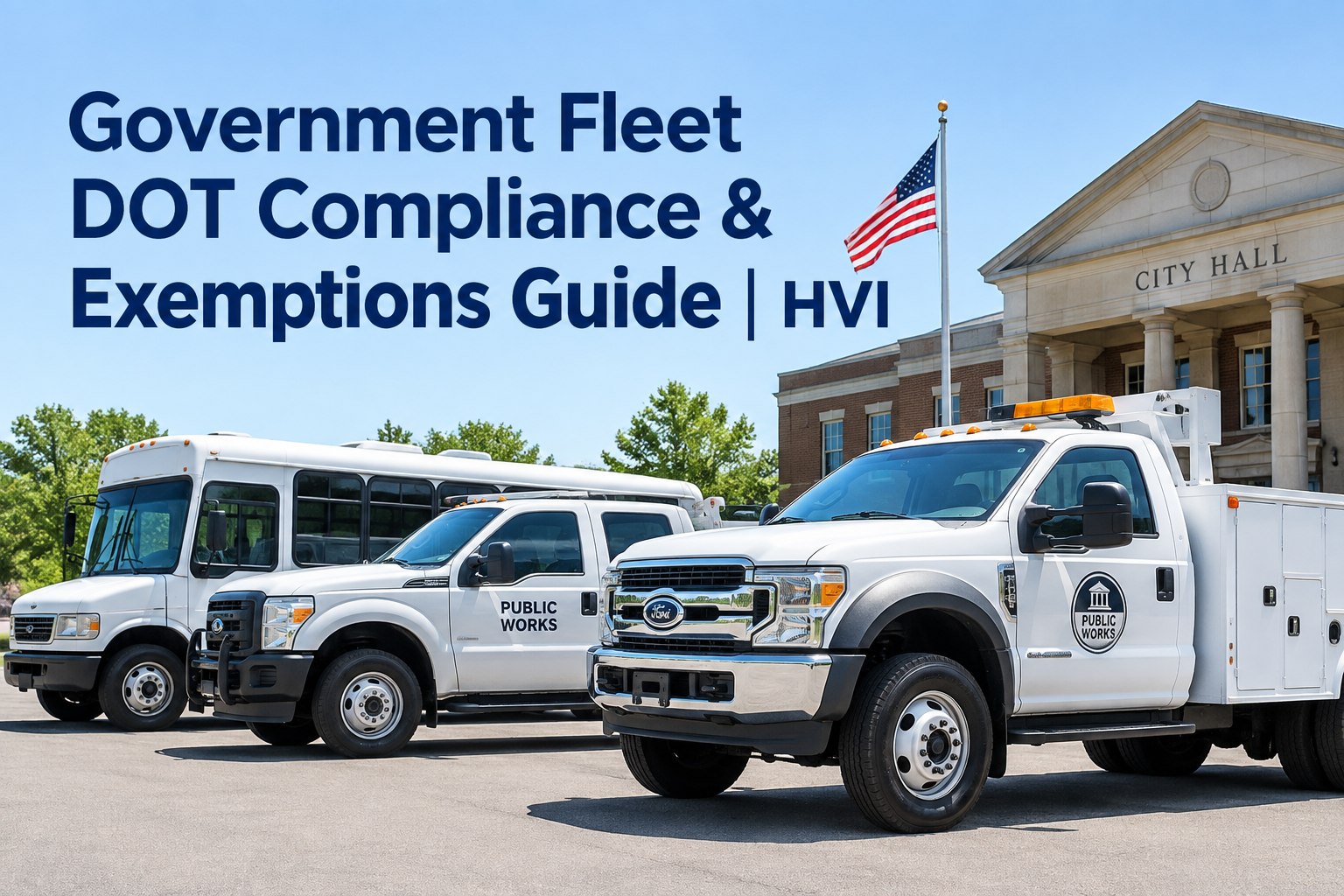
Your city's dump truck sailed through last year's roadside check as "government exempt." This year, an inspector opens the driver's file and finds no medical certificate, no drug-test record, and a lapsed annual inspection. Government fleet DOT compliance was never a blanket exemption — it's a narrow, vehicle-specific carve-out, and most public fleets are only covered on about half of what actually applies to them. This page shows exactly what's exempt, what isn't, and where the gap usually gets found. Book a demo once you see where your fleet stands.
The Government Fleet Exemption Myth
Under 49 CFR 390.3(f)(2), transportation performed directly by a state, a political subdivision, or a federal agency is exempt from most Federal Motor Carrier Safety Regulations — including hours-of-service rules. That's a real exemption, and it's why a city snowplow crew running a storm shift at 2 a.m. isn't logging hours-of-service violations. But that single carve-out gets stretched by fleet managers to cover things it was never written for.
The exemption applies to the operation being government-performed. It does not touch CDL licensing, drug and alcohol testing, vehicle size and weight limits, insurance requirements, or the basic obligation to keep a mechanically sound vehicle on the road. A government-owned dump truck rated over 26,001 lbs still needs a CDL-licensed driver behind the wheel, full stop — the badge on the door doesn't change the axle rating. Most departments only discover how narrow this line is when an auditor asks; it's worth booking a demo to walk through your own vehicle list before that happens.
Typically Exempt
- Hours-of-service logs for drivers directly employed by the government unit
- DOT number registration for vehicles used exclusively for official government purposes
- Federal economic/operating authority requirements that apply to for-hire carriers
- Limited CDL exception for snow/ice removal in a declared emergency, in-state only, if allowed by that state
Almost Never Exempt
- CDL requirements under 49 CFR Part 383 for any vehicle over 26,001 lbs GVWR
- Drug and alcohol testing under 49 CFR Part 382 for CDL-required positions
- Annual vehicle inspection and maintenance recordkeeping obligations
- Vehicle size, weight, and structural (FMVSS) design ratings
- Medical certification for CDL holders
Read that second column again: those five items cover almost every audit finding a public fleet actually gets flagged for. If your department's compliance file is built around "we're exempt," it's built on the wrong column.
Where This Plays Out, Vehicle by Vehicle
Exemptions aren't decided by department — they're decided vehicle by vehicle, based on weight, use, and who's driving. Here's how it typically breaks down across a mixed municipal fleet.
Snowplows & Ice Control
HOS-exempt during in-territory storm work under 390.3(f)(2). CDL and drug/alcohol rules still apply — a limited CDL exception exists only during a declared emergency, only in-state, and only if that state adopted it.
Refuse & Dump Trucks
The most-cited category. Over 26,001 lbs GVWR, these require a CDL driver, medical certificate, and annual inspection — regardless of the city seal on the door.
Police & Fire Apparatus
Emergency-response vehicles carry the broadest FMCSR exemption while actively responding. Off-duty transport, routine maintenance runs, and non-emergency moves fall back under standard rules.
Transit & Passenger Buses
Frequently subject to separate FTA and state transit safety oversight in addition to CDL and drug/alcohol rules — often the most heavily regulated vehicle class in the fleet, not the least.
Utility & Public Works Trucks
Vehicles servicing public utilities can carry an HOS exemption while actively repairing or maintaining utility infrastructure — but CDL, weight, and inspection rules apply the moment the truck is on a public road.
Admin Sedans & Light Pickups
Under 10,001 lbs GVWR, used locally, non-hazmat — these are usually the true "no DOT number needed" case. Still not a reason to skip a maintenance and inspection log if the vehicle carries staff daily.
CDL & Driver Qualification Rules Government Fleets Still Owe
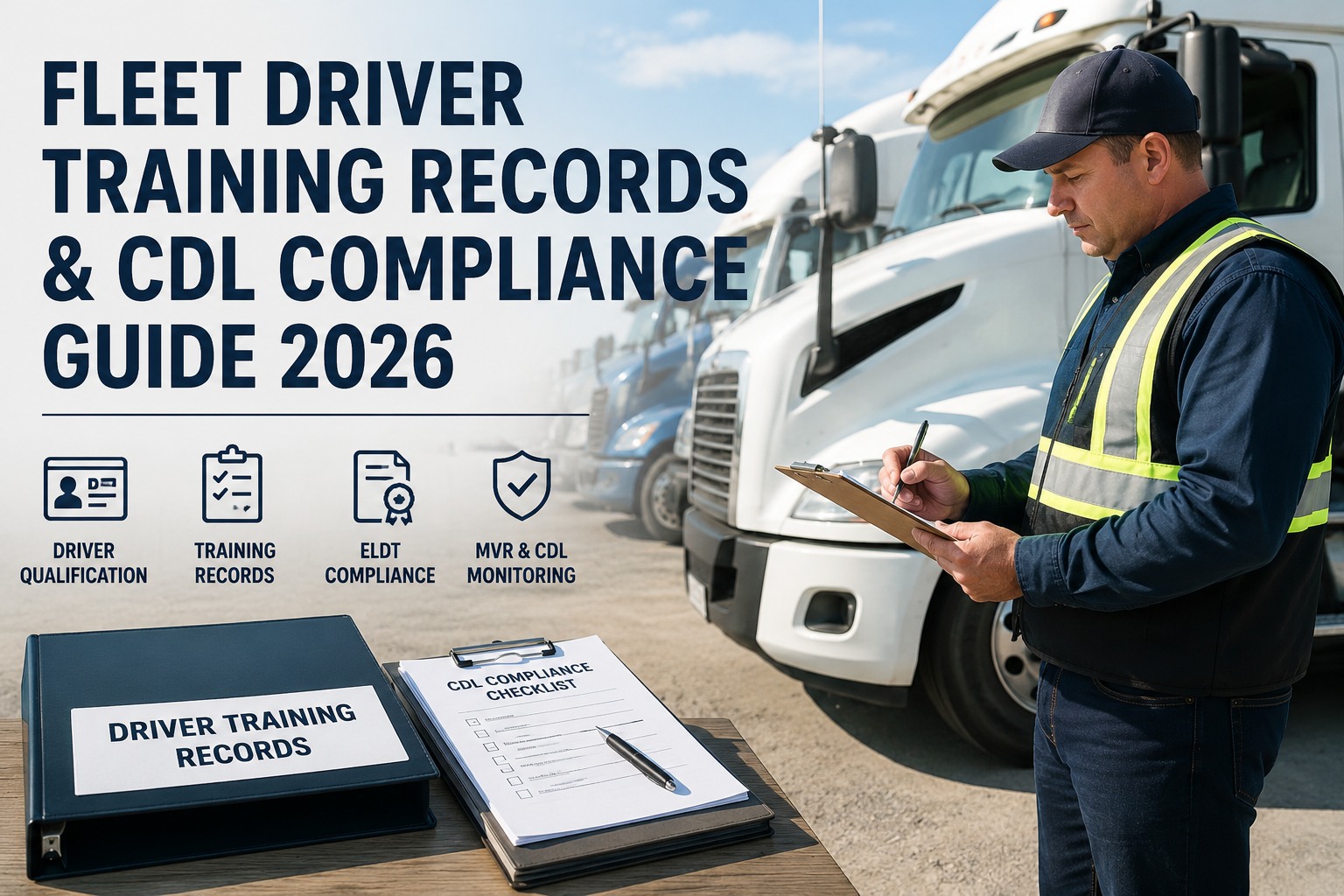
This is the part that trips up more departments than any weight limit ever does: every employee driving a CDL-required vehicle needs a current CDL, a valid medical certificate, and a driver qualification file — even if their paycheck says "Public Works" instead of "Trucking Co." Here's the checklist an auditor is actually working from.
One state association put it plainly after reviewing municipal citations: the three most common infractions in government fleets are driving without a required CDL, skipping drug and alcohol testing, and running overweight dump trucks or refuse haulers. None of the three has anything to do with government ownership — they're driver and vehicle records, and they're exactly what a daily operator reporting workflow is built to catch before it becomes a citation. If your driver files are still living in separate spreadsheets, sign up for a free trial to see what a renewing DQ file actually looks like.
Inspection Records & Audit Exposure
Government ownership doesn't relax the recordkeeping bar — if anything, it raises it, because public fleet records are frequently subject to open-records requests in addition to a DOT or state audit. A missing inspection sheet isn't just a compliance gap; it's a public document that doesn't exist when a reporter, an insurer, or a city council member asks for it.
Pre- and Post-Trip Inspections
Signed DVIR-style reports for every CDL-required vehicle, every shift — paper logs are the single most common item an audit can't verify after the fact.
Annual Inspection Certificates
Dated, signed, and tied to the specific unit number — not a folder of loose paper in a supervisor's truck.
Maintenance History Tied to Meter Readings
PM intervals by hours or mileage, with completed work orders — the backbone of proving "reasonably maintained" if a vehicle is ever involved in an incident.
Driver Qualification & Testing Records
Centralized, not siloed across HR, the motor pool, and individual department supervisors who each keep "their own" file.
A department that can pull every record above for any unit in under five minutes has already won most of an audit before it starts. A department that's still checking a filing cabinet is one missing folder away from a finding — book a demo to see how a centralized, audit-ready system prevents that first inspection from ever going wrong.
From a Compliance Officer Who's Been Through the Audit
Every year we'd tell the finance committee we were "federally exempt" and every year that answer got less convincing. What actually happened was one inspection where a 2010 dump truck had no medical cert on file for the driver who'd been running it for eight months. That single gap turned into a two-week records pull across the whole yard.
Now every vehicle has a compliance tag — exempt, partially exempt, fully regulated — and every driver file renews itself before it expires instead of after someone notices. The audits still happen. They just take an afternoon now instead of two weeks.
Getting From "We Think We're Fine" to Audit-Ready
Public fleets rarely fix compliance gaps in one pass — it's a sequence, and skipping a step usually means redoing it later once an audit forces the question anyway.
-
1
Classify every vehicle by GVWR, use, and driver
Not by department. A 32,000 lb dump truck and a 6,500 lb admin sedan owned by the same office have completely different obligations.
-
2
Build driver qualification files that renew themselves
Medical certs, CDL expirations, and drug-test cycles tracked with alerts, not a spreadsheet someone checks quarterly if they remember.
-
3
Digitize inspections at the point of use
Signed, timestamped reports from the driver's phone replace the paper sheet that "should be in the truck somewhere."
-
4
Centralize retrieval for audits and records requests
One search, one export, every unit — instead of a department-by-department scramble every time someone asks for proof.
Layered in that order, most public fleets go from "hoping the exemption covers us" to being able to hand an auditor a complete file in minutes — without adding headcount to chase paperwork.
Conclusion: Government Fleet DOT Compliance Is a Vehicle List, Not a Blanket Rule
The 390.3(f)(2) exemption is real, but it's small — it covers hours-of-service for government-performed transport, not the CDL, drug-testing, weight, and inspection rules that make up nearly every citation public fleets actually receive. Getting government fleet DOT compliance right means treating every unit as its own case: what it weighs, what it hauls, who's driving it, and whether that record can be produced today, not eventually. Fleets that build that habit stop dreading audits and open-records requests — because the answer is already on file. When you're ready to see what that looks like for your own vehicle list, book a demo and walk through it with your actual fleet data.
Frequently Asked Questions
Are government-owned vehicles exempt from DOT regulations?
Only partially. Vehicles operated directly by a federal, state, or local government unit are generally exempt from needing a DOT number and from federal hours-of-service rules under 49 CFR 390.3(f)(2), when used exclusively for official government purposes. However, this exemption does not extend to CDL licensing requirements, drug and alcohol testing under Part 382, vehicle size and weight limits, medical certification, or the basic obligation to keep the vehicle safely maintained and inspected. A government fleet can be fully DOT-number-exempt and still be cited for an unqualified driver or an overweight truck.
Do municipal snowplow and refuse truck drivers need a CDL?
In most cases, yes. Any vehicle with a gross vehicle weight rating over 26,001 lbs requires a CDL-licensed driver regardless of who owns the vehicle. Some states allow a narrow, limited CDL exception for snow and ice removal during a declared emergency, restricted to the government unit's own territory, but this exception is optional at the state level and does not apply to routine, non-emergency operation. Refuse and dump trucks over the weight threshold almost never qualify for a CDL exception and are one of the most commonly cited vehicle types in government fleet audits.
Are government fleets required to do drug and alcohol testing?
Yes. Drug and alcohol testing requirements under 49 CFR Part 382 apply to any employee who operates a CDL-required commercial motor vehicle, regardless of whether the employer is a private company or a government agency. There is no blanket government exemption for pre-employment, random, post-accident, or reasonable-suspicion testing. Skipping testing for CDL-required drivers is one of the three most frequently cited compliance failures in municipal and county fleet audits.
What records should a government fleet keep for a DOT or state audit?
At minimum: signed pre- and post-trip inspection reports for every CDL-required vehicle, current annual inspection certificates tied to each unit number, maintenance history linked to meter readings or calendar intervals, and complete driver qualification files including medical certificates, CDL status, and drug/alcohol testing records. Because public fleet records are also frequently subject to open-records requests, these documents should be centralized and quickly retrievable, not scattered across individual department files or paper logs kept in vehicle cabs.
Do government fleet vehicles still need annual inspections?
Yes. The 390.3(f)(2) exemption addresses hours-of-service and, in most cases, DOT number registration — it does not remove the requirement to keep commercial vehicles in safe operating condition or waive applicable annual inspection and maintenance recordkeeping obligations. A government fleet is still expected to operate vehicles that meet federal motor vehicle safety standards and to be able to demonstrate that inspection and maintenance schedules are being followed and documented.
Turn "we think we're exempt" into a documented answer
HVI gives government and municipal fleets configurable compliance profiles per vehicle, driver qualification tracking with expiration alerts, signed digital inspection records, and one-search audit retrieval — so the next records request or roadside audit takes minutes, not weeks.
No credit card · Configurable by vehicle class · Live in under two weeks