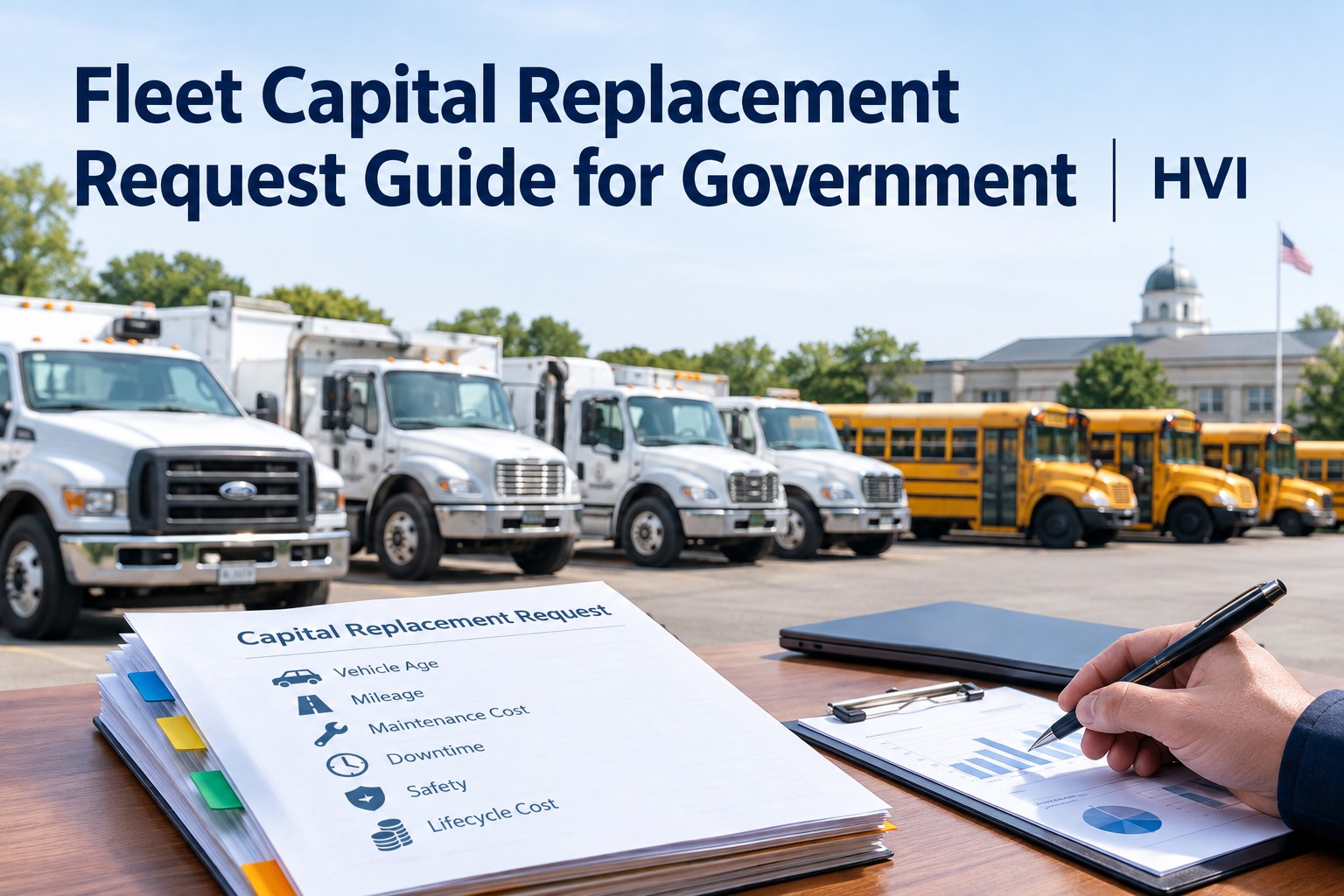
A fleet capital replacement request built on "it's old and keeps breaking" gets deferred nearly every time — not because the vehicle isn't due, but because nobody can turn that sentence into a number a council or CFO can defend. The requests that actually get funded start years earlier, with a documented score instead of a feeling. Here's the scoring model, the deferral math, and the one-page structure that survives a budget hearing.
How Is Each Replacement Criterion Actually Scored?
Pick a criterion. See how it's banded into points under a common government scoring model — the same structure a council review will expect to see.
Scored as: current age ÷ the class's expected service life, expressed as a percentage.
Bands: under 20% of expected life = 1 point, rising in 20-point steps to 5 points once the vehicle has reached or passed its projected life.
Scored as: current odometer or engine-hours ÷ the class's projected lifetime mileage or hours.
Bands: same 20%-step structure as age — low utilization relative to projection scores low, at-or-past projection scores 5.
Scored as: cumulative lifetime repair cost ÷ original purchase price.
Bands: commonly treated as an early warning once it crosses roughly 25%, and a serious review point near 50% of purchase price.
Scored as: a structural and cosmetic condition rating, typically assessed on a 0–5 scale by a technician or inspector.
Bands: frame, body and structural condition weigh heaviest — a vehicle can score well on age and mileage and still flag high here.
The Four-Criteria Fleet Capital Replacement Request Scoring Model
Age, mileage or hours, maintenance cost ratio, and condition — each scored 1 to 5 points — is the scoring structure behind most defensible government fleet replacement programs, and it isn't theoretical. One Texas county's published fleet policy scores every vehicle within two years of its scheduled life cycle against exactly these criteria, then applies a class-specific replacement threshold: 20 points minimum for light-duty vehicles, 30 for medium and heavy trucks and off-road equipment, and 15 for grounds equipment. Vehicles below their threshold get scored again the following year, even past their assigned replacement age — the score decides, not the calendar.
That last detail matters more than it looks: a vehicle that hits its "expected" replacement year on paper but scores low gets another year, and one that's younger but deteriorating fast gets flagged early. The threshold approach turns replacement timing into a documented, repeatable decision instead of a fixed schedule nobody actually follows.
What a Score Threshold Actually Triggers in a Fleet Capital Replacement Request
| Total score range | What it signals |
|---|---|
| 5–6 | Excellent condition — no action needed, revisit next scoring cycle |
| 7–11 | Good condition — monitor, no request warranted yet |
| 12–18 | Consider replacement — build the evidence case now, before it's urgent |
| 19–25 | Replacement needed — a request should already be in the current or next capital cycle |
The gap between "consider" and "needed" is exactly where most fleets lose time — a vehicle sitting at 14 or 15 points today is the one that should be entering next year's capital request, not waiting until it crosses 19 and becomes an emergency line item. Book a demo to see every vehicle's score trended year over year, so the "consider" tier gets flagged with enough runway to actually request funding for it.
The Cost of Waiting: Estimating Deferral Consequences
A score justifies a request, but a reviewer still asks the obvious follow-up: what happens if we say no this year? Deferral has a real, calculable cost on both sides of the ledger. On the expense side, maintenance and repair cost per mile typically accelerates once a vehicle crosses its cost-ratio threshold — not linearly, but in the kind of step-change that shows up as a widening gap between that vehicle's trend line and its class average. On the recovery side, resale and disposal value erodes faster than replacement cost inflates, meaning every deferred year is quietly shrinking the trade-in credit that would have offset the eventual purchase. Downtime compounds both: a vehicle held past its window doesn't just cost more to fix, it's unavailable more often while it's being fixed, which shows up as overtime, rentals or delayed service elsewhere in the department that depends on it. Book a demo to see cost-per-mile and downtime trends charted against the deferral point, so the "what if we wait" question already has an answer attached.
The One-Page Request Every Reviewer Actually Reads
A capital replacement request that survives a budget hearing fits on one page, and every reviewer is scanning for the same handful of fields — anything beyond this rarely gets read before the vote.
Vehicle Identity & Class
Unit number, year, make, model and vehicle class — the reader needs to place it instantly.
Current Condition & Score
The replacement score, its band, and a one-line note on what's driving it.
Operating History
In-service date, mileage or hours, and utilization relative to its class projection.
Maintenance Expenditure
Cumulative repair cost, cost ratio against purchase price, and the recent trend — flat, rising or accelerating.
Replacement Cost & Disposal Value
Current market replacement cost and expected trade-in or auction value, net of any upfit removal.
Operational Impact & Requested Funding
What happens to service delivery if this is deferred, and the specific dollar amount being requested this cycle.
Sign up free to export this exact field set per vehicle directly from cost and condition records already on file, instead of rebuilding it by hand every budget season.
Connecting Individual Requests to a Rolling Multi-Year Plan
A single vehicle's request is strongest when it's clearly one line inside a five-to-ten-year rolling capital plan, not a standalone ask that appears once and surprises reviewers. Government vehicle procurement routinely takes a year or more from approved funding to delivery once specification, competitive bid and production lead times are factored in — which means a vehicle scoring 14 or 15 points today needs its request moving now, not after it crosses the replacement threshold and becomes urgent. A rolling plan updated annually, alongside each year's scoring cycle, lets a fleet show reviewers exactly where this year's request sits inside a multi-year pattern instead of asking them to evaluate it in isolation. Book a demo to see this year's scored candidates rolled into next year's capital plan automatically, instead of rebuilt from scratch each budget cycle.
What a Fleet Director Actually Has to Defend Internally
For years our requests were basically a list with "high mileage, frequent repairs" next to each unit, and council pushed back on almost every one. The year we switched to a scored request — age, mileage, cost ratio, condition, all documented per vehicle — the conversation changed entirely. Nobody argues with a number that's been consistent across every vehicle on the list. We still don't get everything we ask for, but we stopped getting asked to justify why we're even asking.
The Takeaway
A fleet capital replacement request gets funded when it stops being an opinion and starts being a documented score — age, mileage, maintenance cost ratio and condition, banded consistently across every vehicle, tied to a one-page evidence packet, and positioned inside a rolling multi-year plan rather than a surprise line item. The fleets that get consistent capital funding aren't the ones with the oldest vehicles; they're the ones whose requests never make a reviewer ask "how do we know this is actually necessary." Sign up free and start scoring your fleet before your next capital cycle opens.
Frequently Asked Questions
What criteria go into a fleet capital replacement request scoring model?
Most defensible government scoring models use four criteria, each scored on a 1-to-5-point scale: age relative to the vehicle class's expected service life, mileage or hours relative to projected lifetime usage, cumulative maintenance cost as a ratio of original purchase price, and a structural condition assessment. Some models add a fifth criterion for repair frequency or service count. Total scores typically run from 5 to 25, with higher scores signaling a stronger case for replacement.
What maintenance cost ratio typically signals a vehicle needs replacement?
A commonly used early-warning point is when cumulative lifetime repair cost reaches roughly 25% of the vehicle's original purchase price, with 50% often treated as a serious review threshold. These figures vary by local policy and vehicle class, so they should be treated as general benchmarks rather than a universal rule, but they give a consistent, documentable trigger point rather than a subjective judgment call.
What should a one-page fleet replacement request include?
A request that holds up under review typically includes vehicle identity and class, current condition and replacement score, operating history including mileage or hours and utilization, cumulative maintenance expenditure and cost trend, expected replacement cost and disposal or trade-in value, the operational impact of deferral, and the specific funding amount requested. Reviewers are scanning for these fields specifically, and anything beyond a single page rarely gets read before a vote.
How does deferring a vehicle replacement affect long-term cost?
Deferral typically increases cost on two fronts at once: maintenance and repair cost per mile tends to accelerate once a vehicle passes its cost-ratio threshold, and resale or disposal value erodes faster than replacement cost inflates, shrinking the trade-in credit available toward the eventual purchase. Downtime from an aging vehicle also compounds the impact through overtime, rentals, or delayed service in the department that depends on it.
How does an individual replacement request connect to a multi-year capital plan?
A single replacement request is strongest when it's clearly positioned as one line inside a rolling five-to-ten-year capital plan rather than a standalone ask. Because government vehicle procurement often takes a year or more from funding approval to delivery, vehicles approaching their replacement threshold need to enter the plan before they become urgent, and the rolling plan should be updated annually alongside each year's replacement scoring cycle.
Build Capital Replacement Requests From Real Vehicle Records
HVI tracks cost, downtime and condition per vehicle over its full life, so replacement scoring and the request packet behind it come from retrievable records — ready before the capital budget window opens, not assembled the week it's due.
No credit card · No hardware required · Live before your next capital cycle