The audit finding wasn't that the fleet lacked rules — it was that nobody could prove anyone had actually agreed to follow them. Government fleet policy development usually starts the same way: a policy exists somewhere as a Word document from six years ago, half the current staff have never seen it, and there's no record that they were ever asked to. Book a Demo
62% of public fleets can't prove anyone signed their own policy
A written policy that nobody acknowledged, and nobody can prove was distributed, holds up about as well in an audit as no policy at all.
A government fleet policy isn't one document, it's a governance system with a document at the center of it — rules that mean nothing until someone can prove they were adopted, distributed, understood, and actually followed. Most of the gap between "we have a policy" and "we can defend our policy" lives in that proof, not in the writing itself.
The Six Sections Every Government Fleet Policy Development Effort Needsskip one and the policy has a hole an auditor will find before you do
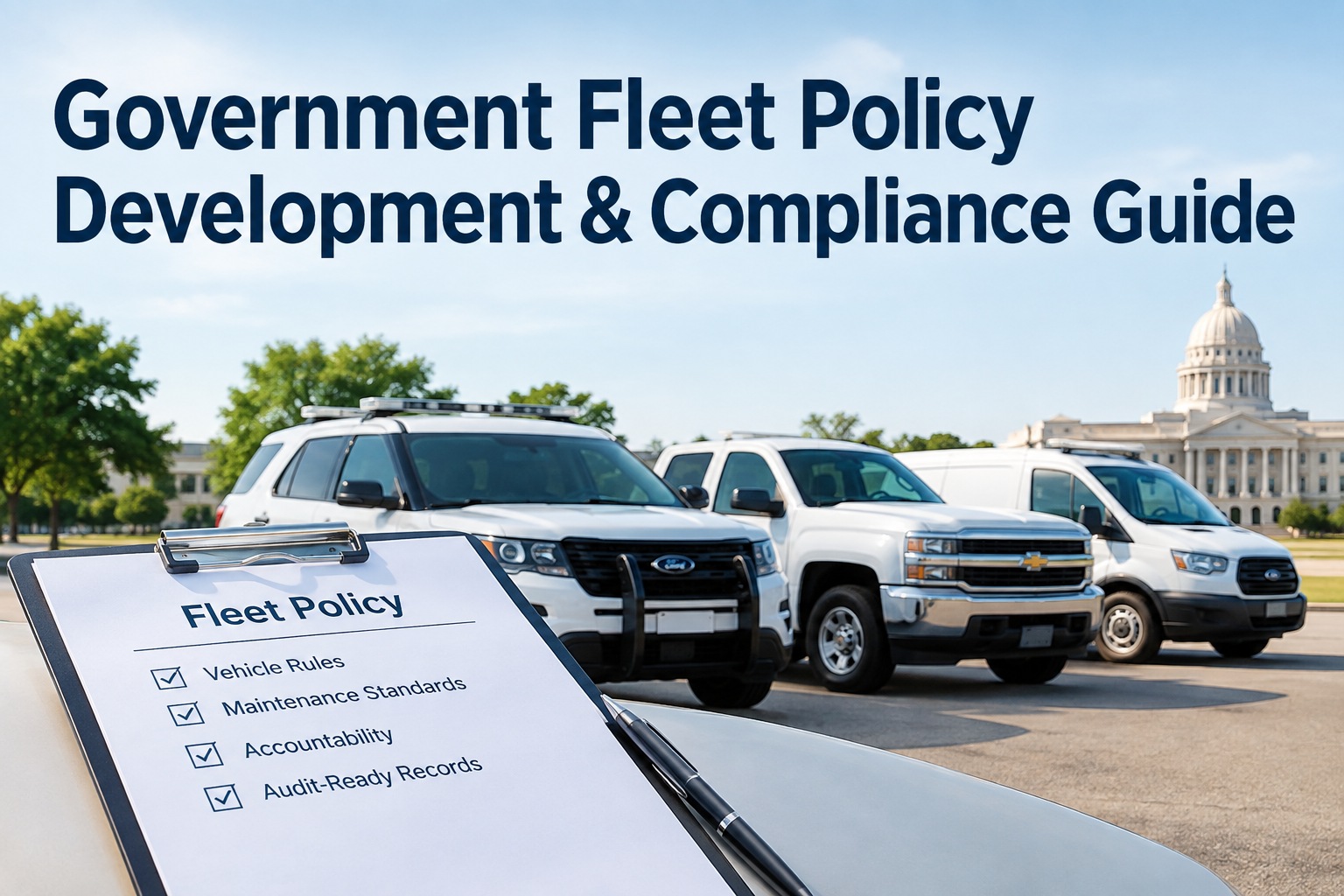
Public fleet policies vary by agency size and mandate, but the ones that actually hold up in review consistently cover the same six areas.
Scope & governance
Which vehicles, departments, and personnel the policy covers, and who has final authority to approve exceptions.
Vehicle assignment & use
Who qualifies for a take-home or assigned vehicle, permitted personal use, and the approval chain for exceptions.
Maintenance & inspection standards
Required inspection intervals, preventive maintenance schedules, and what happens when a defect is found.
Driver qualification requirements
License class, medical certification, training, and any agency-specific driving record standards.
Record-keeping & reporting
What gets documented, how long it's retained, and who can produce it on request.
Review & revision cycle
A fixed interval for revisiting the policy, plus the triggers that force an earlier review.
Three violations account for most government fleet citations — missing CDLs, skipped drug and alcohol testing, and overweight vehicles — and every one of them traces back to a gap in sections 3 or 4 above. See where government fleet DOT exemptions actually apply before assuming your fleet is covered by default.
From Policy Clause to Proofa rule in a document and a fact you can defend are two different things
This is the part most policy documents leave entirely unanswered: when a rule says something must happen, what specifically has to exist afterward to prove it did? A policy without an answer to that question is a set of intentions, not a governance system.
| Policy requires | What actually proves it happened |
|---|---|
| Daily pre-trip inspection completed | A signed, timestamped inspection record, retrievable by vehicle and date |
| Driver holds a valid license and medical certificate | A current certificate on file, with an alert before it expires |
| Preventive maintenance performed on schedule | A complete maintenance history tied to the specific asset, not a shop invoice pile |
| Employees acknowledged the policy | A signed acknowledgment record, dated, per employee |
| Defects reported are corrected before dispatch | A defect-to-repair record showing the finding, the fix, and sign-off |
An auditor doesn't ask whether your policy is well written — they ask you to produce the left-hand column's proof on demand, for a specific vehicle, on a specific date. Book a Demo
The Adoption Process: Draft to Actually Enforceda policy isn't real until it clears every one of these steps
Writing the policy is the easy half. Getting it formally adopted, distributed, acknowledged, and reviewed on a schedule is the part that turns a document into something defensible.
Step four is where the ARI survey data above says most public fleets quietly stop — and it's the single step that determines whether "the policy required it" holds up as a defense at all. Start Free Trial
Government Fleet Policy Development Doesn't End at Adoptionkeeping it current is part of the same job
A fixed annual or biennial review catches routine drift, but four events should trigger a review outside that schedule regardless of when the last one happened: a new regulation affecting the fleet, an audit or incident finding that exposed a gap, a meaningful change in fleet composition (new vehicle classes, new departments added), or new technology that changes how compliance is actually tracked. Treating the review cycle as a calendar date alone misses all four of these.
From a fleet director who stopped assuming the policy was working
We had a policy. It was fine, honestly — well written, covered the right topics. What we didn't have was any proof that the fifteen people who'd started in the last two years had ever actually read it, let alone signed anything.
An internal review caught it before an external one did, which was lucky. Now every new hire signs the current version electronically, it's dated, and I can pull that record in about ten seconds if anyone ever asks. The policy didn't need to get better. We needed proof it was actually reaching people.
Marcus didn't rewrite his policy — he closed the gap between having one and being able to prove it. Book a Demo
Frequently asked questions
What sections should a government fleet policy document include?
A complete policy generally covers scope and governance (which vehicles and personnel it applies to, and who has final authority), vehicle assignment and use rules, maintenance and inspection standards, driver qualification requirements, record-keeping and reporting procedures, and a defined review and revision cycle. Missing any one of these tends to be exactly where a gap surfaces during an audit or an incident review.
Why does signed acknowledgment of a fleet policy matter so much?
A written policy that employees haven't formally acknowledged is difficult to enforce, since there's no record that the affected staff were actually notified of the requirements. Industry survey data on public fleets has found that a majority don't require a signed acknowledgment upon receiving the policy, which means most public fleets would struggle to prove distribution if that question were ever raised in an audit or a legal proceeding.
How often should a government fleet policy be reviewed?
A fixed review cycle, commonly annual or biennial, catches routine drift as regulations and fleet composition change gradually. Beyond that schedule, a review should also be triggered immediately by a new regulation affecting the fleet, an audit or incident finding that exposed a gap, a significant change in fleet composition, or new tracking technology that changes what compliance documentation actually looks like.
Who has the authority to formally adopt a government fleet policy?
This varies by agency structure, but a policy generally needs to be signed off by whichever authority has the power to make it binding on staff — a city council or board for a municipal fleet, or a department head or agency director for an internal departmental policy. A draft that skips formal adoption and goes straight to informal distribution is significantly weaker if its enforceability is ever challenged.
What's the difference between having a fleet policy and being able to prove compliance with it?
Having a policy means the rules exist in writing. Proving compliance means being able to produce specific records on request — a signed inspection log for a specific vehicle on a specific date, a current qualification certificate for a specific driver, a documented maintenance history for a specific asset. Many public fleets have the former without the latter, which is generally where audit findings and enforcement gaps actually originate.
Good Government Fleet Policy Development Ends With Proof, Not Just a Document
HVI turns policy requirements into audit-ready records — signed PDF acknowledgments and inspections, qualification expiry alerts, and searchable retrieval by vehicle, driver, and date — so your policy is something you can defend, not just something you wrote. Live in under two weeks.
No credit card · Signed PDF records included · Qualification alerts ready on day one