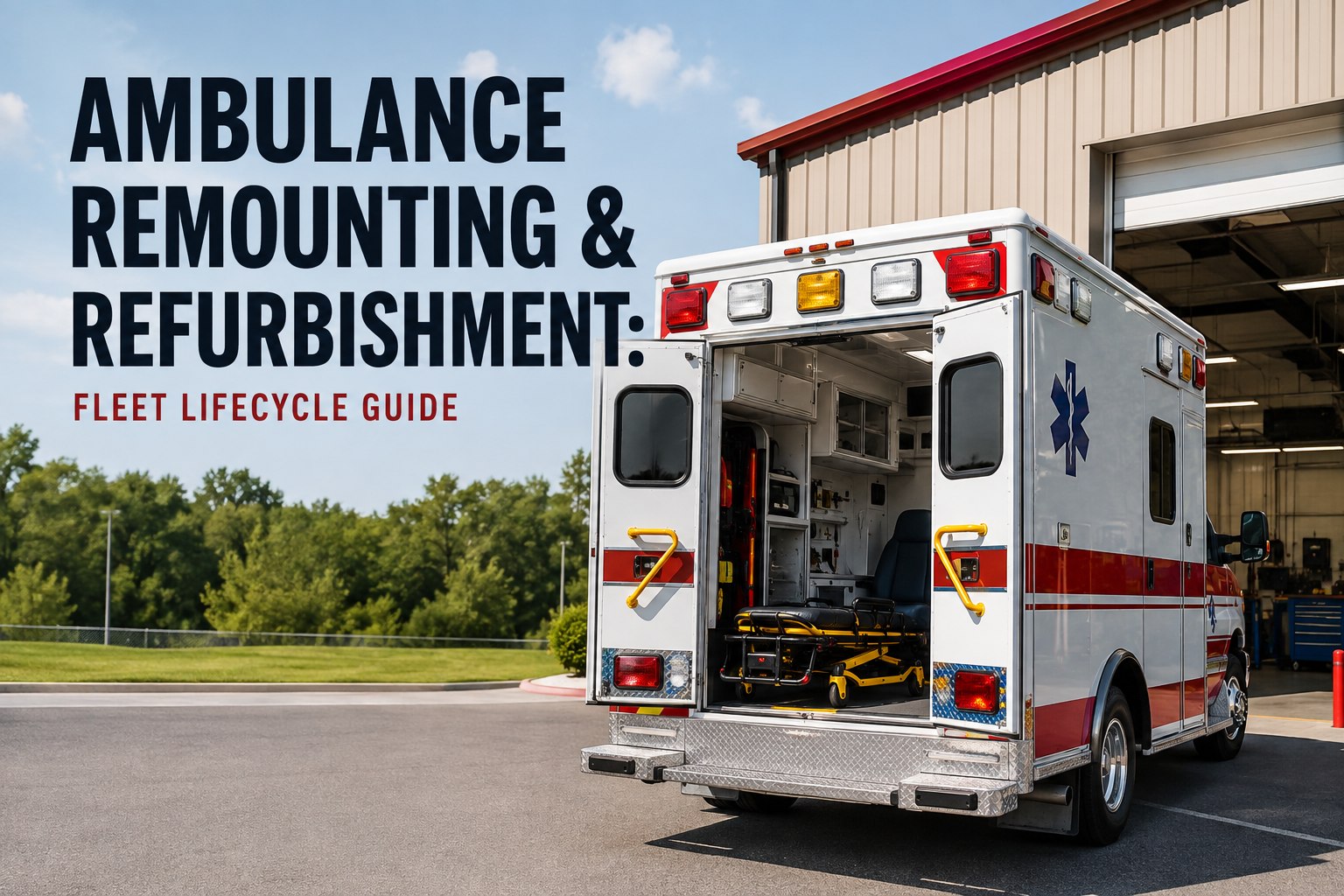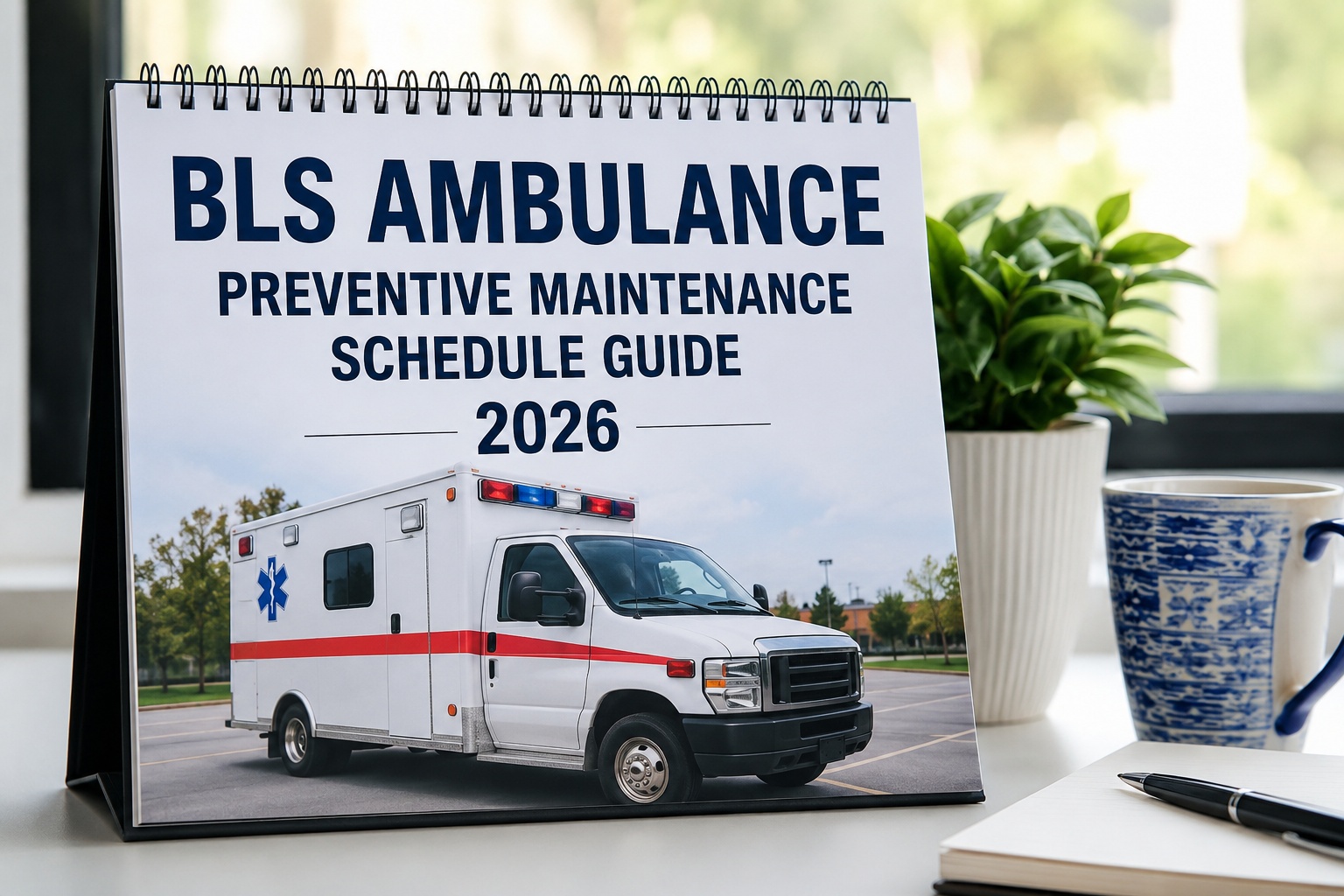
A Type II BLS ambulance doing 60,000 miles a year is not running a passenger-car schedule. The Sprinter 3500, Ford Transit, and Chevy Express vans in your basic life support fleet live in severe-duty territory: stop-and-go city miles, long idle hours while on scene, and weight loads the chassis was never designed to carry empty. Standard OEM service intervals are built for a delivery van doing 15,000 miles a year in light traffic. If you follow those intervals on a BLS ambulance, you are operating with half the protection the drivetrain actually needs. The HVI severe-duty flag cuts OEM intervals in half automatically, so a 7,500-mile oil change becomes 4,000 miles, and a 60,000-mile transmission service becomes 30,000. You can walk through the severe-duty setup on your own units before you commit, but the core idea is simple: a BLS ambulance PM schedule has to match how hard the vehicle actually works, not what the owner's manual says.
What does a 60,000-mile-per-year BLS ambulance actually cost you when the PM interval is wrong?
A single roadside failure on a patient transport van can sideline the unit for three shifts, cost $1,800 in towing and expedited repair, and trigger a complaint during the next DOT audit. The gap between the OEM schedule and severe-duty reality is where that failure lives. HVI closes it by flagging every Type II ambulance as severe duty and halving every interval — automatically, per asset, with no spreadsheet to babysit.
Four numbers that explain why BLS ambulance maintenance breaks budgets
Every figure below is tied to a cost you already pay — in tow bills, downtime hours, audit risk, or premature component replacement. The pattern is the same across municipal, non-emergency, and private EMS operators: the PM schedule is built for light duty, and the van is running heavy.
BLS ambulance PM schedule: OEM standard vs severe-duty reality
This is the interval map a Sprinter 3500, Ford Transit, or Chevy Express ambulance actually needs. The right column is what HVI applies automatically when a unit is flagged severe duty. If your current CMMS or spreadsheet is still using the left column, you are running each van 30,000 miles past its real service point.
| Service Item | OEM Standard | Severe-Duty (HVI) | Failure Mode If Ignored |
|---|---|---|---|
| Engine oil and filter | 7,500 – 10,000 mi | 4,000 mi | Sludge, turbo bearing failure, DPF restriction |
| Transmission fluid and filter | 60,000 mi | 30,000 mi | Clutch pack burnout, torque converter shudder |
| Brake pads, rotors, calipers | 50,000 mi | 25,000 mi | Pad separation, rotor warping, extended stop |
| Transfer case (if applicable) | 60,000 mi | 30,000 mi | Fluid breakdown, chain stretch |
| Differential fluid | 60,000 mi | 30,000 mi | Bearing failure, gear pitting |
| Coolant flush and thermostat | 100,000 mi | 50,000 mi | Overheat, head gasket, EGR cooler failure |
| DPF cleaning and sensor check | As needed | 25,000 mi | Forced regen, turbo backpressure, derate |
| Tire rotation and pressure audit | 7,500 mi | 4,000 mi | Edge wear, blowout risk, TPMS failure |
The transmission interval is where most Type II fleets get hurt. A Sprinter 3500 or Transit 350 carrying 9,000 pounds of converted medical module, equipment, and crew is not the load the 60,000-mile interval was calibrated for. At 45,000 miles, the fluid is already oxidised and the friction material is suspended in it. By 60,000, you are servicing the transmission because it shudders — not because the schedule told you to. See how HVI flags the 30K transmission point automatically so the shop sees it before the driver feels it.
When does a Type II ambulance count as severe duty?
OEM severe-duty criteria are not a suggestion — they are a manufacturer-published service category triggered by operating conditions. If your BLS vans meet any of the four conditions below, the standard interval is already wrong for your fleet, regardless of what the dash reminder says.
Extended idle time
More than 30 minutes of idle per trip hour — common on scene standby, hospital wait, and shift-change idle. Oil degrades by hours, not just miles.
Stop-and-go city operation
More than 50% of miles under 35 mph with frequent braking. Brake pad and rotor life drops by half; transmission fluid temperature stays elevated.
Sustained heavy loading
A converted Type II ambulance module adds 2,500–4,000 pounds of permanent payload. Suspension, tires, and diff fluid all run at their upper limit.
Short-trip cold operation
Trips under 10 miles where the engine never reaches full operating temperature. Fuel dilutes the oil, moisture builds in the crankcase, DPF regen cycles never complete.
What a missed transmission service costs on a Sprinter 3500 ambulance
This is a composite example based on real failure patterns reported by non-emergency and municipal ambulance operators. It is not a single incident — it is the average outcome when a Type II van runs 15,000 miles past the severe-duty transmission interval.
That ratio — a $380 service preventing a $6,400 failure — is the entire argument for a severe-duty BLS ambulance PM schedule. It is also the argument for software that starts flagging these intervals the day you enroll your fleet, instead of waiting for the next breakdown to remind you. The same pattern repeats on brake pads (a $180 pad set catching a rotor before it warps saves a $900 rotor and caliper job) and on DPF cleaning (a $350 service at 25,000 miles prevents a $2,200 forced regen and sensor replacement at 40,000).
How HVI manages BLS ambulance preventive maintenance end to end
HVI is built for fleet-heavy operations that need one platform across trucks, vans, buses, and off-road plant. For a BLS ambulance fleet, four capabilities do the heavy lifting: they turn the severe-duty schedule into automatic alerts, turn paper DVIRs into photo-backed digital records, and turn a roadside defect into a work order before the van is back at the base.
Severe-duty PM scheduling
Flag any Type II van as severe duty and HVI halves every OEM interval automatically — oil at 4K, trans at 30K, brakes at 25K. Alerts fire by date, mileage, or engine hours, with overdue escalation so nothing slips past a busy week.
Digital DVIR with photo capture
Drivers run a pre-trip and post-trip inspection on any phone or tablet, snap photos of defects, and submit. No paper binder, no group-chat photos. Every record is timestamped and audit-ready for DOT, client, and insurance reviews.
Defect-to-work-order in one tap
A defect captured on the roadside becomes a work order the moment it is submitted. The shop foreman sees it, prioritises it, and pulls parts — without a phone call, a text thread, or a re-keyed spreadsheet entry.
Analytics and cost-per-asset
See uptime, PM compliance rate, and cost per ambulance across the whole fleet. Spot the van that is costing triple before it becomes the van that strands a crew on a patient call. You can review the analytics view on a live account before you roll out.
Why the paper DVIR and the shared spreadsheet are costing your BLS fleet
Most non-emergency and muni ambulance fleets still run PM on a wall calendar and DVIR on a clipboard. The cost is not just the paper — it is the gap between what the driver saw and what the shop actually fixed. This comparison shows where the real money leaks.
The status quo
- Driver fills a paper DVIR; it sits in the visor for a week.
- Shop foreman re-keys defects into a spreadsheet at end of shift.
- PM intervals tracked on a wall calendar — no severe-duty multiplier.
- No photo evidence; audit defence is a stack of faded carbon copies.
- Overdue PMs surface when a van breaks down, not when they are due.
The HVI workflow
- Driver runs DVIR on a phone; photos attach to every defect.
- Defects become work orders instantly — no re-keying, no lost notes.
- Severe-duty flag halves every interval automatically, per asset.
- Every record is timestamped and photo-backed, ready for any audit.
- Due and overdue alerts fire before the part fails, not after.
What a correct BLS ambulance PM schedule actually delivers
The point of a severe-duty schedule is not more work for the shop. It is the right work, at the right mile, on the right van — so a $380 service prevents a $6,400 failure instead of the other way around. Here is what changes when the interval matches the duty cycle.
Fewer roadside failures
A Type II van on a 4,000-mile oil cycle and 30,000-mile transmission cycle is far less likely to throw a turbo, a torque converter, or a DPF derate mid-transport. The shop catches wear before it grounds the unit.
Lower cost per asset
Planned services cost a fraction of unplanned ones. The $380 transmission fluid change at 30K is the same job as the $4,200 rebuild at 75K — minus the tow, the downtime, and the lost revenue shift.
Audit-ready compliance
When DOT, a client, or an insurer asks for proof of inspection and PM, every record is in HVI with a timestamp and a photo. No binder, no scramble, no gap between what was scheduled and what was actually done.
One platform, every asset
The same HVI account runs your Type II ambulances, your wheelchair vans, your heavy support trucks, and your shop equipment. One schedule, one parts room, one audit trail — across every site.
If you are running a mixed BLS and non-emergency fleet, the same severe-duty logic applies to your wheelchair van PM and medical transport fleet schedules. You can see the mixed-fleet setup in a 30-minute walkthrough and decide whether the interval map fits your operating conditions before you move a single van off your current system.
We were changing oil on a calendar — every three months, no matter what. Meanwhile a van doing 60,000 miles a year was running 7,500 between services and the turbos were telling us about it. We halved the interval on the Sprinters and Transits, put the DVIR on a phone, and the roadside calls dropped off. The transmission at 30K instead of 60K alone paid for the software the first quarter.