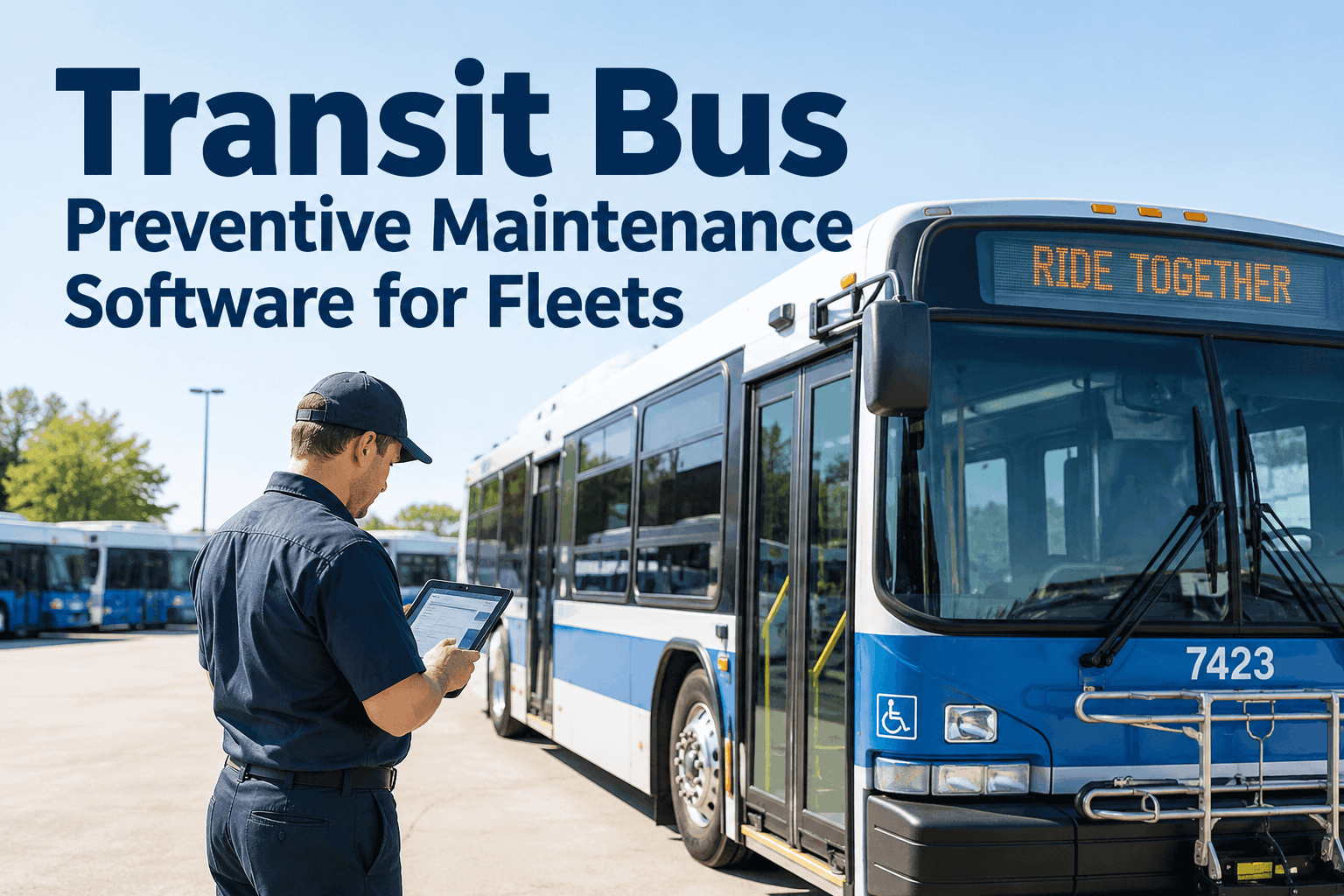
A transit bus has a departure time, and the public is standing at the stop whether the bus shows or not. Miss a preventive maintenance interval and you don't just risk a breakdown — you risk a bus pulled from the morning pull-out, a route running short, and a safety system like a wheelchair lift or a brake that was due for service going one more day. Transit bus preventive maintenance software keeps every bus on its PM program — by mileage, engine hours or calendar — so the fleet is ready when the service clock starts. Book a demo to see transit PM scheduling.
Transit Bus Preventive Maintenance Software That Keeps the Fleet Ready for Pull-Out
Schedule service by mileage, engine hours or calendar, run inspections, and turn defects into work orders — so brakes, doors and wheelchair lifts are in-service-ready before the morning run.
City buses are a hard maintenance case: they idle for hours in traffic so engine hours outrun the odometer, they open and close doors thousands of times a day, and they carry safety and accessibility equipment that is non-negotiable to keep in service. A PM program that treats a bus like a highway truck — miles only — misses most of that. Transit maintenance software has to schedule on the clock that fits each system and prove the safety-critical ones are ready.
The PM program, not a single servicehow transit bus preventive maintenance software runs the A / B / C tiers
Transit fleets don't service a bus all at once — they run a tiered inspection program, each level broader than the last, on mileage intervals set by the agency. The software tracks every bus against each tier and surfaces the next one before it's due.
Set the intervals once from your agency's program and the software counts each bus toward its next PM-A, B or C — the same tiered idea behind a mileage-based 48,000-mile PM Schedule D checklist (fleet reference). Book a demo of A/B/C PM tracking.
The systems a bus can't run withoutwhy transit maintenance software tracks the safety-critical trio closely
Most of a bus can limp. Three systems can't: if the brakes, the doors or the wheelchair lift aren't right, the bus doesn't go into service — and each is both a safety duty and an accessibility obligation. The software gives these their own lines, their own intervals and a hard hold when one fails.
Air system, linings and ABS checked on the PM interval and flagged on any inspection — the one system that ends a bus day instantly.
Thousands of cycles a day. Sensors, seals and interlocks tracked so a door that won't close doesn't strand a run.
An accessibility requirement, not an option. Lift and ramp function tested on schedule, with a defect holding the bus from service.
Every check ties to the bus with a photo on any flag, built on HVI's digital inspection system — and the daily driver side runs the same way as our daily bus inspection checklist. Book a demo of safety-system tracking.
A missed PM is a missing buswhy transit bus maintenance scheduling can't run on a paper board
When a PM slips on a transit fleet, the cost isn't abstract — it walks straight into the morning service. Here's the chain a late inspection sets off, and where the software breaks it.
Firing the PM on time — by whichever of miles, hours or calendar comes first — is exactly what preventive maintenance scheduling is for, and it's the same multi-trigger engine behind public works fleet management across a mixed municipal fleet. Book a demo on your own transit fleet.
The transit bus PM checklistwhat the software runs at each scheduled inspection
When a PM-A, B or C comes due, the technician runs the matching check — safety systems first, then the rest of the bus — with each line tied to the unit, a photo on any flag, and a work order on any fail.
On paper, which buses are due for which tier is a whiteboard someone updates by hand. In the software it's a live list you sort by what's due next. Start a free trial and load this PM check on your fleet this week.
Every bus, its PM statuswhat a transit bus looks like inside the platform
Open any bus and you see both meters, its next PM tier and any open safety defect — so the shop plans the week from the list instead of a whiteboard, and dispatch knows which buses are clear for pull-out.
When the maintenance manager plans labor or reports fleet availability, they sort every bus by PM status and open holds — across the maintenance management workflow and the analytics and reporting dashboard behind it. Book a demo on a bus from your own fleet.
From a transit shop that stopped losing buses at pull-out
Our buses idle half their life in traffic, so going by odometer alone meant the engine-hour services were always running late — and nothing surfaces a late PM like a lift fault at 5am when you have no spare. Once the app tracked each bus on miles and hours against the A/B/C program, the overdue list dried up and the safety holds showed up in the shop the day before, not at the curb. Our pull-out availability has not looked this good in years.
Transit bus PM software FAQs
What is transit bus preventive maintenance software?
Can it schedule by engine hours as well as mileage?
Does it track the PM-A / PM-B / PM-C program?
Does it cover brakes, doors and wheelchair lifts?
How long until it's running on our transit fleet?
Keep every transit bus on its PM program
Transit bus preventive maintenance software should hold each bus to its A/B/C program and prove the safety systems are ready before pull-out. Put scheduling, inspections and work orders on one platform and protect your service.
- Mileage, engine-hour & calendar scheduling
- A / B / C PM program tracking
- Brake, door & lift safety holds
- Pull-out readiness & reporting