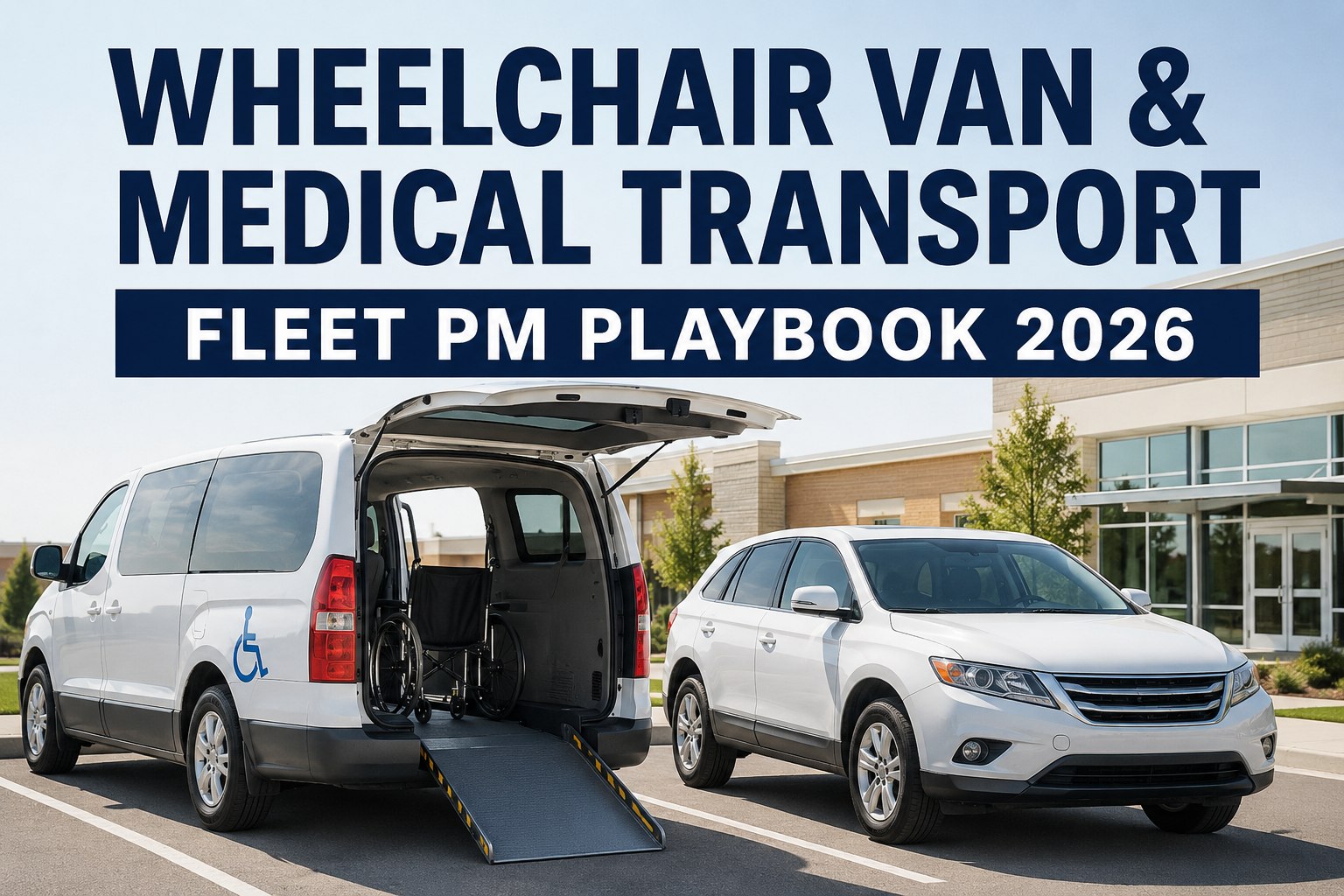
Your 7:15 dialysis pickup is in the lobby, the van is outside, and the wheelchair lift just threw a fault code with a passenger already on the platform. That is the moment every non-emergency medical transport manager dreads, and it is exactly why a dedicated wheelchair van PM program matters more in this sector than in almost any other fleet. NEMT demand has climbed roughly 34% since 2020, your vans run more cycles per day than ever, and the equipment that fails hardest is not the engine — it is the lift, the tie-downs, and the restraints that protect the people you carry. This playbook breaks down the preventive maintenance schedule your wheelchair lifts, securement systems and passenger safety gear actually need in 2026, with the intervals, load tests and records that keep you compliant and on the road. If you want to see how this looks tracked digitally on your own units, you can book a 30-minute walkthrough and we will map it to your fleet.
What does a failed lift cost you at 7 AM on a Monday?
One missed hydraulic check can strand a passenger mid-transfer, trigger a missed dialysis appointment, and put a Medicaid trip log under review. A structured wheelchair van PM plan turns that risk into a 20-minute scheduled task.
The real cost of skipping wheelchair van preventive maintenance
A standard cargo van can limp to the shop. A wheelchair van carrying a passenger to chemotherapy cannot. These four numbers show what is actually at stake when lift and securement PM slips.
Wheelchair lift maintenance intervals: Braun, Ricon and the 800 lb load test
Whether you run Braun UVL under-vehicle lifts or Ricon Klearvue folding platforms, the maintenance rhythm is the same: cycle-based checks layered under calendar-based certification. Here is the schedule that keeps a mobility fleet compliant.
Driver pre-trip lift cycle test
Run the lift through one full deploy-stow cycle empty before the first pickup. Watch for slow travel, jerky motion, roll-stop hesitation, or a handrail that does not lock. Log it as a pass/fail with a photo — a 90-second check that catches most hydraulic and electrical faults before a passenger is on the platform.
Lubrication, wiring and fastener inspection
Grease pivot points per the OEM chart, inspect wiring harnesses for chafe where the platform folds, torque mounting bolts, and check the hydraulic reservoir level. On Braun UVL units pay attention to the slide rails; on Ricon Klearvue units check the fold mechanism and platform sensors.
Hydraulic system check
Inspect hoses for weeping and abrasion, test pump pressure, verify the manual backup pump actually lowers the platform, and check cylinder seals. This is the interval where slow lifts get caught before they become dead lifts. Fleets that schedule these checks in a live demo of HVI stop finding them by passenger complaint.
800 lb load test and lift certification
Load the platform to its rated test weight — 800 lb for most Braun UVL and Ricon Klearvue units — and verify smooth travel, no drift, and full roll-stop function. Record the result, the technician, and the date. This certificate is what brokers, Medicaid auditors and insurers ask for first.
Tie-down anchors, WC-19 compliance and the checks most fleets skip
The lift gets the attention, but the securement system is where liability lives. A WC-19-compliant setup is only as strong as its weakest anchor point, and anchors fatigue silently.
Anchor pull test — annual
Pull-test every floor and wall anchor to WC-19 securement loads once a year. Corrosion under the floor mat and repeated strap tension loosen anchors with no visible sign. Document each anchor point individually, not the van as a whole.
Webbing and retractors — monthly
Check every strap for fraying, cuts, UV fade and contamination. Cycle retractors fully — a retractor that does not lock under a sharp tug is a failed retractor. Replace webbing on condition, not on a calendar, and log the swap.
Occupant belts and shoulder harnesses — monthly
Wheelchair-integrated and vehicle-mounted lap/shoulder belts get the same inspection as securement straps: webbing condition, buckle function, anchor torque. A missing shoulder belt on a WC-19 setup is a compliance gap an auditor will find.
Doors, ramps and interlocks — weekly
Verify the lift interlock prevents driving with the lift deployed, kneel functions lower fully, and manual ramp hinges move freely. Interlock failures are rare and catastrophic — test them every week, not every quarter.
What auditors ask for — and the wheelchair van inspection records that answer them
Medicaid brokers, state NEMT programs, ADA reviews and insurers all ask the same question in different words: prove the equipment was safe on the day of the trip. This mapping shows the record that closes each gap.
| Requirement | What triggers the request | Record that satisfies it | Interval |
|---|---|---|---|
| Lift load certification | Broker credentialing, insurance renewal | 800 lb load-test certificate with technician and date | Annual |
| Hydraulic system integrity | Post-incident review, OEM warranty | 6-month hydraulic inspection with pressure readings | 6 months |
| WC-19 securement compliance | ADA complaint, crash investigation | Anchor pull-test log per anchor point | Annual |
| Daily operational readiness | Missed-trip dispute, passenger injury claim | Timestamped pre-trip lift cycle check with photo | Daily |
| Defect closure | Any audit sampling a reported fault | Work order linking defect report to repair and sign-off | Per event |
The pattern is simple: every requirement maps to a timestamped, photo-backed record. Fleets that start logging wheelchair van inspections free stop rebuilding binders the week before a broker review.
See your lift schedule running on your own units
Book a 30-minute demo and we will build your Braun or Ricon PM plan inside HVI — cycle counters, certification alerts and audit-ready records included.
What one missed hydraulic check actually costs a 12-van NEMT fleet
Run the numbers on a single preventable lift failure and the case for scheduled PM writes itself.
The fix is not more mechanic hours — it is never missing the interval. When the 6-month check fires automatically and the driver’s daily cycle test feeds the same system, the failure simply does not get the chance. You can walk through this exact scenario on a demo call using your own van count and trip volume.
Built for mobility fleets: lift cycles, certifications and proof on demand
PM scheduling by date, mileage or lift cycles
Set the 6-month hydraulic check, annual load test and monthly lubrication once. HVI fires due and overdue alerts per van, so no interval slips because someone changed the spreadsheet.
Digital pre-trip inspections with photos
Drivers run the daily lift cycle test on any phone in under two minutes. A failed item becomes a work order instantly — no paper DVIR, no photo lost in a group chat.
Certification and audit records in seconds
Every 800 lb load test, anchor pull test and repair sign-off is timestamped and photo-backed. When a broker or insurer asks, you pull the record by van and date instead of digging through binders.
Cost and uptime analytics per van
See cost per asset, lift-related downtime and compliance rate across the fleet. Spot the van eating repair budget before it strands a passenger — and prove ROI to ownership with real numbers.
Your 2026 wheelchair van PM playbook, condensed
PM lifts on cycles, not just miles. Daily cycle tests, monthly lubrication, 6-month hydraulic checks and the annual 800 lb load test form the spine of wheelchair van PM — skip one layer and the others cannot compensate.
Securement is a system, not a strap. Annual WC-19 anchor pull tests, monthly webbing checks and weekly interlock tests are what stand between a hard brake and a liability claim.
The record is the product. Brokers, Medicaid programs and insurers pay and renew on proof. Timestamped, photo-backed records turn an audit from a week of panic into a two-minute export.
One failure costs 32x the check that prevents it. A $120 hydraulic inspection versus a $3,850 failure cascade is the whole business case — and a medical transport CMMS makes the inspection impossible to forget. If you are ready to move off paper, set up your first van free and run next week’s pre-trips digitally.
“I used to find out about lift problems from a driver texting me a photo of a fault code at 6:40 in the morning. Now the daily cycle test lands in the system before the van leaves the lot, and I track one number every Friday: lifts down. Last quarter it was zero. The annual load tests used to sneak up on us — two vans expired the same month a broker audited us. Never again.”
Daniel Reyes — Fleet & Safety Manager, 22-van non-emergency medical transport provider
Wheelchair van and NEMT fleet maintenance questions
How often should a wheelchair lift be serviced?
What is the 800 lb wheelchair lift load test?
What does WC-19 require for tie-down anchors?
Can drivers do the daily lift inspection themselves?
How do I prove compliance during a Medicaid broker audit?
Put every lift, anchor and certificate on one schedule
HVI runs your wheelchair van PM on any phone — daily cycle tests, 6-month hydraulic alerts, annual load-test records and audit-ready exports for every van in the fleet.
Free to start — Works on any phone — No card needed