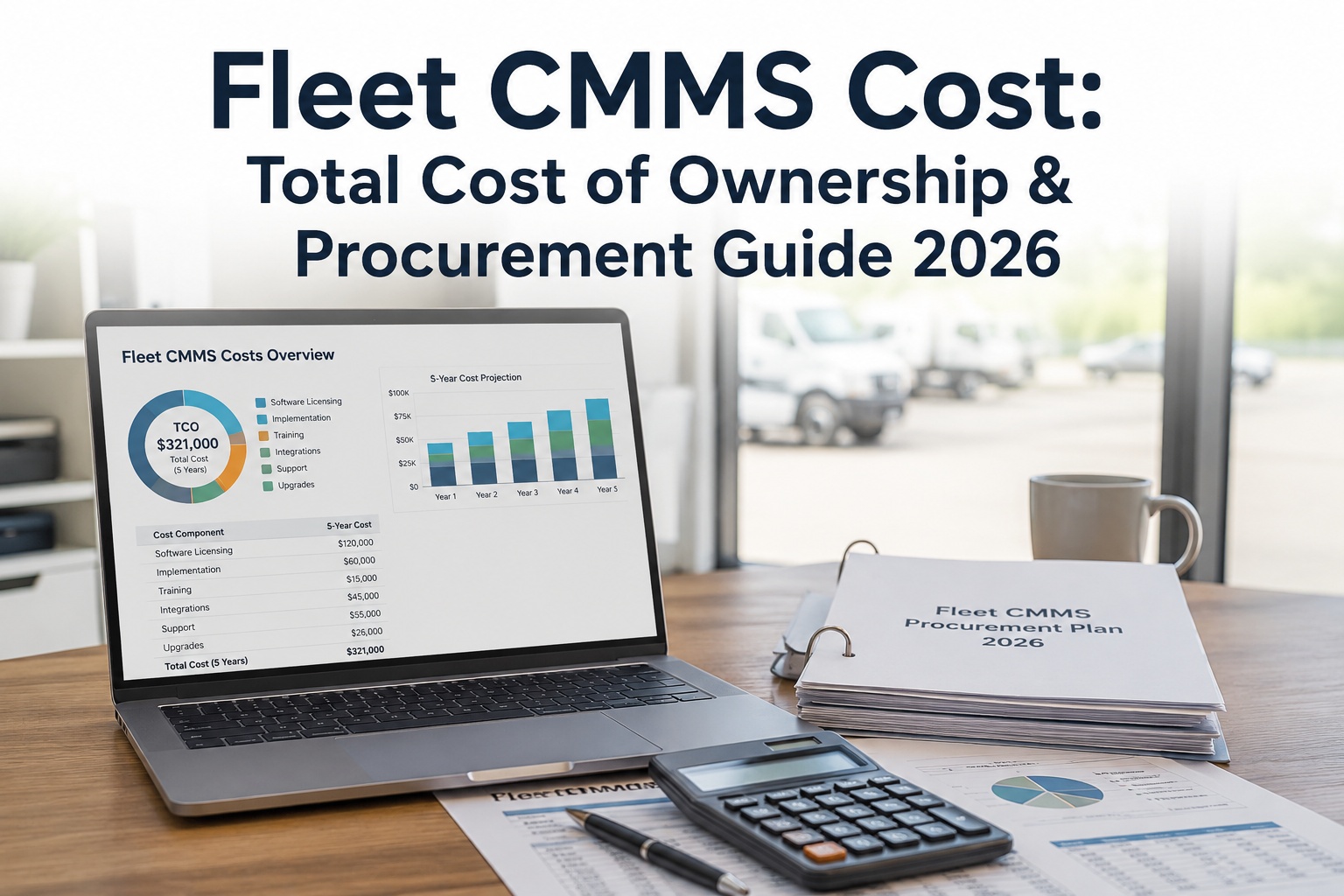
The sticker price on a fleet CMMS quote is roughly 30–40% of what the system will actually cost over five years. The rest sits below the line — implementation, data migration, integrations, training, support tiers, renewal escalators, and internal FTE hours nobody put in the RFP. Fleet CMMS cost is a procurement problem before it's a software problem. This guide breaks TCO into the seven line items every procurement team should model, and lists the RFP questions that separate honest vendors from the rest. Book a demo
Fleet CMMS Cost & 5-Year TCO
Every vendor quotes the subscription. Only some tell you the other 60%. Here's the framework to model both.
Most procurement disappointments follow the same pattern. Vendor A quotes lower per-user than Vendor B, wins the bid, and by month four the change orders have arrived: data migration was scoped at 40 hours and needs 200, the ERP integration is quoted separately, "premium support" is a tier extra, renewal comes with a 12% uplift. The lower quote wasn't lower. It was less complete. The fix is a shared cost framework every vendor answers in the same terms.
The seven cost line items procurement must model
Fleet CMMS cost breaks cleanly into seven categories. A defensible CMMS total cost of ownership model asks every vendor to answer every one — in writing, with assumptions listed. The differences show up on the ones the vendor least wants to itemize.
Swipe horizontally to see all columns on mobile →
| Line item | What it covers | Typical range | Where vendors hide it |
|---|---|---|---|
| 1. Licensing / subscription | Per-user or per-asset recurring fee. Sometimes tiered by module. | $30–$75/user/mo SMB tier; $75–$150 mid; $150+ enterprise | Renewal escalators (10–30%), module unbundling |
| 2. Implementation | Configuration, workflow setup, template building, environment provisioning. | 0.5× to 2× year-1 license; complex setups 3×+ | Scope creep on custom fields, workflows, approval chains |
| 3. Data migration | Moving asset records, PM history, work orders, parts inventory from legacy. | Highly variable; scales with legacy data quality | Charged hourly with no cap; messy data doubles hours |
| 4. Training | Admin, technician, and manager training. Onsite vs. remote. Ongoing enablement. | Bundled hours + per-session add-ons for extra cohorts | Additional hires trigger new training bills |
| 5. Integrations | Telematics, ERP, fuel cards, accounting, GPS, OEM feeds, SSO. | Standard connectors bundled; custom API work billed separately | "Standard" doesn't include your specific ERP version |
| 6. Support & upgrades | Ticket response SLAs, phone support, dedicated CSM, product updates. | Basic often included; premium tiers 15–30% of license | Response-time SLAs only in top tier |
| 7. Internal FTE | System admin, data hygiene, report building, ongoing config, change management. | 0.25 FTE small fleet; 1–2 FTE mid; 3+ FTE enterprise | Never in the vendor quote — but always in the real cost |
Line 7 is the one procurement teams miss most often, and it's the one that shifts the ranking between vendors. A system that requires a dedicated admin FTE to keep clean vs. one that runs on 0.25 FTE is a $60,000–$180,000/year difference in fully-loaded cost that never appears on either vendor's quote. Book a demo to walk through the seven-line model for your fleet
Three 5-year TCO scenarios
The same 100-asset fleet, quoted by three plausible vendor archetypes, can land in three very different 5-year totals. The point of running scenarios isn't precision — it's exposing which vendors carry which risks so procurement can weight bids on TCO rather than year-one price.
Legacy enterprise CMMS
Established brand, heavy implementation, per-module pricing, mandatory annual maintenance fees.
- Yr 1: Highest — heavy implementation load, long onboarding
- Yr 2–5: Sustained license + 15–20% maintenance fee
- Hidden: Custom report add-ons, module upgrades, custom integration bills
- FTE need: 1–2 dedicated admins typical
- Renewal: Escalators locked in, contract length usually 3–5 yr
Cheap starter tool
Low sticker price, thin feature set, limited integrations, upgrade forced within 18–24 months.
- Yr 1: Lowest quoted — the trap that wins the RFP
- Yr 2: Feature gaps force paid add-ons or workarounds
- Yr 2–3: Migration to a real system needed — second implementation cost
- Hidden: The rebuy. Data migration TWICE. Training TWICE.
- Renewal: Steepest per-user increases at tier upgrade
Modern purpose-built fleet CMMS
Mid-range subscription, self-serve implementation option, most integrations bundled, transparent renewal terms.
- Yr 1: Moderate — higher than starter, lower than enterprise
- Yr 2–5: Flat or predictable escalator; feature parity maintained via updates
- Bundled: Standard integrations, mobile access, inspection templates, PM by meter
- FTE need: 0.25–0.5 FTE for a typical mid-sized fleet
- Renewal: Contract flexibility, month-to-month or annual options
Every fleet's actual numbers land somewhere in this triangle. The exercise worth doing before signing anything is modeling all three against your fleet's specific asset count, integration list, and expected user growth over 5 years — and asking each vendor to fill in their assumptions in the same template. Start a free trial to test the workflows before you commit to the contract
The 12 RFP questions that separate honest vendors
Most fleet CMMS RFPs get answered in marketing language. Twelve specific questions force line-item honesty and let procurement compare like-for-like. Ask every vendor. Score every answer.
If it's "market rate" or blank, assume double-digit.
User count, asset count, feature use — get it in writing.
Uncapped hourly is the single biggest overrun risk.
Ask by name. "Standard ERP integration" is not an answer.
If 4-hour response is only in the premium tier, note the delta.
Vendors that low-ball this are the ones you'll need 2 FTE for.
Some vendors double-charge for technician mobile access.
Export format, timeline, cost, retention window.
Bundled hours, then hourly. Get the hourly rate.
Additional cohorts for future hires are usually billable.
Vendors who won't hand over a working environment before RFP close are hiding usability gaps.
If they can only quote year one, the sales team hasn't been trained to answer year five.
Score every answer 1–5, weight the categories, and multiply. The vendor with the best marketing rarely wins on a scored TCO comparison. Book a demo to see HVI's answers to all twelve in one call
Municipal & government procurement notes
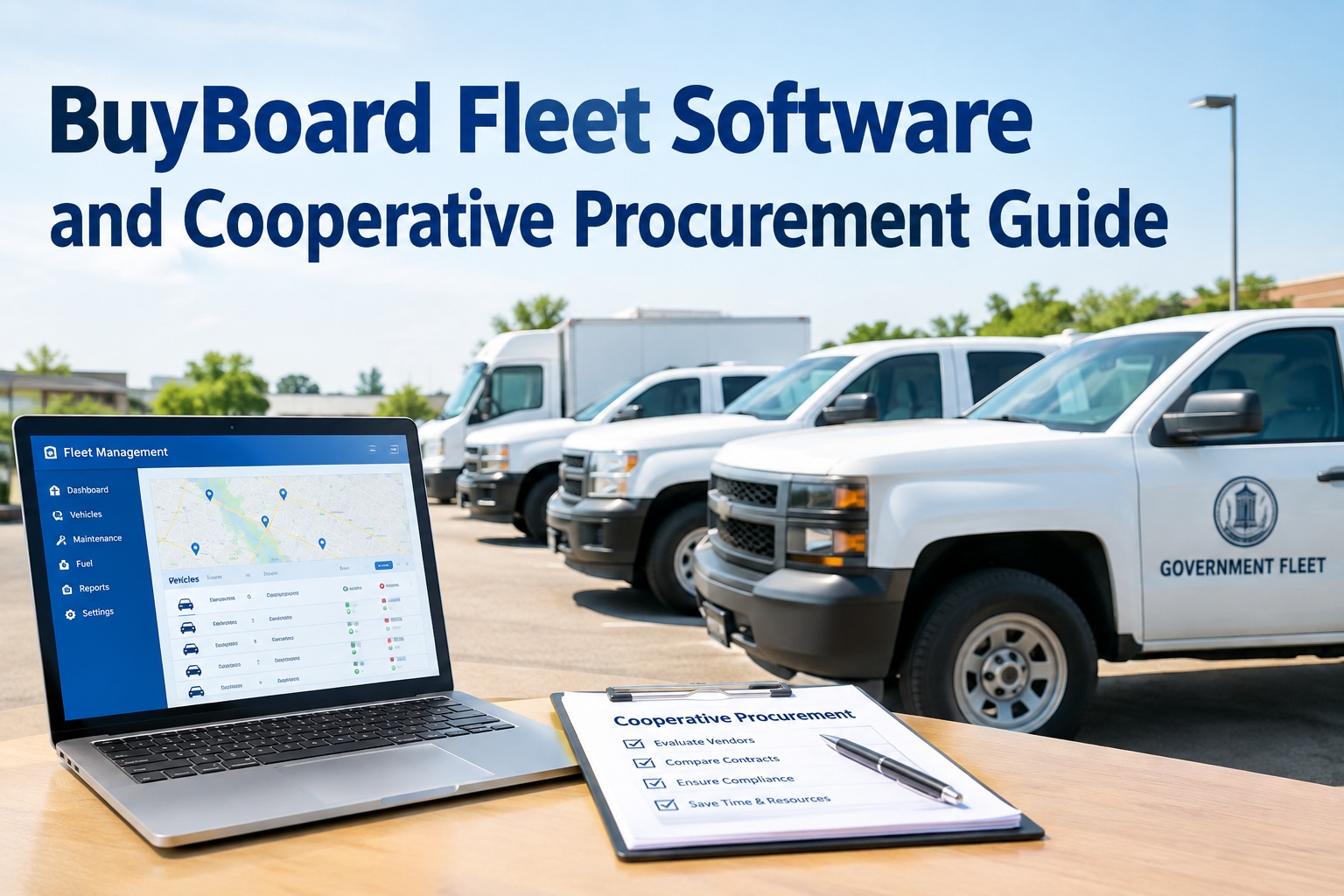
Public-sector fleet CMMS procurement has additional friction: multi-year contract requirements, RFP-only sourcing, cooperative purchasing options (Sourcewell, OMNIA, GSA), and specific data-residency or audit-trail requirements. Three practical notes for municipal, county, and state fleet buyers.
First, favor vendors that publish transparent per-user or per-asset pricing over "call for quote" vendors — the latter almost always price higher for public entities and slower on renewal negotiations. Second, insist on a written 5-year TCO in the RFP response format, not just a subscription quote. Third, verify whether the vendor participates in cooperative purchasing agreements you already have in place — a Sourcewell or GSA schedule vendor can dramatically compress procurement cycle time and remove the need for a full competitive RFP. Book a demo to see how HVI answers these procurement questions , or start free without the procurement cycle.
From a public works fleet director who ran three procurements
Our first CMMS looked cheap in the RFP. Two years in, the "additional module" fees and per-report charges had us at three times the year-one quote — and we still couldn't do half of what we needed. Second procurement, we knew better. We built a 5-year TCO template, made every vendor answer the same 15 questions, and weighted the score. The lowest quoted vendor came in third on TCO.
The lesson wasn't "buy expensive." It was "buy transparent." The vendor that couldn't itemize year 3–5 was the one hiding the cost.
Frequently asked questions
How much does fleet CMMS software cost per user?
Industry-wide, fleet CMMS pricing falls into four broad tiers. Free or starter tools run $0–$30 per user per month and are typically limited by asset count, feature set, or user seats — useful for very small operations but easily outgrown. SMB-oriented CMMS platforms sit at $30–$75 per user per month and cover the essential feature set most small-to-mid fleets need: work orders, PM scheduling, inspections, parts inventory, mobile access. Mid-market CMMS runs $75–$150 per user per month and adds heavier features like multi-site support, advanced reporting, and broader integration options. Enterprise CMMS platforms typically start at $150+ per user per month or use custom pricing tied to modules, sites, and integrations — these are designed for very large, multi-site, compliance-driven operations. The per-user number is only the starting point of total cost — a defensible procurement decision requires modeling implementation, data migration, integration, training, support, and internal FTE cost over 5 years alongside the subscription.
What is included in CMMS total cost of ownership?
A defensible CMMS TCO model covers seven line items. Licensing (recurring subscription per user or per asset, often with tier or module structure). Implementation (configuration, workflow setup, environment provisioning — typically 0.5× to 2× year-one license, sometimes higher for complex enterprises). Data migration (moving asset records, PM history, work orders, and parts inventory from legacy systems — highly variable based on legacy data quality). Training (admin, technician, manager cohorts, plus ongoing enablement for new hires). Integrations (telematics, ERP, fuel cards, accounting, GPS, OEM feeds — some bundled as "standard," others billed separately as custom API work). Support and upgrades (basic ticket support often included, premium tiers with faster SLAs typically 15–30% of license). Internal FTE (system administration, data hygiene, report building, ongoing configuration — ranging from 0.25 FTE for small fleets to 3+ FTE for enterprise operations). The last item is the one procurement teams miss most often, and it's frequently the single largest hidden cost over 5 years.
How do I build a 5-year fleet CMMS TCO model?
Start with five inputs: current annual subscription quote per vendor, vendor's written implementation statement of work (not an estimate), internal IT hourly rate and expected hours to support the system, list of specific integrations needed by name (telematics platform, ERP version, fuel card provider), and projected user growth over 36–60 months. Build a spreadsheet with the seven cost line items as rows and years 1–5 as columns. Run three scenarios: best case (clean data migration, no scope creep), base case (2–3 integration complications, moderate scope creep), and worst case (messy legacy data, one custom integration overrun, one tier upgrade forced by user growth). Add 15–20% contingency to every scenario. Compare vendors on the base case first, and use the worst case to test which vendor's model is most exposed to overruns. The vendor with the lowest year-one quote is very rarely the vendor with the lowest 5-year TCO, and the vendor that refuses to fill in years 3–5 with specifics is usually the vendor whose renewals contain the largest escalators.
What are the biggest hidden costs of fleet CMMS?
Five hidden costs cause the most procurement overruns. First, data migration billed hourly with no cap — messy legacy data can double or triple the quoted hours, and vendors know this. Second, integration surcharges — "standard integrations" often exclude the specific version of your ERP or telematics platform, and the custom API work is billed separately at $150–$300 per hour. Third, tier upgrades triggered by user or asset growth — contracts often specify aggressive escalators when you cross a threshold, and growth is under-modeled at RFP time. Fourth, renewal escalators — annual increases of 10–30% are common in enterprise contracts, and if the escalator isn't locked in writing, it defaults to "market rate" which vendors interpret generously. Fifth, and largest, internal FTE cost — a system that requires a dedicated admin vs. one that runs on 0.25 FTE is a $60,000–$180,000 per year difference in fully-loaded labor cost that never appears on any vendor quote but is very real on the operating budget.
How do municipal and government fleets procure CMMS software?
Public-sector fleet CMMS procurement typically follows one of three paths. First, competitive RFP — the traditional route requiring a formal solicitation, vendor responses, scoring, and award, often taking 3–9 months from RFP release to contract execution. Second, cooperative purchasing agreements — entities like Sourcewell, OMNIA Partners, GSA (federal), and state-level cooperative contracts pre-compete vendors, allowing member agencies to purchase against an existing contract without running a full RFP. This can compress procurement time from months to weeks. Third, sole-source justification — permitted in some jurisdictions when a specific vendor uniquely meets a documented need, though this route requires strong written justification. For all three paths, best practice is to require vendors to submit a written 5-year TCO with year-by-year breakdown as part of their response, alongside references to comparable public-sector deployments and any relevant certifications (SOC 2, StateRAMP for cloud services in some states). Verify data residency, audit trail depth, and export capabilities against the specific requirements of your jurisdiction's records retention rules.
Test the workflows. Then model the cost.
A 5-year TCO model built on hands-on evaluation is far more defensible than one built on vendor spec sheets. HVI gives fleet and procurement teams a working environment for inspections, PM, work orders, parts, and reporting — so the assumptions in the TCO model come from real workflow, not marketing copy. Live in under two weeks.
No credit card · No hardware · Setup in minutes