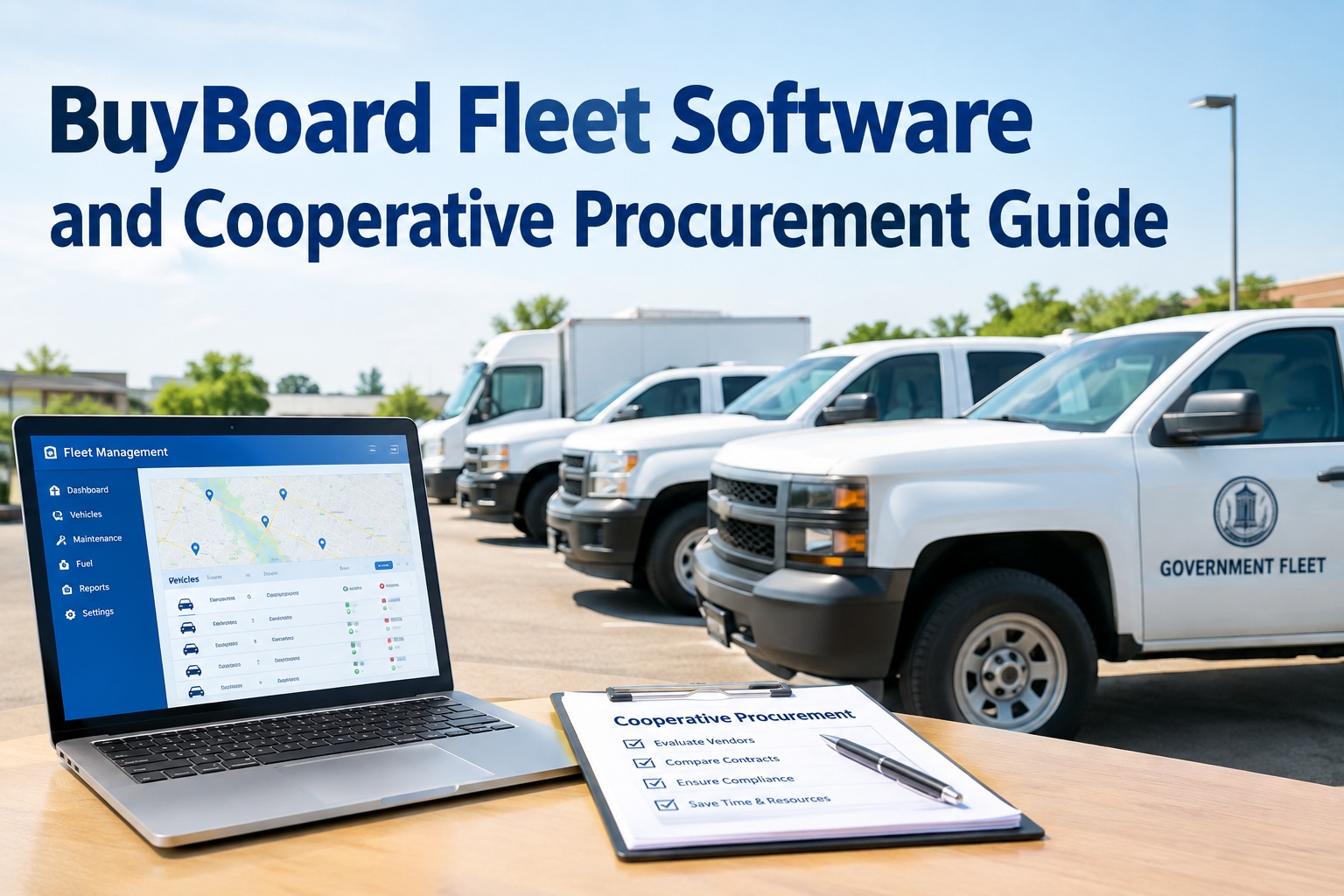
Your fleet still runs maintenance on a spreadsheet, you've found software that fixes it, and procurement says a formal RFP will take the better part of a year. That gap is what cooperative purchasing closes: BuyBoard fleet software procurement lets eligible agencies buy from already-competed contracts instead of running the bid themselves. Book a demo to explore HVI for your fleet.
BuyBoard Fleet Software Procurement: One Path Takes a Year, One Takes Weeks
Both satisfy your competitive-procurement rules. The difference is who runs the bid — you, or the cooperative that already did.
- Write & advertise the RFP
- Vendor Q&A & responses
- Committee scoring
- Award & contract
- Confirm the contract exists
- Evaluate the solution
- Issue a purchase order
- Documented audit trail
Cooperative purchasing doesn't bypass procurement rules — it works within them, using contracts that were already competitively awarded so your agency doesn't run the solicitation again. For government fleet software, that can turn a multi-quarter procurement into a matter of weeks. This guide covers what BuyBoard is, how cooperative procurement satisfies your competitive-bid obligations, what to evaluate in fleet technology whichever path you take, and how the options compare.
BuyBoard is a purchasing cooperative created by the Texas Association of School Boards (TASB) in 1998. It runs competitive solicitations on behalf of its members, so schools, cities, counties and other government entities can buy from already-awarded contracts instead of issuing their own RFP. It includes the Local Government Purchasing Cooperative for Texas entities and the National Purchasing Cooperative for entities elsewhere. Membership is free, and every purchase carries a documented audit trail.
BuyBoard cooperative procurementhow it satisfies your competitive-bid rules without an RFP
Many fleet managers assume skipping their own RFP must mean skipping the rules. It's the opposite. Cooperative purchasing exists precisely so agencies can meet their competitive-procurement obligations — the compliance is done for them, upstream, by the cooperative.
When BuyBoard awards a contract, it has already run a competitive solicitation advertised in accordance with state procurement law. Because that competition happened, a member agency buying from the resulting contract is generally satisfying its own competitive-bid requirement — without preparing, advertising and scoring a fresh RFP.
That's the whole mechanism, and it's why cooperative purchasing has become a mainstream path for government fleet software procurement, including BuyBoard fleet management software contracts. The heavy lifting — the public solicitation, the vendor vetting, the competitive award — is aggregated across thousands of member entities and done once. Your agency inherits the result: a pre-competed contract, a vendor already vetted, and the documentation an auditor or council will ask for. The time saved is real — agencies commonly compress a 6-to-12-month procurement into roughly 30 to 60 days. Book a demo to see what HVI delivers for government fleet management
One caveat that matters: cooperative purchasing is a path, not a rubber stamp. Your agency still has to confirm that its local policy permits cooperative buys, that the specific contract is currently active, and that the solution genuinely fits your needs. Always verify current contract availability directly with the cooperative and the vendor before you rely on it.
Evaluating government fleet softwarewhat to judge before you buy, whatever the procurement path
A cooperative contract shortens the buying, not the choosing. The evaluation still matters — arguably more, because you're moving faster. In fleet CMMS procurement, these are the capabilities that separate a platform built for public fleets from a commercial tool with a government sales page.
Audit-ready records
Every inspection, work order and part must record against the asset with a timestamp, so an audit or public-records request is an export, not a reconstruction. This is table stakes for public accountability.
Mixed-fleet & compliance
Public fleets run everything from sedans to snowplows to fire apparatus. The platform needs configurable templates per asset class and must track DOT, EPA and local compliance on one calendar — not a stretched one-size template.
Cost accountability
Cost-per-asset tracking and department-level allocation so you can defend budgets and replacement requests to elected officials with data, not opinion — and code spend to the right fund.
Mobile & field-ready
Operators and technicians work in yards and on roadsides, not at desks. Inspections and work orders have to run on a phone or tablet and sync when back in range — adoption dies without it.
Run this evaluation before you lean on any contract. The purpose of a cooperative path is to remove the procurement delay, not the diligence — a fast route to the wrong platform is still the wrong platform. The best practice is to see the software against your real asset list first. Start free and put HVI in front of your own fleet data
Fleet software cooperative purchasing vs RFPhow the two government procurement paths compare
Cooperative purchasing isn't always the answer, and a good procurement office weighs the trade-offs. Here's how the main paths for government fleet software procurement stack up against the factors that decide which one fits a given purchase.
| Factor | Cooperative (BuyBoard) | Traditional RFP |
|---|---|---|
| Timeline | ~30–60 days | 6–12 months |
| Competitive bid met | Yes — done upstream | Yes — you run it |
| Admin burden | Low | High |
| Vendor choice | Awarded vendors only | Fully open |
| Custom requirements | Standard offerings | Tailored spec |
| Best when | Vendor already on contract | Highly specialised needs |
Swipe to compare →
The rule of thumb: cooperative purchasing shines for standardised, frequently-bought categories — and fleet software fits that profile — where a fresh RFP adds little beyond delay. A traditional RFP earns its time only when requirements are so specialised that no existing contract covers them. For most agencies replacing a spreadsheet or aging system, the cooperative path is faster and just as defensible. Book a demo to see whether HVI fits your agency's requirements
From a city procurement & fleet lead
We spent almost eleven months on our last software RFP — writing it, advertising it, scoring it, negotiating it. By the time we awarded, two of the shortlisted vendors had changed their pricing and one had been acquired. It was exhausting and half the work was stale by the end.
For the fleet maintenance system we went the cooperative route instead. The competitive piece was already done, so our job was the part that actually matters — making sure the software fit how our shops work. We had it evaluated and on a purchase order inside two months, with a clean audit trail. Same compliance, a fraction of the calendar. I don't know why we'd write an RFP from scratch again for something already on a coop contract.
People also ask
Do I still meet competitive-bid rules if I buy through BuyBoard?
Generally yes. BuyBoard awards its contracts through a competitive solicitation advertised under state procurement law, so buying from one typically satisfies a member agency's competitive-bid requirement. Always confirm your own local policy permits cooperative purchasing first.
Is BuyBoard only for Texas agencies?
No. BuyBoard includes the Local Government Purchasing Cooperative for Texas entities and the National Purchasing Cooperative for government entities elsewhere in the U.S. It was founded by the Texas Association of School Boards but serves members nationally.
How much does BuyBoard membership cost?
Membership is free for eligible government and education entities. There's no purchasing obligation from joining — members use the cooperative's contracts when it makes sense and buy through other paths when it doesn't.
Can I buy fleet management software through a cooperative?
Yes — software and SaaS are common cooperative categories. Whether a specific fleet platform is available depends on which vendors currently hold awarded contracts, so confirm availability directly with the cooperative and the vendor before relying on it.
The takeaway
BuyBoard fleet software procurement lets eligible agencies buy from already-competed contracts, compressing a 6–12 month RFP into roughly 30–60 days — without skipping competitive-bid rules.
Cooperative purchasing satisfies compliance upstream: the solicitation, vetting and award are done once and shared — but you still confirm your local policy, active contract status, and fit.
The path speeds the buying, not the choosing — evaluate any platform for audit-ready records, mixed-fleet compliance, cost accountability and mobile use before you commit.
Cooperative purchasing through BuyBoard turns the slowest part of adopting government fleet software — the procurement itself — into the fastest, without trading away the compliance and documentation public agencies live by. The competitive work is already done; your job is to choose well and confirm the contract fits your rules. Get both right and you can replace an aging system in weeks instead of losing a year to paperwork. Book a demo to explore HVI for your government fleet
Frequently asked questions
What is BuyBoard and how does it work for fleet software?
BuyBoard is a purchasing cooperative created by the Texas Association of School Boards (TASB) in 1998 to help government entities meet procurement obligations more efficiently. It runs competitive solicitations — advertised in accordance with state procurement law — and awards master contracts to vendors. Member agencies can then buy from those already-competed contracts instead of running their own RFP. BuyBoard includes the Local Government Purchasing Cooperative for Texas entities and the National Purchasing Cooperative for government entities elsewhere, and membership is free with no purchasing obligation. Software and SaaS are common cooperative categories, so an agency buying a fleet inspection and maintenance platform may be able to do so through a cooperative contract, provided a vendor currently holds an awarded contract for it. The practical benefit is speed: what might take six to twelve months as a formal RFP can often be completed in roughly 30 to 60 days, while still producing the documented audit trail public procurement requires.
Does cooperative purchasing satisfy competitive-bid requirements?
In most cases, yes — that is the entire point of a purchasing cooperative. When a cooperative like BuyBoard awards a contract, it has already conducted a competitive solicitation advertised under state procurement law. Because that competition took place, a member agency buying from the resulting contract is generally able to satisfy its own competitive-bid requirement without repeating the process. This is why cooperative purchasing works within procurement rules rather than bypassing them: the competition is done upstream and shared across all member entities. It is not automatic, though. Each agency remains responsible for confirming that its local procurement policy explicitly permits cooperative purchasing, that the specific contract is currently active, and that the purchase complies with any local thresholds or approval steps. The competitive-bid compliance travels with the cooperative contract, but the responsibility to verify it applies to your situation stays with your agency.
How much faster is cooperative procurement than an RFP?
The difference is substantial. A traditional Request for Proposal for fleet software typically runs six to twelve months from writing the specification through advertising, vendor responses, committee scoring, and final award. Cooperative purchasing removes the largest and slowest steps — the public solicitation and competitive award — because the cooperative already completed them. That commonly compresses the agency's timeline to roughly 30 to 60 days, since the remaining work is evaluating fit, confirming the contract and local policy, and issuing a purchase order. The time saved matters beyond convenience: a long RFP can go stale, with vendor pricing changing or companies being acquired before the award is made. The speed advantage only materialises if a suitable vendor already holds a cooperative contract and your policy allows cooperative buys, so confirming those two things is the first step.
What should a government fleet look for in fleet management software?
Regardless of how you buy it, several capabilities separate software built for public fleets from a commercial tool with a government sales page. First, audit-ready records: every inspection, work order and part should log against the asset with a timestamp so audits and public-records requests are answered by export, not reconstruction. Second, mixed-fleet and compliance handling: public fleets span sedans, refuse trucks, snowplows and fire apparatus, so the platform needs configurable templates per asset class and the ability to track DOT, EPA and local compliance on one calendar. Third, cost accountability: per-asset cost tracking and department-level allocation to defend budgets to elected officials and code spend to the right fund. Fourth, genuine mobile and offline capability, because operators and technicians work in yards and on roadsides, not at desks, and adoption collapses if the tools don't run on a phone or tablet. Evaluating against these criteria matters most when moving quickly through a cooperative path, since speed removes the procurement delay but not the need to choose the right platform.
Is cooperative purchasing always better than a traditional RFP?
No, it depends on the purchase, and a good procurement office weighs the trade-offs. Cooperative purchasing is strongest for reasonably standardised, frequently-bought categories where a fresh RFP adds little value beyond consuming time, and fleet software generally fits that profile. Its advantages are speed, low administrative burden, and inherited competitive-bid compliance. Its limitations are that you're choosing among vendors who already hold awarded contracts rather than the fully open field, and buying largely standard offerings rather than a spec tailored line by line. A traditional RFP earns its longer timeline when requirements are specialised enough that no existing cooperative contract covers them, or when local policy or purchase size demands a full open competition. For most agencies replacing an aging system or spreadsheet with an established category of software, the cooperative path delivers the same defensibility far faster. The right approach is to check whether a suitable cooperative contract exists first, and reserve the full RFP for cases that truly need it.
See if HVI is the right fleet platform for your agency
However you procure it, the software has to fit how your shops actually work. HVI gives government fleets digital inspections, preventive maintenance, work orders, parts inventory and audit-ready compliance in one connected platform — and we'll walk it through against your real asset list. Explore the fit first; sort the purchasing path second.
No credit card · See it on your own fleet · Confirm contract options with your procurement office