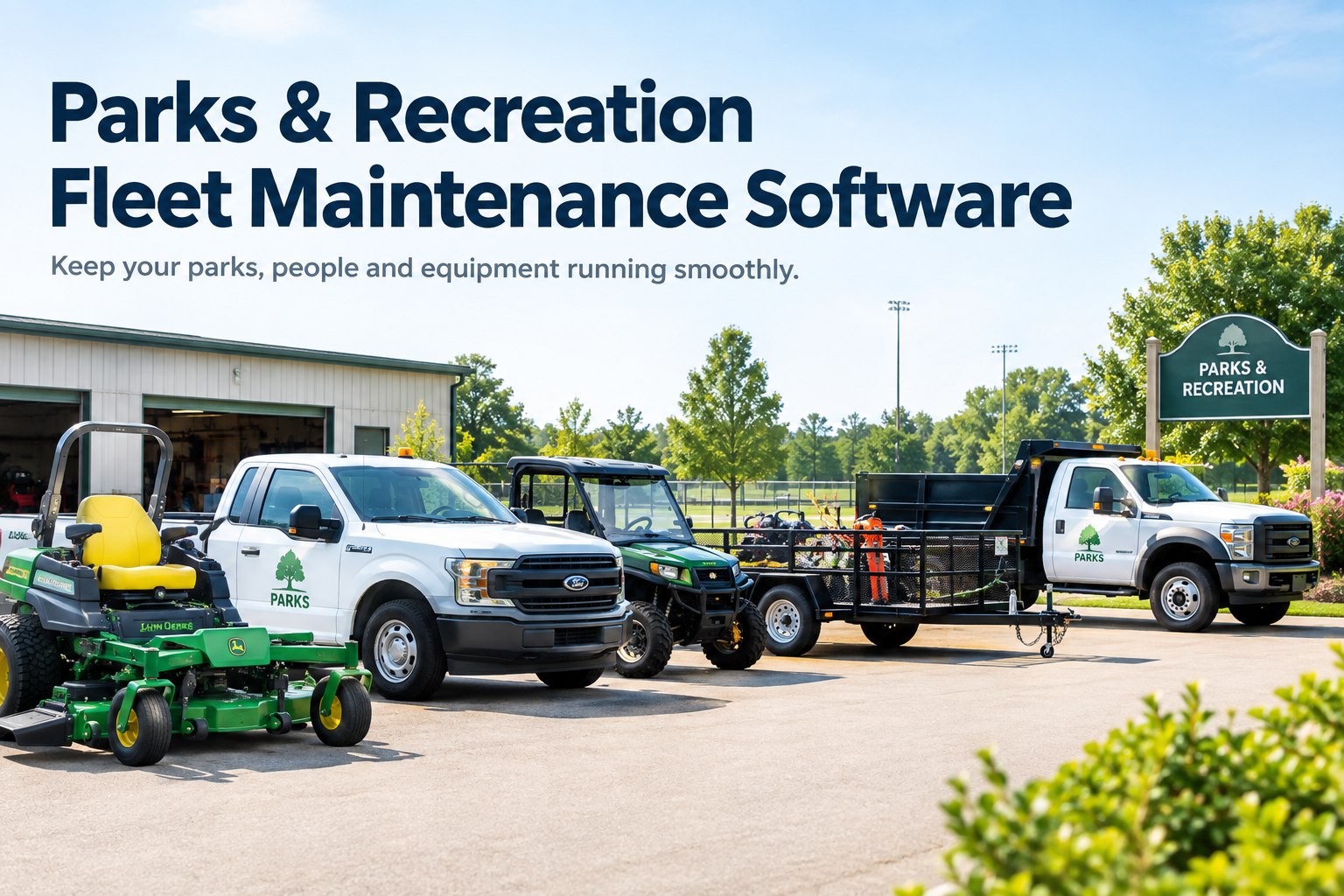
Most fleet software was built to track a few dozen trucks. A parks and recreation department is a different animal: a hundred-plus assets scattered across every park, ballfield, and depot in town — ride-on mowers, tractors, UTVs, trailers, chippers, blowers, and a pile of small equipment that never makes it onto a conventional fleet list at all. Half of it runs on engine hours, not miles, and all of it has one short season to get the year's work done. Parks fleet maintenance software has to handle that spread — every asset, every site, every trigger — in one place. This guide covers what makes it different and how one dashboard pulls it together. Book a demo to see the parks fleet dashboard.
Your assets are scattered across town, and most systems can't see them all
A parks fleet isn't parked in one yard. It's distributed across dozens of sites, mixes road vehicles with grounds equipment, and includes small machines that fall through the cracks of mileage-based systems — until one of them is missing or dead at the start of mowing season.
That spread is the whole challenge of parks and recreation fleet management: diversity of equipment, dispersion across sites, and a season that leaves no room for downtime. The rest of this guide works through each — why hours beat mileage for grounds equipment, how the season drives the calendar, the remote-site and small-equipment problems, and how one dashboard keeps every asset visible wherever it lives.
One department, a whole catalog of asset types
The first thing a parks fleet system has to do is simply hold the variety. A road-vehicle fleet tool built around make/model/odometer chokes on a walk-behind mower or a wood chipper. Each of these classes wears differently, gets inspected differently, and needs its own template — and the small stuff matters as much as the big stuff, because it's the small stuff that goes missing.
Conventional fleet systems quietly ignore the last two or three categories because they don't have a VIN or an odometer — which is exactly how a department loses track of a $600 blower or can't say when a trimmer was last serviced. Every asset, regardless of size, earns a record. Book a demo to see every equipment type on one asset register
Why hours beat mileage for grounds equipment
Here's the trigger problem that trips up road-fleet tools: a mower doesn't have meaningful mileage. It crawls across a field at walking pace for hours, wearing its engine, belts, blades, and hydro system the whole time — while any odometer reading is almost meaningless. For grounds equipment, operating hours are the honest measure of wear.
The fix is to trigger PM on operating hours for mowers, tractors, and grounds equipment, on mileage for road-going utility vehicles and trucks, and on the calendar for seasonal tasks — and to service on whichever trigger comes due first. A single method stretched across the whole fleet either over-services the light machines or runs the heavy ones into failure. Start free and set hour-based PM per machine
The season runs the calendar
A parks fleet lives and dies by the season. Spring and summer are a sprint with no room for downtime — a mower down in peak growing season is fields going uncut and complaints rolling in. The maintenance calendar has to work around that, front-loading service before the rush and using the quiet months for the heavy work.
Recommission stored equipment, sharpen blades, spring startups, and get everything service-ready before the grass takes off.
Full mowing load. Fast turnarounds, hour-based PM firing constantly, defects fixed same-day because a down mower is uncut fields.
Leaf and debris season, final cuts, and the wind-down — catch up on deferred service as the load eases.
Winterize and store, then use the quiet months for major service, so equipment is recommissioned and ready before spring.
The winter shutdown-and-recommission cycle is its own discipline — equipment stored wet or unserviced comes back to a spring emergency. Calendar-based triggers handle the seasonal tasks that don't map to hours or miles at all: winterization, spring startup, blade sharpening before the season. Book a demo to build a seasonal PM calendar
The remote-site and offline reality
Parks crews don't work at a central shop — they're out at a ballfield across town, a trailhead with no signal, a facility miles from the depot. That geography creates two problems a depot-based system ignores: inspections have to happen where the equipment is, often with no connectivity, and assets move between sites in ways the records have to keep up with.
Offline inspection capture
Crews complete pre-use and equipment inspections on a phone or tablet at the site — even with no signal — and the records sync when they're back in range. The check happens where the machine is, not back at a desk from memory.
Asset transfers between sites
A mower moves from one park to another for a big job; a trailer gets reassigned. The record follows the asset, so its location, hours, and service history stay accurate no matter which site it's working from today.
Pre-use operator checks
A quick operator inspection before a machine runs — fluids, blades, guards, hour meter, obvious damage — catches a problem at the site before it becomes a breakdown mid-job or a safety incident.
Without offline capture and per-asset location tracking, remote sites become blind spots: equipment nobody inspected, hours nobody logged, and a service history that's guesswork. The record has to travel with the crew and the machine. Start free and capture inspections offline in the field
Parks as one class in the whole government fleet
A parks department rarely stands alone — it usually shares a garage and a fleet office with public works, police, fire, and other municipal vehicles. The advantage of one platform with configurable templates by asset type is that parks doesn't need its own separate system; it becomes one well-served class in a single fleet operation leadership can see end to end.
That shared-platform approach is exactly how a mixed municipal fleet stays coherent, and we cover the full cross-department picture in our municipal fleet guide. For parks specifically, it means the smallest, most scattered fleet in the government finally gets the same visibility as the trucks. Book a demo to see parks alongside your whole fleet
From a grounds maintenance manager who found the missing machines
Ask me two years ago how many blowers and trimmers we had and I honestly couldn't have told you. The mowers and tractors were on the fleet system; everything smaller lived in operators' heads and a couple of sheds. We'd buy new ones every spring because nobody could find the old ones or knew if they still ran.
Putting every asset — down to the trimmers — on the same system with hour meters and pre-use checks changed the whole operation. Now I know what we own, where it is, and when it was last serviced. The mowers get PM on hours instead of whenever someone remembered, and the crews do their checks on the phone right at the field, no signal needed. Spring startup stopped being a scramble because winter service actually got logged.
Frequently asked questions
Why track engine hours instead of mileage for parks equipment?
Because most parks and grounds equipment doesn't accumulate meaningful mileage — it accumulates operating hours. A ride-on mower crawls across a field at walking pace for hours at a time, wearing its engine, belts, blades, and hydrostatic drive the whole while, but any odometer reading would be tiny and essentially meaningless. The same is true of tractors running a PTO, chippers, and most stationary or slow-moving grounds machines. Operating hours are the honest measure of how hard these assets have worked. The difference is dramatic in practice: a mower used lightly might run about 50 hours in a season while a heavily used identical machine runs 300 hours in the same calendar year, reaching its service threshold roughly six times sooner. A calendar-only or mileage-only schedule treats those two machines the same and either over-services the light one or runs the heavy one well past due into a failure. The right approach is to trigger preventive maintenance on operating hours for mowers, tractors, and grounds equipment; on mileage for road-going utility vehicles and trucks; and on the calendar for purely seasonal tasks — then service each asset on whichever trigger comes due first. That's why parks fleet software needs hour-based PM as a first-class capability, not an afterthought bolted onto a mileage-based tool.
How do you manage equipment spread across many parks and sites?
The key is a system where every asset carries its own record that travels with it, plus the ability to inspect and log work at the site rather than only at a central depot. Parks fleets are inherently distributed — equipment lives at individual parks, ballfields, recreation facilities, depots, and storage sheds, and crews work away from the shop all day. Two capabilities make that manageable. First, offline inspection capture: crews complete pre-use and equipment inspections on a phone or tablet right at the site, even with no cell signal, and the records sync automatically when the device is back in range, so the check happens where the machine is instead of being reconstructed later from memory. Second, per-asset location tracking with asset transfers: when a mower moves from one park to another for a big job, or a trailer gets reassigned, the record follows the asset so its current location, accumulated hours, and full service history stay accurate. Without those, remote sites become blind spots — equipment nobody inspected, hours nobody logged, and a service history that's guesswork. With them, a manager can see every asset across every site in one dashboard regardless of where the crew happens to be working that day, which is what turns a scattered collection of machines into a managed fleet.
How should a parks fleet handle seasonal maintenance?
Seasonal maintenance for a parks fleet works best when the calendar is built around the operating season rather than treated as a flat year, because spring and summer are a high-demand sprint with almost no room for downtime and the quieter months are when heavy service should happen. A practical seasonal cycle has four phases. In spring, the focus is ramp-up: recommissioning stored equipment, sharpening blades, performing spring startups, and getting everything service-ready before the grass starts growing fast. Summer is peak load with fast turnarounds, hour-based PM firing frequently, and defects fixed same-day because a down mower means fields going uncut and public complaints. Fall is transition — leaf and debris season, final cuts, and catching up on deferred service as the workload eases. Winter is shutdown and overhaul: winterizing and storing equipment properly, then using the quiet months for major service so machines are fully recommissioned before spring. The winter shutdown-and-recommission discipline matters more than departments often realize, because equipment stored wet or unserviced comes back to a spring emergency. Calendar-based PM triggers handle the seasonal tasks that don't map to hours or miles — winterization, spring startup, pre-season blade sharpening — while hour-based triggers keep the heavily used machines serviced through the peak. Building that seasonal calendar into the maintenance system, with tasks and assigned crews, keeps seasonal work from falling through the cracks during busy transitions.
Can small equipment like blowers and trimmers be tracked too?
Yes, and tracking the small equipment is often where a parks department gains the most, because it's exactly the category conventional fleet systems ignore. Mileage- and VIN-based fleet tools are built around road vehicles, so they have no natural place for a walk-behind mower, a backpack blower, a string trimmer, or a chainsaw — assets that have no odometer and often no obvious unique identifier. The result is that this equipment lives in operators' heads and scattered sheds, which is how a department loses track of what it owns, can't say when a trimmer was last serviced, and ends up buying replacements every spring because the existing ones can't be found or nobody knows if they still run. A parks fleet system should let every asset be recorded regardless of size or whether it has an odometer, with its own service history, hour meter where applicable, and pre-use checks. That accountability does several things: it establishes what the department actually owns, prevents duplicate purchases, ensures small engines get the seasonal service they need to survive, and surfaces patterns like a specific machine that keeps needing repairs. Treating small equipment as real tracked assets rather than disposable consumables extends their service life and gives the manager an honest inventory — which also matters at budget time and during any audit of municipal assets.
Can parks equipment be managed alongside other municipal vehicles?
Yes, and for most municipalities that's the sensible approach rather than running a standalone parks system. Parks and recreation equipment usually shares a garage and a fleet office with public works, police, fire, and administrative vehicles, and while each of those classes has very different maintenance needs, they don't need separate software — they need one platform with configurable templates by asset type. In that model, mowers and tractors carry hour-based PM and equipment-specific inspection templates, utility vehicles carry mixed hour-and-mileage triggers, trailers carry their own checks, and they sit in the same system as police vehicles with their upfit inspections, fire apparatus with their testing schedules, and public-works trucks with theirs. The benefit for leadership is a single readiness view across every department, with every defect flowing through the same defect-to-work-order-to-readiness loop regardless of which department owns the asset, and consistent service-history and cost records across the whole fleet. For the parks manager specifically, being one well-templated class within a shared platform means the smallest and most geographically scattered fleet in the government finally gets the same visibility, hour-based scheduling, and accountability that the truck fleet has always had — without the department having to justify and maintain a separate tool. It also makes budgeting and audits easier, since parks assets and their costs are recorded the same way as everything else the government owns.
See the parks fleet dashboard in HVI
HVI brings a scattered parks and recreation fleet into one dashboard — every asset type from tractors to trimmers, hour-, mileage-, and calendar-based PM per machine, configurable inspection templates by equipment type, offline inspection capture for crews out in the field, per-asset location and service history, and defect-to-work-order workflows. One platform across parks and every other government department, so the most scattered fleet you run is finally fully visible. Live for your department in days.
No credit card · Every asset type, any location · Onboard in days