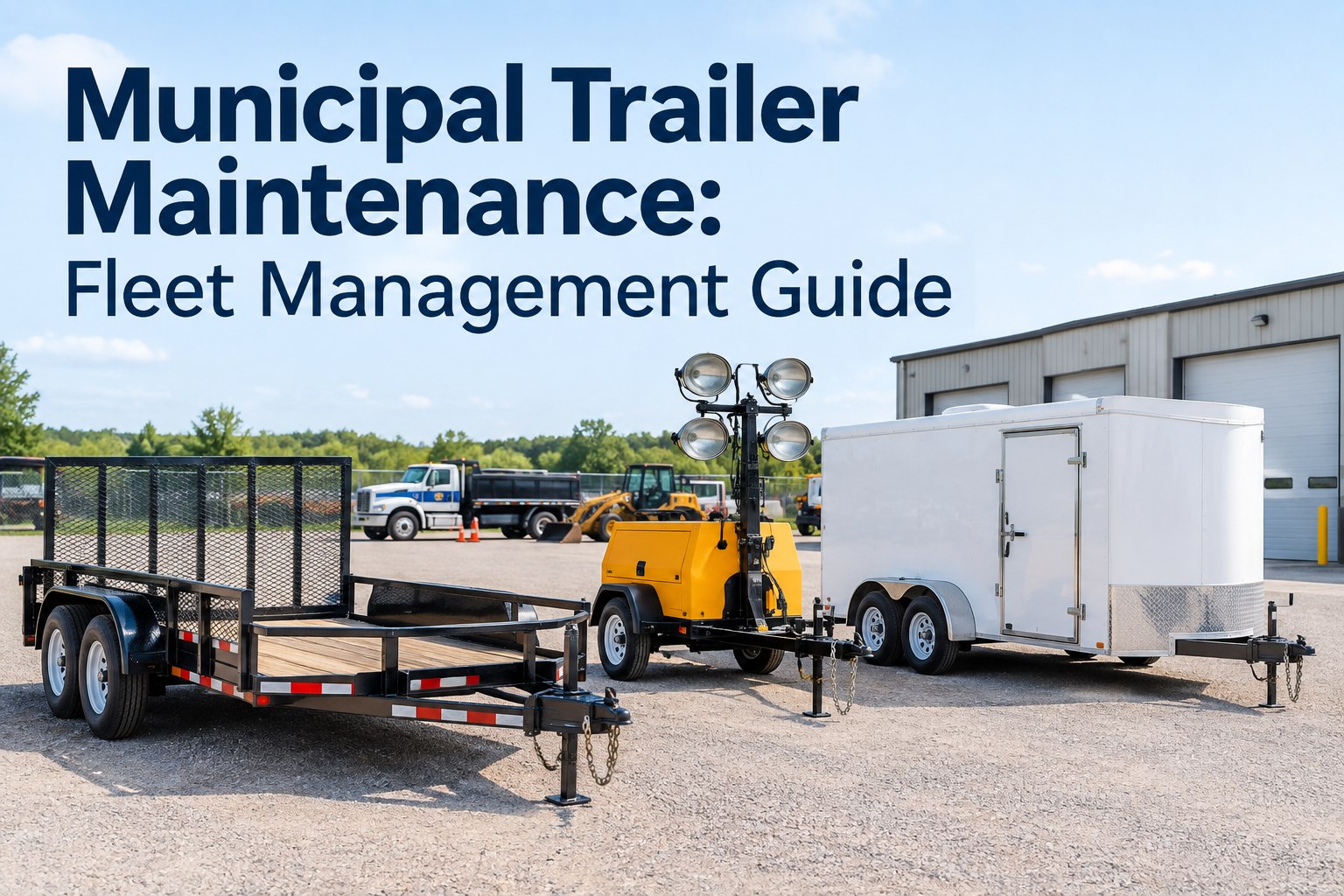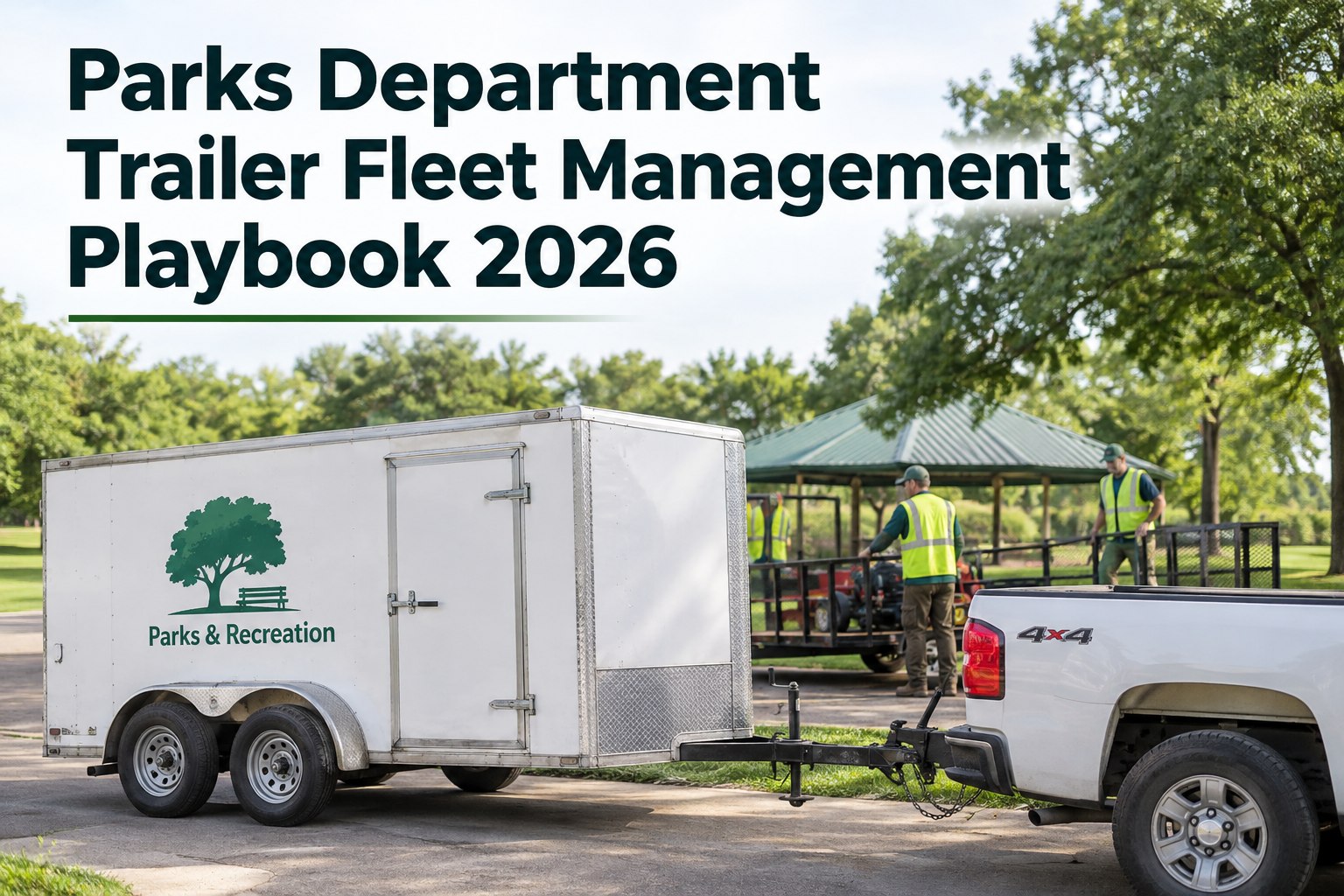
Your parks department trailer fleet is probably the least-documented equipment you own: five to fifteen trailers per yard — mower decks, tool boxes, water tanks, chipper boxes — most of them untitled, unregistered in any system, and invisible until one drops a wheel bearing on the highway with a crew behind it. This playbook gives you the exact PM intervals, the FMCSA §396.3 rule that applies once a trailer crosses 10,000 lbs GVWR, and a QR-tag registry method that turns every trailer into a tracked asset with its own inspection history. If you want to see the registry running on your own units before committing to anything, you can book a 30-minute walkthrough of HVI's trailer module and bring your messiest yard list.
The trailer that fails at 7 AM on a Saturday was telling you for months.
Wheel bearings run dry, brake shoes wear past the rivets, and tires age out on the date code — all silently, because nobody owns the trailer list. Here is the registry, the inspection rhythm, and the PM schedule that catches it early.
Four numbers every parks trailer fleet manager should know
These are not scare statistics. Each one maps to a line item in your budget or a phone call you have already taken.
Does DOT trailer inspection apply to government fleets?
The most common misconception in municipal shops: "we're a city department, FMCSA doesn't touch us." It depends on weight and use, not on who signs the paycheck.
§396.3 applies when
- Trailer GVWR exceeds 10,000 lbs and it runs in interstate commerce or is part of a CMV combination
- Your state has adopted FMCSR for intrastate municipal operations — most have, fully or partially
- The trailer hauls equipment to a job that crosses a state line, even once a year
- A grant, contract, or interagency agreement requires DOT-compliant maintenance records
What §396.3 actually demands
- A systematic inspection, repair and maintenance program — written or digital, not verbal
- Records kept for every unit under your control, retained while you own it plus 6 months after
- Proof of inspection means: date, unit ID, what was checked, what was fixed, who signed it
- Roadside inspectors can ask for it; so can your city attorney after an incident
Even where a small tag-along mower trailer falls under the threshold, the liability standard after a highway failure does not. If a bearing seizes and the trailer crosses the center line, "we had no system" is the worst sentence in the room. A defensible record is the whole game — and it is exactly what a guided demo of HVI's inspection log will show you producing in under a minute per trailer.
Trailer wheel bearing PM and the three-interval schedule
Trailers fail on a calendar, not on mileage. They sit for months, then get dragged 40 miles behind a crew cab. This schedule is built for that reality.
| Component | Interval | What you check | What it costs if skipped |
|---|---|---|---|
| Wheel bearings | Repack every 12 months | Grease condition, seal leaks, play at the hub, race scoring | Seized hub on the road: tow, axle damage, lost crew day — often $800–$2,500 all-in |
| Brake shoes / pads | Inspect annually; expect service near 50,000 miles of tow | Lining thickness, magnet wear on electric brakes, drum scoring, breakaway battery | Metal-on-metal ruins drums; a trailer with no brakes behind a loaded mower is a runaway |
| Tires | Replace at 6 years by DOT date code, regardless of tread | Date code on sidewall, sidewall cracking, uneven wear from axle alignment | Aged tires delaminate at highway speed; tread separation takes fenders and wiring with it |
| Lights & wiring | Every pre-use check | All lamps, connector corrosion, ground wire, breakaway switch cable | Top source of roadside stops for utility trailers; also the cheapest fix on this list |
| Coupler, chains & jack | Every pre-use check; lube monthly in season | Coupler latch wear, chain rating and hooks, jack operation, safety pin | Coupler failure at speed is the single worst trailer incident — uninsurable and unforgivable |
The pattern to notice: three of these five items are calendar-based. A mileage-triggered system alone will never fire on a trailer that moved 300 miles all year. You need date-based preventive maintenance with due and overdue alerts — the kind you can set up free in HVI for every trailer in the yard in one sitting.
Building a municipal trailer registry in one week
You do not need titles or VINs to start. You need an ID, a tag, and a first inspection. Here is the five-day sequence parks crews actually finish.
Count and ID everything with a coupler
Walk every yard, satellite site and pump station. Assign each trailer a simple asset ID — PARKS-T-01, PARKS-T-02. Record what exists: plate if any, VIN if any, axle count, GVWR from the tongue sticker, what it hauls. Most departments find two or three trailers nobody remembered.
Tag each trailer with a QR code
Print weatherproof QR labels and mount one on the tongue and one inside the toolbox lid. In HVI each code opens that trailer's profile: photos, specs, open defects, full service history. No app login hunting, no binder — scan and you are looking at the unit.
Run the baseline inspection on every unit
One technician, one checklist, one trailer at a time: bearings for play, brakes, tire date codes, lights, coupler, deck and welds. Photograph every defect inside the inspection so it is timestamped and attached to the unit. This first pass usually surfaces 20–30% of the fleet needing work — that is normal, and it is the point.
Convert defects into work orders
Every flagged item becomes a work order with a priority: safety-critical (lights, brakes, coupler) this week; wear items (tires near date limit, dry bearings) this month. Parts get reserved against the order so the bearing kit is on the shelf before the trailer comes in.
Set the recurring PM triggers
Load the schedule from the table above: 12-month bearing repack, annual brake inspection, tire date-code watch, monthly in-season lube. HVI fires due and overdue alerts to the shop foreman automatically — the calendar now owns the follow-up, not someone's memory.
A crew of two can finish a 12-trailer yard inside the week, and the system runs itself from there. If you want the checklist templates pre-loaded rather than building them from scratch, ask for the municipal trailer template pack during your demo.
What one seized bearing actually costs a parks department
Run the math on a single failure — a 14-foot equipment trailer hauling a zero-turn mower, bearing seizes 25 miles from the yard on a Saturday event setup.
A 49:1 cost ratio on the cheapest PM task in your shop. Multiply it by the two or three roadside trailer calls most yards take each season and the registry pays for itself before summer.
HVI turns your trailer fleet from invisible to audit-ready
QR-tagged trailer registry
Every trailer gets an ID, photos, specs and a scannable tag. Any supervisor or contractor opens the full record from a phone in 3 seconds — no binder, no login hunt. Outcome: zero untracked units after week one.
Date-based PM that fires itself
Bearing repacks, brake inspections and tire date-code limits run on the calendar with due and overdue alerts to the foreman. Outcome: the 12-month repack stops depending on anyone's memory.
Photo-backed inspection log
Digital checklists with defect photos, timestamps and signatures create the systematic record §396.3 and your city attorney both want to see. Outcome: any audit request answered in seconds, not a weekend of paper digging.
Defect-to-work-order in one tap
A failed light or worn coupler flagged on inspection becomes a work order with parts reserved — no text-message photos lost in a group chat. Outcome: defects close in days, and nothing safety-critical rides to the next event.
See your own trailer list running in HVI
Bring your yard count to a 30-minute demo — we will load one of your trailers live and show the registry, the PM alerts and the inspection log end to end.
The parks trailer calendar: what to do and when
Trailer work clusters around the mowing season. Schedule against the calendar below and the shop stops getting ambushed in April.
Early spring — wake-up inspection
Full checklist on every unit before first mow: bearings for play and seal weep, tire pressures and date codes, lights after winter corrosion, breakaway batteries charged and tested. This is the highest-value inspection of the year.
In season — monthly lube and lights
Coupler and jack lube, connector dielectric grease, quick lamp walk-around. Crews run a 3-minute pre-use scan-and-check on the QR tag each morning the trailer rolls.
Mid season — brake and tire deep check
Pull drums on braked axles, measure linings, check magnet wear, look for uneven tire wear that signals axle alignment or overload. Catch it in July, not on the October highway run.
Late fall — bearing repack and winterize
The annual repack lands here for most yards: clean, inspect, repack, new seals. Wash and photograph decks and welds, log hours, park on boards, and close the year's record on every unit.
Load these four seasonal blocks as recurring schedules and the calendar enforces itself. Most managers who walk through the seasonal setup on a demo call have it configured before the call ends.
The parks trailer playbook in five lines
Your parks trailer fleet is a real fleet: 5–15 units per yard with real failure modes, and it deserves the same registry discipline as your trucks.
FMCSA §396.3 applies over 10,000 lbs GVWR — but the liability standard applies to every trailer you own, titled or not.
Three intervals prevent most roadside failures: 12-month bearing repack, annual brake inspection with 50,000-mile service expectations, and 6-year tire date-code replacement.
One seized bearing costs roughly 49 times the repack that prevents it. The registry pays for itself on the first avoided tow.
A QR tag, a baseline inspection and four seasonal PM blocks — one week of setup, and the calendar owns the follow-up forever. You can start your trailer registry free today and tag the first yard this week.
I inherited eleven trailers and a spreadsheet with four of them on it. The one that ate a bearing on Route 9 wasn't even on the sheet. Now my rule is simple: no QR tag, it doesn't leave the yard. I check the overdue report every Monday with my coffee — it takes two minutes, and last season we had zero roadside calls for the first time in six years.
Marcus Delaney — Fleet & Maintenance Supervisor, municipal parks and recreation department
Parks trailer fleet FAQs
Do municipal and parks trailers really fall under DOT inspection rules?
How often should trailer wheel bearings be repacked?
Our trailers have no titles or VINs. Can we still register them in a system?
How do I track trailer tires that barely wear but still need replacing?
What records should I be able to produce if a trailer is in a road incident?
Tag your first trailer this week
Start the registry free, or book a 30-minute demo and watch one of your own units go from invisible to fully tracked — QR tag, PM schedule, inspection log and all.
Free to start — Works on any phone — No card needed