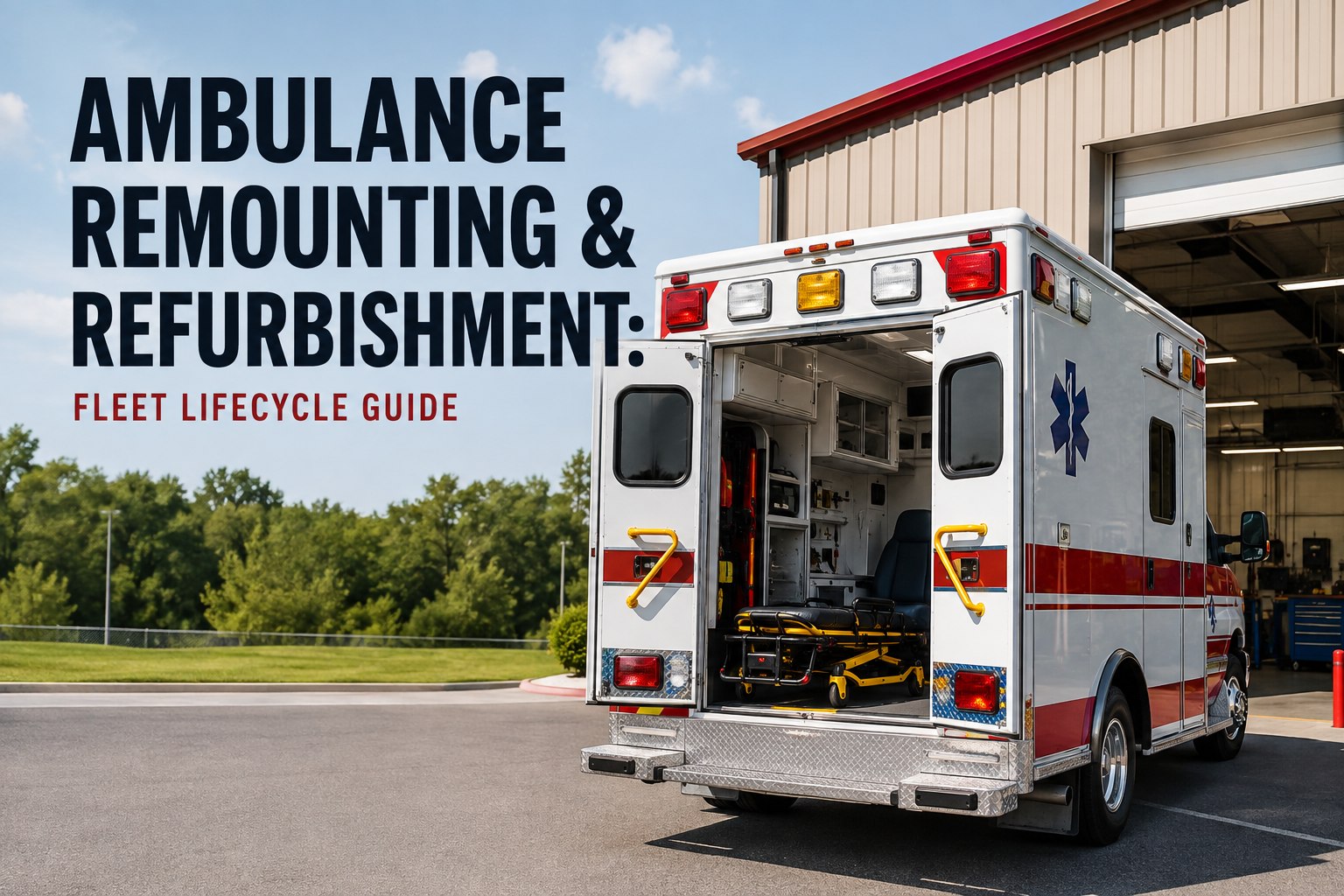
The chassis on your Type III unit has 320,000 hard miles on it, the cab is rusting through, and the shop foreman is telling you the front end is loose again — but the module box sitting on top of that worn-out chassis still has another decade of useful life in it. That mismatch is the core problem ambulance remounting solves, and it is why more EMS operations are rebuilding and rechassising instead of writing a $250,000 check for a brand-new unit. A properly executed ambulance refurbishment extends your medic module lifecycle to 15–20 years, costs $60,000–$90,000 less than a new build, and lets you bring the box up to current NFPA 1917 standards in the process. The hard part is not the mechanical work — it is tracking which module is on which chassis, how many times it has been remounted, and whether its safety systems still meet code. If that information is spread across paper folders and spreadsheet tabs, you can see how HVI tracks module life and remount history on a live demo before the next capital planning cycle starts.
FLEET LIFECYCLE & CAPITAL PLANNING
Stop retiring modules that still have 10 years of life left
Your ambulance box outlasts its chassis by a factor of three. A structured remount program captures that value, but only if you track the asset data that justifies the rebuild. HVI gives you the module-level history, remount counts, and compliance status you need to make the call with confidence.
THE NUMBERS THAT DRIVE THE DECISION
What ambulance remounting actually costs and saves
Every capital planning conversation about an EMS fleet replacement comes down to four numbers. When you put them side by side, the case for remounting over new-build writes itself — provided you have the data to prove the module is worth keeping.
MODULE vs CHASSIS LIFECYCLE
Why ambulance chassis replacement outpaces the box
The fundamental mismatch in EMS fleet replacement is that the chassis wears out three times faster than the module bolted to it. The cab takes the road abuse, the engine racks up hours, and the drivetrain components hit their service limits — while the patient compartment, cabinet framework, and electrical systems sit above the wear zone. Understanding this ratio is what separates a fleet that remounts strategically from one that buys new every six years and wonders where the capital budget went.
If you are not tracking module ID and remount count in a central system, you are almost certainly scrapping boxes that have another full lifecycle left in them — or worse, remounting a module that should have been retired because you cannot prove its structural history. You can walk through the module tracking workflow on your own units with a quick HVI demo and see exactly what data you are missing today.
REMOUNT PROCESS WORKFLOW
How an ambulance refurbishment program works end to end
A defensible ambulance lifecycle policy follows a structured sequence. Skip a step and you either overspend on a box that should have been retired, or you send a structurally questionable module back into service. Here is the workflow that protects both the patient and the capital budget.
Pull the module history
Retrieve the full lifecycle record: original build date, current remount count, structural inspection findings, NFPA 1917 or KKK-A-1822 compliance status, and cumulative repair costs. If you cannot pull this in one report, the decision is already a guess.
Structural and systems assessment
Inspect the module floor, sidewall framing, roof, and partition for corrosion, cracks, and impact damage. Test the 12V and 120V electrical systems, verify the HVAC load, and check the oxygen system for leaks. This determines whether the box is a remount candidate or a write-off.
Chassis selection and preparation
Source a new or low-mileage chassis that matches the module's wheelbase and mounting geometry. Strip the old chassis, prepare the new cab and frame, and confirm the GVWR can handle the loaded module weight — including all equipment and crew.
Remount and code update
Lift the module, mate it to the new chassis, and use the opportunity to update to the current NFPA 1917 standard — whether that means new patient restraints, upgraded electrical load testing, revised exterior lighting, or slick-surface compliance. Document every change with photos and timestamps.
Recommission and log
Complete a full post-remount inspection, verify all systems, and re-enter the unit into service with an updated asset record. The new chassis VIN, remount date, updated compliance status, and next PM interval should all live in one place — not in a three-ring binder in the shop office.
COMPLIANCE AT REMOUNT
KKK-A-1822 vs NFPA 1917: what changes at remount time
Most modules on the road today were built under the older KKK-A-1822 federal specification. When you remount, you have a window to bring that box up to the current NFPA 1917 standard — and in many jurisdictions, you are required to. The table below maps the key areas where the two standards diverge and what a remount shop needs to address.
| System or Area | KKK-A-1822 (Legacy) | NFPA 1917 (Current) | Action at Remount |
|---|---|---|---|
| Patient Restraints | General cot securing requirements | Specific load testing, updated hardware standards, crash-tested retention | Upgrade cot mount and retest |
| Electrical System Testing | Basic continuity and load checks | Full electrical load test, alternator output verification, specific wire sizing | Run complete electrical load test |
| Exterior Lighting | Opticom and warning light placement generalities | Defined zones, specific photometric requirements, reduced light scatter | Reposition and recertify warning package |
| Interior Surfaces | Cleanable surfaces required | Slick-surface standards, specific material requirements, seam sealing | Replace porous materials, reseal seams |
| HVAC Performance | Temperature differential baseline | Specific performance testing, airflow measurement, documented cooling capacity | Test and document HVAC output |
| Equipment Mounting | Secure mounting, general load | Specific G-force load ratings, documented crash performance | Remount and retest cabinet hardware |
If your current inspection process does not capture these compliance checkpoints with photo evidence, you are carrying audit risk every time a unit goes back in service. You can start logging remount compliance inspections free with an HVI account and build the audit trail before the next fleet review.
WHEN TO REMOUNT vs REPLACE
The remount decision: a four-factor checklist
Not every module deserves a second chassis. Before you commit $90,000 to $140,000 to a remount, run the box through this checklist. If you cannot answer these four questions with documented data, you are making a capital decision on gut feel — and that is how operations end up remounting a module that corrodes through in two years.
Remount if: module is under 15 years old
The box has not hit the structural fatigue wall yet. Aluminum framework this age typically has another full chassis lifecycle left if corrosion is surface-level and confined to known problem areas.
Remount if: cumulative repair costs are low
Lifetime module repair spend is under 30% of remount cost. If you have been patching the same electrical gremlins and resealing the same roof leaks for three years, the box is telling you something.
Replace if: structural corrosion is advanced
Floor plan or sidewall framing shows structural rust through, cracked welds at stress points, or delamination. A remount on a compromised frame is a liability, not a savings.
Replace if: module layout is operationally obsolete
The configuration no longer matches your clinical workflow, equipment has outgrown the cabinet space, or the box cannot accommodate current cot and restraint systems without a full rebuild.
Track every module, every remount, every compliance update in one place
See how HVI maps your ambulance remount history, NFPA 1917 status, and capital planning data into a single dashboard — book a 30-minute demo on your own fleet.
AMBULANCE TOTAL COST OF OWNERSHIP
A worked example: remount vs new build over 20 years
Take a 20-truck EMS fleet running Type III units. A new ambulance today runs roughly $230,000 to $280,000 depending on spec. A remount — new chassis, module refurbishment, and NFPA 1917 code update — runs $90,000 to $150,000. The numbers below illustrate the lifetime math on a single asset across two chassis cycles.
Buy new, replace at year 12
Buy new, remount at year 7
That is roughly $133,000 saved per unit over 20 years — and on a 20-truck fleet, the difference compounds to over $2.6 million in capital that stays in your budget instead of going to the truck dealer. The catch is that you can only capture this margin if you have the data to prove a module is worth remounting and the documentation to show it was done to code. If you want to see how that looks on a live dashboard, book a walkthrough and we will set it up with your own asset list.
HOW HVI HELPS
HVI for ambulance remount and module lifecycle tracking
HVI gives you the asset-level data structure that paper binders and spreadsheets cannot. Every module gets a unique ID tied to its current chassis, its remount count, its compliance status, and its full maintenance history — accessible from any phone or tablet in the yard, at the shop, or in the field. Here is what that looks like in practice.
Module ID and remount count tracking
Every module carries a permanent record that follows it across chassis. You see the original build date, current chassis VIN, number of remounts, and cumulative service hours in one view — so the remount decision is based on data, not memory.
NFPA 1917 and KKK-A-1822 compliance status
Digital inspection checklists capture every compliance checkpoint at remount — patient restraints, electrical load tests, lighting zones, slick surfaces — with photo evidence and timestamps. When the auditor asks, you pull it up in seconds.
Preventive maintenance by engine hours and mileage
Schedule PM on the new chassis by date, mileage, or engine hours with automatic due and overdue alerts. No more missed oil changes on a low-mileage chassis that racks up idle hours waiting at the hospital bay.
Capital planning analytics and cost-per-asset
Run a report that shows lifetime repair cost per module, depreciation curve, and remount ROI side by side. The numbers that justify your next capital request are already calculated and exportable — not buried in a spreadsheet only one person understands.
Whether you run a 6-truck county EMS operation or a 60-unit private service across multiple sites, the principle is the same: you cannot manage a 20-year module lifecycle with a 6-month memory. If you want to start building your module tracking database free with an HVI account, the setup takes less than an afternoon and works on the phones your team already carries.
KEY TAKEAWAYS
What to act on this quarter
Tag every module with a permanent ID and log its current chassis, remount count, and build date. If that data lives in one person's head, your capital plan is one retirement notice away from collapse.
Pull lifetime repair costs per module before the next remount decision. A box that has consumed 40% of its replacement cost in patches over three years is not a remount candidate — it is a lesson.
Build a compliance checkpoint list for every remount that maps KKK-A-1822 legacy items to NFPA 1917 current requirements, and photograph each one as it is completed.
Run a 20-year total cost of ownership comparison on your next three replacement candidates. The remount math usually wins by six figures per unit — but only if the data supports it.
Move the whole record off paper and spreadsheets before the next audit cycle. Photo-backed, timestamped digital records are what separate a defensible fleet from an exposed one.
"The thing that killed us wasn't the cost of the remount — it was not knowing which boxes had already been remounted twice. We pulled a module off a chassis last year, sent it to the shop, and the foreman called back saying the floor was gone. If we'd had the history in front of us, we'd have scrapped it and ordered new instead of spending forty grand to find out it was junk."
FREQUENTLY ASKED QUESTIONS
Ambulance remounting and refurbishment: common questions
How much does an ambulance remount cost compared to buying new?
How many times can an ambulance module be remounted?
Does an ambulance remount require NFPA 1917 compliance updates?
What is the difference between KKK-A-1822 and NFPA 1917 for ambulances?
How do I track ambulance module lifecycle and remount history?
Book a 30-minute demo and see HVI on your own fleet
Bring your module list, your chassis VINs, and your compliance questions. We will show you how the tracking, inspection, and capital planning tools work on real assets — not a generic demo environment.
Free to start · Works on any phone · No card needed