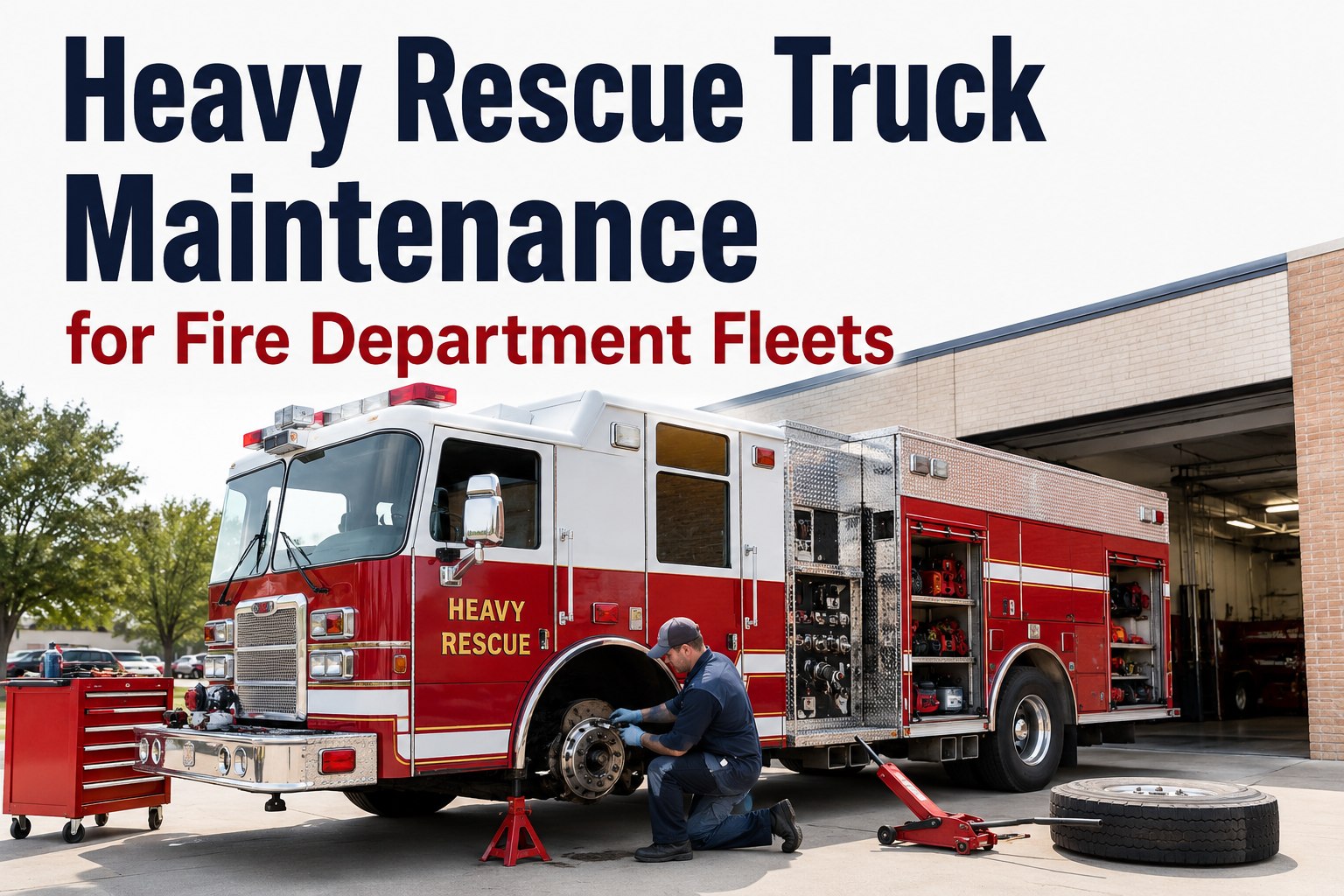
When a heavy rescue rolls up on a crash scene at 2 a.m., every hydraulic tool, generator, light mast, and air cascade cylinder on that rig has to work the first time, because there is no backup coming. Yet most departments still juggle separate paper logs for the chassis, the Hurst tool, the gen-set, and the SCBA fill system, each on its own PM interval, and none of them talking to each other. Heavy rescue truck pm only works when every sub-system on the rig is tracked in one place, tied to the apparatus record and to the mechanics who keep it ready; seeing that unified asset view on your own fleet is usually the moment paper binder rescue programs finally make sense.
One rig, four sub-systems, zero paper logs
Heavy rescue trucks carry hydraulic extrication tools, diesel gen-sets, air cascade systems, and lighting masts, each governed by its own NFPA interval and annual load-test rule. HVI ties every sub-system to the apparatus record so no PM slips and no certification lapses on the scene.
The real cost of a missed rescue rig PM interval
A heavy rescue is not a standard pumper with a bigger box on the back. It is four mission-critical systems bolted to one chassis, and each system fails differently, on its own clock. When one of those clocks is missed, the cost is not just a shop visit, it is a truck out of service on the day someone needs it.
Cascade, hydraulic tools, gen-set, lighting: each on its own clock
The reason rescue rig maintenance is harder than engine company work is interval fragmentation. The chassis may be on a 90-day or 5,000-mile cycle, the gen-set on a 200-hour cycle, the light mast on a 250-hour cycle, the cascade cylinders on an annual hydrostatic and visual inspection per NFPA 1989, and the Hurst or Holmatro tools on an annual load test. None of those intervals line up. HVI lets you map every interval to one apparatus record so the shop foreman sees what is due, what is overdue, and what is coming in the next 30 days on a single screen.
Air Cascade System
- Cylinder hydrostatic test and visual inspection dates
- Fill-log tracking to catch overfill patterns
- Regulator and pressure-relief valve function check
- Hose and fitting condition on every fill point
Hydraulic Tools (Hurst / Holmatro)
- Annual load test certification per manufacturer spec
- Hydraulic fluid level and condition check quarterly
- Hose inspection for abrasion, kinks, and fitting wear
- Spreader, cutter, and ram function test on rotation
Diesel Gen-Set
- Oil and filter change at 200 hours, not by calendar
- Weekly no-load exercise run logged with runtime hours
- Fuel level and fuel quality check for standby diesel
- Battery, alternator, and output voltage inspection
Lighting Mast & Scene Lights
- Mast raise, lower, and lock function test quarterly
- Quartz and LED head condition and aim check
- Extension cord and connector arc-damage inspection
- Mast pivot and cable wear at 250-hour mark
Rescue tool inspection checklist that actually covers the rig
Most rescue truck checklists in use today are chassis DVIRs with a couple of tool lines tacked on the bottom. That structure misses the point. The chassis is the easy part. The tools, the cascade, the gen-set, and the lights are what make it a rescue rig, and each one needs its own inspection block inside the same digital form. Below is the tiered structure HVI uses for a spec rescue fleet, and you can walk through it on your own units to see how it fits your apparatus.
Tier 1 · Chassis & Cab (Every Shift)
- Engine oil, coolant, DEF levels
- Air brake pressure build and cut-out
- Tire pressure and tread depth all axles
- Steering, horn, wipers, all lighting
- Seatbelts, mirrors, glass condition
Tier 2 · Rescue Equipment (Weekly)
- Hydraulic tool function and fluid level
- Cascade bank pressure and fill log
- Gen-set no-load exercise run logged
- Lighting mast full raise and aim
- Struts, air bags, and shoring inventory count
Tier 3 · Certification & Compliance (Annual)
- Hurst / Holmatro annual load test records
- Cascade cylinder hydrostatic test dates
- Gen-set 200-hour service completed
- Limited slip diff and ABS chassis test
- NFPA 1911 pump and ancillary equipment test
How HVI tracks every rescue rig interval on one screen
The table below shows how a typical heavy rescue's sub-system PM intervals map into HVI. Each interval is tracked by the trigger that actually makes sense for that system: engine hours for the gen-set, calendar days for the cascade hydro, and load-test cycles for the hydraulic tools. When an interval is due, HVI generates a work order automatically and alerts the shop foreman, so nothing waits for someone to notice a clipboard date. You can see the due-and-overdue dashboard on a live call to judge it for yourself.
| Sub-System | Service Interval | Trigger Type | Compliance Reference |
|---|---|---|---|
| Air cascade cylinders | Annual visual, 5-year hydrostatic | Calendar date | NFPA 1989 |
| Hydraulic tools (Hurst / Holmatro) | Annual load test | Calendar + test cycle | Manufacturer spec |
| Diesel gen-set | 200-hour oil and filter | Engine hours | OEM service manual |
| Lighting mast | 250-hour cable and pivot service | Engine hours | OEM service manual |
| Chassis (engine, brakes, tires) | 90-day or 5,000-mile | Date or mileage | FMCSA / DOT Part 396 |
Paper binder vs unified rescue truck CMMS
The shift from paper to a rescue truck CMMS is not about going digital for its own sake. It is about collapsing four logbooks into one apparatus record, so when a compliance officer asks for the last Hurst tool load test, you answer in seconds instead of digging through a cabinet. If you want to start logging inspections free and see the difference on one rig first, HVI lets you do that without a long rollout.
Four logbooks, one cabinet, zero cross-references
- Chassis DVIR on a clipboard in the cab
- Hurst tool log in a binder in the equipment room
- Cascade fill log on a wall sheet near the compressor
- Gen-set hours handwritten on a sticker on the unit
- No alert when the 200-hour service is overdue
- Audit takes hours of manual cross-referencing
One rig record, every interval tracked, alerts on
- Every sub-system tied to the apparatus VIN
- Hydraulic tool load-test date auto-flags at 11 months
- Cascade hydro date tracked with 60-day pre-alert
- Gen-set hours pulled from telematics or manual entry
- Work order auto-generated when any interval hits
- Audit pack exported in seconds with photos and timestamps
Stop juggling four logbooks for one truck
See HVI running on your own rescue fleet, with your own PM intervals and tool certifications loaded. Book a 30-minute demo and we will show you the due-and-overdue dashboard, the digital DVIR, and the audit export on a live account.
Heavy rescue truck pm only works when the rig is one asset
The core mistake in heavy rescue truck pm is treating the rig as a chassis plus a pile of accessories. It is one apparatus with four or five mission-critical sub-systems, each on its own PM clock, and if any one of those clocks is missed the whole truck is degraded on the scene. The fix is not a bigger binder or a more careful spreadsheet. The fix is a rescue truck CMMS that ties the cascade, the hydraulic tools, the gen-set, the lighting mast, and the chassis to a single apparatus record, with alerts that fire before the interval lapses and audit-ready records that prove compliance in seconds. Whether you run a single walk-in rescue or a spec rescue fleet across multiple stations, the payoff is the same: fewer unplanned shop days, no lapsed certifications, and a rig that is ready every time the tones drop. If you are ready to see it on your own fleet, that is the fastest way to judge whether HVI fits your shop.
"We had a Hurst tool load test lapse because the cert date was on a sticker inside the equipment room door and nobody saw it for three weeks. Now HVI flags it at 11 months and the work order is in the shop before I even think about it. That one alert alone paid for the switch."
Heavy rescue truck maintenance questions, answered
How often should hydraulic rescue tools be load tested?
What is the PM interval for a rescue truck gen-set?
Can HVI track cascade cylinder hydrostatic test dates?
Does HVI work for walk-in rescue trucks and spec rescue bodies?
How does HVI prove compliance during a fire rescue apparatus audit?
One platform for every rig, every tool, every interval
Book a 30-minute demo and we will load your rescue apparatus, your PM intervals, and your tool certifications into a live HVI account, so you can see the due-and-overdue dashboard and the audit export on your own fleet.
Free to start · Works on any phone · No card needed