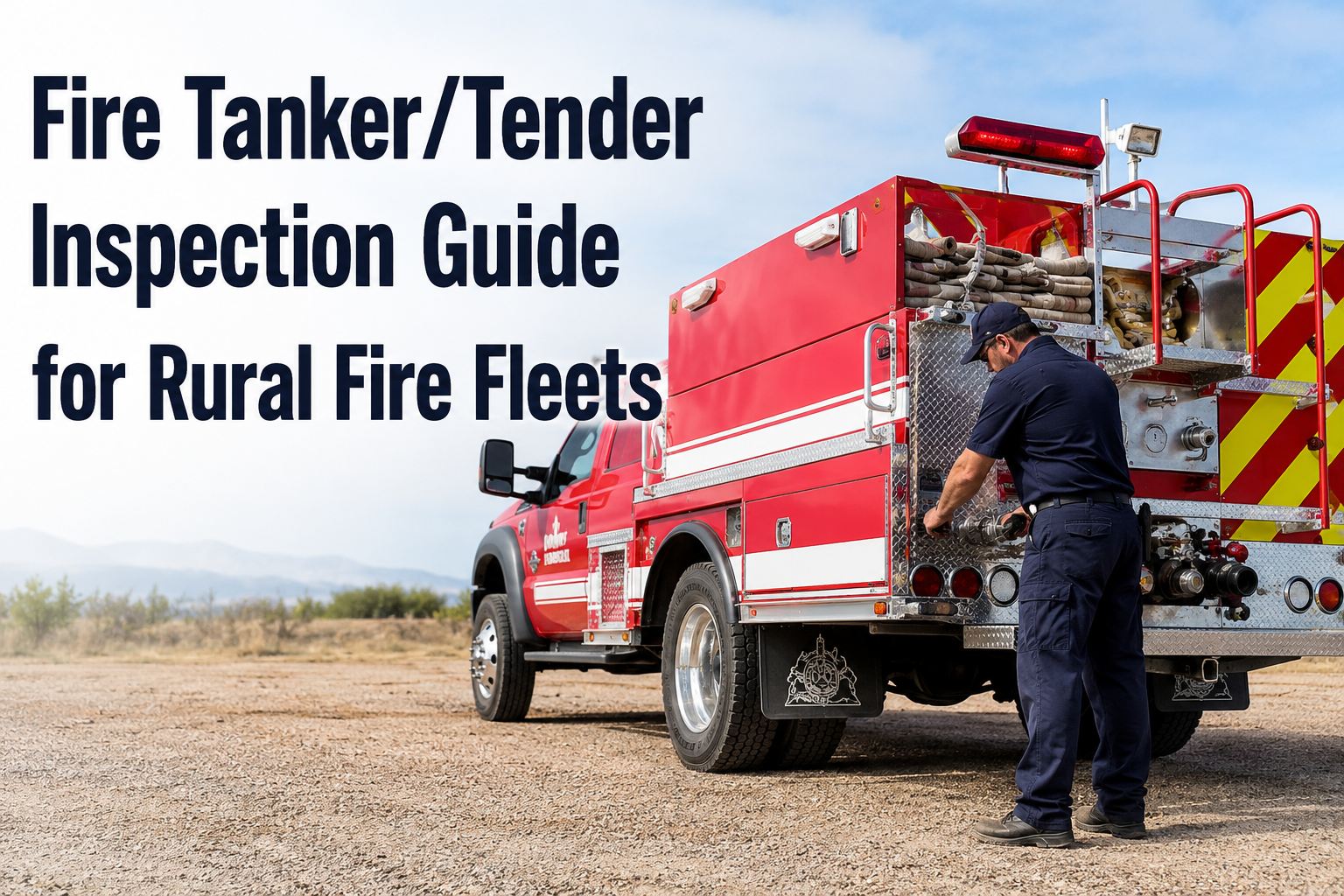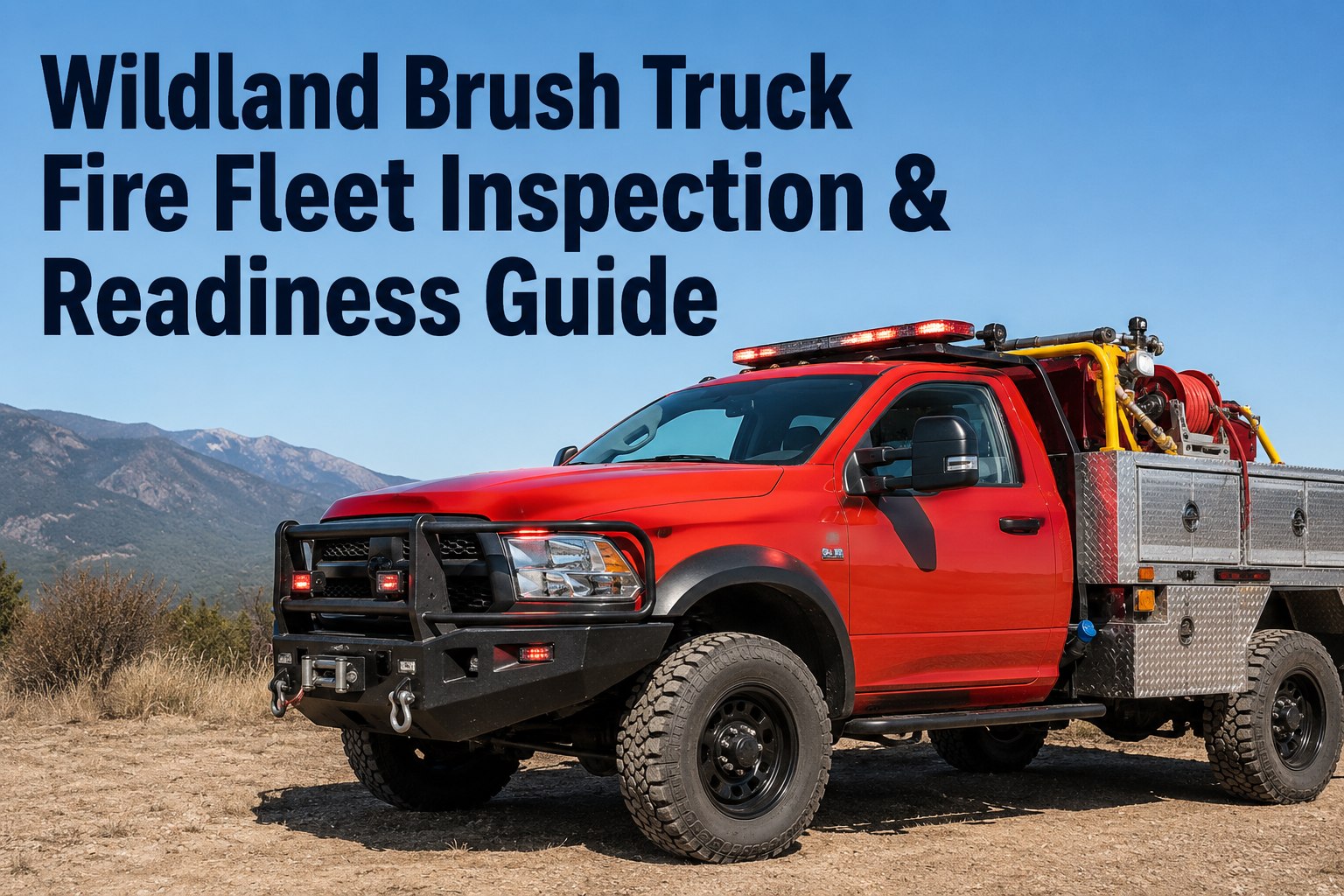
When the dispatch tone drops at 14:00 on a 38°C July afternoon and your Type 3 wildfire engine rolls out of quarters, the last thing you can afford is a pump intake that will not prime or a foam cell that lost its charge sometime between winter storage and the first red-flag warning. Wildland brush truck PM is not the same game as structural engine maintenance — these units get driven hard into terrain that breaks suspensions, shaken over two-tracks that crack welds, and heat-cycled through pump-and-roll runs that stress cooling systems and electrical looms far beyond anything a standard pumper sees. NFPA 1906 sets the bar for wildland fire apparatus, and if your inspection routine is still a clipboard, a binder, and a group chat full of untrackable phone photos, you are already behind the curve. book a demo and see the wildland templates on your own units before the next call-out exposes the gaps.
Is your brush truck ready to pump-and-roll in the first 90 seconds on scene?
Most wildland engine failures are not dramatic mechanical breakdowns — they are small inspection misses that compound under thermal load and rough terrain. HVI replaces the paper binder with timestamped, photo-backed inspections built around NFPA 1906 and interagency wildland standards.
What a Missed Wildland Engine Inspection Actually Costs You
Every season, WUI fleets lose apparatus to failures that a 15-minute structured check would have caught. The numbers below are the ones that show up on your shop floor and your audit reports.
A mid-size WUI fleet running 12 wildland engines can easily lose 30–40 apparatus-days over a single fire season to unplanned pump repairs, foam system recharges, and electrical faults traced back to vibration damage. At a loaded shop rate and lost availability, that is real money — and more importantly, it is apparatus that is not available when the next incident page goes out. walk through the HVI wildland fleet setup on a live call to see exactly where those hours are hiding.
What NFPA 1906 and Interagency Wildland Standards Actually Require
NFPA 1906 is the standard for wildland fire apparatus, covering Type 3 through Type 6 engines. It governs everything from pump capacity and foam system design to structural integrity, roll-over protection, and the inspection cadence that keeps these units mission-ready. The Interagency Standards for Wildland Fire Management (commonly referenced as the "Red Book" and tied to the Interagency Fire Center standards) layer on top of that with operational readiness requirements — and if you run a CSRL-listed fleet or respond on federal incidents, those standards are not optional.
Pump-and-Roll Capability
NFPA 1906 requires the pump to deliver rated flow while the apparatus is moving at a specified speed. This means the drivetrain, PTO, and pump cooling loop must be verified under load, not just statically checked in quarters.
Foam System Integrity
Class A foam systems must be checked for proper proportioning, tank condition, and line charge. A foam cell that has crystallised or lost concentration is a silent failure you only discover when you need it most.
Thermal Blanket & Heat Shielding
Heat shielding around the pump panel, exhaust routing, and underbody must be inspected for degradation. Operating in wildland conditions means exposure to radiant heat that breaks down shielding faster than structural duty.
Roll-Over Protection
Type 6 brush trucks and smaller wildland engines often operate on slopes and two-tracks where rollover risk is real. NFPA 1906 addresses crew cab integrity and ROPS — and your inspection needs to verify mounting bolts, cab structure, and cage condition.
The challenge is not knowing the standard — it is proving you meet it, every time, on every unit, with records that hold up under an audit. Paper binders get wet, lost, or left in the rig. Spreadsheets do not capture the photo of that cracked pump manifold weld you spotted during a brush truck daily check at the edge of a fire line. That is the gap a digital wildland fleet CMMS closes.
Wildland Brush Truck Daily Check & Inspection Tiers
Wildland engine inspection is not a single checklist — it is a tiered system. Daily checks catch the obvious. Weekly checks catch the developing. Post-run checks catch the damage. Here is how a structured wildland fleet breaks them down, and how HVI templates mirror each tier.
Brush Truck Daily Check
Every shift · 10–15 min- Engine oil, coolant, transmission fluid levels
- Water tank level and tank-to-pump valve position
- Foam tank level and proportioner valve set
- Tire condition and pressure including spares
- All exterior and scene lights operational
- Seatbelts, cab mounts, and ROPS hardware visible
- Pump engaged and pressure gauge responds
Weekly Pump & Foam
7 days or 50 engine hrs · 30–45 min- Full pump-and-roll test at rated flow and pressure
- Foam proportioner calibration check with test solution
- Intake and discharge valve operation, no binding
- Plumbing and manifold inspection for weeps and cracks
- Thermal blanket and heat shield visual condition
- Battery hold-downs and electrical loom routing
- Driveline and suspension bushing visual check
Post-Run Damage Assessment
After every wildland deployment · 20–30 min- Underbody and frame inspection for impact or heat damage
- Pump panel and gauge condition after thermal exposure
- Hosebed and hose condition, chafing and heat marks
- Tire and wheel damage from off-road operation
- Foam system flush and recharge to spec concentration
- Crew cab and ROPS structural bolt torque visual
- Photo documentation of any new defect or damage
Wildland Engine Inspection Focus by Apparatus Type
Not all wildland engines are built the same, and your inspection routine should not treat them as if they are. The table below maps the critical inspection focus areas by wildland engine type — because a Type 3 and a Type 6 fail in different ways and need different attention. You can see how HVI handles separate templates per engine type on a demo call — it is one of the features wildland fleet managers ask about first.
| Engine Type | Typical Use | Water / Foam Capacity | Critical Inspection Focus | Common Failure Mode |
|---|---|---|---|---|
| Type 3 Wildfire Engine | Initial attack, WUI, wildland | 500+ gal / foam | Pump-and-roll drivetrain, midship pump cooling, structural frame | Pump overheating on long pump-and-roll runs |
| Type 4 Wildland Engine | Heavy wildland, sustained ops | 750+ gal / foam | Weight distribution, axle loading, large tank baffles | Tank baffle weld cracks from off-road slosh |
| Type 5 Wildland Engine | Initial attack, narrow access | 400–750 gal | Chassis flex, skid plate condition, narrow trail bodywork | Body and plumbing damage from trail impacts |
| Type 6 Brush Truck | Mobile attack, patrol, mop-up | 150–400 gal / foam | ROPS, suspension bushings, pump-and-roll PTO, tire damage | Suspension and driveline failure from rough terrain |
A Type 3 wildfire engine spends more time running its midship pump under load, so pump cooling, intake priming, and manifold condition are your recurring cost centres. A Type 6 brush truck, by contrast, is a tactical patrol vehicle — it gets beaten up on two-tracks and logging roads, so your suspension, tire, and roll-bar inspection work is where you save availability. One inspection template does not serve both, and trying to force it is how defects get missed.
Paper Binder vs Brush Truck CMMS: What Changes
Most WUI fleets know the paper binder is broken — they just are not sure the switch is worth the effort. Here is the side-by-side that shows exactly what changes when you move wildland engine inspections into a purpose-built CMMS.
Paper & Group Chat
- Inspection forms get wet, torn, or left in the apparatus
- Defect photos live in individual phones, unattached to records
- No way to prove a check was done — just a signature on a line
- PM intervals tracked on a whiteboard or in someone's head
- Audit prep means days of digging through binders and spreadsheets
- Parts ordered through text messages with no inventory tracking
- No visibility into which engines are falling behind on readiness
HVI Digital Inspections
- Inspections run on any phone or tablet, online or offline in the field
- Defect photos attach directly to the inspection record with GPS pin
- Every check is timestamped with user, unit, date, and location
- PM alerts fire automatically by date, mileage, or engine hours
- Audit-ready records pull up in seconds, filterable by unit or date range
- Parts linked to work orders with multi-shop inventory visibility
- Dashboard shows fleet readiness and overdue inspections at a glance
The shift is not just about going paperless — it is about closing the loop. When a driver flags a weeping intake valve during a brush truck daily check, HVI turns that defect into a work order instantly, routes it to the shop, and tracks the part and the fix. You stop losing defects in the gap between the cab and the bay. If you want to start logging inspections free and see that loop close on your own units, the signup takes minutes.
The Math: What Structured Wildland PM Saves a 12-Engine Fleet
Let us make this concrete. Say you run 12 wildland engines — a mix of Type 3 and Type 6 units — and you lose an average of 3 apparatus-days per engine per season to unplanned pump, foam, or suspension failures that a structured inspection would have caught early. That is 36 apparatus-days of lost availability over a fire season.
At a conservative loaded cost of $1,200 per apparatus-day — covering shop labour, parts, towing, and the operational cost of a missing engine on an incident — that is roughly $25,200 in recovered value per season. And that does not count the audit hours saved, the reduced roadside or on-scene breakdown risk, or the insurance and compliance benefit of being able to prove every single inspection was completed. book a 30-minute demo and we will run the numbers on your actual fleet — the conversation is worth it before next season.
Wildland Fleet Readiness, Built Into Every Inspection
HVI is built for the realities of wildland and WUI operations — not adapted from a generic fleet template. Here is how specific capabilities map directly to the wildland engine inspection problems that cost you availability.
NFPA 1906-Aligned Inspection Templates
Pre-built templates for Type 3 through Type 6 wildland engines cover pump-and-roll verification, foam system checks, thermal shielding, and ROPS hardware. Drivers and technicians run them on any phone — offline in the field, synced when back in range. No more generic checklists that skip wildland-specific failure points.
Instant Defect-to-Work-Order
When a defect is flagged on a brush truck daily check — a weeping valve, a cracked weld, a low foam cell — HVI generates a work order instantly, routes it to the shop, and tracks it through to completion. The defect photo, the unit, the timestamp, and the location all travel together. Nothing falls into the gap between the field and the bay.
PM Scheduling by Engine Hours
Wildland engines do not accumulate miles the way a highway truck does — they accumulate pump hours and idle hours. HVI schedules preventive maintenance by date, mileage, or engine hours, with due and overdue alerts that surface before a unit misses a critical service interval. You can see the PM alert workflow on a live demo and judge it for yourself.
Audit-Ready Records in Seconds
When an auditor, a safety officer, or an insurance reviewer asks for proof that Engine 341 had its foam system checked before the July deployment, you pull it up in seconds — with the photo, the technician, the timestamp, and the GPS pin. No binders, no scrambling, no gaps. That is what wildfire fleet readiness looks like when it is documented properly.
From Paper to Audit-Ready in Four Weeks
Moving a wildland fleet off paper binders does not have to be a months-long IT project. Here is the typical rollout timeline for a WUI fleet moving to HVI — and yes, you can walk through each step on a demo call before you commit to anything.
Template Setup & Asset Import
Your wildland engine types, pump specs, and inspection cadence are configured in HVI. Existing assets, parts, and PM history are imported. No data re-entry from scratch — we map what you already have.
Driver & Technician Onboarding
Drivers install the app and run their first brush truck daily check on a phone or tablet. Technicians see the defect-to-work-order flow. Most crews are comfortable inside one shift — the interface is built for gloves and sun glare, not desk work.
Full Fleet Cutover
Paper binder is retired. Every wildland engine in the fleet runs through HVI for daily checks, PM scheduling, and defect tracking. The dashboard goes live for the Fleet Manager and Director of Maintenance.
First Audit Pull & Optimisation
First real audit or readiness review using HVI records. Overdue PM intervals and recurring defect trends are visible for the first time. Templates are fine-tuned based on what the data shows.
See HVI Running on Your Own Wildland Fleet
Book a 30-minute demo and we will load your engine types, your inspection cadence, and your PM intervals — then show you exactly what changes when the paper binder is gone.
Wildland Brush Truck PM: What Actually Matters
Tier your inspections. A brush truck daily check, a weekly pump-and-roll test, and a post-run damage assessment are three different jobs — treat them that way and you catch failures at the right stage.
Match the template to the engine type. A Type 3 wildfire engine and a Type 6 brush truck fail differently. One generic checklist guarantees you miss the failures that matter most on each unit.
Close the defect-to-work-order loop. The gap between a field defect and a shop fix is where availability leaks. Digital inspections with instant work orders kill that gap.
Prove readiness, do not just claim it. NFPA 1906 and interagency wildland standards require documented evidence. Timestamped, photo-backed records are the only thing that holds up when someone asks.
Schedule PM by engine hours, not just miles. Wildland engines accumulate pump and idle hours faster than road miles. If your PM system only tracks odometer readings, you are missing services.
The paper binder is costing you more than you think. Between lost availability, audit prep hours, and defects that slip through, a 12-engine fleet can recover over $25,000 per season by moving to a structured wildland CMMS.
The foam system on Engine 412 failed on a fire line two seasons ago — turned out the proportioner had not been checked in weeks because the paper form was sitting in a binder nobody opened. We switched to HVI and now I can see every check, every photo, and every overdue PM on my phone before the first truck rolls. That alone was worth the move.
Wildland Brush Truck Inspection & Readiness FAQ
What does NFPA 1906 require for wildland brush truck inspections?
How often should a Type 6 brush truck be inspected?
What is pump-and-roll and why does it matter for wildland engine inspections?
Can HVI handle different inspection templates for Type 3 and Type 6 engines?
Does HVI work offline for wildland inspections in remote areas?
Get Your Wildland Fleet Audit-Ready Before the Next Call-Out
Book a 30-minute demo and see HVI running on your own wildland engines — or start free and log your first brush truck inspection today.
Free to start · Works on any phone · No card needed