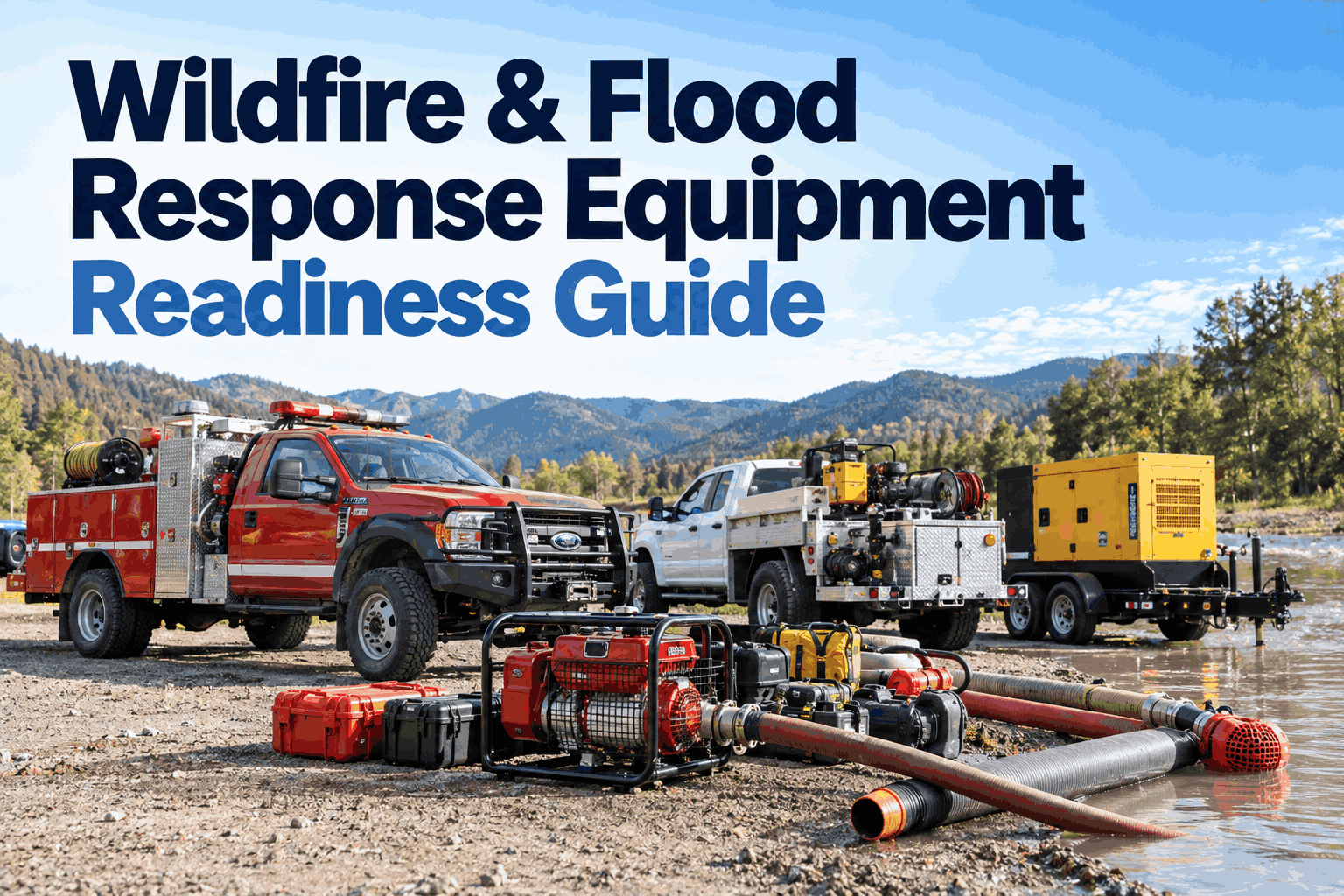
Wildfire response equipment that hasn't moved in eight months needs to work in the first ninety seconds of deployment. Flood pumps staged in a public works bay since last spring must prime and flow the moment a crew connects them at a high-water scene. Municipal emergency equipment — brush trucks, portable pumps, generators, high-water rescue assets — doesn't get a warm-up lap. It either performs on arrival or it becomes part of the problem. This guide covers the full readiness cycle for wildfire,and flood response equipment: pre-season inspection, calendar-triggered readiness checks, deployment documentation, post-incident return-to-service, and how HVI helps municipal teams keep every asset documented and deployment-ready year-round.
Wildfire & Flood · Municipal Fleet · 2026 Readiness Guide
Wildfire & Flood Response Equipment Readiness
Your brush trucks, portable pumps, generators, and high-water assets sit idle for months — then must perform immediately. A documented readiness program is the only thing standing between a deployment and a failure on scene.
of municipal maintenance budgets spent on emergency repairs, not planned prevention
2.2M
acres burned in the Pacific Northwest alone in 2024 — a new regional record
$40K+
average cost of a single missed pump service on fire apparatus
Why Emergency Equipment Fails at the Worst Moment
The operational pattern for wildfire and flood response equipment is uniquely punishing: long idle periods followed by immediate high-demand use, often in extreme heat, smoke, contaminated water, and remote locations with no nearby parts or service support. NFPA 1911 requires documented inspection and service testing for fire apparatus precisely because this pattern creates predictable failure modes that only show up under load — not during the idle months when nobody is watching.
Extended Idle Degradation
Pump seals dry out. Fuel degrades. Batteries self-discharge. A brush truck that sat untested for six months can fail to prime within minutes of arriving on scene.
Cost: $8,000 – $40,000 per missed pump service
No Connectivity in the Field
Wildfire staging areas and flood-affected road networks have no cell service. Paper inspection binders get wet, lost, or left behind. Defects go undocumented mid-deployment.
Risk: Undocumented defects = unresolved defects
Missing Maintenance History
Personnel turnover means the previous mechanic's notes live in a binder nobody can find. With no service history, there's no way to know if the pump was ever tested under load.
NFPA 1911 Ch. 6: Records retained for the life of the vehicle
Post-Incident Contamination
Equipment returned from wildfire exposure carries ash, heat stress, and degraded seals. Flood assets bring contaminated water into pump internals. Without a return-to-service protocol, the next deployment starts compromised.
Risk: Unknown damage becomes next deployment's failure
The Three-Phase Readiness Cycle
Municipal wildfire and flood readiness isn't a single annual inspection — it's a continuous three-phase cycle. Miss any phase and you break the chain. Book a demo to see how HVI structures this cycle for your fleet with calendar triggers and offline-capable inspection forms.
Phase 1
Pre-Season Readiness — 30–60 Days Before Peak Season
This is your last chance to find a defect before it matters. Every piece of wildfire and flood response equipment gets a full inspection, run test, and consumable audit before the calendar flips into high-risk months.
Pump prime test — full rated flow under load
Generator load bank test — rated kW output verified
Battery condition & charge state on all vehicles
Fuel quality check — treat or replace degraded fuel
Hose, fitting, strainer, and adapter inventory
Foam system flush and concentrate level check
Brush truck suspension and driveline inspection
High-water vehicle seal and bilge check
PPE inventory and expiry date audit
Crew qualification currency — all certs current
HVI
Calendar-triggered inspection forms deploy automatically 45 days before your defined season start. Technicians complete them offline on mobile — no connectivity needed.
Phase 2
Active Deployment — Documentation That Travels With the Equipment
When a mutual-aid request goes out or a flood event activates, equipment leaves your yard and enters an environment where documentation matters most and is hardest to maintain. Every defect found during deployment must be captured — even without cell service.
Pre-deployment vehicle and equipment check
Mutual-aid dispatch record — asset, location, crew
Field defect logging — offline, with photo
Pump run hours logged per deployment day
Fuel and fluid resupply documentation
Equipment location and availability status
Mid-deployment inspection if event exceeds 48 hrs
Crew qualification match to assigned equipment
HVI
Offline inspections sync automatically when connectivity returns. Defects flagged in the field create work orders the moment the device connects — no manual re-entry.
Phase 3
Post-Incident Return-to-Service — Nothing Goes Back in Service Unchecked
Equipment returned from wildfire or flood deployment carries damage you can't see: heat-stressed seals, ash-clogged filters, contaminated pump water ends, fatigued hose, degraded foam concentrate. Return-to-service is a full inspection, not a wash and park.
Full decontamination — ash, mud, contaminated water
Pump water end flush and internal inspection
Heat stress check on boom welds and chassis
Filter replacement — air, fuel, oil, hydraulic
Hose and fitting inspection — pressure test
Foam system flush and refill
Hour-meter update and PM schedule adjustment
Signed return-to-service clearance before restaging
HVI
Post-incident inspection forms are triggered automatically when an asset is marked returned. Hour-meter updates from deployment pull the next PM forward — so a pump that ran hard for 3 days gets its next service sooner, not at the original calendar date.
Run All Three Phases in HVI — Calendar Triggers, Offline Forms, Automatic Work Orders
Set up your pre-season, deployment, and return-to-service inspection templates once. HVI triggers them automatically, captures them offline, and turns every defect into a tracked work order before the next deployment.
Equipment-Specific Readiness — What Each Asset Needs
Different emergency assets fail in different ways. Here are the readiness priorities for the four equipment categories that see the highest failure rate in wildfire and flood deployments.
Wildfire Response
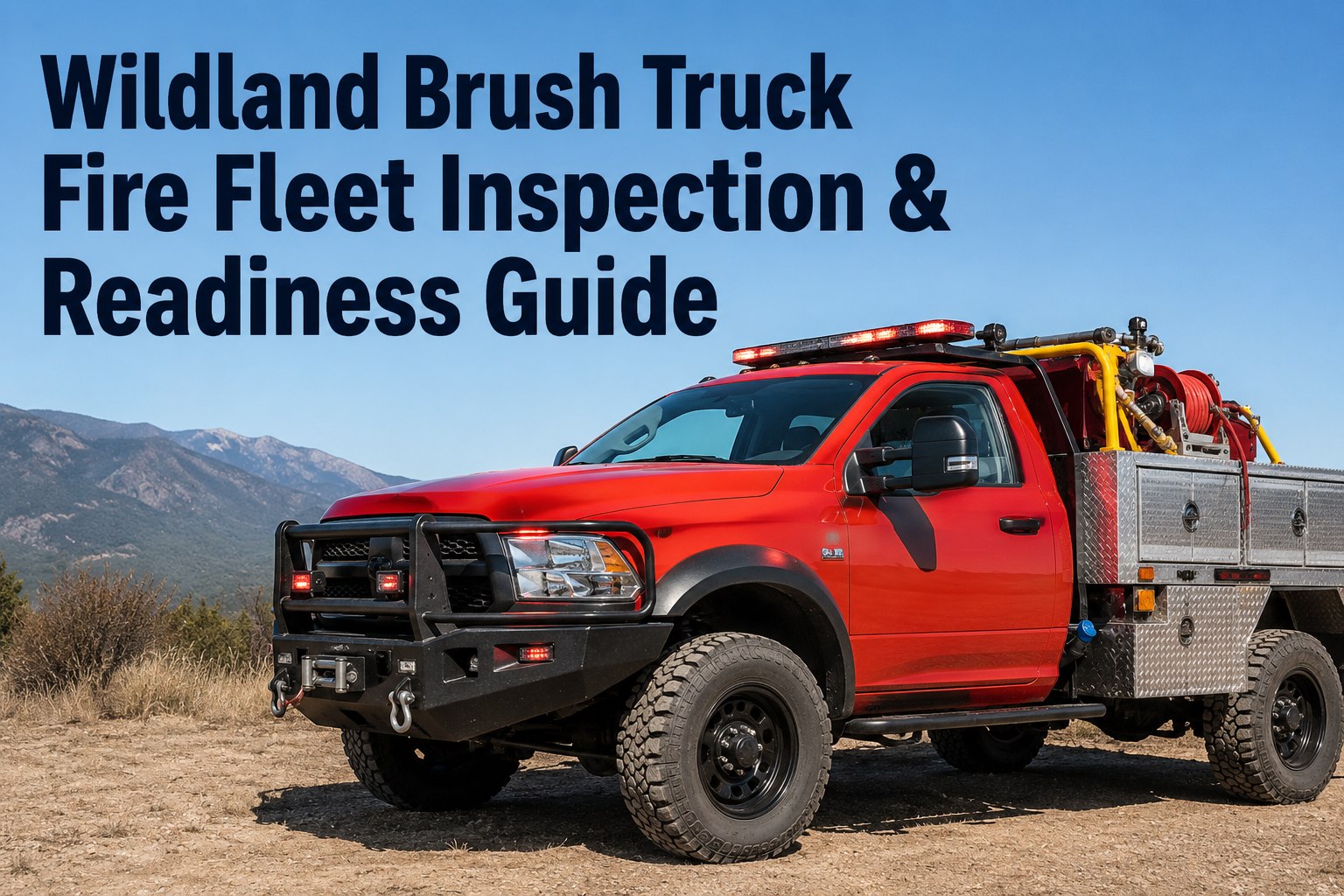
Brush Trucks & Wildland Engines
High Risk
Pump-and-roll PTO failure · Suspension damage from off-road terrain · Heat-stressed cooling system
Pump-and-roll delivery at rated flow while moving
ROPS and cab structure visual — no cracks or loose mounts
Suspension bushings and driveline joints
Cooling system — hoses, clamps, coolant level
Foam system — concentrate level, eductor function
Tire condition — sidewalls, tread, pressure for terrain
NFPA 1906 · Interagency Wildland Standards
Flood Response
Portable & Trailer-Mounted Pumps
High Risk
Priming failure after idle · Strainer clogging · Contaminated water end
Cold-prime test — prime and flow within 30 seconds
Strainer and intake basket — clean, no damage
Impeller and seal inspection — no leakage at shaft
Discharge and suction hose — no cracks or abrasion
Engine oil, fuel, air filter — fresh before season
Coupling adapters inventory — Storz, NH, cam-lock
NFPA 1911 · Manufacturer PM Schedule
Power Supply
Generators & Portable Power
Medium Risk
Load test failure · Fuel degradation · AVR and voltage regulator issues
Load bank test at rated kW — sustained 30-minute run
Fuel system — drain and refuel if stored > 90 days
Oil level and condition — change if at interval
Air filter — clean or replace
Output voltage and frequency under load
Transfer switch and outlet condition
Manufacturer PM Schedule · NFPA 110
Flood & High-Water
High-Water Vehicles & Rescue Assets
High Risk
Seal failure after floodwater exposure · Winch and recovery gear condition
Axle and differential seal check — no water intrusion
Bilge pump — function and float switch test
Winch cable condition and load rating
Snatch blocks, shackles, recovery straps
Electrical — all water-exposed connectors dried and sealed
Life safety equipment — PFDs, throw bags, count & condition
NFPA 1901 · Manufacturer Flood Return-to-Service
Parts Min/Max — The Readiness Gap Nobody Talks About
An inspection that finds a defect is only useful if the part to fix it is on the shelf. Emergency response equipment operates on a parts availability problem: OEM components for specialized brush trucks, portable pump seals, and generator AVRs can have 2–8 week lead times from distributors. A pre-season inspection that flags a failing pump seal in March is only valuable if the seal is ordered immediately. HVI's Parts Min/Max controls let you set minimum stock levels for critical consumables and receive alerts before you fall below threshold — before the season starts, not after it does.
Asset
Critical Parts to Stock
Lead Time Risk
Brush Truck / Wildland Engine
Pump seal kit · PTO gasket · Foam eductor · Air filter · V-belts
Expert View — From a Municipal Emergency Fleet Manager
“
We had a portable pump fail to prime during a flood activation in 2022. The pump had passed its annual inspection on paper — but that inspection was done eleven months earlier and the paper record was sitting in a binder at the station. Nobody had run the pump under load since the pre-season check. By the time we got a replacement unit to the scene, we had lost ninety minutes. After that we rebuilt the entire readiness program around documented run tests every 90 days and a return-to-service protocol that treats every deployment as a maintenance event. The paper records are gone. Everything is digital, with photo proof, and defects create work orders that don't close until the repair is signed off. It's a fundamentally different level of accountability.
Municipal Emergency Fleet ManagerPublic Works & Emergency Services, Pacific Northwest
Conclusion — Readiness Is a Program, Not an Annual Inspection
Wildfire response equipment and flood response equipment share one unforgiving characteristic: they must work immediately, in extreme conditions, after months of sitting idle. A single annual inspection doesn't close that gap — a continuous three-phase readiness program does. Pre-season checks catch the defects while there's still time to fix them. Deployment documentation creates the record that protects your jurisdiction and your crew. Post-incident return-to-service ensures every asset is cleared before it goes back on the shelf.
The difference between a program that works and one that fails under pressure is documentation — offline-capable, automatically triggered, defect-tracked, and tied to parts availability. HVI is built for exactly that. Set up your emergency readiness templates, run your pre-season inspections, and know that every asset in your fleet has a documented, current, signed-off readiness status before the next event is called.
Keep Your Emergency Fleet Deployment-Ready — Document It in HVI
Municipal public works, fire departments, and emergency management teams use HVI to schedule readiness checks, run offline field inspections, track defects to resolution, and maintain parts availability for wildfire and flood response assets.
Pre-season readiness templates
Offline inspection — no connectivity needed
Automatic defect-to-work-order workflow
Parts min/max alerts before season
Post-incident return-to-service protocol
Mutual-aid deployment records
90 days
Maximum recommended interval between pump run tests for seasonal emergency equipment
No credit card required · Works for fleets of 5 to 500+
Frequently Asked Questions
01How often should municipal wildfire response equipment be inspected when not in active use?
At minimum, a documented pre-season inspection 30–60 days before wildfire season, plus a run test every 90 days during the off-season for apparatus-mounted and portable pumps. NFPA 1906 requires annual pump performance testing for wildland apparatus. Monthly visual checks and weekly battery maintenance are good practice regardless of season. The 90-day pump run test is critical because pump seals and priming systems degrade during idle periods in ways that don't appear in a visual inspection — they only show up when you try to flow water under load.
02What is a post-incident return-to-service inspection and why does it matter?
A return-to-service inspection is a systematic check of every system on a piece of emergency equipment after it has been used at an incident — before it is returned to service-ready status. For wildfire deployments, this means checking for heat-stressed components, ash contamination in air and oil systems, degraded seals from heat cycling, foam system depletion, and hose or fitting damage. For flood deployments, it includes flushing pump water ends of contaminated water, checking electrical connectors and seals for water intrusion, and verifying that axle and differential oils haven't been contaminated. Equipment that is washed and parked without a return-to-service inspection may carry undetected damage into the next deployment.
03How do you document emergency equipment inspections when there is no connectivity in the field?
Paper binders are the traditional answer, but they create documentation gaps — forms get wet, lost, or never make it back to the station. The better approach is an offline-capable mobile inspection tool. HVI supports offline inspections: technicians complete inspection forms, log defects, and take photos without cell service. When the device reconnects — at the staging area, back at the station, or anywhere with connectivity — all inspection records sync automatically and defects convert to work orders. This gives you a complete, timestamped record of every field inspection without relying on connectivity in remote wildfire or flood-affected areas.
04What NFPA standards apply to wildfire and flood response equipment maintenance?
The primary standards are NFPA 1906 (Standard for Wildland Fire Apparatus), which covers inspection, testing, and maintenance requirements for brush trucks and wildland engines including pump-and-roll capability requirements; NFPA 1911 (Standard for the Inspection, Maintenance, Testing, and Retirement of In-Service Emergency Vehicles), which applies to apparatus-mounted pumps and requires documented service testing and records retained for the life of the vehicle; NFPA 1962 (Standard for the Care, Use, Inspection, Service Testing, and Replacement of Fire Hose), covering hose inspection and testing; and NFPA 110 for emergency and standby power systems including generators. Many jurisdictions also follow interagency wildland fire standards from NWCG (National Wildfire Coordinating Group) for mutual-aid deployments.
05How does HVI help with mutual-aid deployment documentation for emergency equipment?
HVI maintains a complete asset history for each piece of equipment — including deployment records, inspection results, defects found and resolved, and return-to-service sign-offs. When equipment is dispatched under a mutual-aid agreement, the pre-deployment inspection record is attached to that asset's profile, creating a documented chain of readiness. Defects found during the mutual-aid deployment are logged offline and sync back to the originating fleet's records. This gives both the requesting and responding agency a verifiable service record for equipment involved in the deployment, which matters for both liability and FEMA reimbursement documentation.