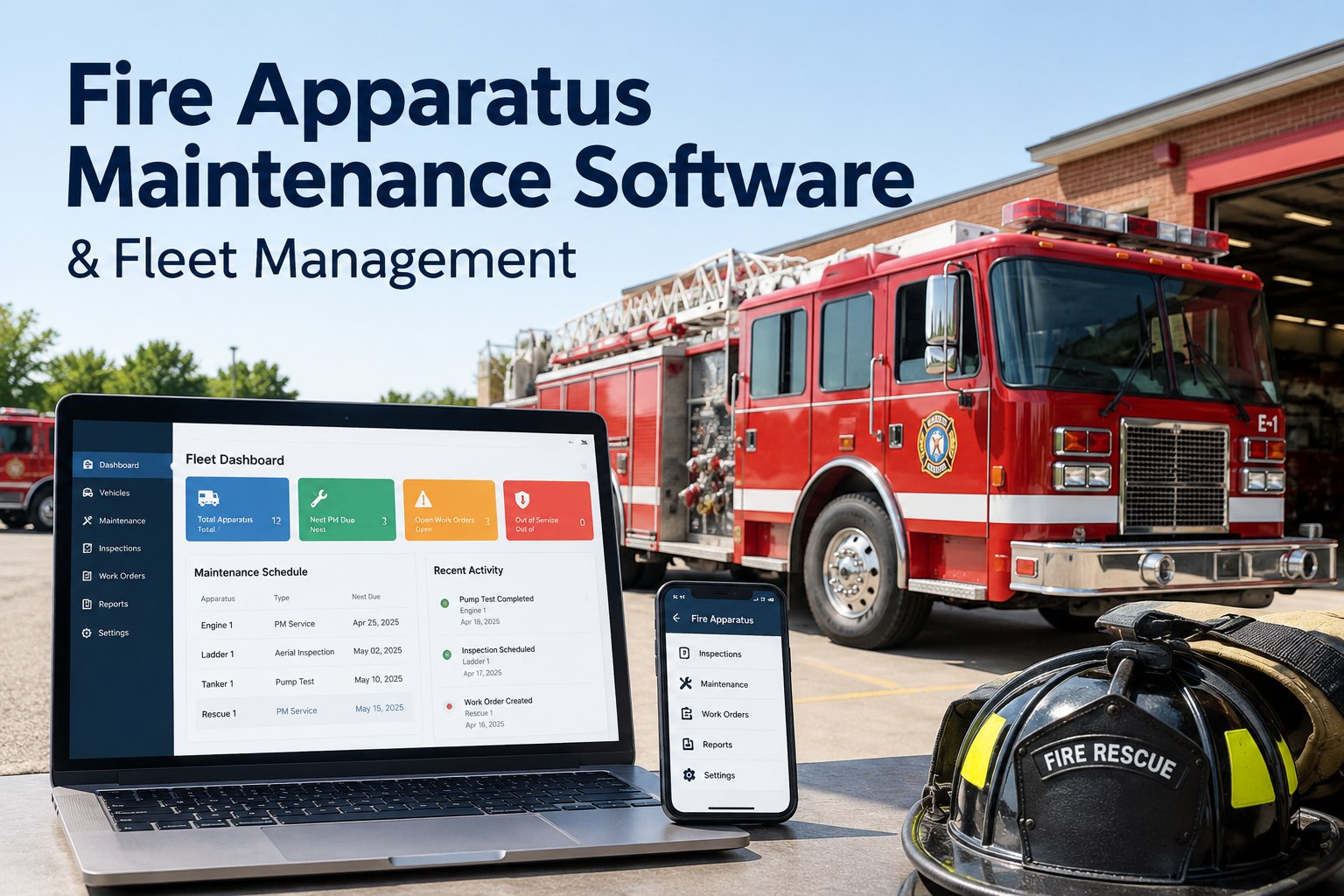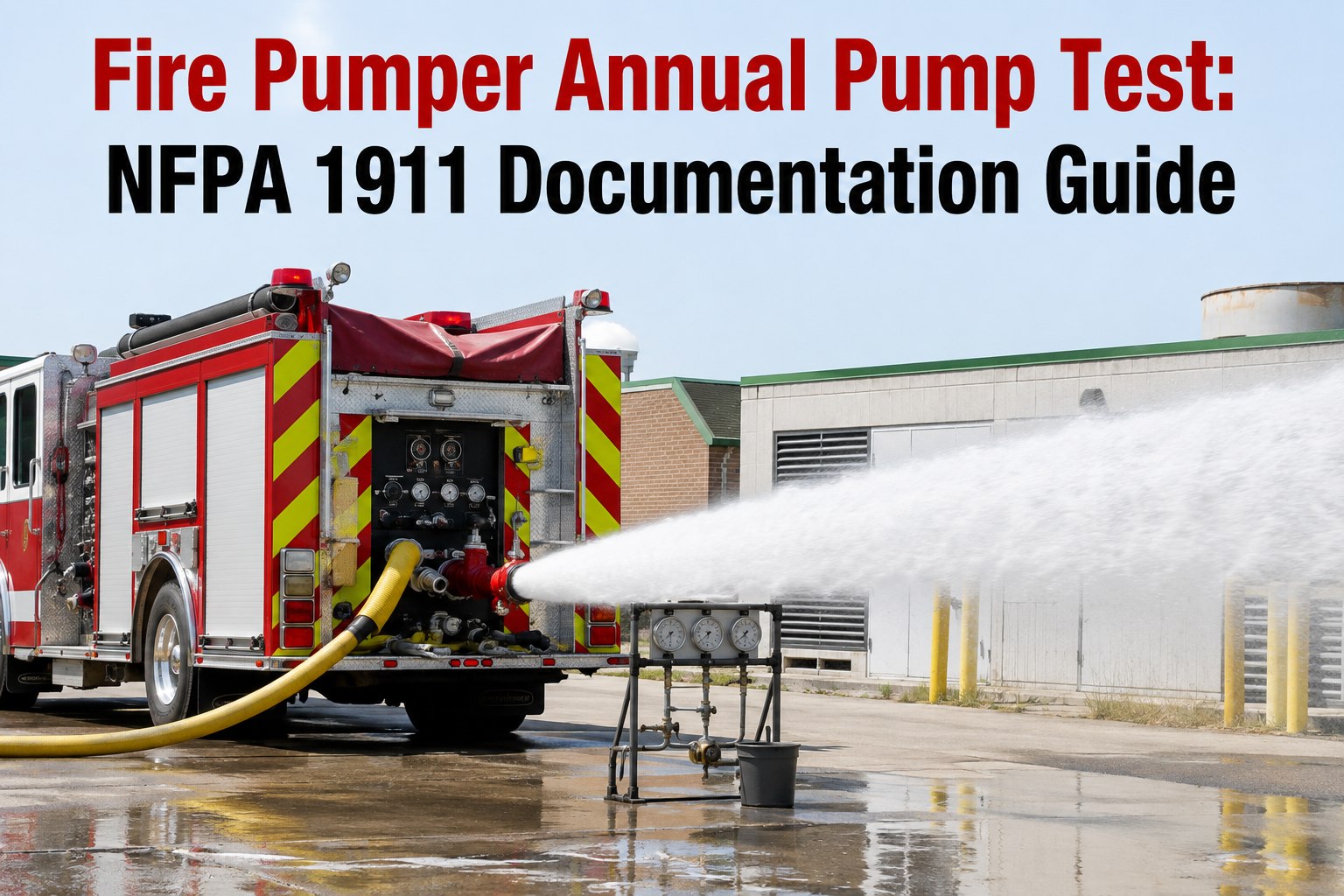
The pump panel gauge is reading 150 PSI net and your watch says 19 minutes into the 100-percent capacity run — but the clipboard with last year's fire pumper pump test results is sitting on a desk back at the station, and the insurance auditor needs proof before Friday. NFPA 1911 annual pump testing is one of those tasks that looks simple on paper until you are the one standing at the discharge valve with a stopwatch, a phone full of photos, and no clean way to tie those readings back to the apparatus record. If you are running Pierce, E-ONE, KME or any mixed pumper fleet, the documentation is what fails you, not the pump. You can see how HVI handles the full pump-test workflow on a live call or read on for the field guide.
Can you prove every pressure reading, for every pumper, for the last three years?
NFPA 1911 demands 100/70/50 percent capacity runs at 150 PSI net — 20 minutes, 10 minutes, 10 minutes — documented and date-stamped. Paper logs get lost, photos live in someone's phone, and the auditor walks in on Monday morning.
What a missing pump test record actually costs your fleet
It is never just the test itself. It is the downstream ripple — insurance, ISO rating, mutual-aid eligibility, and the officer who has to explain a gap in court.
The fire pumper annual pump test, step by step
NFPA 1911 lays out a three-stage capacity test at 150 PSI net pump pressure. Each stage has a fixed duration and a fixed percentage of rated capacity. Miss a minute, lose a reading, or drop below pressure and you re-run the stage.
100% Capacity — 20 Minutes at 150 PSI Net
Run the pump at its full rated capacity — 1,000, 1,250, 1,500 or 2,000 GPM depending on the apparatus — for a continuous 20 minutes. Net pump pressure must hold at 150 PSI. The engine must not overheat, the intake must not cavitate, and the discharge pressure must not drift. Capture the reading at minute 0, minute 10, and minute 20 minimum.
70% Capacity — 10 Minutes at 150 PSI Net
Throttle back to 70 percent of rated capacity and hold for 10 continuous minutes. Same net pressure target: 150 PSI. This stage catches issues that only show up under partial load — seal leaks, packing drip rates, transmission temperature drift. If the pump passed stage one but stumbles here, document it as a defect and flag the apparatus.
50% Capacity — 10 Minutes at 150 PSI Net
Final stage: 50 percent of rated capacity for 10 minutes at 150 PSI net. The pump should settle into a steady state. This is where you check for cavitation under low flow, gauge needle bounce, and any residual heat issues from the earlier stages. Log the final pressure, engine temperature, and transmission temperature.
UL Certification vs Annual Service Test
A UL-certified pump was tested at the factory. That certificate does not cover you for the annual NFPA 1911 service test. If the annual test passes and is documented, you do not need to re-run the UL cert test. If the annual test fails, the apparatus is out of service until the defect is repaired and the test re-run — no exceptions. Book a demo and we will walk you through how HVI maps each reading to the standard.
Key terms every pump test record must capture
Auditors do not just want to see "passed." They want to see the specific readings, the net pressure calculation, the apparatus ID, the date, and the technician signature. Here is what each field means and why it matters.
Net Pump Pressure
Discharge pressure minus intake pressure. The 150 PSI target is net, not gauge. If your intake is 40 PSI from a hydrant, your discharge gauge should read 190 PSI. Getting this wrong is the single most common documentation failure.
Rated Capacity
The GPM the pump was certified to deliver at 150 PSI net. Usually stamped on the pump panel nameplate. A 1,250 GPM pumper runs 1,250 at 100%, 875 at 70%, and 625 at 50%. Document the nameplate rating on every test sheet.
Continuous Runtime
Each stage must run without interruption for the full duration. A pressure drop, a valve adjustment, or an engine stall resets the clock. The start time and end time must be on the record — not just the duration.
Date-Stamped Evidence
A reading without a date and a technician identity is not evidence. NFPA 1911 records must show who ran the test, when, on which apparatus, and with what results. Photo logs with metadata timestamps are the strongest form of proof.
NFPA 1911 requirement-to-record mapping
If you have ever stood in front of an auditor with a binder of loose sheets, you know the gap between what the standard asks for and what the paper actually shows. This table maps each NFPA 1911 requirement to the exact field that must appear on your pump test record.
| NFPA 1911 Requirement | What the Auditor Wants to See | Common Paper-Log Failure | Digital Record Field |
|---|---|---|---|
| 100% capacity, 20 min, 150 PSI net | Start time, end time, discharge PSI, intake PSI, GPM | Duration written as "20 min" with no start/end timestamps | Stage 1 timestamped reading block |
| 70% capacity, 10 min, 150 PSI net | Same fields as stage 1, plus engine temp trend | Engine temperature not recorded or recorded once at the end | Stage 2 reading block with temp fields |
| 50% capacity, 10 min, 150 PSI net | Same fields plus transmission temp and packing drip rate | Packing drip rate omitted entirely | Stage 3 reading block with drip-rate field |
| Apparatus identification | Unit number, VIN, pump serial number, model year | Only the unit number written — no pump serial | Auto-populated from asset record |
| Technician identity and qualification | Printed name, signature, certification number | Illegible signature, no cert number | Logged-in user ID with cert number on file |
| Test date and location | Full date, test site (draft tank or hydrant), water source | Date written as "6/24" with no year or location | Auto date-stamp plus GPS location tag |
| Defect documentation | Any anomaly noted during the test, with a photo | Defects remembered but never written down | Photo-annotated defect flag linked to work order |
What a single failed pump test stage costs a 4-pumper fleet
Take a mid-size department running four pumpers — two Pierce Enforcer units, an E-ONE Cyclone, and a KME Panther. Pumper 3 fails the 70-percent stage because the packing gland is worn and the discharge pressure drops to 138 PSI at minute six. Here is what that single failure looks like in real dollars and hours.
The real number: $3,500 and three truck-days
That is one stage on one pumper. Now multiply across a fleet where the packing was not flagged at the last quarterly inspection because the defect was noted on a paper towel and never made it into a work order. A 30-minute walk-through of HVI's pump test template shows how the defect becomes a work order the second the photo is taken.
Why fire pumper pump test records fail audits
The pump passes. The paperwork does not. Here are the five failures that show up over and over in audit findings — and what each one looks like in the field.
Do not
- Write "passed" with no pressure readings attached
- Record gauge pressure instead of net pump pressure
- Store test photos in a personal phone gallery with no apparatus tag
- Use a generic form that does not reference NFPA 1911 sections
- Backfill the record days after the test from memory
Do
- Capture discharge and intake PSI at every stage with timestamps
- Calculate and record net pressure — 150 PSI target — on the form
- Photo-log each gauge reading with the apparatus ID visible in frame
- Use a form that maps to NFPA 1911 §18 stage requirements
- Generate the record in real time, synced to the asset history
Digital pump test records that survive any audit
HVI turns the NFPA 1911 pump test from a clipboard exercise into a timestamped, photo-backed record that lives on the apparatus asset forever. No binders, no phone photos, no memory gaps.
Photo-Logged Pressure Readings
Every gauge reading is captured as a photo inside the inspection, with the apparatus ID and timestamp baked into the record. The auditor sees the gauge face, the date, and the unit — in one frame. No more "trust me, it read 150."
NFPA 1911 Pump Test Template
A pre-built inspection template maps each stage — 100/70/50 percent at 150 PSI net — to its own reading block. The technician works top to bottom. Net pressure is calculated automatically from discharge minus intake. Duration is timed in-app.
Defect-to-Work-Order in One Tap
If a stage fails or a reading drifts, the technician flags it as a defect inside the same inspection. HVI instantly creates a work order linked to the apparatus, with the photo, the reading, and the stage attached. The shop sees it before the truck is back in quarters.
Three-Year Audit Trail, Searchable
Every pump test record lives on the asset profile — not in a file cabinet. Pull up any pumper, filter by inspection type, and export the last three years of tests as a single PDF for the insurance auditor. The timestamp, the technician, and every photo are all there.
Fire pumper annual inspection checklist: what to capture on test day
Print this, tape it to the pump panel, or load it as a template in HVI — but every item below must appear on the finished record. If any field is blank, the auditor can challenge the entire test.
Pre-Test Setup
- Apparatus unit number, VIN, and pump serial number recorded
- Pump nameplate rated capacity (GPM) documented
- Test date, start time, and location confirmed
- Water source identified — draft tank, hydrant, or static
- Technician name and certification number on file
- All discharge and intake caps removed and checked
During Each Stage
- Discharge pressure recorded at start, mid, and end of stage
- Intake pressure recorded at start, mid, and end of stage
- Net pressure calculated and confirmed at 150 PSI target
- Engine temperature logged at end of each stage
- Transmission temperature logged at end of each stage
- Packing drip rate observed and noted
- Gauge photo taken with apparatus ID visible
Post-Test Documentation
- All three stage readings complete — no blanks
- Any defects flagged with photo and description
- Defects converted to work orders before truck returns
- Record synced to apparatus asset history
- PDF export generated and filed for audit
- Next annual test date scheduled in PM calendar
See HVI's NFPA 1911 pump test template on your own apparatus
Book a 30-minute demo and we will load your pumper specs, show you the three-stage template, and hand you the audit-ready PDF at the end. No slides, no pitch — just your fleet, your forms, your readings.
What matters most for your next fire pumper pump test
The record is the test
A pump that passes but has no timestamped, photo-backed record is the same as a pump that was never tested. NFPA 1911 documentation is not paperwork — it is the evidence of compliance. Every reading, every stage, every date.
Net pressure, not gauge pressure
The 150 PSI target is net pump pressure — discharge minus intake. Recording the gauge reading without the intake reading is the most common documentation failure. Calculate it on the form, not in your head.
Defects become work orders immediately
A packing drip or a pressure drift at 70 percent is not a note on a clipboard. It is a work order. If it does not reach the shop before the truck parks, it costs you three truck-days the next time the auditor shows up.
Three years, searchable, on demand
When the insurance auditor walks in, you do not have two days to build a binder. You need every pumper's last three annual tests in a single PDF, on screen, in two minutes. That is the bar — and paper does not meet it.
If you are ready to move the fire pumper annual pump test off clipboards and phone galleries, book a demo and we will build your template live or start logging inspections free today.
What a maintenance chief actually tracks on test day
The pump always passes. It is the paper that fails. I had an auditor ask for the 2022 test on Engine 4 and the only copy was a photo someone texted to the captain — who had since retired. Now every reading goes into HVI at the gauge, with the photo, and I can pull three years of tests in about ten seconds. That is the difference between passing an audit and explaining why you did not.
Fire pumper pump test: the questions every fleet asks
How often does a fire pumper need an NFPA 1911 pump test?
What is the 150 PSI net pressure requirement in the pump test?
Do I need a UL certificate if my annual NFPA 1911 pump test passes?
How long does a fire pumper pump test take per apparatus?
Can HVI generate the NFPA 1911 pump test record automatically?
Stop rebuilding pump test records from memory and phone photos
Book a 30-minute demo and we will show you HVI running the full NFPA 1911 pump test on a live apparatus record — photo-logged, timestamped, audit-ready. Or start free and load your own pumpers today.
Free to start — Works on any phone — No card needed