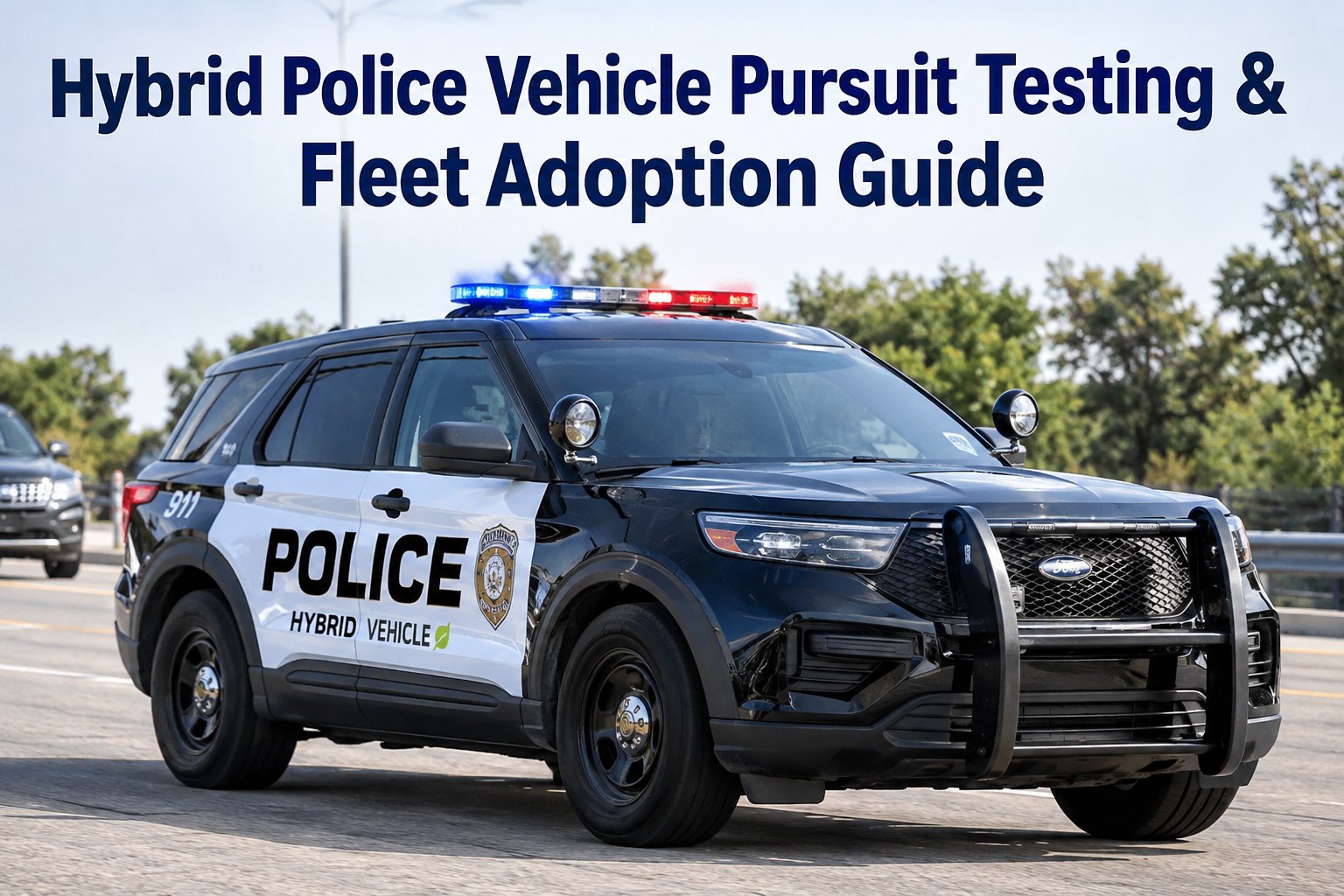
Your patrol cars idle through eight-hour shifts, burn fuel at traffic posts, and still need to pass pursuit certification before they ever hit the road. A hybrid police vehicle like the Ford Police Interceptor Utility Hybrid answers all three problems at once: it has been pursuit-rated by Michigan State Police testing since 2018, it delivers roughly 24 mpg combined versus about 17 mpg for the gas-only version, and agencies report fuel savings in the region of $2,800 per car per year at municipal fuel rates. The catch is that a dual-powertrain patrol car doubles your maintenance tracking workload - the gas engine still needs its 10,000-mile service while the high-voltage battery system runs on a 100,000-mile horizon with an 8-year/100,000-mile warranty to protect. This guide walks you through the pursuit-test data, the real total cost of ownership, and the preventive maintenance structure that keeps a hybrid fleet audit-ready, plus how to book a 30-minute demo to see dual-powertrain PM scheduling running on your own units.
Hybrid Police Fleet Adoption Guide
Is a hybrid patrol car actually ready for pursuit duty - and what does it cost you if the PM plan is wrong?
Michigan State Police has pursuit-rated the Ford Interceptor Utility Hybrid every year since 2018. The fuel math works. The only variable left is whether your shop can track two powertrains per unit without dropping intervals.
The Numbers That Decide Adoption
Hybrid patrol fuel savings and TCO at a glance
Four figures your budget committee will ask for before approving a single hybrid unit. Each one ties directly to cost, uptime or warranty risk.
Combined fuel economy
Versus roughly 17 mpg on the gas-only Interceptor. At 20,000 patrol miles a year, that gap is about 340 gallons saved per unit annually.
MSP pursuit-rated since
The hybrid has passed Michigan State Police acceleration, braking, dynamics and pursuit-course testing every model year since introduction.
HV battery warranty
The high-voltage battery carries an 8-year/100,000-mile warranty - but only if your service records prove the cooling and inspection schedule was followed.
Per unit, not one
ICE service every 10,000 miles plus hybrid-system checks on a 100,000-mile horizon. Miss one track and you risk both downtime and warranty disputes.
Fleet Rollout Plan
How to run a hybrid police vehicle pilot in 90 days
A structured pilot beats a fleet-wide leap. Four phases, each with a measurable gate before you move on.
Days 1-15: Baseline your gas units
Pull 12 months of fuel, idle-hour and maintenance data from your current Interceptors. You cannot prove hybrid savings without a clean "before" picture. Log idle hours separately - patrol cars often idle 60% of engine-on time, and that is where hybrids save the most.
Days 16-45: Deploy 2-4 hybrid units
Assign them to your highest-mileage beats first. Set up digital daily inspections that cover both powertrains: engine fluids and belts plus battery cooling vents, inverter coolant and under-hood orange-cable checks. Officers log defects with photos from the phone they already carry.
Days 46-75: Track cost per mile weekly
Compare fuel cost per mile, unplanned work orders and downtime hours against your gas baseline. Watch for hybrid-specific items: 12V battery drain from upfit equipment, cooling-system fault codes, regenerative-braking wear patterns on pads and rotors.
Days 76-90: Decision gate
Present cost-per-mile delta, projected annual savings per unit and any downtime events to your command staff or council. If the pilot saved even $700 per car in one quarter, the annualized case for fleet-wide adoption writes itself. You can walk through a live pilot dashboard on a demo call before your gate review.
Dual-Powertrain Maintenance
The two-track PM schedule every hybrid patrol car needs
A hybrid is not one vehicle on one schedule - it is two systems aging at different speeds. Split your preventive maintenance this way and nothing falls through.
Track A: Gas engine - every 10,000 miles
- Oil and filter change - severe-duty interval, not the civilian schedule
- Brake inspection - hybrids wear pads slower, but rotors still rust from light use
- Coolant, belts, hoses and air filter
- Tire rotation and pursuit-rated tire wear check
- Upfit load test: light bar, radio, laptop, camera draw on the 12V system
Track B: Hybrid system - to 100,000 miles
- HV battery cooling intake and filter cleaning - blocked vents kill pack life
- Inverter coolant level and condition check
- Orange-cable and connector visual inspection for chafing or corrosion
- Diagnostic scan for stored hybrid fault codes at every Track A visit
- Warranty documentation: every check timestamped to protect the 8-yr/100K coverage
In HVI you build this as two linked PM templates on one asset: mileage-triggered for Track A, mileage-plus-date-triggered for Track B, with due and overdue alerts to the shop foreman. Agencies that start logging hybrid inspections free typically have both templates live in the first afternoon.
Total Cost of Ownership
Hybrid patrol TCO: where the money actually moves
A worked example for a 25-car municipal fleet running 20,000 miles per car per year at a municipal fuel rate of $3.50 per gallon.
| Cost line | Gas Interceptor | Hybrid Interceptor | Annual delta per car |
|---|---|---|---|
| Fuel (20,000 mi/yr) | ~1,176 gal = $4,116 | ~833 gal = $2,916 | -$1,200 |
| Idle-hour fuel burn | High - engine runs all shift | Low - engine cycles off at post | -$1,600 (typical) |
| Brake service | Pads 1-2x per year | Regen braking extends pad life | -$150 to -$300 |
| Hybrid-system maintenance | n/a | Cooling, scans, coolant checks | +$100 to +$200 |
| Purchase premium | Base price | Higher upfront (amortized) | Recovered in ~2-3 yrs |
Net result: roughly $2,800 saved per car per year, or about $70,000 annually across a 25-car fleet - enough to fund an additional unit every two years from fuel savings alone. The fleets that capture this number cleanly are the ones tracking fuel and work orders in one system rather than reconciling fuel cards against paper logs. If you want that reconciliation automated, book a demo and see fuel-plus-work-order reporting on a single dashboard.
See HVI running on your own fleet - book a 30-minute demo
We will load a dual-powertrain PM template, a patrol-car DVIR and a cost-per-mile report before the call, using your unit count.
How HVI Helps
Built for fleets that run two powertrains per unit
Four HVI capabilities mapped to the exact problems a hybrid police fleet creates.
Dual PM scheduling
Mileage, date and engine-hour triggers on the same asset. Track A fires at 10,000 miles, Track B at its own interval - due and overdue alerts go to the foreman before either lapses.
Photo-backed digital DVIR
Officers complete shift-start inspections on any phone in under five minutes. A photo of a cracked orange cable or blocked battery vent becomes a timestamped work order instantly - no paper, no group-chat pictures.
Warranty-proof records
Every hybrid-system check is timestamped, photo-backed and exportable in seconds. When a battery claim hits year six of the 8-year warranty, your service history ends the dispute instead of starting one.
Cost-per-mile analytics
Fuel entries, work orders and parts costs roll up per unit, so your pilot-vs-baseline comparison is a report, not a spreadsheet project. Council-ready numbers in one export.
Adoption Concerns, Answered
Hybrid patrol myths vs what the test data shows
The concern
"A hybrid cannot handle pursuit speeds or hard braking."
The record
Michigan State Police has pursuit-rated the Interceptor Utility Hybrid every year since 2018, including acceleration, top-speed, braking and vehicle-dynamics courses. It passes the same battery of tests as every gas unit on the approved list.
The concern
"The battery will die mid-shift with all our upfit equipment running."
The record
The hybrid system was engineered for police idle loads - the engine cycles on automatically to maintain charge. The real failure point is the 12V battery under heavy aftermarket draw, which is why upfit load testing belongs in every 10,000-mile service.
The concern
"Our shop is not certified for high-voltage work, so maintenance will stall."
The record
Routine hybrid PM - cooling intakes, coolant levels, visual cable checks, code scans - is standard technician work with the right inspection checklist. High-voltage repairs go to the dealer under the 8-yr/100K warranty, and your job is documentation, not disassembly.
Key Takeaways
What to tell your command staff or council
- Pursuit readiness is settled. MSP testing since 2018 means the hybrid police vehicle question is no longer "is it capable" but "can we maintain it properly."
- The fuel case is strong. 24 mpg vs 17 mpg plus idle reduction lands near $2,800 per car per year at municipal rates - about $70,000 annually for a 25-car fleet.
- Maintenance is the real variable. Two PM tracks per unit, warranty-sensitive hybrid documentation and 12V upfit checks decide whether the TCO math survives contact with your shop.
- Pilot first, scale on data. A 90-day, four-unit pilot with clean baseline data gives you a defensible fleet-wide decision.
- Software carries the load. A CMMS that handles dual schedules, photo DVIRs and cost-per-mile reporting turns hybrid adoption from an admin burden into a report you export. You can sign up free and build your first hybrid PM template today.
"My gripe was never the hybrids - it was the paperwork. We had gas cars on one spreadsheet and the hybrids on a second one, and I missed a battery-cooling service by 4,000 miles because nobody owned the second sheet. Now both schedules live on the unit record and my phone buzzes before anything goes overdue. The number I watch is cost per mile: our hybrids run 14 cents a mile cheaper than the gas cars, and I can prove it in one click when the chief asks."
Daniel Reyes - Fleet Manager, mid-size municipal police fleet
Common Questions
Hybrid police vehicle FAQ
Is the Ford Interceptor Utility Hybrid really pursuit-rated?
How much fuel does a hybrid patrol car actually save?
What maintenance does the hybrid system add?
What happens if the high-voltage battery fails?
How should we structure a hybrid fleet pilot?
Run your hybrid fleet on one schedule, one record, one dashboard
Dual-powertrain PM templates, photo-backed patrol DVIRs and cost-per-mile reporting - set up for your unit count before your first call ends.
Free to start - Works on any phone - No card needed