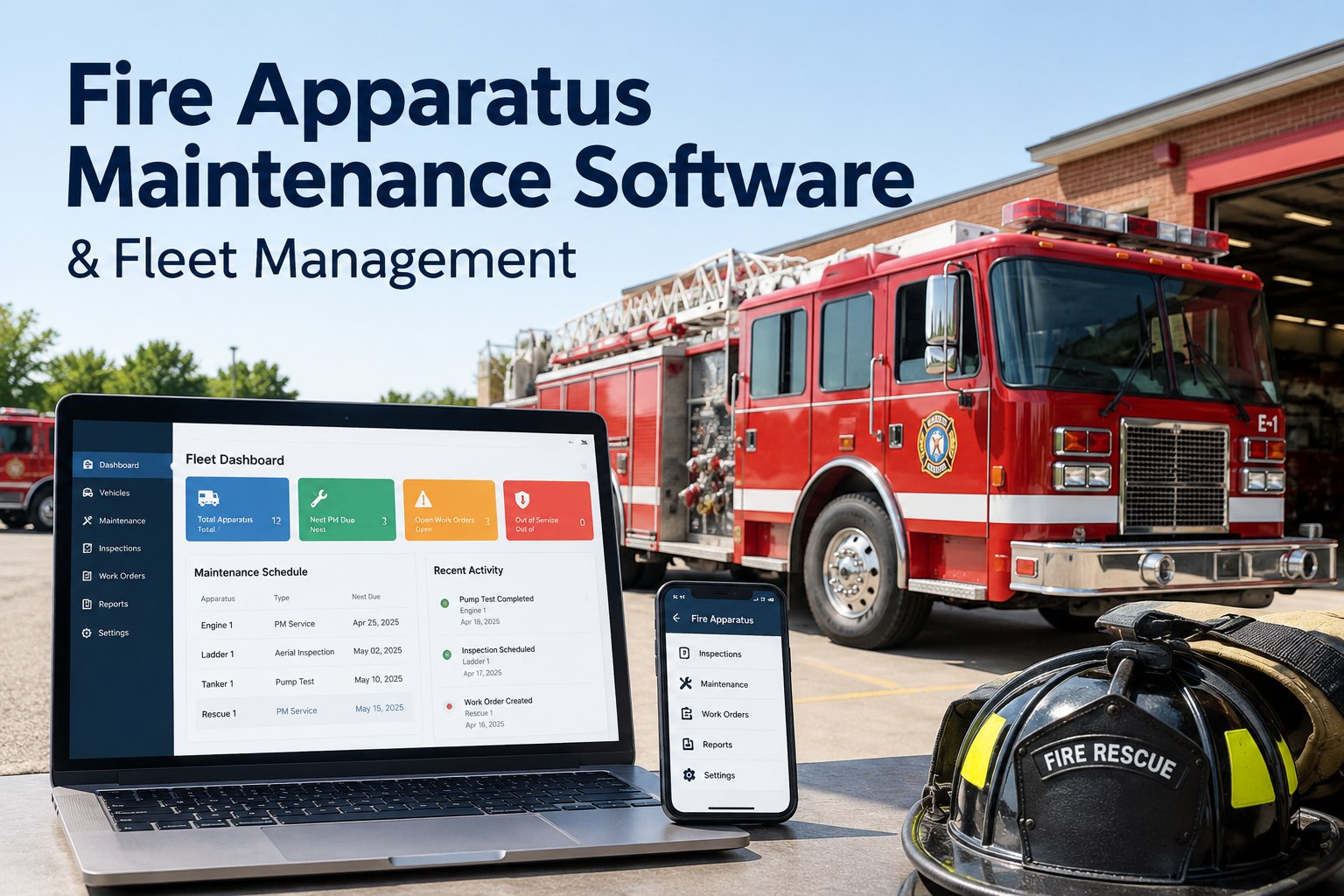
A fire engine can sit at 12,000 miles and still be one of the hardest-worked vehicles your government owns — because the odometer doesn't count the hours it idles at a scene with the pump wide open. And unlike almost any other fleet vehicle, an apparatus has to prove it still works on a fixed schedule: an annual pump test, aerial load tests, ladder and hose testing, all under NFPA 1911. Miss one and you're running a half-million-dollar truck that can't document its own readiness. Good fire apparatus maintenance software tracks the wear you can't see and the tests you can't skip, in one place. Book a demo to see the fire fleet dashboard.
Fire apparatus don't fail on mileage — they fail on missed tests and idle hours
Ordinary fleet software watches the odometer. An apparatus needs three things a mileage tracker can't give it: hour-based service for a truck that wears at idle, a certification-testing calendar that's effectively mandatory, and a daily crew check tied to response activity. Track only miles and you miss all three.
That combination is what makes fire department fleet management its own discipline. Below is why the low-mileage, high-hour profile drives maintenance, the certification-testing calendar that governs an apparatus's whole year, how the daily crew check fits, and how one dashboard turns all of it into provable readiness a chief can stand behind.
The low-mileage, high-engine-hour reality
Here's the profile that breaks mileage-based scheduling. A pumper responds a few miles to a scene, then runs its engine hard for an hour or more driving the pump — drawing water, building pressure, doing the actual work — all while the odometer sits still. Reserve units, tankers, and brush trucks can go a whole year barely moving and still accumulate real wear from testing, training, and idle. The truck ages; the odometer lies.
The practical shift is simple to state and hard to do on paper: schedule apparatus PM on engine hours and calendar alongside mileage, matched to how hard each unit actually works, and let whichever interval comes due first trigger the service. Book a demo to see hour-based PM per apparatus
The certification-testing calendar you can't skip
This is what truly sets fire apparatus apart from every other vehicle in a government fleet. Beyond routine PM, an apparatus must periodically prove it still performs — through formal tests under NFPA 1911. These aren't optional maintenance; they're pass/fail certifications, and a lapsed or failed test can pull the unit from service and, in some cases, affect insurance coverage. Each has its own interval and its own record.
Annual pump test
A documented test proving the pump delivers at least its rated capacity from draft, run through a series of performance points. It catches wear, seal failures, and flow degradation before the pump fails at a fire — required annually under NFPA 1911.
Aerial device inspection & load test
Inspection and load testing of aerial ladders, elevating platforms, and water towers. A structural and functional certification on the most safety-critical moving system a department operates — degradation here is catastrophic, so it's tested and certified on schedule.
Ground ladder testing
Ground ladders carried on apparatus require their own periodic testing for structural integrity. A separate record from the aerial device, with its own schedule — a set of assets easy to overlook precisely because they're not the truck itself.
Hose testing
Fire hose is service-tested to confirm it withstands operating pressure without failure. A hose that bursts under pressure is a serious liability and a failed operation — so each length is pressure-tested and recorded on its own interval.
The danger with all four is the same: they're calendar-driven certifications that live or die on a date, and a paper log or spreadsheet is exactly where a due date slips until an ISO rating review or a post-incident investigation finds the gap. Staged alerts — 90, 60, and 30 days out — are what keep a test scheduled ahead of its lapse. Book a demo to see the NFPA test calendar per apparatus Start free and track every NFPA test date with staged alerts
The daily check: readiness tied to runs, not a fixed clock
Between the annual tests and the hour-based PM sits the check that happens most often: the daily and weekly crew inspection. NFPA 1911 frames it around activity — a check within 24 hours of a response run, or at least weekly, whichever comes more often. That's a different rhythm than a calendar reminder, and it's the frontline that catches a problem before the next call, not the next quarter.
- Fluids, tires, brakes, steering
- Warning lights, siren, air system
- Battery and charging state
- Body walkaround, leaks, damage
- Pump engages and holds pressure
- Primer, valves, gauges function
- Tank level, foam system if fitted
- No leaks at connections
- Inventory present and secured
- SCBA, tools, hose loads
- Ladders seated and locked
- Powered equipment functional
Done as a guided mobile check, the crew moves through vehicle, pump, and equipment in order, nothing gets skipped, and equipment inventory is verified in the same pass — so a missing tool or a soft pump is caught at the station, not discovered on the fireground. Any failed item routes straight to the shop as a work order with the apparatus ID attached. Book a demo to see a guided apparatus check
One dashboard: from defect to work order to readiness
The reason to bring PM, testing, equipment, and daily checks into one place isn't tidiness — it's that an apparatus's readiness depends on all of them at once, and a chief needs to see it without walking to the shop. When everything lives in one system, a defect flows through a visible loop and readiness updates in real time across the whole department.
For a government fleet running fire apparatus alongside ambulances, police vehicles, and public-works equipment, one platform handling every vehicle type — each with its own templates, intervals, and certificates — removes a real source of audit risk and gives department leaders one readiness view instead of a binder per station. And because in-service apparatus maintenance and recordkeeping tie back to standards like NFPA 1911 and to systematic maintenance requirements, keeping that record digital and complete is compliance insurance as much as day-to-day clarity. Start free and roll apparatus readiness up department-wide
From a fire department fleet manager who ended the spreadsheet scramble
Our pump test dates lived in one spreadsheet, aerial certs in another, and the daily checks were paper on a clipboard in each rig. It worked until it didn't — we came within a week of running an engine with a lapsed pump certification, and only caught it because someone happened to flip to the right tab. On a half-million-dollar truck, "someone happened to notice" is not a system.
Putting the hour-based PM, every NFPA test date, and the equipment inventory in one place with alerts changed how I run the fleet. I get 90, 60, and 30-day warnings before a test is due, the daily checks feed straight into work orders, and I can pull up any apparatus and show a chief or an auditor exactly where it stands. The readiness board is the first thing I look at every morning now.
Frequently asked questions
Why isn't mileage-based fleet software enough for fire apparatus?
Because fire apparatus wear and readiness are driven by factors mileage simply doesn't capture. A pumper may respond only a few miles to a scene and then run its engine hard for an hour or more driving the pump, accumulating significant engine, cooling, and driveline wear while the odometer barely moves. Reserve units, tankers, and brush trucks can go nearly a full year without much mileage yet still age from idle, testing, and training. On top of that wear profile, fire apparatus carry a certification-testing burden no ordinary vehicle has — annual pump tests, aerial device load tests, ground ladder testing, and hose testing under NFPA 1911 — which are calendar-driven and effectively mandatory, not mileage-driven. And the daily readiness check is tied to response activity, framed as within 24 hours of a run or at least weekly, rather than a fixed odometer interval. Mileage-based software watches only one of these dimensions and misses the other three, which is how apparatus end up overdue for hour-based service or, worse, running with a lapsed certification. Fire department fleet management needs hour-based and calendar-based scheduling, certification-date tracking, and activity-tied daily checks all together, which is exactly what generic mileage-focused tools don't provide.
What does NFPA 1911 require for fire apparatus maintenance?
NFPA 1911 is the Standard for the Inspection, Maintenance, Testing, and Retirement of In-Service Automotive Fire Apparatus, and it sets the minimum requirements for keeping in-service apparatus safe and ready. In broad terms it covers several layers. First, routine daily and weekly visual and operational checks — performed within 24 hours of a response run or at least weekly, whichever is more frequent — covering fluids, lights, warning devices, air and pump systems, and onboard equipment. Second, more detailed periodic inspections and preventive maintenance performed by technicians on a schedule appropriate to the apparatus and its activity. Third, formal performance testing: an annual pump test proving the pump delivers its rated capacity, periodic aerial device inspection and load testing, and related testing of components. Ground ladders and fire hose carry their own testing requirements under related standards. The standard also addresses documentation and record retention demonstrating the apparatus was maintained and fit for service. It's worth noting that NFPA 1911 establishes minimum requirements, and departments should set actual intervals and program details based on manufacturer recommendations, apparatus configuration, call activity, and their own risk assessment. Non-compliance carries real consequences, since maintenance and testing gaps can affect insurance and surface during ISO rating reviews or post-incident investigations. Always work from the current edition of the applicable standards for your jurisdiction.
How often does a fire pump need to be tested?
Under NFPA 1911, fire pumps require an annual service test, in addition to the routine operational checks a crew performs much more frequently. The annual pump test is a documented performance test that proves the pump can deliver at least its rated capacity from draft, run through a defined series of pressure and flow points, and it's designed to reveal wear, seal failures, and performance degradation before the pump fails to deliver required flow and pressure during actual firefighting. Because it's a pass/fail certification tied to a date, a lapsed or failed annual pump test can take an apparatus out of service and can have insurance and rating implications. Alongside the annual formal test, crews should verify pump function during their daily or weekly checks — confirming the pump engages, holds pressure, and that primer, valves, and gauges operate — so that a developing problem is caught between annual tests rather than only at the next scheduled test. The exact test procedure and any additional intervals should follow the current NFPA standard and the pump manufacturer's requirements. Tracking the annual test date with advance alerts, and storing the test results and certificate against the apparatus record, is what keeps a department from discovering a lapse at the worst possible moment.
How should aerial ladders and ground ladders be tracked?
They should be tracked as distinct tested assets, each with its own inspection and testing schedule and its own certification record, separate from the apparatus chassis PM. Aerial devices — aerial ladders, elevating platforms, and water towers — require periodic inspection and load testing that verifies the structural and functional integrity of the most safety-critical moving system a department operates; degradation of an aerial device is potentially catastrophic, so its testing and certification cannot be allowed to lapse. Ground ladders carried on apparatus are a separate matter with their own periodic structural testing requirement, and because they're not the truck itself they're easy to overlook in a vehicle-centric maintenance program. The right approach is to treat each aerial device and each ground ladder set as tracked assets linked to their apparatus, with test dates, results, and certificates stored against them and advance alerts before each test comes due. This prevents the common failure where the chassis is well maintained but a ladder or aerial certification quietly expires, which is exactly the kind of gap that surfaces during an ISO review or after an incident. As with all apparatus testing, follow the intervals and procedures in the current applicable NFPA standards and the manufacturer's requirements.
Can one system manage fire apparatus and other government fleet vehicles?
Yes, and for a municipal or government fleet that's a major advantage rather than just a convenience. Public agencies typically operate a mix of vehicle types — fire apparatus, ambulances, police vehicles, and public-works equipment — each with very different inspection templates, maintenance intervals, testing regimes, and compliance requirements. Managing each type in its own spreadsheet, paper system, or siloed tool creates audit risk because records are scattered and inconsistent, and it hides fleet-wide readiness behind department boundaries. A single fleet maintenance platform with configurable templates by vehicle type lets a fire engine carry its hour-based PM, its NFPA pump and aerial test dates, and its equipment inventory, while an ambulance carries its own module and medical-equipment records and a plow truck carries its seasonal checks — all in one system. The benefit for leadership is department-level visibility: a fleet director or chief can see readiness across every unit and vehicle type from one dashboard, and every defect flows through the same defect-to-work-order-to-readiness loop regardless of which department owns the vehicle. It also keeps maintenance and testing recordkeeping consistent and audit-ready across the whole fleet, which matters when apparatus records tie back to NFPA 1911 and vehicles are subject to systematic inspection and maintenance requirements. One platform, every vehicle type, one provable readiness picture.
See the fire fleet dashboard in HVI
HVI brings fire apparatus maintenance into one government fleet dashboard — hour-, mileage-, and calendar-based PM, NFPA pump, aerial, ladder, and hose test dates with 90/60/30-day alerts, certificates attached to each asset, equipment inventories, guided daily crew checks, and defect-to-work-order workflows. Department leaders get a provable readiness status per apparatus, across every vehicle type in the fleet. Keep the most expensive trucks you own in service and audit-ready. Live for your department in days.
No credit card · Configurable templates by vehicle type · Onboard in days