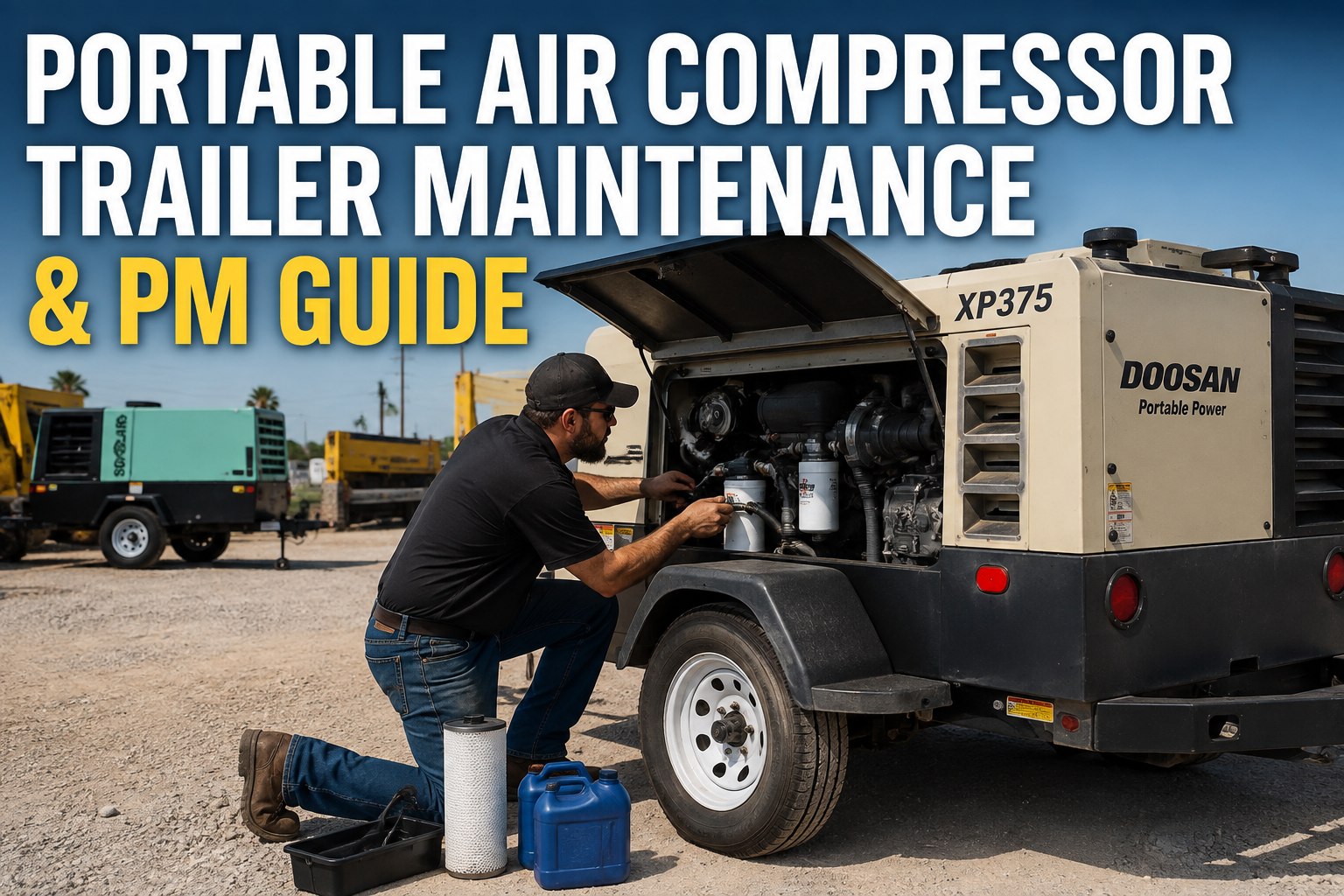
Portable air compressor trailer maintenance is a three-system discipline — airend + engine + towable trailer — running on different hour intervals with different failure modes. Rotary screw airends fail from oil starvation, separator rupture, or dust ingestion; diesel engines follow their own manufacturer PM schedule; DOT-compliant trailers require annual inspection separate from either. Atlas Copco XAS-series baseline schedules run daily checks, 250-hour engine service, 500-hour separator inspection, and 2,000-hour major service for long-life compressor fluid. Missing any one of the three systems produces the failure. Book a demo .
Portable Air Compressor Trailer — The Three-System PM Discipline
Airend, engine, trailer. Different intervals, different failure modes, different consequences when missed. One PM schedule for all three misses two of them.
Rotary screw airend, oil/air separator, compressor oil circuit, air filter, air receiver, safety valves. Failure mode: airend seizure from oil starvation or dust ingestion, separator rupture from missed replacement.
Deutz, John Deere, Kubota, or Cummins depending on model. Follows engine OEM PM schedule (not compressor OEM). Tier 4 Final units include DPF regeneration cycle. Failure mode: standard diesel failures + fuel contamination in remote-site operations.
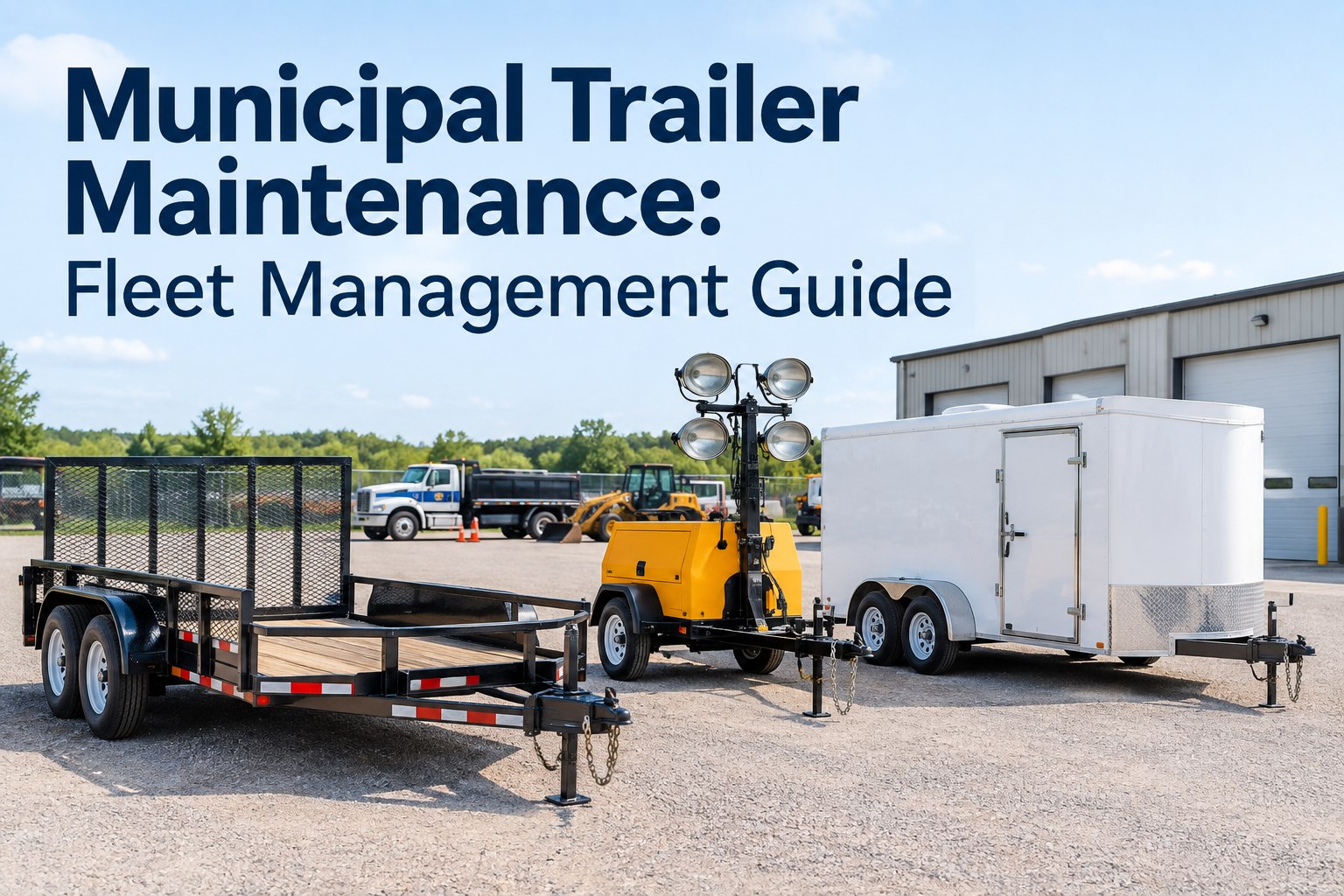
DOT-compliant chassis: axle, brakes (surge or electric), wheels + tires, coupler, safety chains, lights, jack, fenders. Follows DOT annual inspection cycle. Failure mode: wheel bearing failure, brake failure, coupler wear — separate PM track from compressor and engine.
A portable air compressor trailer is really three vehicles sharing a chassis. The rotary screw airend runs on compressor-OEM service intervals (Atlas Copco, Sullair, Doosan, Kaeser); the diesel engine runs on its own OEM schedule (Deutz, John Deere, Kubota, Cummins) commonly at different intervals than the compressor; and the DOT-compliant trailer runs on annual DOT inspection cycles independent of both. Managing the unit as a single PM schedule — the pattern common in construction, oil-and-gas, and municipal fleets where "the compressor is due for service" gets treated as one event — systematically misses two of the three systems. The engine that gets serviced when the compressor does but not when the engine hours actually accumulate fails on a jobsite in month 14; the trailer that never gets a DOT inspection because it's "not a truck" fails at roadside when the operator moves it between sites. Three tracks, three schedules, three records systems is the operational discipline that produces the equipment life the manufacturers advertise.
The compressor track — airend, separator, and the oil discipline that determines equipment lifeRotary screw airend maintenance across Atlas Copco, Sullair, Doosan, Kaeser lineups
The rotary screw airend is the single most expensive component on a portable air compressor and the one most vulnerable to preventable failure. Oil starvation, separator rupture, and dust ingestion account for the majority of airend failures — and all three are addressed by disciplined PM on schedule. Book a demo to see HVI's compressor-side PM tracking
The maintenance: Standard compressor oil at 1,000-hour intervals; long-life compressor fluid (Atlas Copco spec) at 2,000-hour / 2-year intervals. Oil filter replacement at 500 hours; sample analysis at 250 hours for trend detection.
The failure mode: Contaminated or degraded oil accelerates airend wear, produces varnish deposits that restrict cooling, and reduces oil separation efficiency. Oil-starvation events can seize the airend within minutes.
The maintenance: Separator element inspection at 500 hours; replacement at 2,000 hours per Atlas Copco long-service-interval schedule. Signs of degradation include increased pressure differential and oil carryover in delivered air.
The failure mode: Separator rupture releases compressor oil into the compressed air stream, contaminating downstream tools and pneumatic systems. Continued operation with ruptured separator damages the airend and drains the compressor oil reservoir rapidly.
The maintenance: Air filter primary element check daily via restriction indicator; replacement per manufacturer schedule or restriction indicator trigger. Secondary safety element replacement per schedule. Dusty environments require accelerated intervals.
The failure mode: Dust ingestion into the airend produces abrasive wear on the rotor screws — the highest-cost failure category. Ambient dust particularly relevant on construction sites and dusty industrial operations.
The maintenance: Periodic safety valve function test per manufacturer schedule (typically annual or at 1,000-hour service). Pressure regulator function verification; unloader valve operation check.
The failure mode: Failed safety valve on a pressure vessel is a serious safety issue. Regulatory jurisdictions vary on pressure vessel inspection requirements; some require licensed inspector recertification periodically. Verify with local authority for specific requirements.
Environmental-adjusted PM intervals (dust factor, temperature factor, humidity factor) applied per-unit at the shop level produce better airend outcomes than universal OEM defaults. Book a demo to see per-unit interval configuration
The engine track — separate schedule, separate OEM, separate PM recordsDeutz, John Deere, Kubota, Cummins engines each follow their own PM schedule under the compressor OEM's chassis
The diesel engine on a portable air compressor follows the engine OEM's PM schedule, not the compressor OEM's. Atlas Copco XAS-series units with John Deere engines refer operators to the John Deere instruction manual for engine maintenance; other model + engine combinations follow the same pattern. Managing engine maintenance under the compressor schedule commonly produces off-cycle intervals that miss engine service points. Start a free trial to configure engine + compressor PM tracks separately.
Engine oil change per engine OEM schedule (commonly 250 hours for standard-duty diesel). Oil filter replacement with oil change. Sample analysis where used for trend detection. Engine oil is a different fluid specification than compressor oil — the two are not interchangeable.
Coolant level check daily; coolant service per engine OEM schedule (typically 2,000-hour or 2-year interval). Radiator external cleaning — portable units accumulate dust and debris on radiator fins that reduces cooling efficiency and accelerates engine wear.
Primary fuel filter, secondary fuel filter, water separator drain. Remote-site operation increases fuel contamination risk (bulk-tank refills, water ingress from condensation). Fuel filter service intervals commonly shorten for units operating from unsealed fuel sources.
Tier 4 Final units include Diesel Particulate Filter with automatic regeneration cycles. Regeneration frequency, DPF cleaning intervals, and DEF (if applicable) tracking per engine OEM guidance. Extended low-load operation can affect regeneration completion.
Battery voltage check, terminal condition, charging system output. Portable units often sit for weeks between uses — battery draw during storage and cold-crank capacity are more prominent failure modes than for daily-driven equipment. Solar maintainers are common in seasonal storage.
Drive belts, engine hoses, coolant hoses inspected for wear, cracking, chafing at manufacturer schedule. Belt tension verification. Vibration environment on tow-behind equipment accelerates wear compared to stationary installations.
The trailer track — DOT compliance is separate from either the engine or the compressorAnnual DOT inspection, brake system, wheel bearings, lights, and the compliance requirement fleets commonly miss
The DOT-compliant tow-behind trailer under a portable air compressor is subject to the same annual inspection requirements as any commercial trailer under the operator's jurisdiction — and is commonly the maintenance category most missed by fleets that treat the compressor unit as "not really a trailer." A failed DOT inspection at roadside stops the equipment from getting to the job.
Federal Motor Carrier Safety Regulation 49 CFR 396.17 requires annual inspection of commercial motor vehicles including many trailer categories. Applicability depends on GVWR, use, and jurisdiction — confirm specific requirements with qualified DOT compliance counsel for the operator's specific configuration.
Surge brakes (common on smaller units) or electric brakes (larger units). Brake shoe/pad wear, actuator function, hydraulic line condition or electrical wiring integrity. Brake service commonly overlooked because "the compressor doesn't have brakes"; the trailer does.
Wheel bearing repack per manufacturer schedule (commonly annual or per mileage). Bearing failure while towing is a route-ending event with significant safety implications. Grease seal condition and hub temperature during operation are additional indicators.
Tail lights, brake lights, turn signals, marker lights, and DOT reflectors per applicable regulations. Wiring harness inspection for damage from vibration, weather exposure, or hitch chafing. Trailer plug condition and coupling with tow vehicle.
Coupler mechanism function, latch security, ball socket wear. Safety chain condition, hook attachment, correct crossing pattern when coupled. Breakaway switch and battery function on units so equipped. All required per DOT roadside inspection.
Tire tread depth, sidewall condition, pressure per placard, load rating vs actual load. Axle condition, spring/suspension inspection, u-bolts, shackles. Trailer tires commonly have different age-out and inspection considerations than tow-vehicle tires.
DOT annual as a separate calendar-triggered PM record — distinct from the compressor and engine hour-triggered schedules — is the tracking discipline that keeps the trailer track from getting missed. Book a demo to see HVI's DOT annual inspection records
From a construction fleet maintenance supervisor on portable compressor PM
Our first year running 8 portable air compressor units across construction sites, we lost 3 airends and had 2 units red-tagged at roadside for DOT trailer violations. The pattern was the same across every failure: we were tracking the compressor as one asset with one PM schedule. Engine oil never got changed on the units running heavy field hours because the compressor hours and engine hours don't accumulate proportionally — a unit at extended idle for jobsite standby burns engine hours without adding much compressor duty. Trailer inspection just didn't happen because nobody's job description said "the compressor also has DOT trailer requirements."
The fix wasn't a bigger PM budget — it was splitting the tracking into three parallel schedules. Each unit now has three separate PM records in our system: compressor hours for airend service, engine hours for engine service, and calendar date for annual DOT trailer inspection. Same equipment, same crew — different tracking discipline. Two years in, we've had 0 airend failures and 0 DOT roadside issues on the compressor fleet. The economics on the three separate schedules pay back the first prevented airend rebuild.
Frequently asked questions
What are the PM intervals for a portable air compressor?
Portable air compressor PM intervals span three parallel schedules. Compressor side (Atlas Copco XAS baseline representative of industry practice): daily fluid checks and walk-around; 50-hour initial break-in service; 250-hour oil sample and compressor filter check; 500-hour compressor oil filter and separator inspection; 1,000-hour standard-fluid oil change; 2,000-hour / 2-year long-life fluid change, oil filter replacement, and separator element replacement per Atlas Copco specification. Engine side follows the engine OEM schedule (Deutz, John Deere, Kubota, Cummins depending on model) — commonly 250-hour oil and filter changes for standard-duty diesel, coolant service at 2,000 hours or 2 years, fuel filter per OEM interval. Tier 4 Final units add DPF regeneration cycles and DEF monitoring where applicable. Trailer side follows DOT annual inspection cycle including brake service, wheel bearing repack (commonly annual), light and coupler inspection, and tire condition. Every model has specific manufacturer-published intervals in the operator manual; the ranges above reflect Atlas Copco XAS-series industry-representative intervals for reference. Operating environment (dust, temperature, humidity) can substantially shorten recommended intervals per Atlas Copco environmental impact guidance.
Why are portable compressors managed as three systems instead of one?
A portable air compressor trailer combines three fundamentally different equipment systems under one chassis: the rotary screw airend running on compressor OEM service intervals (Atlas Copco, Sullair, Doosan, Kaeser), the diesel engine running on its own OEM schedule (Deutz, John Deere, Kubota, Cummins commonly), and the DOT-compliant tow-behind trailer running on DOT annual inspection cycles. Managing the unit as a single "the compressor is due for service" PM event systematically misses two of the three systems. Engine hours and compressor hours don't accumulate proportionally — a unit at extended idle for jobsite standby burns engine hours without adding compressor duty; a unit running compressor-intensive work adds compressor hours without proportional engine hours. Scheduling one against the other produces off-cycle service on both. DOT trailer inspection is a compliance requirement separate from either equipment PM schedule — commonly missed by fleets treating the compressor as "not a trailer." Fleets that split tracking into three parallel PM schedules (compressor by compressor-hour meter, engine by engine-hour meter, trailer by annual calendar) consistently report fewer airend failures and fewer DOT roadside issues than fleets running unified schedules. Three tracks, three schedules, three records systems is the operational discipline that matches the equipment's actual PM requirements.
What is the most common cause of portable compressor airend failure?
Three failure categories account for the majority of preventable rotary screw airend failures on portable air compressors, and all three are addressed by disciplined PM on schedule. Oil starvation: the highest-consequence airend failure, produced by low compressor oil level, degraded oil losing lubricating properties, or oil-cooling system failure allowing oil temperatures to exceed rated limits. Airend seizure can occur within minutes of oil starvation onset. Separator element rupture: missed replacement of the oil/air separator (Atlas Copco baseline: 2,000-hour or 2-year interval) can produce element failure that releases compressor oil into the compressed air stream, damages the airend, and drains the oil reservoir. Dust ingestion: air intake filter neglect allows abrasive particles to enter the airend, producing accelerated wear on the rotor screws. Construction sites, mining operations, and other dusty environments substantially accelerate this failure mode — air filter intervals should be shortened for units in dusty operation, and restriction indicators should be checked daily. Environmental factors (ambient temperature, humidity, dust) substantially affect all three failure categories per Atlas Copco environmental impact guidance; operating environment should inform PM interval adjustment rather than treating manufacturer-published intervals as universal.
Do portable air compressor trailers require DOT inspection?
DOT annual inspection applicability for tow-behind portable air compressor trailers depends on the trailer's Gross Vehicle Weight Rating, the operating jurisdiction, and how the equipment is used. Federal Motor Carrier Safety Regulation 49 CFR 396.17 requires annual inspection of commercial motor vehicles including many trailer categories used in commercial operation; state and local regulations may add requirements. The specific applicability determination for a given portable compressor trailer configuration should be confirmed with qualified DOT compliance counsel — not through internal interpretation. That said, the operational reality across most commercial fleets running portable air compressor trailers is that DOT annual inspection is required, and it's a compliance category commonly missed by fleets treating the compressor unit as "not really a trailer" for maintenance planning purposes. Missing DOT inspection produces roadside compliance issues that stop the equipment from reaching the jobsite regardless of compressor or engine condition; failed inspection at roadside also produces out-of-service orders that require correction before the unit can be moved. DOT trailer inspection should be scheduled as a recurring event separate from either the compressor OEM's PM schedule or the engine OEM's PM schedule. Specific compliance obligations for a specific fleet should be confirmed against current FMCSA regulations and qualified counsel.
How does HVI support portable air compressor trailer PM?
HVI provides the multi-system PM scheduling, inspection template, defect capture, work order routing, fluid sample tracking, and DOT trailer inspection records layer supporting portable air compressor trailer maintenance across the three-track schedule. Features that apply to portable compressor fleet workflows include: separate PM scheduling per system with independent hour tracking (compressor hours for airend service, engine hours for engine service tracked separately, DOT annual calendar for trailer inspection); configurable inspection templates for each system with the specific checklist items and defect criteria per subsystem; defect capture with photo evidence and severity classification; work order routing from defect to repair; fluid sample tracking supporting oil analysis programs for both compressor oil and engine oil trend detection; parts consumption records for filters, separator elements, belts, hoses, and other consumables; and searchable multi-year per-unit maintenance history supporting warranty documentation, budget planning, and equipment lifecycle decisions. HVI is not itself a compressor OEM authority (Atlas Copco, Sullair, Doosan, Kaeser), engine warranty authority, airend rebuild service, DOT roadside inspection authority, or DOT compliance counsel — those functions remain with equipment manufacturers, authorized service centers, qualified inspectors, and specialized compliance professionals. What HVI provides is the digital PM scheduling and inspection records infrastructure that turns the three-parallel-tracks discipline into an operational reality rather than an aspirational plan.
One PM schedule misses two of three systems — the three-track discipline is what matches the equipment's actual PM requirements
HVI schedules compressor, engine, and trailer as three parallel PM tracks with separate hour meters, separate templates, and separate records — producing the maintenance records infrastructure that keeps airends running, engines serviced on their own schedule, and trailers current on DOT annual inspection.
No credit card · No hardware · Setup in minutes