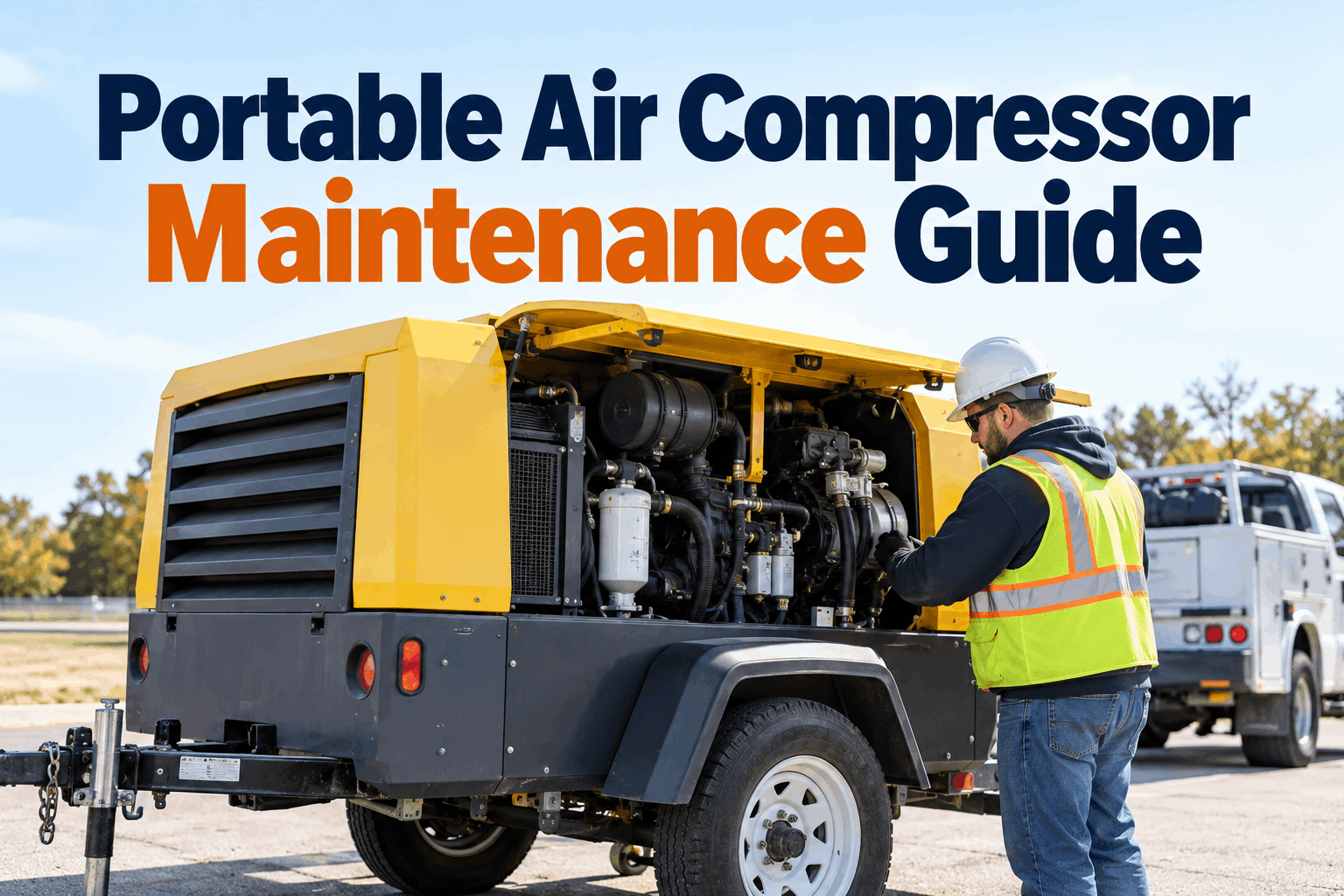
Portable air compressor maintenance is where a lot of municipal fleets quietly lose money — not because the machine is complicated, but because nobody's quite sure who owns it. A towable unit is a diesel engine, a compressor, and a road trailer bolted into one package, and it usually gets parked between jobs, run hard when it's finally needed, and serviced only when it quits on a crew. Treat it as one managed asset instead of an orphan in the yard, and it stops being the thing that strands a line crew at 7am. Here's how — book a quick walkthrough as you read.
One unit. Three machines to maintain.
A portable compressor hides three maintenance jobs in one towable frame — a diesel engine, a compressor airend, and a road chassis. Skip any one of them and the whole unit leaves a crew waiting. Managed as a single asset, it just works.
Most fleets inherit portable compressors the way they inherit light towers and pumps — useful, shared across departments, and nobody's clear favorite. Water and sewer borrows it, the paving crew borrows it, it sits for three weeks, then it's expected to make 185 CFM at full pressure the morning a main breaks. That shared, on-and-off life is exactly why these units fail early: hours pile up without anyone tracking them, fluids go stale, the trailer side never gets looked at, and a small flagged issue becomes a roadside breakdown with a crew standing around. The fix isn't more complicated maintenance — it's treating each compressor as a complete asset with a schedule, a history, and one place the whole fleet looks. This guide walks through what that takes.
Why a portable air compressor is really three assets in onewhere portable air compressor maintenance actually splits
The reason these units get neglected is that no single trade owns the whole thing. The diesel mechanic looks at the engine, nobody owns the airend until it fails, and the trailer side gets treated like it isn't a trailer at all. Good portable compressor maintenance starts by naming all three domains and giving each one a schedule.
1 · The diesel engine
Oil and filter, coolant, fuel and the fuel-water separator, air intake, belts and battery. Standard diesel PM — but tied to the compressor's run hours, not a truck's odometer, which is where it slips.
2 · The compressor airend
The heart of a rotary-screw unit: compressor fluid, the oil filter, and the air-oil separator element that keeps oil out of your air. Neglect it and you get oil carryover, high temps, and a rebuild bill.
3 · The towable chassis
Wheel bearings, tires, lug torque, brakes, lights, coupler and safety chains. The half that's most neglected because people see "a compressor," not a trailer that has to survive the highway.
When all three live on one asset record, the engine, the airend, and the chassis share one run-hour clock and one history — so a 500-hour service means all the right items at once, not three separate half-remembered jobs. Start a free service log for one unit and you'll see how fast the picture clears up.
The portable air compressor maintenance schedule that holds upan hours-based air compressor PM schedule across all three domains
A workable air compressor maintenance schedule is built on operating hours, not the calendar, because a shared municipal unit might run 400 hours one month and sit the next. Always follow your OEM manual for exact intervals and fluid specs — but the shape of a solid preventive maintenance plan looks like this. Think of it as the backbone of your preventive maintenance program, applied to every compressor in the pool.
| Interval | Engine | Compressor / airend | Trailer / chassis |
|---|---|---|---|
| Daily / pre-use | Oil & coolant level, drain fuel-water separator, visual leaks | Fluid level, listen for knocks, check air temp & pressure build | Tire pressure & condition, lug nuts, lights, coupler & chains |
| ~250 hours | Engine oil & filter (per OEM), inspect belts, clean intake | Inspect airend fluid & lines, check separator pressure drop | Inspect brakes, re-check lug torque, grease points |
| ~500 hours | Fuel filter, air filter element, cooling-pack clean-out | Compressor fluid & oil filter change (fluid type dependent) | Inspect wheel bearings, suspension, safety-valve test |
| ~1,000 hours | Valve & injector check per OEM, coolant service | Air-oil separator element, hoses, min-pressure valve | Repack / replace wheel bearings, brake service |
| Annual | Full engine service, battery & charging test | Pressure-vessel & relief-valve inspection, full airend check | DOT-style trailer inspection, frame, fenders, wiring |
The two line items that cost fleets the most when missed are the compressor fluid and the separator element — stale fluid runs hot and carries oil into the air supply, and a clogged separator quietly robs efficiency and fuel. Both are rated in hours, which is exactly why an hours-based trigger beats a sticky note. You can see how an hours-based PM schedule runs in HVI across a whole fleet.
The half everyone forgets: the towable chassistowable air compressor maintenance below the frame
Ask most crews about compressor maintenance and they'll talk fluids and filters. Almost nobody mentions the trailer — and that's precisely where the dangerous failures hide. A seized wheel bearing or a tire that's aged out doesn't just strand the unit; it can come apart at highway speed on the way to the job. The running gear deserves the same discipline as the engine.
Before every tow
- Tire pressure, tread and sidewall condition — check the date code, not just the tread
- Lug nuts torqued to spec (they loosen after the first miles on a reinstalled wheel)
- Coupler latched and locked, safety chains crossed, breakaway cable connected
- All lights and reflectors working — brake, turn, running
On the PM cycle
- Repack or replace wheel bearings on interval — the single most-missed trailer item
- Inspect and service brakes if equipped; test the breakaway system
- Check suspension, springs and frame for cracks, rust and fatigue
- Grease the jack and coupler; inspect wiring harness for chafing
If you want the deep version of this, HVI's portable air compressor trailer PM guide breaks the running gear down further, and the daily compressor checklist covers the pre-use walkaround. The point of digitizing them is simple: see how trailer inspections get logged so a flagged bearing can't be forgotten between the yard and the highway.
From inspection to work order to service recordwhere compressor maintenance software earns its place
A schedule and a checklist only matter if what they find actually gets fixed and recorded. The gap in most municipal yards isn't knowing what to check — it's what happens after a tech notices a weeping hose or a soft tire. On paper, it gets written on a form that ends up in a glovebox. The workflow that closes that loop looks like this.
Inspect
Operator or tech runs the digital inspection from a phone — engine, airend and chassis in one pass, with photos.
Flag the defect
A failed item becomes a tracked defect instantly — not a note that disappears. Severity and photo attached.
Work order
One click turns the defect into a work order with parts and labor, assigned to a tech — nothing re-typed.
Service record
The repair closes into a permanent, signed history on that compressor's asset record — audit-ready.
That's the whole value of running this through maintenance management instead of paper: the inspection that catches a problem and the work order that fixes it live on the same asset, so the history is complete and nothing falls through the cracks. Watch a defect turn into a work order end to end.
From an equipment manager who runs a shared pool
Our compressors were the Wild West. Three departments used them, nobody logged hours, and we'd find out a unit needed a bearing when it was already on a flatbed coming back from the shoulder. The engine always got some attention because we have diesel guys — the airend and the trailer, forget it.
Putting each one on its own asset with an hours-based schedule was the whole fix. Now the 500-hour service hits the fluid, the separator and the running gear together, and when an operator flags something it's a work order before the unit's even back in the yard. We haven't lost a compressor to a roadside bearing since. It's not fancy — it's just that nothing gets forgotten anymore.
Managing a whole fleet of portable compressorsfrom one unit to a municipal compressor fleet
One compressor on a schedule is good discipline. A dozen of them, shared across water, sewer, streets and parks, is a management problem — and that's where treating them as real assets pays off. Instead of chasing each unit's paper trail, you get the whole pool on one screen.
Hours tracked per unit
Each compressor accrues its own run hours, so PM triggers fire on the unit that actually earned them — not a blanket calendar date.
Defects visible across sites
A flag raised by a crew at one site is visible to the shop immediately, wherever the unit is parked — no glovebox forms.
Full history per asset
Every service, part and inspection lives on the unit, so you know its real condition and cost before you repair or retire it.
Parts & cost in one place
Tie filters, fluid and separator elements to each work order so parts and inventory and true cost-per-unit are visible.
This is the same connected approach municipal fleets use for the rest of their government fleet equipment — portable compressors just finally join it instead of living as orphans in the yard. Spin up an asset record for each compressor free and build the history from today forward.
Portable air compressor maintenance — FAQs
How often should a portable air compressor be serviced?
Service by operating hours, not the calendar, and follow your OEM manual for exact figures. A typical rhythm is daily pre-use checks, a minor engine service around 250 hours, compressor fluid and filters near 500 hours, the air-oil separator element around 1,000 hours, and a full engine, airend and trailer inspection annually. A shared municipal unit can hit these intervals fast, so tracking hours per unit matters more than a fixed date.
What's the most neglected part of towable air compressor maintenance?
The trailer chassis. Crews focus on the engine and sometimes the airend, but wheel bearings, tires, lug torque, brakes and the coupler get overlooked because the unit reads as "a compressor," not a trailer. That's also where the most dangerous failures happen — a seized bearing or an aged-out tire can come apart on the highway. The running gear should be on the same PM discipline as everything else.
Why are the compressor fluid and separator element so important?
On a rotary-screw airend, the compressor fluid lubricates, seals and cools, and the air-oil separator element keeps that fluid out of your air supply. Stale fluid runs hot and carries oil downstream; a clogged separator raises pressure drop, wastes fuel and lets oil through. Both are rated in operating hours, which is exactly why an hours-based maintenance schedule beats servicing from memory.
Can I manage the engine, airend and trailer on one record?
Yes — and you should. The whole point of treating a portable compressor as a single asset is that all three domains share one run-hour clock and one service history. When the 500-hour service comes due, it covers engine, airend and chassis items together, instead of three separate half-remembered jobs owned by nobody. HVI is built to hold the unit as one asset exactly this way.
Is HVI compressor-specific diagnostic software?
No — and it's worth being clear. HVI doesn't run OEM diagnostics, control the compressor, or replace the manufacturer's service software. What it does is manage the maintenance side: digital inspections, hours-based preventive maintenance, defect tracking, work orders and signed service records across your whole fleet. It's the system that makes sure the right service happens on time and gets recorded — the compressor's own OEM manual and tools still handle the deep diagnostics.
Make every portable compressor a managed asset
Engine, airend and chassis on one record. Hours-based PM that fires on the unit that earned it. Defects that become work orders and close into a signed history. That's how a municipal fleet stops losing compressors to a missed bearing or stale fluid — and keeps crews working instead of waiting.
One asset record per unit · Hours-based PM · Inspection → work order → history