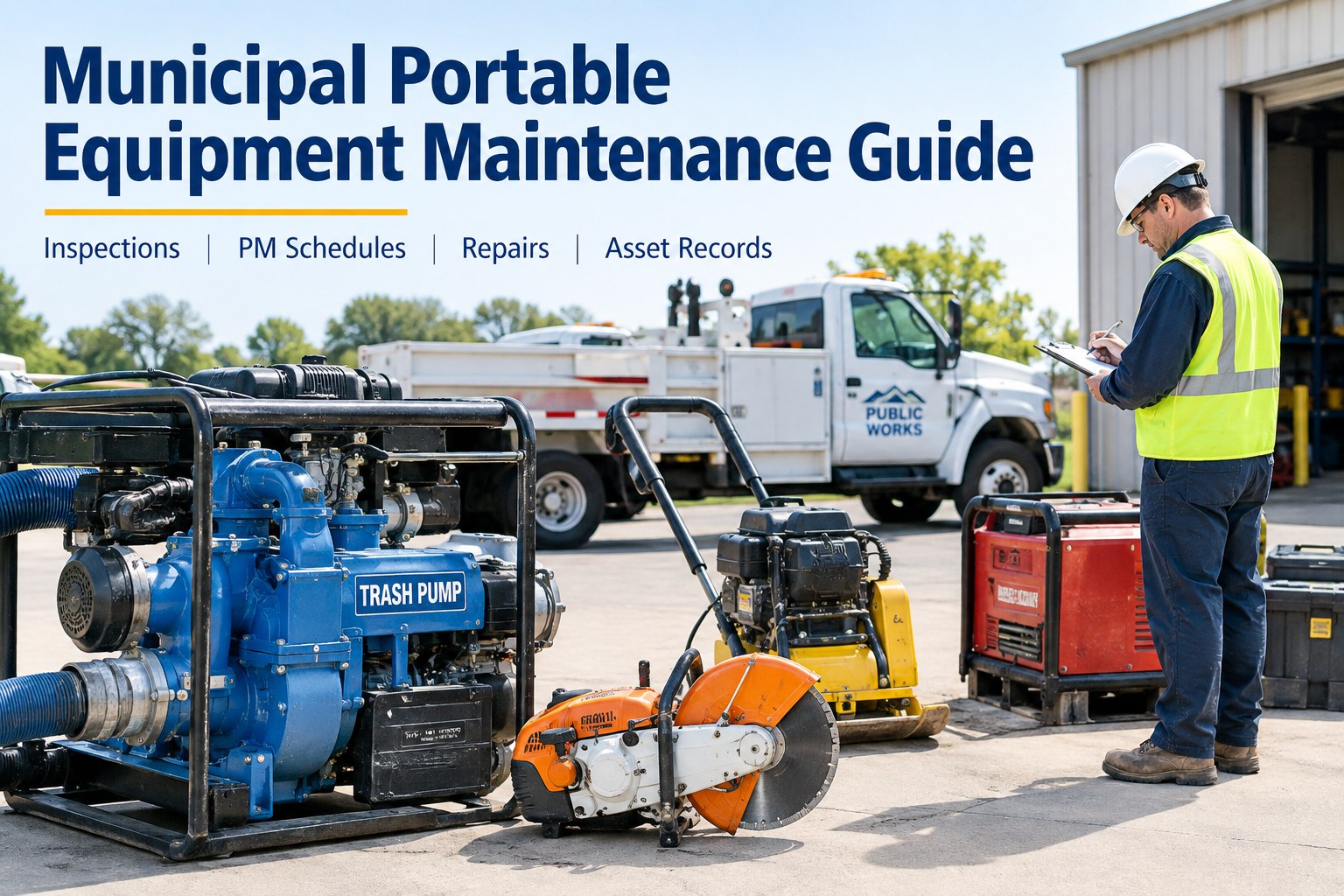
Storm water is rising at Fifth and Main, and the crew needs a trash pump running in the next ten minutes. The one that's supposed to be on truck 12 isn't there — it went to the parks depot for a leaf-cleanup job three weeks ago and never came back. Nobody logged it, nobody serviced it since, and right now nobody even knows if it starts.
Municipal Portable Equipment Maintenance: The Fleet You're Not Tracking
Trucks get a unit number, a PM schedule, and a file. Trash pumps, saws, compactors, and blowers usually get a shelf in the shop and a hope that someone remembers to check the oil. That gap is exactly where equipment goes missing, unserviced, and unavailable the one day it's actually needed.
The Asset Register Problem: What Good Equipment Records Actually Include
A truck is hard to lose. It has a plate, a home lot, and a driver who's assigned to it every shift. A plate compactor has none of that by default — it rides in whatever truck bed has room, gets handed between crews without paperwork, and shows up in the shop only when it stops starting. Fixing that starts with treating portable equipment as a real asset register, not a supply closet.
Unique ID & Type
A tagged asset number and make/model — not "the blue saw" or "the pump from parks."
Location & Depot
Which yard, which truck, or which crew currently has it — updated when it actually moves, not once a year.
Department & Assigned Operator
Who's responsible for its condition right now, so accountability doesn't dissolve the moment it changes hands.
Condition & Service History
Last inspection, last oil change, last repair — visible before dispatch, not discovered mid-emergency.
Matching Maintenance Intervals to the Equipment, Not the Vehicle Fleet
A truck's PM schedule runs on mileage. A trash pump doesn't have miles — it has engine hours, and often a manufacturer-specified interval measured in exactly that. Applying a fleet's calendar-based vehicle schedule to small engine equipment either over-services gear that barely ran, or lets a heavily used pump go months past its due interval.
Hour-based intervals catch the equipment that's actually working hard; calendar intervals catch fuel and rubber components that degrade sitting on a shelf regardless of use. Most portable equipment needs both, tracked separately per asset. Book a demo to see hour-based and calendar-based PM running side by side on the same equipment list.
Pre-Use Inspection: What's Worth Checking Every Time
Not every check needs a shop visit. A two-minute pre-use inspection, done consistently by whoever's about to run the equipment, catches most of what turns into an unavailable pump or an injured operator later. Sign up for a free trial to put these five checks on a phone-based checklist your crews actually complete.
Why Portable Equipment Goes Missing Between Crews, Depots, and Emergencies
The failure pattern is almost always the same. A crew borrows a pump for a job at another depot. The job runs long, the crew moves on to the next call, and the pump stays wherever it was last used — no note, no transfer record, nothing in the shop's schedule to flag it as overdue. Three months later, during a storm response, someone finally goes looking for it and finds a piece of equipment that's been sitting outside, unmaintained, since the last time anyone actually needed it.
This isn't a discipline problem you fix by asking crews to try harder. It's a records problem, and it gets solved the same way vehicle tracking solves it: every move logged against the asset, every service interval visible regardless of which depot currently has custody, and a location that updates in the field — including offline, since half of where this equipment works has no signal.
From an Equipment Manager Who Stopped Guessing What Was Where
We ran a physical count of every pump, saw, and compactor across five depots and found three pumps nobody had serviced in over a year, two that weren't even on our list anymore, and one that had quietly been sitting in a contractor's trailer since a joint job the spring before.
Now every piece of portable equipment has its own record, the same as a truck — location, hours, last service. When the next storm call comes in, dispatch can actually see what's ready instead of sending someone to check three depots by phone.
Defects, Removal From Service, and Getting Back to Work
A worn guard, a cracked fuel line, or an engine that won't hold idle deserves the same response on a compactor as it would on a truck: tag it, pull it from service, and don't let it go back out until the repair is actually confirmed. In practice, portable equipment skips this step constantly, because it's easy to hand a "mostly working" saw to the next crew rather than walk it to the shop. A simple four-step habit closes that gap: report the defect the moment it's found, physically tag the unit as out of service, log the repair against that specific asset once it's done, and require a sign-off before it's dispatched again. Book a demo to see that four-step flow run the same way for a pump as it does for a pickup truck.
Seasonal Storage and Emergency Readiness
Equipment that sits idle for months — a plate compactor between paving seasons, a trash pump between storm events — needs a different kind of attention than equipment in daily use: fuel stabilized or drained, batteries maintained on a tender, and a documented startup check before it's marked ready. The mistake most departments make is treating "in storage" as "no longer needs a record." A pump that's been sitting since October and hasn't been started once won't be ready in the ten minutes a flood gives you in April — unless someone already knows it needs attention before the water starts rising. Book a demo to see stored equipment flagged for a startup check automatically before the season it's needed.
Municipal Portable Equipment Maintenance Checklist
Every Time It's Used
- Oil and fuel level checked
- Fuel lines and filter inspected
- Belts, hoses, and guards checked
- Emergency stop tested where equipped
- Any defect reported before return
On a Recurring Schedule
- Hour-based oil and filter service per manufacturer spec
- Location and custody confirmed against the asset register
- Full condition inspection and photo record
- Seasonal storage prep or startup check
- Service history reviewed for repeat defects
Conclusion: Municipal Portable Equipment Maintenance Deserves the Same Discipline as the Fleet
A trash pump, a cut-off saw, or a plate compactor rarely gets the unit number, the PM schedule, or the accountability that a truck gets automatically — and that's exactly why it's the piece of equipment most likely to be missing, unserviced, or dead on arrival the one day it's actually needed. Municipal portable equipment maintenance isn't a smaller version of fleet maintenance; it just needs the same core habits — a real asset register, intervals that match how the equipment actually works, and a record that survives a move between crews and depots. Book a demo to see what that looks like against your own equipment list, pumps and saws included.
Frequently Asked Questions
What should a municipal portable equipment asset register include?
A complete record should include a unique asset ID and equipment type, its current location or assigned depot, the department and operator currently responsible for it, its condition, and its full service history including inspections, repairs, and hour readings. Without these fields tracked consistently, portable equipment like pumps, saws, and compactors is far more likely to be lost, left unserviced, or unavailable when it's needed.
Should portable equipment maintenance be based on hours or a calendar schedule?
Most portable equipment benefits from a combination of both. Engine hours reflect actual use and are usually the basis for oil changes and major service intervals specified by the manufacturer. Calendar-based checks matter separately for components that degrade with time regardless of use, such as stored fuel, rubber hoses, and belts. Equipment that sits for long stretches, like seasonal compactors, often needs calendar-based storage and startup checks in addition to hour-based service.
How can municipalities prevent portable equipment from getting lost between crews and depots?
Equipment tends to go missing when it moves without a corresponding record update — a crew borrows a pump for one job and it never gets logged as returned or transferred. Preventing this requires treating every move as an event to be recorded against that specific asset, ideally through a mobile system that works offline in the field, so location and custody stay current even when equipment travels between depots, crews, or emergency deployment sites without reliable connectivity.
What pre-use checks are important for small engine equipment like pumps and saws?
Before each use, operators should check oil and fuel levels, inspect the fuel system for cracks or fouling, check belts and hoses for wear, and confirm guards and emergency stop mechanisms are functional and undamaged. These checks take only a few minutes but catch the majority of issues that would otherwise cause a no-start in the field or an unsafe operating condition.
How should municipalities prepare portable equipment for seasonal storage and emergency readiness?
Equipment going into extended storage, such as compactors between paving seasons or trash pumps between storm events, should have fuel either stabilized or drained, batteries maintained on a tender where applicable, and a documented startup check scheduled before the equipment is marked available again. Treating stored equipment as needing no further attention is a common cause of failures at the exact moment the equipment is needed for an emergency response.
Track portable equipment the same way you track your fleet
HVI gives municipalities a single asset register for trucks, pumps, saws, compactors, and every other piece of portable equipment — with configurable inspection templates, hour- or calendar-based PM, and offline-capable field records that keep custody and condition current wherever the equipment goes.
No credit card · Works offline in the field · Live in under two weeks