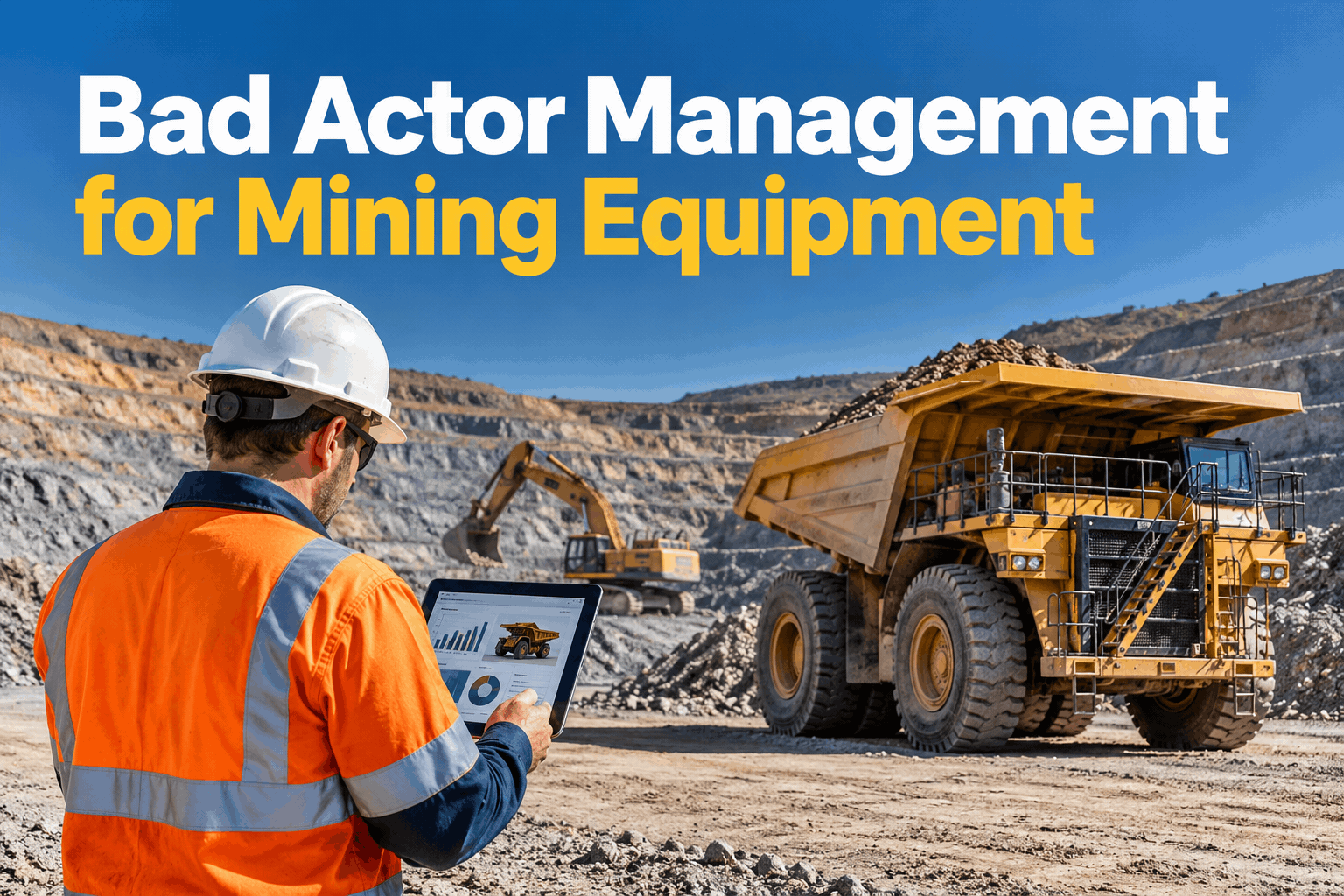
Every mining maintenance manager has that one haul truck — in the workshop every other week with the same final-drive complaint. Bad actor management is the reliability discipline that stops you chasing those chronic offenders forever: it finds the few assets and failure modes draining your budget, ranks them with maintenance data, and drives out the root cause instead of re-repairing the symptom. This guide covers the program, the mining numbers that make it pay, and how to run it. Book a bad-actor program demo to see it on your fleet.
A handful of machines is quietly running your reliability budget
On every mining fleet, a small set of haul trucks, excavators and dozers drives most of the downtime and cost. A bad actor management program finds them, ranks them, and eliminates the repeat — not the symptom.
-
1
HT-114 · Haul truck312 hrs
-
2
EX-07 · Excavator198 hrs
-
3
DZ-22 · Dozer121 hrs
On a mining fleet the stakes are different from a warehouse: a single haul truck down isn't a missed pick, it's a stalled dig face and a production target slipping by the shift. Bad actor management is how you stop treating every breakdown as equal and go after the assets and failure modes that actually move the needle. Below is the program loop, the mining economics that make it worth running, and how to keep it going.
The loopbad actor management is a continuous program, not a one-off report
The difference between an analysis and a program is the loop. You don't rank the fleet once — you run these six stages on a cadence, so new bad actors surface and old ones stay dead.
- 1IdentifyCapture failures with consistent codes against each asset
- 2RankSort by downtime, cost and frequency to find the worst
- 3InvestigateRoot-cause the top offenders — asset or failure mode
- 4EliminateCorrective action: PM change, spec fix, operator coaching
- 5VerifyConfirm the repeat is actually gone, not just quiet
- 6ReviewRe-rank on cadence — the loop never closes for good
Skip the loop and bad actors creep back: a PM change fixes one failure mode while another climbs the ranking unnoticed. Running it as a standing program is what separates a reliability culture from a workshop that just fixes what breaks. Explore the reliability-centered maintenance framework this program sits inside.
Cost per hourwhy the "cheap" machine on a mining fleet often isn't
Ranking by total repair cost alone misleads on mining assets, because they run wildly different hours. Normalize by operating hour and the real bad actor appears — sometimes the unit nobody suspected.
On high-value mining assets the repair invoice is rarely the biggest number anyway — the lost production from a stalled dig face or a short-handed haul cycle dwarfs it. That's why cost per operating hour, not raw spend, settles which asset to attack first. See cost-per-operating-hour reporting across every unit, or book a demo of per-asset reliability ranking.
Asset or mode?the split that decides where your corrective action lands
A repeat failure is one of two problems — and they need opposite fixes. Read it wrong and you replace a component five times instead of fixing the cause once.
One haul truck keeps failing
The same unit fails repeatedly, often across systems or on a fault its sister trucks don't share. The problem travels with the machine.
The same fault hits the whole class
Many units of one model fail the same way. The cause travels with the fleet — spec, duty, PM task or a batch of parts, not one machine.
Swap the final drive on HT-114 five times and you've treated a symptom; find that every truck hauling the wet-season ramp fails the same seal from overheating, and you've found a fleet-wide fix worth multiples more. See maintenance history grouped by asset and failure mode to tell the two apart fast.
The rhythma bad actor review cadence that keeps the program alive
A program is a cadence, not a project. These are the review rhythms that keep bad actors surfacing and corrective actions honest across a mining operation.
Scan new repeat failures and overdue corrective actions. Catch a climbing bad actor early.
Re-rank the fleet by downtime, cost/hr and frequency. Assign root-cause investigations on the top offenders.
Verify eliminated bad actors stayed dead, review program KPIs, and feed findings into PM and spec decisions.
The cadence is what turns one good analysis into a lasting drop in downtime — without it, the ranking goes stale and the workshop drifts back to firefighting. Book a demo of a recurring bad-actor review built on your own fleet data.
Kill the causeroot-cause investigation that ends the repeat for good
Once an asset or mode tops the ranking, the investigation points at a cause instead of booking another repair. Four angles cover most mining repeat failures.
Is the unit worked beyond its spec — grades, payloads or cycle times it wasn't rated for?
Do failures cluster on one crew, shift or haul route? Impact and handling patterns leave fingerprints.
Wet-season ramps, dust, heat, abrasive ground — does the failing component hate the conditions?
Is the PM task for this mode effective? Did a prior rebuild use the wrong part or skip a step?
Attach photographic defect evidence to each finding, log the corrective action, and schedule a follow-up to confirm it held — the repeat only counts as eliminated when it doesn't come back. See photographic defect evidence on inspections, or sign up free and standardize your failure codes.
Four numbersthe reliability KPIs that prove the program is working
Track these per asset and the bad actors can't hide — and you can prove a corrective action actually paid back.
Repeat failure rate is the one to put on the reliability-review wall: when it falls on a mode you targeted, your corrective action worked; when it doesn't, the real cause is still out there. Book a demo of per-asset reliability KPIs trended over time.
On the recordwhat a bad actor looks like in the maintenance history
- Jul 11Final drive — overheat, oil loss148 hrs
- Aug 29Final drive — same fault, rebuild96 hrs
- Oct 06Final drive — 3rd recurrence68 hrs
Three final-drive failures on one truck, same mode, each dragging a dig face down for days — the system flags it and opens a review before a fourth rebuild. That's the shift from firefighting to killing the root cause. See how PM optimization closes the loop once a cause is found.
From the reliability desk
We ran our fleet by gut for years — everyone "knew" which trucks were dogs. When we finally ranked by cost per operating hour and repeat rate, two of our eighteen haul trucks were eating a third of the maintenance budget, and both were the same final-drive mode off one wet-season ramp. We changed the cooling PM and the route, not the trucks, and the repeat rate on that mode dropped to almost nothing. The data had been in our work orders the whole time.
Bad actor management FAQs
What is bad actor management in mining maintenance?
It's an ongoing reliability program that finds the small number of assets and failure modes causing a disproportionate share of your downtime and cost, then eliminates their root causes. It runs on a loop — identify, rank, investigate, eliminate, verify, review — rather than as a one-time report, so new bad actors keep surfacing.
How is it different from a one-off failure analysis?
An analysis ranks the fleet once; a program runs the review on a cadence. That cadence is what keeps bad actors dead — a corrective action fixes one mode while another climbs the ranking, and only a recurring review catches it. Management means the loop never fully closes.
Why rank by cost per operating hour, not total cost?
Mining assets run very different hours, so raw repair cost misleads. A truck with a big annual bill can be cheap per hour if it runs constantly, and a low-cost unit can be your worst value if it barely turns a wheel. Cost per operating hour normalizes use and reveals the true bad actor.
How do I tell a chronic asset from a systemic failure mode?
If one unit keeps failing — across systems or on a fault its sisters don't share — the problem travels with the machine, so repair hard or retire it. If many units of one class fail the same way, the cause is spec, duty, PM or a parts batch, so fix the process fleet-wide, not one asset.
What data does a bad actor program need?
Consistent failure codes, accurate work orders tied to the right asset, real operating hours, and full maintenance history. Without clean records the ranking is noise. A connected maintenance system keeps codes, hours and history per asset by default, which is what makes the program repeatable.
Run a bad actor program that actually sticks
HVI ties every defect, work order, repair cost and operating hour to each mining asset — so repeat offenders rank themselves, root-cause reviews open on cadence, and corrective actions get verified. Analytics, maintenance history, defect tracking and PM optimization, live in under two weeks.
No credit card · Reliability reporting from day one