On a mine site, a bolt is never just a bolt. A haul-truck wheel nut, a shovel structural bolt, a mill flange — when one lets go it's not a repair, it's an incident report. The hard truth of mining bolting torque is that the number on the wrench isn't what holds the joint; it's a stand-in for a clamp load you can't see, and an undocumented bolt-up is a failure waiting for the wrong shift. This guide turns critical bolting into a documented, verifiable standard — book a demo.
The wrench reads torque. The joint needs clamp load.
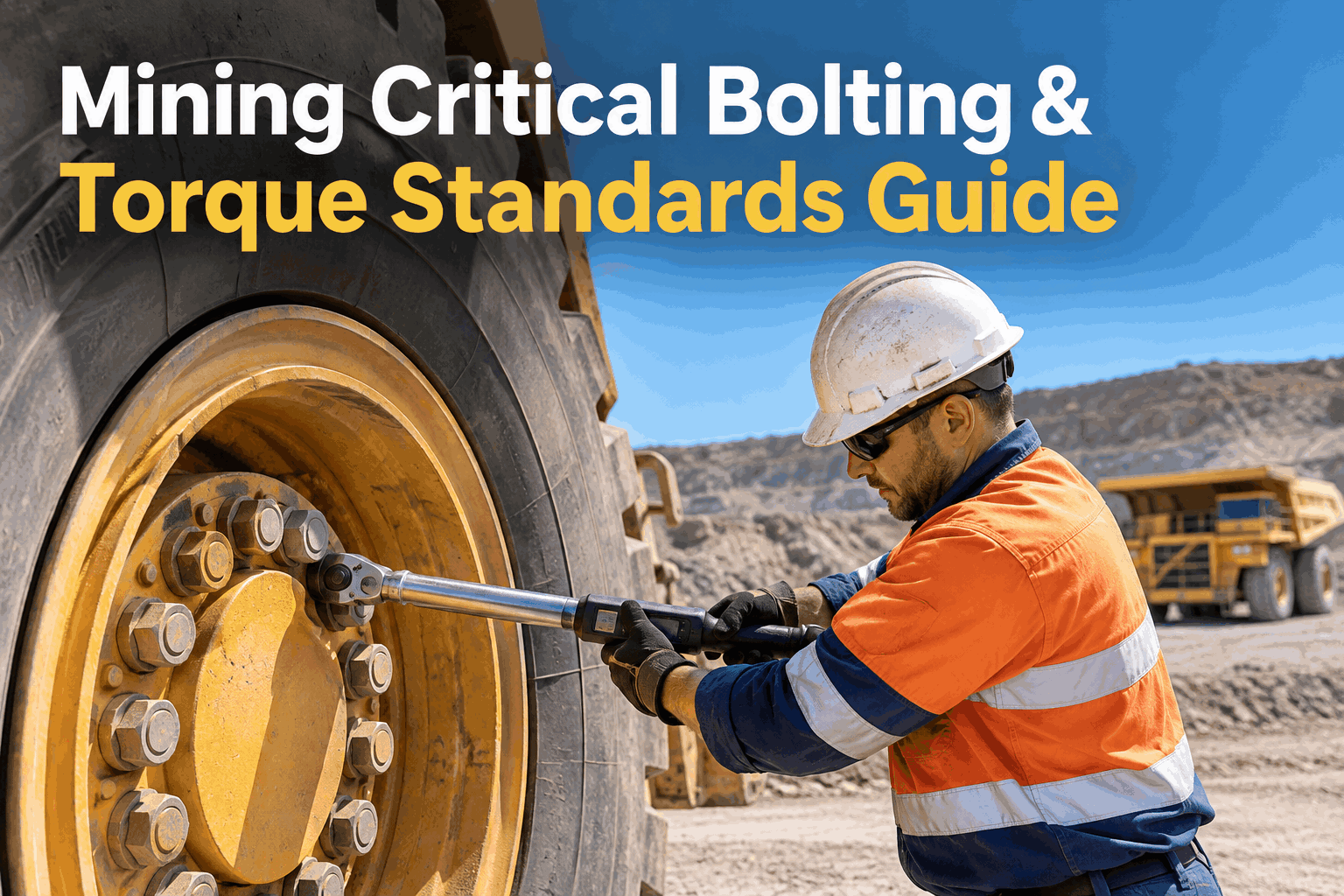
Critical fasteners fail when preload is wrong or lost — and torque alone doesn't prove it. HVI makes the bolting procedure a documented, verified step: right spec, right sequence, calibrated tool, re-torque scheduled, every result signed to the record.
Critical bolting looks simple — tighten the fastener to the spec — but the gap between "we torqued it" and "the joint is correctly clamped and will stay that way" is where mine-site failures live. Torque is a proxy, preload is the goal, and the only thing that makes a bolt-up trustworthy is a documented procedure done with a verified tool and recorded. Here's why torque alone isn't enough, which fasteners truly matter, and the standard that makes them safe.
Why torque alone lieswhat mining bolting torque actually controls — and doesn't
The goal of tightening a critical bolt isn't a torque number — it's clamp load (preload), the tension that actually holds the joint. Torque is just the easiest thing to measure, and most of it never becomes clamp load at all.
Only a small share of the torque you apply becomes the clamp load that matters — the rest is lost to friction. Change the friction (dry vs lubed threads, rust, a reused nut) and the same torque gives a very different preload. That's why a number alone can't be trusted, and why procedure and verification matter as much as the spec.
This is the gap a documented standard closes: it controls the variables torque can't — thread condition, lubrication, sequence and tool accuracy — so the clamp load actually lands in range. That discipline is what a digital inspection and checklist enforces, separate from a static critical torque chart that only lists the target values. Book a demo to see a torque procedure enforced step by step →
Which fasteners are "critical"the bolts where a failure is a safety event, not a repair
Not every bolt needs this rigor — but the critical ones need all of it. A critical fastener is one whose failure risks a person, a structure or a catastrophic loss, and on a mine fleet they fall into clear groups.
Wheel nuts & rims
Haul-truck and loader wheels. A loose or over-torqued nut leads to stud failure and wheel separation — the highest-visibility bolting hazard on site.
Structural bolts
Frame, chassis, body and ROPS/FOPS mounts. Loss of preload here cracks structures and compromises operator protection.
Pins & retainers
Bucket, boom and linkage pin retainers. A backed-out retainer bolt lets a pin walk — dropping an attachment or seizing a joint.
Flange & housing bolts
Drivetrain flanges, final drives, mill and pump housings. Uneven or lost torque leaks, warps mating faces and fails bearings.
Each group has its own spec, sequence and re-torque interval — so each needs its own checklist, not a generic "tighten the bolts" line. HVI ties the right bolting procedure to the right asset and component, the same way the rest of mining equipment maintenance is standardized per machine. Start free and build your critical-fastener list →
The documented bolting procedurefive steps that turn a torque spec into a verified joint
A torque value on a chart is a starting point, not a procedure. What makes a critical joint trustworthy is doing five things in order, every time, and recording the result — this is the backbone of any mining torque standard.
The last step is where failures hide: critical joints settle and lose preload after their first hours of service, so a re-torque isn't optional — it's part of the spec. HVI schedules it automatically and keeps the signed values, the same way it runs preventive maintenance for the rest of the machine. Book a demo to see re-torque scheduled and recorded →
Torque verification in HVIthe bolting record a reliability team can actually stand behind
This is what makes a bolting standard real: each critical fastener, its spec and actual torque, when the re-torque is due, and who signed it — the record a maintenance manager can produce when an auditor or an incident asks.
Instead of "the tech said they torqued it," the team has the spec, the actual value, the calibrated tool used and the signature — plus a flag the moment a wheel reads under spec. That proof is what analytics and reporting builds from, and you can book a demo to see this record on your own fleet.
Critical bolting verification checklistthe torque inspection steps that confirm a joint is safe
A critical-bolting check isn't just "is it tight" — it's the full verification that the joint was done right and is staying right. Here's a baseline checklist, grouped the way HVI loads it, each item observable at the machine.
- Correct torque spec for the fastener confirmed
- Thread condition & lube state per spec
- Torque wrench within calibration date
- Tightening sequence / pattern followed
- No cracked, stretched or corroded fasteners
- Match-marks aligned — no movement since torque
- No gaps or fretting at the mating face
- Retainers & locking devices in place
- Re-torque after initial service hours scheduled
- Actual torque values logged, not just "done"
- Technician sign-off recorded
- Any out-of-spec reading becomes a work order
On paper the record is a scrawled tick that proves nothing; in HVI the actual values and the calibrated tool are captured, an out-of-spec reading can't be closed without a work order, and the whole result is signed to the machine. Start free and load your bolting checklists →
From a mine maintenance manager
We had a wheel come loose on a haul truck — no one hurt, but it stopped the pit and triggered an investigation. When they asked for the torque records, what we had was a checkbox that said "wheels torqued." No values, no tool, no re-torque. That checkbox was worthless the moment it mattered.
Now every critical joint captures the spec, the actual reading and the wrench ID, and the re-torque is scheduled, not remembered. The match-marking alone catches movement on the walkaround. When the auditor comes back, I hand them a record instead of an apology.
Mining bolting torque — FAQs
Why isn't hitting the torque spec enough for critical bolts?
Because torque is a proxy for clamp load, and most of it is lost to friction. Change the thread condition or lubrication and the same torque gives a different preload. Hitting the number matters, but so do thread condition, tightening sequence, a calibrated tool and a scheduled re-torque — together they land the clamp load in range.
Which fasteners count as "critical" on mining equipment?
Any whose failure risks a person, a structure or a catastrophic loss — wheel nuts and rims, structural and ROPS/FOPS bolts, bucket and boom pin retainers, and drivetrain or housing flange bolts. These need a documented procedure and verification; routine fasteners don't carry the same rigor.
Why do critical bolts need a re-torque?
Joints settle in their first hours of service — surfaces bed in, gaskets compress, vibration works on the fastener — and preload drops. A re-torque after initial service hours restores the clamp load. Skipping it is one of the most common causes of a fastener that was tightened correctly still coming loose.
Does the torque wrench really need to be calibrated?
Yes. An out-of-calibration wrench gives a confident reading that's simply wrong, so the joint can be under or over preload while the record says "to spec." Tracking each wrench's calibration date — and tying it to the torque records — is part of a real bolting standard, not an extra.
How does HVI help with critical bolting and torque records?
HVI holds the bolting procedure as a checklist tied to each asset — spec, sequence, calibrated-tool check and re-torque schedule — captures the actual values and sign-off, flags out-of-spec readings as work orders, and keeps the signed record per fastener. It's the inspection and records layer that makes a bolting standard provable.
Make every critical joint provable, not just tightened
HVI turns critical bolting into a documented standard — right spec and sequence, calibrated tool, scheduled re-torque and a signed record per fastener — so a bolt-up is verified on the walkaround, not questioned after an incident. Live on your fleet in under two weeks.
No credit card · Works offline in the pit · Critical-bolting records ready on day one