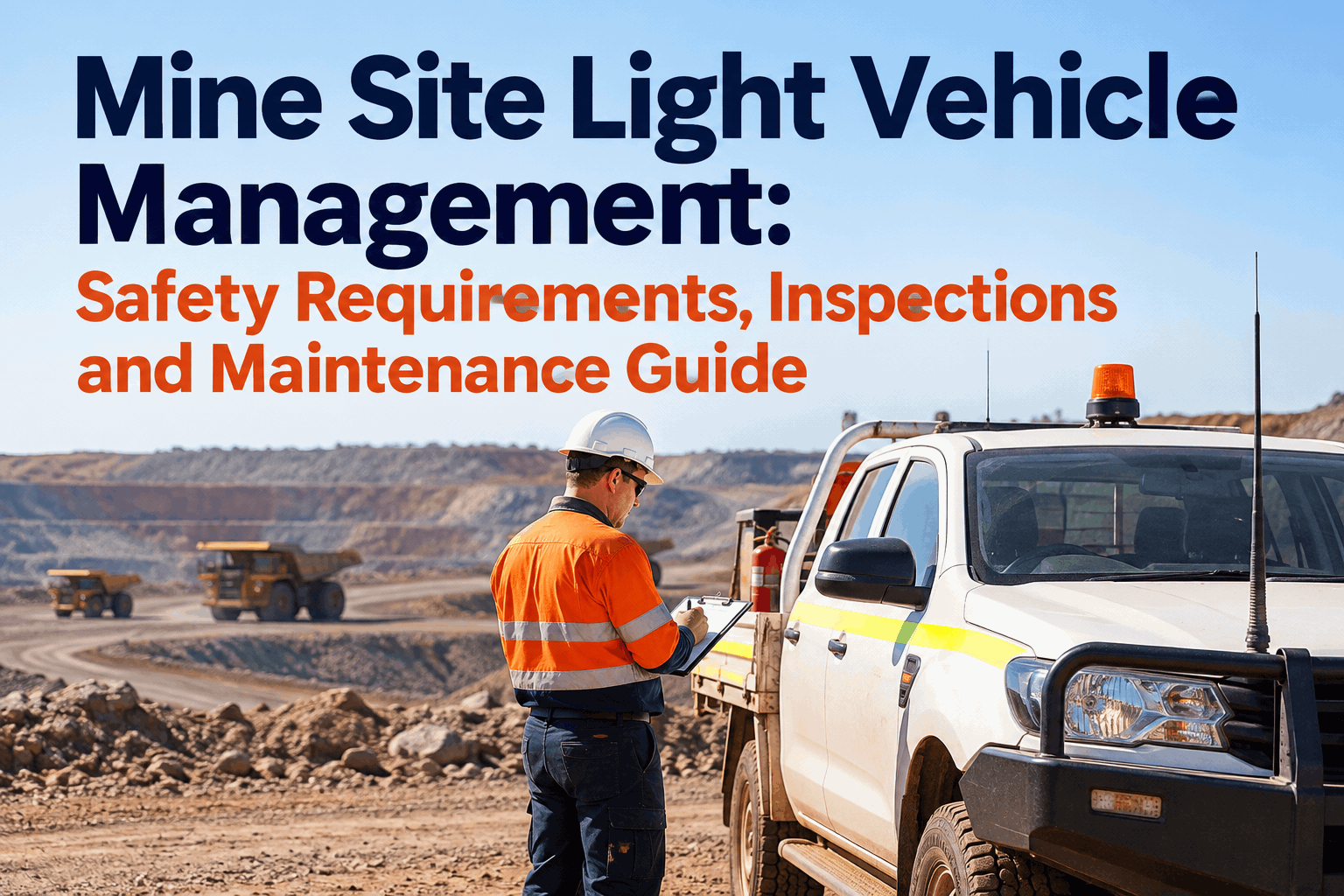
A supervisor's pickup pulls onto a haul road, a 240-tonne truck backs toward it, and from that cab the ute isn't there — it's in a blind zone the size of a tennis court. That's the truth behind mine light vehicle management: the smallest vehicle on site carries the biggest risk, because the equipment that can crush it can't see it. The discipline comes down to making every light vehicle conspicuous, on the radio, and fit for the haul zone — proven before the shift. Book a demo of light-vehicle pre-starts.
Mine Light Vehicle Management Starts With One Question: Can the Haul Truck See You?
A light vehicle is only safe near heavy equipment if it's conspicuous, on the radio, and fit — verified every shift. Here's the fitment standard, the daily check, and the record that backs it.
- Buggy-whip flagFitted
- Rotating beaconWorking
- UHF radio · haul channelTested
- Headlights & reflectivesGlobe out
3 of 4 — not fit for the haul zone until the globe is replaced.
On a mine, the light vehicle is the easy thing to overlook — it's just a ute, a service truck, a supervisor's 4WD. But it shares roads with equipment that outweighs it a hundred to one and has blind zones bigger than the vehicle itself. Managing light vehicles well isn't about the ute's engine; it's about whether the haul truck operator can see it, hear it on the radio, and whether every warning device on it actually worked when the shift started.
Why the small vehicle is the big riskthe haul truck blind zone a light vehicle disappears into
The reason light vehicles dominate mine collision statistics isn't bad driving — it's physics and sightlines. A haul truck operator sits metres above the ground with blind zones extending well beyond the machine. A light vehicle sitting in one of them is, to the operator, simply not there.
You can't make the truck smaller or the blind zone disappear — so the entire strategy is making the light vehicle impossible to miss and impossible to lose on the radio. Book a demo to see LV fitness tracked per unit. This is the vehicle-level companion to the broader powered haulage safety and fatality-prevention guide, which covers the haul-truck side and site traffic controls.
The fitment standardwhat makes a light vehicle fit for a haul zone
Before a light vehicle goes anywhere near heavy equipment, it has to carry the kit that makes it visible and contactable. These are the non-negotiables — and each one is only protection if it's confirmed working, not just fitted.
Buggy-whip flag
A high-mounted flag on a mast, tall enough to clear a haul truck's sightline over the tray — the first thing an operator sees.
Rotating beacon
An amber flashing light, run at all times in operating areas, visible from every angle day or night.
UHF radio
Tuned to the site and haul-road channels, tested each shift, so the LV can call in before entering a zone and be acknowledged.
Lights & reflectives
Headlights, tail and reflective markings intact, so the vehicle reads as a vehicle in dust, low light and glare.
Vehicle ID
A visible unit number so the vehicle can be identified on the radio and in any incident review.
Access authorization
A current permit to enter haul zones — the driver trained and the vehicle signed off as compliant.
Fitted isn't the same as working. A beacon with a dead globe or a radio on the wrong channel is a compliant-looking vehicle that's actually invisible. Sign up free and verify fitment every shift.
The pre-start checklista mine light vehicle inspection checklist
Every light vehicle gets this walk-around before it turns a wheel on site. It splits three ways: the gear that makes it safe near equipment, the vehicle's own condition, and the driver's own readiness. In HVI it's a configurable template, and any fail opens a defect on the spot.
Conspicuity & comms
- Buggy-whip flag fitted and upright
- Beacon rotating and bright
- UHF on and tested on haul channel
- Lights, indicators and reflectives working
The vehicle
- Tyres, wheels and visible leaks
- Brakes and park brake function
- Seatbelts and, if fitted, rollover protection
- Recovery gear, fire extinguisher, first aid
The driver
- Haul-zone access permit current
- Knows the day's traffic plan and zones
- Radio protocol and call-in points clear
- Fit for duty, no fatigue flags
Run this every shift and a failed beacon is caught in the yard, not discovered in a near-miss report. Book a demo to load this checklist on your light fleet.
The pre-start recorda failed device holds the vehicle, on the record
Here's where management becomes real instead of a sticker on the windscreen. The pre-start runs on a phone or tablet, each conspicuity item verified, and when the beacon fails the vehicle is flagged out of the haul zone with a defect and a DVIR record behind it — not a verbal "she'll be right."
One dead globe is enough to pull the ute from the haul zone — flagged, work-ordered, and recorded before it ever rolled out.
Because every check is a dated DVIR record, the light fleet carries the same provable inspection trail as the heavy equipment. Book a demo to see the LV pre-start on your site.
From a mine safety manager who watched the near-miss reports
Our serious near-misses almost always came back to a light vehicle the operator didn't see — a flat beacon, a radio someone forgot to switch to the haul channel, a flag that had snapped off days earlier and nobody logged. The vehicle looked compliant parked in the yard. Once the pre-start was digital and a failed conspicuity item actually held the vehicle, those gaps closed fast — you can't drive into the pit on a dead beacon anymore because the system won't clear you. The light vehicles finally get treated like the risk they are.
Mine light vehicle management — quick answers
What is required to make a light vehicle fit for a mine haul zone?
Typically a high-mounted buggy-whip flag, a rotating amber beacon, a UHF radio on the site and haul channels, working lights and reflectives, a visible unit ID, and a current access permit. Each has to be verified working before the shift — fitted but failed is the dangerous state.
Why are light vehicles such a high collision risk on mine sites?
Because they share roads with haul trucks that outweigh them around a hundred to one and have blind zones larger than the light vehicle itself. A ute sitting in a truck's blind zone is invisible to the operator, so the whole control strategy is conspicuity and radio communication.
What should a light vehicle pre-start inspection cover?
Three areas: conspicuity and comms (flag, beacon, UHF, lights), the vehicle itself (tyres, brakes, seatbelts, recovery and emergency gear), and the driver (current permit, knowledge of the traffic plan, fit for duty). A failed conspicuity item should hold the vehicle from the haul zone until fixed.
Do light vehicles need the same inspection records as heavy equipment?
Yes — and it's often the gap. Heavy equipment gets rigorous pre-starts while light vehicles run on a casual glance. A dated DVIR-style record for each light vehicle gives you the same defensible inspection trail, which matters both for safety and for any incident review.
How does HVI help with mine light vehicle management?
HVI runs configurable pre-start and safety checklists for light vehicles, logs them as DVIR records, tracks defects to work orders, and schedules preventive maintenance. A failed conspicuity check flags the unit before it enters a haul zone. It manages the inspections and records — it doesn't replace your site's traffic management plan or safety controls.
Give mine light vehicle management the same rigour as the heavy fleet
HVI turns every light vehicle's pre-start into a verified, recorded check — flag, beacon, radio and lights confirmed, defects flagged, access held when something fails — so the smallest vehicles on site are as conspicuous and provable as the biggest. Live across your light fleet in under two weeks.
No credit card · No hardware · Light-vehicle pre-starts from day one