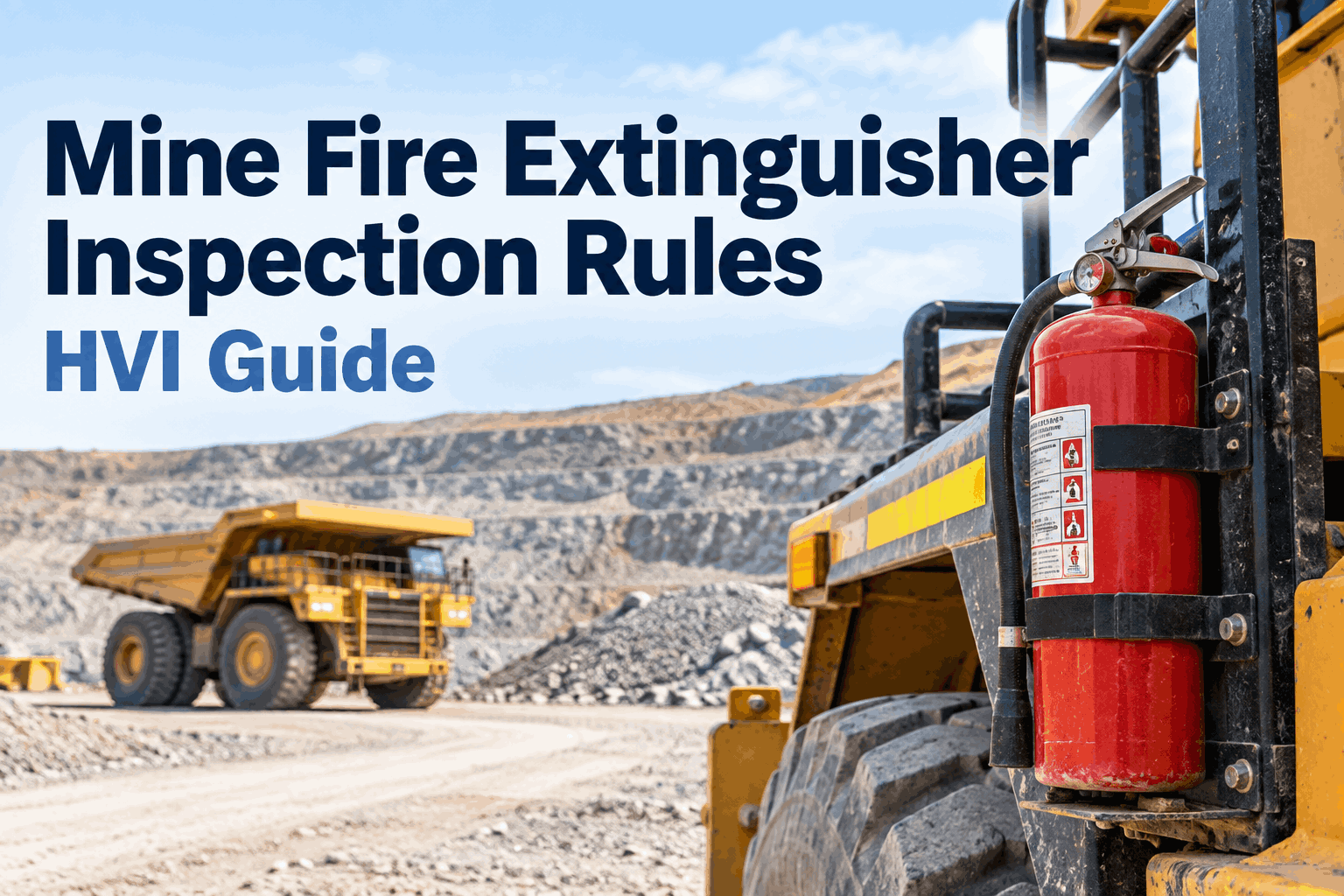
A fire extinguisher can look fine from the cab and still fail the check that matters. For metal and nonmetal mines, a disciplined mine fire extinguisher inspection program means knowing what is due monthly, what needs annual maintenance, when testing applies, and where the proof is stored when MSHA asks for it.
Mine Fire Extinguisher Inspection Rules | HVI Guide
Build a repeatable inspection trail from the extinguisher on a haul truck or service vehicle to the certification record your safety team needs later.
Mine fire extinguisher inspection is really four clocks
For U.S. metal and nonmetal mines, 30 CFR 56.4201 and 57.4201 establish several different inspection and testing intervals. Treating them as one annual “fire extinguisher check” creates gaps.
Visual extinguisher inspection
Confirm the extinguisher is fully charged and operable. Your field checklist can also capture obvious physical condition, accessibility and anything that could prevent use.
Maintenance check
Maintenance covers mechanical parts, the amount and condition of extinguishing agent and expellant, plus hose, nozzle and vessel condition.
Hydrostatic testing
Testing follows the applicable Table C-1 interval or a schedule based on manufacturer specifications. Different extinguisher types can have different test intervals.
Certification and retention
The inspection or test is certified with its date. Hydrostatic-test certifications remain until retest or permanent removal; other certifications under the standard are retained for one year.
Scope matters: these intervals describe the metal/nonmetal requirements in 30 CFR 56/57.4201. Coal-mine firefighting-equipment requirements can differ, so build checklists around the regulation applicable to your operation rather than copying one schedule across every site.
The operational problem is rarely knowing that inspections exist. It is proving that extinguisher FE-27 on truck HT-14 was checked when required, knowing who found the damaged hose, and showing what happened next. That is where a digital inspection workflow becomes useful.
What to look for during a monthly fire extinguisher inspection
A monthly check should answer one practical question: if someone reaches for this extinguisher during a fire, is there an obvious reason it may not be ready to use?
EXTINGUISHER
Fully charged and operable
Start with the regulatory purpose of the monthly visual inspection. For a stored-pressure unit, the pressure indication should not show an obvious loss of charge.
No obvious physical damage
Look for corrosion, impact damage, leakage or another visible condition that raises doubt about whether the extinguisher will operate effectively.
Hose and nozzle condition
A crushed, split, blocked or badly deteriorated discharge path deserves attention instead of another tick on the form.
Accessible when seconds matter
An extinguisher hidden behind tools, buried in supplies or loose inside a cab may exist on the asset list but still be difficult to use during an emergency.
Inspection identity and evidence
Capture the extinguisher or asset ID, location, inspection date, inspector and any deficiency clearly enough that another supervisor can reconstruct the event later.
The checklist should be short enough to use in the field but specific enough to prevent a meaningless “fire extinguisher — OK” response. HVI can put the inspection on the same mobile workflow used for other digital equipment inspections, while a live HVI walkthrough can show how recurring checks fit into your site process.
Know what was checked, what failed and what happened next
Standardize recurring extinguisher inspections, capture deficiencies at the asset, route repair needs into maintenance and keep inspection history easier to retrieve when the safety team needs it.
Fire extinguisher inspection rules only work when findings trigger action
A checklist that records a defect but leaves it sitting in a binder has documented the problem without controlling it. Define what inspectors do when an extinguisher does not pass.
Ready and operable
Record the completed inspection, inspector and date against the correct extinguisher or equipment record.
Deficiency found
Document the condition clearly. Add a photo where useful so maintenance sees the same damaged hose, bracket, seal or cylinder condition the inspector saw.
Repair, recharge or replace
Route the deficiency to the responsible person. Under 30 CFR 56.4203, an extinguisher must be promptly recharged or replaced with a fully charged unit after any discharge.
This is where inspection and maintenance should meet. A failed checklist item can become a tracked maintenance task instead of being retyped from paper later. See how HVI connects safety findings with maintenance management, or book a demo using your own inspection process.
Mining equipment fire extinguishers need an asset-level view
The extinguisher on self-propelled equipment is not just another loose site asset. Its location matters because the fire risk moves with the machine.
Tie the extinguisher record to the machine
When a fire extinguisher belongs on a haul truck, loader, drill or other self-propelled unit, the inspection history is more useful when it stays connected to that equipment record.
A fire or its effects could impede escape from the self-propelled equipment
THEN A fire extinguisher is required on the equipment.A fire would not impede escape from the equipment but could affect other persons' escape
THEN The extinguisher is on the equipment or within 100 feet.Where the applicable conditions are met
OPTION A manually activatable fire suppression system may serve as the alternative described by the standard.For a multi-site mine, asset-level tracking prevents the familiar problem where the spreadsheet says 87 extinguishers are current but nobody can quickly tell whether the unit mounted on a specific haul truck is one of them. You can start building digital equipment inspection records free and organize checks around the machines your crews actually operate.
Fire extinguisher inspection records should answer five questions fast
A record becomes valuable when someone who was not present during the inspection can understand what happened without calling three people and opening a filing cabinet.
Which extinguisher or firefighting system was checked?
Which site, area or mobile asset was it assigned to?
What inspection, maintenance or testing date was recorded?
Was it operable, or was a deficiency identified?
Was the problem corrected, recharged, replaced or otherwise resolved?
Other certifications
Certifications other than hydrostatic-testing certifications required by this standard are retained for one year.
Hydrostatic test certification
Retain the certification until that extinguisher is retested or permanently removed from service.
Digital records do not change the regulation; they make the evidence easier to manage. Instead of a tag, spreadsheet and corrective-action note living in separate places, the inspection history can stay attached to the asset and be retrieved through HVI safety management.
Your firefighting inspection calendar may cover more than extinguishers
A useful mine fire-safety schedule separates the different equipment categories instead of placing everything on one generic annual checklist.
Do not give every extinguisher the same test date
The applicable interval depends on extinguisher type and the regulatory/manufacturer schedule. Table C-1 includes both 5-year and 12-year intervals for listed extinguisher types.
This is why recurring scheduling matters. The monthly extinguisher check, quarterly firefighting-system visual inspection, annual maintenance and long-cycle hydrostatic date should not depend on somebody remembering a wall calendar. See how HVI can organize recurring inspection work around your actual mine assets.
A better mine fire extinguisher inspection workflow
The goal is not more paperwork. It is a short path from a scheduled check to a verified result, with no gap between finding a problem and assigning responsibility for it.
Schedule
Set the appropriate recurring inspection or maintenance interval.
Inspect
Complete the checklist against the correct extinguisher or machine.
Document
Capture date, inspector, status and supporting evidence.
Correct
Route a failed item into maintenance and track the corrective action.
Retrieve
Pull the history when management, an auditor or the safety team needs it.
The hard part isn't telling someone to look at an extinguisher once a month. The hard part is knowing every unit was actually checked, which ones failed and whether the replacement happened. I want one list that tells me what is due and what is still open before I walk the site.
Build a mine fire-safety inspection program that survives a busy production week
The best system is one your crew can still follow when production is behind, equipment is moving between areas and the safety office has more than extinguishers to manage.
Inventory the extinguishers
Give each unit a clear identity and connect mobile-equipment extinguishers to the correct asset.
Separate inspection frequencies
Do not mix monthly visual checks, annual maintenance and hydrostatic testing into one generic due date.
Define pass/fail criteria
Give inspectors clear prompts instead of a single vague “OK / not OK” field.
Make deficiencies actionable
Define who receives a failed inspection and how recharge, replacement or repair gets closed.
Keep the certification trail
Store dates and required certifications according to the applicable retention requirement.
Review overdue and open items
Give supervisors visibility into what is due, what failed and what has not yet been resolved.
If your current process relies on extinguisher tags plus a separate spreadsheet, start with one site or one equipment group. Build the checklist, assign the recurrence, route failed items and confirm that the history is easy to retrieve. Then expand. You can start that inspection workflow in HVI without redesigning the entire safety program at once.
Mine fire extinguisher inspection FAQs
How often must fire extinguishers be inspected at metal and nonmetal mines?
Under 30 CFR 56.4201 and 57.4201, fire extinguishers must be visually inspected at least once a month to determine that they are fully charged and operable. A maintenance check is required at least once every 12 months. Hydrostatic testing follows the applicable regulatory table or a schedule based on manufacturer specifications.
What should a monthly mine fire extinguisher inspection check?
The regulatory purpose is to determine that the extinguisher is fully charged and operable. A practical field checklist should help the inspector identify obvious conditions that could interfere with operation, including charge indication where applicable, physical damage, hose or nozzle problems, accessibility and mounting condition. The inspection should also be tied to the correct extinguisher or equipment record.
How long should mine fire extinguisher inspection records be retained?
Under the certification provision in 30 CFR 56/57.4201, certifications of hydrostatic testing are retained until the extinguisher is retested or permanently removed from service. Other certifications required by that standard are retained for one year. Always confirm the requirements applicable to your mine and equipment.
Are fire extinguishers required on self-propelled mining equipment?
For metal and nonmetal mines, 30 CFR 56/57.4230 addresses self-propelled equipment. Where a fire or its effects could impede escape, an extinguisher must be on the equipment. Where the fire would not impede escape from the equipment but could affect other persons' escape, the standard allows the extinguisher on the equipment or within 100 feet. The standard also describes when a manually activatable fire suppression system may be used as an alternative.
How can HVI help manage mine fire extinguisher inspections?
HVI can bring recurring digital inspections, equipment records, deficiency capture, maintenance follow-up and safety records into one connected workflow. That gives mine safety and maintenance managers clearer visibility into what was inspected, what was flagged, what corrective work remains open and the inspection history associated with an asset.
Make every mine fire extinguisher inspection easier to prove
A strong mine fire extinguisher inspection program is not a monthly signature exercise. It separates visual checks, annual maintenance and hydrostatic testing, connects extinguishers to the right locations or equipment, turns deficiencies into corrective work and keeps the required certification history available.
HVI gives safety and maintenance teams one place to run that workflow instead of chasing tags, spreadsheets and disconnected repair notes. If you want to see how it fits your mine, walk through your inspection process with HVI.