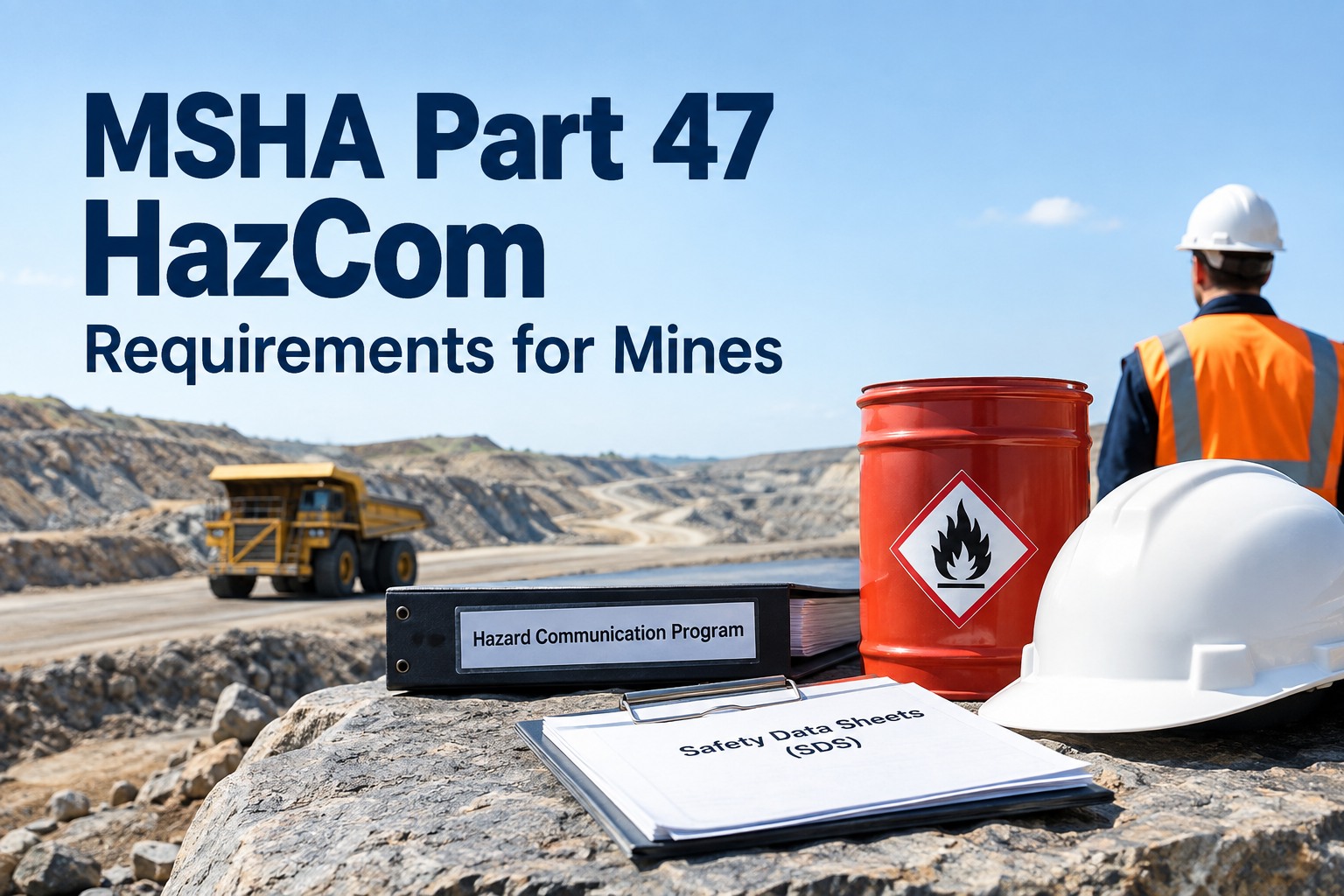
Every mine runs on chemicals — fuels, solvents, lubricants, reagents, cleaning agents — and a miner has a legal right to know what they're exposed to. MSHA Part 47 HazCom is the rule that guarantees it, and it's built from five pieces that only work as a set: a written program, a chemical list, labels, safety data sheets, and training. Miss any one and the whole program is incomplete, because HazCom is judged on being complete and current, not on good intentions. This guide walks all five and the records that hold them together. See a HazCom program kept current and audit-ready
A HazCom Program Isn't Complete Until All Five Pieces Are in Place
Part 47 has five required elements, and a gap in any one is a gap in the program. Tap each to see what it takes — and why it never stops.
The document that ties everything together — how your mine puts hazard determination, safety data sheets, labels, and training into practice. It's the first thing an inspector asks for, and it has to reflect what actually happens at the mine, not a template.
An inventory of every hazardous chemical produced or used at the mine, each identified so it can be cross-referenced to its label and safety data sheet. It's a living list — every new chemical that arrives has to be added.
Every hazardous chemical container must be labeled with a name referable to the list and appropriate hazard warnings — a miner's first source of information. A label that falls off or goes illegible must be replaced immediately.
A safety data sheet for each hazardous chemical, kept accessible to miners during every work shift. When a new chemical is added to the list, its SDS has to be on hand — you can't stock the chemical without it.
Every miner — including office workers and contractors — trained on the physical and health hazards of the chemicals in their work area, the protective measures, and the contents of the HazCom program. New miners and new chemicals both trigger training.
HazCom rests on two ideas: miners have a right to know about the chemicals they work around, and operators have a responsibility to know what's on site. Below is each of the five elements in detail, the labeling rules that trip mines up most, and how documented records keep the whole program provable as chemicals and people change.
The foundation: written program and chemical list
The first two elements are the backbone everything else hangs on. Without a current written program and an accurate chemical list, the labels, data sheets, and training have nothing to organise them — and both are the first documents an inspector reviews.
The written program
A document describing how your mine actually carries out hazard determination, SDS management, labeling, and training — specific to your operation, kept current, and available to miners. A generic template that doesn't match practice is a finding waiting to happen.
The hazardous chemical list
An inventory of every hazardous chemical produced or used at the mine, each identified so it ties to its label and SDS. This is the master reference — and it's only useful if every new chemical gets added the moment it arrives on site.
The pattern that keeps a mine compliant is simple to state and easy to let slip: a new chemical means a new list entry, a new SDS, a new label, and training — all four, together, before miners work around it. The list is where that chain starts. Book a demo to see the chemical list, SDS, and training linked per chemical.
Container labels — where mines get cited most
Labels are a miner's first source of information about a chemical, and they're also where the everyday reality of a working mine collides with the rule. Chemicals get decanted, labels wear off, drums get reused — and each of those is a potential citation. Part 47 is specific about what a label needs and what to do when one fails.
What a label must show
A chemical name that can be referenced to the list and SDS, plus appropriate hazard warnings — flammability, reactivity, health effects, and precautions.
Replace a failed label immediately
If a label falls off or becomes illegible, it must be replaced immediately — you can prepare one from the SDS or affix the SDS to the container until a replacement is ready.
"Tag out" while you fix it
If you can't relabel right away, tagging out the container and moving it so no miner is exposed — while you get a replacement label — keeps you compliant in the meantime.
There are sensible allowances: label alternatives like signs, placards, or batch tickets work for stationary process containers, and some raw materials and obvious containers are exempt under Subpart J. But the core duty holds — a hazardous chemical container a miner can be exposed to needs a label, and a missing one that's gone unreplaced is a citation. Start free and track container-label checks as a routine task.
Safety data sheets — one per chemical, always accessible
The safety data sheet is the detailed reference behind every label: the full hazard profile, handling precautions, first-aid, and emergency information for a chemical. Part 47's rule on them is short but strict — you need one for every hazardous chemical, and miners have to be able to reach it.
One SDS per hazardous chemical
Every chemical on the list has a corresponding safety data sheet on hand — if you use or produce it, you must have its SDS.
Accessible during every shift
Miners must be able to access the SDS during each work shift — whether kept on paper or electronically, it has to be genuinely reachable where they work.
Retained and kept current
Data sheets are retained and updated as chemicals or their information change — an outdated or missing SDS is as much a gap as never having had one.
The failure mode is predictable: a chemical gets added to the shelf but its SDS never makes it into the collection, or the sheets live in a binder in an office no shift crew can reach. Tying each chemical to its SDS, accessible where miners actually work, is what closes both gaps. Book a demo to see an SDS attached to every chemical and reachable per shift.
Training — the right-to-know made real
All the documentation in the world means nothing if miners don't understand it, which is why training is the element that actually delivers the right-to-know. And its scope is broader than many mines assume — it reaches everyone on site who can be exposed.
Training covers every miner who can be exposed — including office workers and independent contractors. It must cover the physical and health hazards of the chemicals in each miner's work area, the protective measures they can take, and the contents of the mine's HazCom program.
Because both new miners and new chemicals trigger a training obligation, this is a recurring duty, not a one-time orientation. A miner who starts after the last session, or a chemical introduced since, each create a training gap that has to be closed — and documented. Tracking who's been trained on what, and re-training when either changes, is how the right-to-know stays real. Start free and track HazCom training per miner and per chemical.
The records that prove the program ran
Each of the five elements produces a record, and a Part 47 inspection examines the documentation as closely as the practice. A mine can be genuinely handling chemicals safely, but if it can't produce the written program, the list, the data sheets, and the training records, it can't demonstrate compliance — and undocumented HazCom is treated as absent HazCom.
HazCom is complete only when the chemical list, every SDS, current labels, and each miner's training all line up — and you can show it. The program lives or dies on whether those records stay connected and current as chemicals and people change.
Because HazCom is recurring by nature — chemicals arrive, labels wear, miners turn over — the records only stay complete if they're captured as the changes happen and kept linked to the chemical and the miner. A program managed that way produces its whole proof on demand, instead of revealing a gap under an inspector's questions. Book a demo to see the full HazCom record retrieved in minutes.
The Part 47 HazCom compliance checklist
Use this to confirm all five HazCom elements are complete and current, not just present somewhere. Use this Part 47 HazCom checklist online free, with the chemical list, SDS, and training records tracked together automatically.
Maintain a current written program
A written HazCom program that matches actual practice at the mine and is available to miners.Keep the chemical list complete
Every hazardous chemical used or produced on the list, with each new arrival added on receipt.Label every hazardous container
Name referable to the list plus hazard warnings — and replace any failed label immediately.Keep an SDS for every chemical
One safety data sheet per chemical, accessible to miners during each work shift.Train every exposed miner
Including office workers and contractors — on hazards, protective measures, and the program, with new miners and chemicals re-triggering it.Keep every record retrievable
Program, list, SDS, labels, and training documented and producible on demand for an inspection.
From a compliance manager who closed the chemical-list gap
Our HazCom program looked fine on the surface — we had a written program and a binder of data sheets. What we didn't have was a reliable link between the two. A new degreaser came in through the shop, went straight into use, and never made it onto the chemical list, so there was no SDS for it and nobody was trained on it. It took an inspector to find that, and it was an easy citation.
Now nothing gets added to the shelf without going on the list, pulling its SDS, and flagging training for the crew that uses it — it's one connected step. When MSHA came back, I pulled the list, matched every chemical to its SDS and training, and there were no gaps to find. HazCom stopped being a binder I hoped was current and became a program I could actually prove.
Frequently asked questions
What is MSHA Part 47 HazCom?
30 CFR Part 47 is MSHA's Hazard Communication standard, which requires mine operators to identify the hazardous chemicals at their mine and inform miners about them. It's built on five required elements: a written HazCom program, a list of hazardous chemicals, container labels, safety data sheets for each chemical, and miner training. HazCom rests on two principles — miners have a right to know about the chemicals they work around, and operators have a responsibility to know what's on site. It applies to all mining sectors and all miners, including office workers and independent contractors who can be exposed.
What are the five elements of a HazCom program?
A compliant Part 47 program has five parts: a written HazCom program describing how the mine carries out the standard; a list of every hazardous chemical used or produced at the mine; labels on containers of hazardous chemicals showing a name referable to the list and appropriate hazard warnings; a safety data sheet for each hazardous chemical, accessible to miners each work shift; and training for every exposed miner on the hazards, protective measures, and the program's contents. All five must be complete and current together — a gap in any one is a gap in the program.
Who has to be trained under Part 47 HazCom?
Every miner who can be exposed to a hazardous chemical, which Part 47 interprets broadly — it includes office workers and independent contractors on the mine site, not just production crews. Training must cover the physical and health hazards of the chemicals in the miner's work area, the protective measures they can take, and the contents of the mine's HazCom program. Because new miners and newly introduced chemicals both create a training obligation, it's a recurring requirement: a miner who starts after the last session or a chemical added since needs training before working around the hazard.
What are the container labeling rules under Part 47?
Each container of a hazardous chemical must be labeled with a name that can be referenced to the chemical list and safety data sheet, plus appropriate hazard warnings. If a label falls off or becomes illegible, it must be replaced immediately — you can prepare one from the SDS or affix the SDS to the container in the meantime. If you can't relabel right away, tagging out the container and moving it so no miner is exposed keeps you compliant while you obtain a label. Alternatives like signs or batch tickets are allowed for stationary process containers, and some raw materials and obvious containers are exempt under Subpart J.
How should safety data sheets be kept under Part 47?
A mine must have a safety data sheet for every hazardous chemical it uses or produces, and miners must be able to access it during each work shift — kept either on paper or electronically, as long as it's genuinely reachable where miners work. The sheets must be retained and kept current as chemicals or their information change. The common failure is a chemical getting added without its SDS entering the collection, or the sheets being stored where a shift crew can't reach them. Tying each chemical on the list to its SDS, accessible at the point of work, closes both gaps.
Keep all five HazCom elements connected and current
HVI keeps the moving parts of a Part 47 program tied together — the chemical list, an SDS per entry, container-label checks, and training per miner — on a checklist that flags what's missing and holds every record retrievable. So a new chemical can't slip in without its paperwork, a new miner gets trained, and a HazCom inspection becomes a record you produce, not a gap you discover.
No credit card · Chemical list, SDS & training tracking · Audit-ready HazCom records