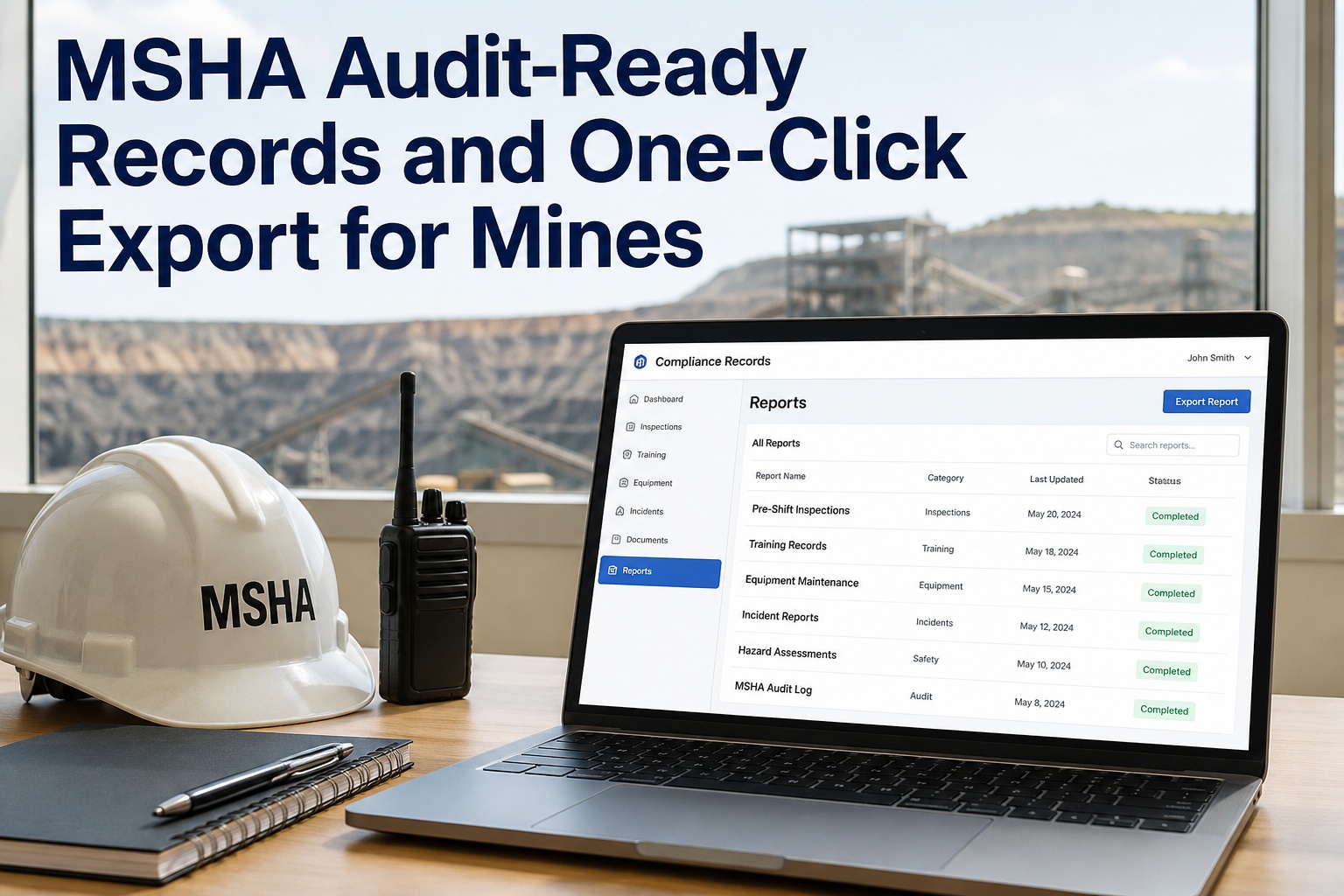
When the MSHA inspector pulls through the gate, you are not really being tested on what you fixed last night — you are being tested on whether the record of every pre-shift, every defect repair, and every tag-out for the past several months is sitting in a binder that someone can actually find. MSHA inspection preparation that treats the visit as a one-off scramble always loses, because underground mines get four inspections a year and surface mines get two, which means the next inspector is never far away. The operations that pass cleanly are the ones where mine inspection readiness is just the normal byproduct of how records are kept every shift. If your current audit prep looks like three people in a trailer photocopying binders for two days, you can see how a digital inspection system changes that timeline on a live walkthrough — but first, it helps to understand exactly what happens during a visit and what the inspector is actually looking for.
Is your mine site ready right now — or only after a two-day scramble?
Four underground visits a year. Two on surface. The inspector does not call ahead. Permanent record-readiness is not a best practice — it is the only strategy that survives the cadence. Stop assembling evidence after the truck pulls in.
Why mine inspection readiness is a permanent state, not an event
The inspection frequency is fixed in regulation. Your preparation has to match that rhythm — or you spend every quarter catching up.
The MSHA inspection process: four stages you will live through
Every visit follows the same arc. Knowing each stage lets you assign the right person, the right documents, and the right answers before the clock starts.
Opening conference
The inspector presents credentials, states the scope (regular, spot, or complaint-driven), and asks for your designated representative. This is where you set tone — a calm, organised opening tells the inspector you run a tight ship. You confirm who accompanies them underground or on the bench, and you request the same right to representation on their side.
Records review
The inspector sits down and asks for pre-shift and on-shift examination books, training files, workplace examination records, tag-out documentation, and any open or closed citations. If any of that lives in a stack of loose paper or a spreadsheet someone updated last week, this is where the visit starts to go sideways. A missing defect closure log for a haul truck brake issue is a citation waiting to be written.
Physical walkaround
Accompanied by your representative, the inspector visits working sections, haul roads, shops, fuel storage, and any active equipment. They look at guarding, brakes, lights, horns, fire suppression, high-voltage lockout, and whatever they noticed in the records. If a pre-shift noted a bad tire on Truck 17 and the record does not show it was changed before the truck rolled, the walkaround becomes a targeted hunt.
Closing conference
The inspector reads back every potential citation, the section of standard cited, the abatement time, and whether each is assessed as significant, substantial, or unwarrantable failure. This is your last chance to correct a factual misunderstanding before it goes in writing. If a defect was actually closed but the paper was missing, this is where you produce the record — if you can find it in time.
MSHA document request: what the inspector wants to see first
If you can produce these five record types in under five minutes, you are ahead of most sites. If you are flipping through binders, you are already behind.
| Record type | What it proves | What a gap costs you |
|---|---|---|
| Pre-shift / on-shift examinations | That a competent person checked the section and equipment before work started | Citation per missing entry; pattern risk if gaps are repeated |
| Defect closure logs | That a noted defect on a truck, loader, or bolter was repaired and signed off | Equipment cited as operating with a known defect |
| Training files | New-miner, task, annual refresher, and records of site-specific hazard training | Per-person citations; potential removal from the working section |
| Workplace examinations | That ground conditions, ventilation, and travelways were checked and hazards noted | Significant and substantial findings if conditions are found uncorrected |
| Tag-out / lockout documentation | That energy sources were isolated before maintenance on crushers, belts, or high-voltage | Unwarrantable failure if work was done without isolation |
A quick demo on your own equipment list shows how each of these record types is produced from the same digital inspection data — no separate binder, no re-entry, no gap between what the operator saw and what the record shows.
Inspector accompaniment rights: who goes on the walkaround
You have the right to accompany the inspector. So does the miners' representative. Getting this wrong at the opening conference sets a bad tone for the entire visit.
Operator's representative
You designate a representative — usually the site safety manager, superintendent, or shift foreman — who accompanies the inspector at all times during the physical inspection. This person should know where records live, be able to explain defect closure timelines, and document what the inspector looks at and photographs.
Miners' representative
A representative chosen by the miners has the same right to accompany the inspection. You cannot refuse, delay, or influence that choice. Your representative should document everything independently — if the miners' rep raises an issue the inspector then investigates, you want your own record of what was said and seen.
Field tip: Your representative should carry a phone or tablet with live access to inspection history, work orders, and defect closures. If the inspector asks "when was the last time Truck 23's brakes were flagged and who fixed them," answering in 10 seconds with a timestamped record is the difference between a clean visit and a citation. You can look at the live record-lookup flow on a demo to see exactly how that works on a phone in the pit.
From a single citation to pattern-of-violation status
One citation is a bad day. A pattern of violations is an existential threat to the operation. The escalation path is predictable — and so is the way off it.
The jump from Level 2 to Level 3 is where mine managers lose sleep. An unwarrantable failure finding means the inspector believes the violation was not just present but that management exercised "more than ordinary negligence" — you knew about the bad brake, the missing guard, the expired training, and let the equipment run anyway. The record is what proves otherwise. If the pre-shift shows the defect was noted and the work order shows it was pulled from service the same shift, you have a defensible position. If the record is missing, the inspector's finding stands.
See HVI running on your mine fleet — book a 30-minute demo
We will load your equipment list, show the inspector-lookup flow, and export a sample audit pack by date, asset, or operator — live, on your phone.
Citation response mining: closing the loop after the inspector leaves
A citation is not the end of the visit — it is the start of an abatement clock. Miss the deadline and a routine finding turns into an enforcement action.
Receive and log
Within hours of the closing conference, log every citation into a tracked system with the cited standard, the abatement deadline, and the responsible person. Paper citations that sit in a desk drawer are how deadlines get missed.
Repair and document
Fix the condition — replace the guard, repair the brake, retrain the miner — and capture proof: work order, parts used, photo of the repaired condition, date, and technician signature. Verbal "it's fixed" does not survive an abatement follow-up.
Submit abatement
Send the abatement documentation to MSHA before the deadline. If you need more time, request an extension in writing before the date passes — not after. Late abatement is itself a citable condition and feeds the pattern-of-violation pipeline.
Trend and prevent
Every citation should be trended by equipment, section, shift, and defect type. If the same haul truck gets flagged for the same brake issue across two inspections, that is a preventive maintenance failure — not an inspection problem.
Mine site audit prep built into every shift — not bolted on at inspection time
HVI turns the daily inspection, defect report, and work order into a permanent, exportable audit record. When the inspector arrives, you are not building a binder — you are opening a file.
Indefinite record retention
Every pre-shift, defect, work order, and workplace examination is stored indefinitely in the cloud. No purge cycle, no lost binder. When an inspector asks for a record from 14 months ago, it is one search away — by equipment, date, or operator.
One-click audit export
Filter by equipment, date range, or operator and export a complete audit pack in seconds. What used to take two days of photocopying and tabbing becomes a single export before the inspector finishes the opening conference.
Defect-to-work-order, same shift
When an operator flags a defect on a pre-shift, HVI generates a work order instantly. The repair, the parts, the technician, and the sign-off are all timestamped and linked. The inspector sees a closed loop, not a loose note.
Photo-backed proof
Every inspection and defect can carry a photo with a timestamp and GPS tag. When the inspector asks for proof that a guard was reinstalled or a tire was changed, the photo is already attached to the record — not in someone's text messages.
You can start logging inspections free and see the audit record build itself on your own equipment — or book a guided walkthrough focused on MSHA record types.
A worked example: what a missing defect log actually costs
Consider a 30-truck surface operation where a pre-shift notes a cracked rim on Truck 11. The operator writes it on the paper form, hands it to the shift supervisor, and the truck is parked. The maintenance team swaps the wheel from the parts bay, the truck goes back to work the next shift — but the paper defect note was never matched to a work order, and the defect closure was never logged.
- Inspector asks for the defect closure record for Truck 11 — it does not exist
- Citation issued: operating with a known defect, S&S finding
- Penalty assessed; abatement requires documented repair proof within 10 days
- Site safety manager spends two days reconstructing what happened from text messages and parts bay sign-out sheets
- Reconstructed record is incomplete — inspector notes the gap on the next visit
- Operator flags cracked rim on the pre-shift in the app — photo attached
- HVI auto-generates a work order; truck is marked out-of-service
- Maintenance swaps the wheel, signs off in the app with parts and timestamp
- Inspector asks for the record — supervisor exports by Truck 11, last 30 days, in 10 seconds
- Full closed loop: defect, work order, parts, photo, sign-off, back in service
That is not a hypothetical — it is the exact scenario that plays out on mine sites every inspection cycle. The difference between the two columns is not better mechanics or better operators. It is whether the record exists when someone asks for it. If you want to see how that closed loop looks on your own trucks, a 30-minute demo walks through it end to end.
MSHA readiness program: the five things that actually matter
Treat readiness as a daily output
Every pre-shift, defect, and work order is an inspection record. If it is captured digitally and timestamped, you are already audit-ready. If it is on paper, you are always one visit away from a scramble.
Close the defect-to-repair loop every shift
An open defect that gets fixed but never logged is the same as a defect that was never fixed — from the inspector's perspective. Auto-generated work orders close that gap by design.
Designate and train your walkaround rep
The person who accompanies the inspector needs live access to records on a phone or tablet. Fumbling through a binder while the inspector waits is how minor findings escalate.
Track abatement deadlines in a system, not a sticky note
Every citation has a clock. Miss it and a routine finding becomes an enforcement action. A CMMS with due-date alerts means nothing slips past the deadline.
Trend citations to find the real problem
Repeated findings on the same equipment or section point to a maintenance or training failure, not an inspection problem. Trend data turns citations into preventive action.
The worst MSHA visit I ever had wasn't because we had bad equipment — it was because we had a good truck with a repaired brake and no paper to prove it. The inspector wrote it up as operating with a known defect. After we moved to digital inspections, the next inspector asked for the same type of record and I handed him a tablet with the work order, the photo, and the timestamp. He moved on in thirty seconds. That was the moment I stopped dreading inspections.
MSHA inspection preparation: questions managers actually ask
How often does MSHA inspect a mine site?
MSHA inspects underground mines four times a year and surface mines twice a year, at minimum. Additional visits can be triggered by complaints, accidents, or targeted enforcement programs. Because the cadence is fixed and visits arrive without scheduling notice, mine inspection readiness has to be a permanent state — you cannot prepare for a specific date. You can review your current readiness gap on a demo call to see where your records would hold up.
Can I refuse to let the inspector underground or on the bench?
No. MSHA inspectors have the legal right to enter the mine, inspect records, and examine working areas without advance notice. You have the right to accompany the inspector and to have a miners' representative present, but you cannot refuse entry or delay the inspection. Interfering with an inspection is itself a citable offense.
What records does MSHA ask for first during an inspection?
The most commonly requested records are pre-shift and on-shift examination books, defect closure logs, training files, workplace examination records, and tag-out or lockout documentation. Inspectors typically start with these because gaps in any of them indicate broader compliance issues. Having all five available digitally and searchable by date, equipment, or operator is the fastest way through the records review stage.
What is the difference between a significant-and-substantial finding and an unwarrantable failure?
A significant and substantial (S&S) finding means the violation was reasonably likely to cause serious injury. An unwarrantable failure is more serious — it means management exercised more than ordinary negligence, meaning you knew or should have known about the condition and allowed it to continue. Unwarrantable failure findings carry withdrawal orders and feed directly into pattern-of-violation analysis.
How long do I have to abate a citation?
Most citations require abatement within the time stated on the citation — often 10 to 30 days, depending on severity. If you cannot meet the deadline, you must request an extension in writing before the date passes. Late abatement is itself citable and contributes to pattern-of-violation status. Always document the repair with a work order, photo, and sign-off before submitting abatement proof.
Be ready before the inspector arrives — not after
HVI gives you the records, the exports, and the closed-loop defect tracking that turn MSHA inspection preparation from a two-day scramble into a ten-second search.
Free to start — Works on any phone — No card needed