An inspector hands you a citation at the crusher and your office manager files it next to last month's paperwork without reading the classification line. That is how MSHA citation types get treated as interchangeable paperwork when they are anything but. A routine citation, a significant and substantial designation, an unwarrantable failure finding, and a pattern-of-violations letter are four different levels of enforcement risk, and the gap between the first and the last is the gap between an administrative task and a threat to your right to operate. This guide walks through the escalation ladder, what each rung costs you in penalties and withdrawal orders, why repeat findings on the same standard compound so fast, and how the abatement and contest process actually works. If you want to see how a digital record trail changes your position before the next inspection, you can book a 30-minute walkthrough on your own fleet at any point.
Which MSHA Citation Types Actually Threaten Your Operation?
Not every finding carries the same weight. The classification printed on the form tells you whether you are dealing with housekeeping or an enforcement action that can idle equipment, pull miners off a working area, and multiply your penalty exposure.
What Each MSHA Citation Type Means in Practice
Every citation carries a classification, and that single line drives the penalty formula, the inspector's follow-up behaviour, and your legal exposure. Here is the ladder from bottom to top.
Standard Citation (104(a))
A violation of a mandatory standard without aggravated findings. Think a missing guard decal or a record-keeping gap. Penalties are assessed on gravity and negligence, but a single 104(a) is an administrative matter: fix it by the abatement date, document the fix, and move on. The risk is not the citation itself. The risk is ignoring it.
Significant and Substantial (S&S)
An S&S designation means the violation was reasonably likely to contribute to a reasonably serious injury. This is where penalty assessments climb and where your violation history starts working against you. S&S findings feed directly into the pattern-of-violations screening, so every one you accept without contest becomes a brick in a wall you may have to defend later.
Unwarrantable Failure (104(b))
An unwarrantable failure finding says the operator knew, or should have known, about the condition and failed to correct it: aggravated conduct. A 104(b) order means miners are withdrawn from the affected area until the condition is abated. Worse, once one 104(b) is issued, similar conditions found afterward can draw additional withdrawal orders on the spot.
Pattern of Violations (104(e))
Pattern-of-violations status follows a demonstrated history of S&S violations. Once MSHA issues a POV notice, every subsequent S&S finding at the mine can trigger a withdrawal order. This is the existential tier: production interruptions become routine, scrutiny intensifies across every inspection, and unwinding the status takes a clean record sustained over time.
Why Repeat Violations on the Same Standard Compound So Severely
MSHA's penalty formula scores history and negligence separately, so the second citation for the same defect is never just the first one twice. It is the first one plus your own record used against you.
First citation on a standard
Assessed on gravity and negligence. If your pre-shift exam missed a defect that had been visible for days, negligence points rise. Abate it, record the corrective action, and the matter closes.
Same standard, next inspection
Now history points apply. The inspector sees the prior citation, and the obvious question follows: you knew about this condition and it is back. That is the factual basis for an unwarrantable failure finding, and the penalty assessment reflects both history and elevated negligence.
A pattern the data shows before you do
Repeated S&S findings across standards push the mine toward pattern-of-violations screening. At this point you are no longer managing citations; you are managing enforcement status. The operators who avoid this tier are the ones who caught the recurrence at finding two, because their defect trend data flagged the same standard appearing across units and shifts.
This is exactly where inspection software earns its keep: when the same defect category appears on three haul trucks in a quarter, a trend report surfaces it before an inspector connects the dots for you. You can see how defect trend analytics work in a live demo using your own equipment list.
Abatement and Contest: Your Two Response Tracks After a Citation
You can abate a citation and still contest it. The two tracks run in parallel, and confusing them is how operators miss deadlines or accidentally accept findings they intended to fight.
| Track | What you do | Deadline pressure | What the record must show |
|---|---|---|---|
| Abatement | Correct the condition by the date on the citation, or request an extension with justification before it passes | Set per citation; extensions must be requested, not assumed | Timestamped corrective action: photos, work orders, parts used, who verified the fix and when |
| Contest | Notify MSHA you contest the citation, the S&S designation, the negligence finding, or the proposed penalty | Typically 30 days from the order or proposed assessment; miss it and it becomes final | Your inspection history, prior exam records, and maintenance logs that support your version of the facts |
| Both together | Fix the hazard immediately to protect miners and limit exposure, while preserving your right to challenge the classification | Abatement clock and contest clock run independently | A clean separation: abatement evidence plus a documented good-faith compliance record |
For any specific enforcement matter, consult qualified mine safety counsel and confirm current MSHA policy before deciding whether to contest. Classification law turns on facts, and facts live in your records. Operators who keep timestamped inspection and closure records from day one walk into that conversation with evidence instead of recollections.
The Record-Keeping That Supports a Good-Faith Position
Negligence findings turn on what you knew and when. A disciplined record trail is the difference between "should have known" and "demonstrably on top of it."
Complete exam records
Every workplace exam, on every shift, with the examiner identified and defects logged. Gaps in the sequence read as gaps in diligence.
Photo-backed defects
A photo at discovery and a photo at closure, both timestamped. This is what turns "we fixed it" into "here is the fix, verified."
Defect-to-work-order closure
Each defect linked to a work order, parts, and a named closer. An unclosed defect older than the citation date is a negligence argument waiting to happen.
Trend monitoring
Recurring findings flagged by standard, unit, and location, so you correct the pattern before it reads as disregard for the rule.
Response-time history
How fast defects move from found to fixed. A fleet that closes defects in days, not weeks, has a measurable good-faith story.
Audit-ready retrieval
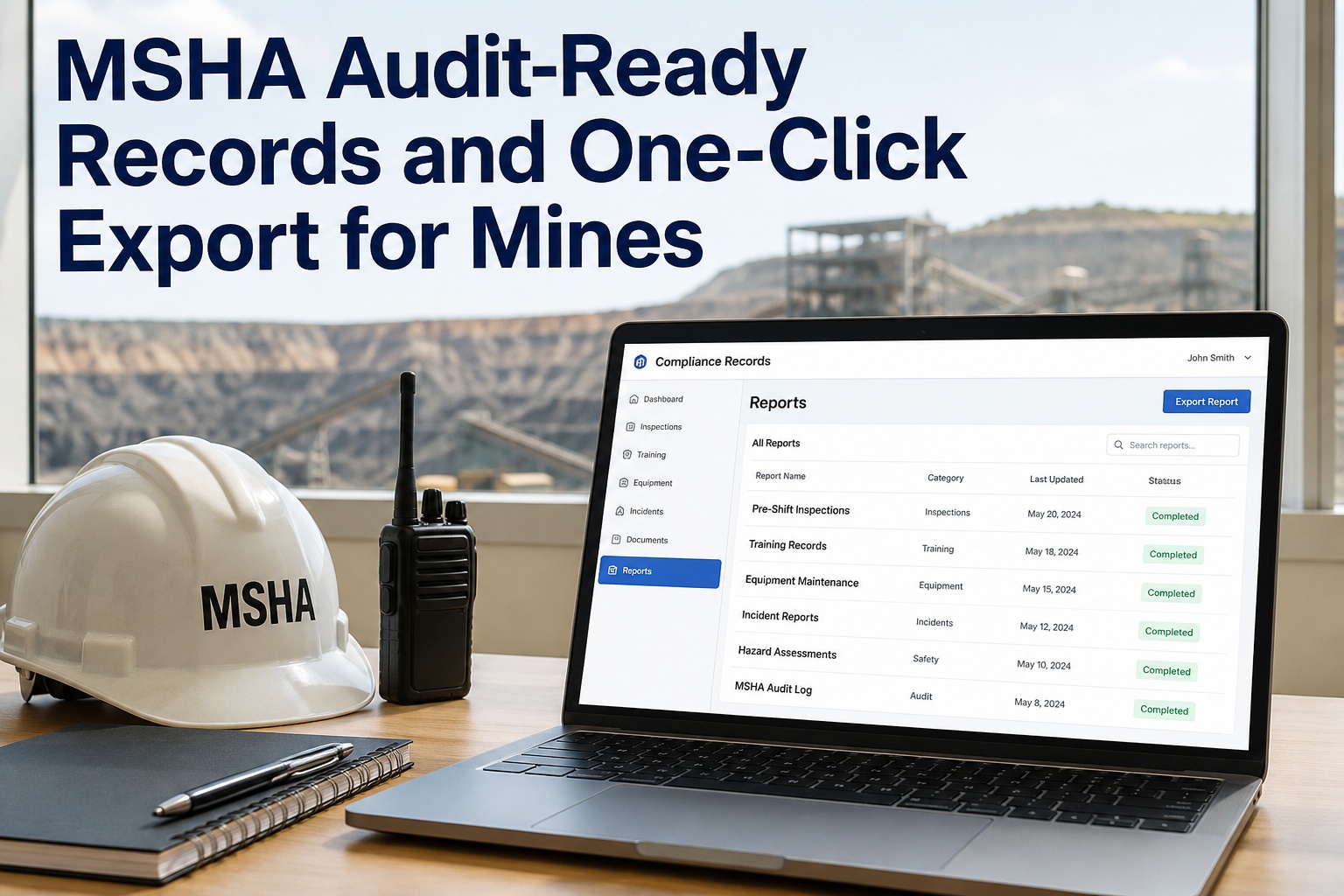
Any record for any unit pulled in seconds, not a day of digging through binders while the inspector waits.
See the Citation Risk Hiding in Your Own Defect History
Book a 30-minute demo and we will walk your fleet's inspection and closure records through the same lens an inspector uses: repeat findings, open defects, and response times.
What One Unwarrantable Failure Finding Actually Costs a Mid-Size Operation
Run the numbers on a realistic scenario: a 25-unit surface operation with haul trucks, a loader, and a crushing spread.
The sequence
A pre-op exam flags a parking brake defect on a haul truck. The note lives in a paper book. Three weeks later an inspector finds the same truck in service with the same defect and the prior exam note on file. That is the factual basis for a 104(b) unwarrantable failure order: the operator knew and did not act.
The truck and its working area are withdrawn until abatement is verified. If the truck is feeding the crusher, the spread slows or stops with it.
The arithmetic
A halted crushing spread at a mid-size aggregates site commonly runs several thousand dollars per day in lost production, idle crew, and rescheduling. Add the elevated penalty assessment from aggravated negligence, the management hours spent on abatement verification and legal review, and the increased scrutiny on every inspection that follows.
The brake repair itself? A few hundred dollars in parts and a morning of labour, three weeks earlier. The gap between those two numbers is the entire argument for a closed-loop defect process, and it is worth walking through your own defect-to-closure times in a demo to see where your gap sits.
Four HVI Capabilities That Keep Findings From Becoming Patterns
Digital inspections with photo capture
Every exam on any phone or tablet, timestamped with photo evidence at the point of discovery. No paper book that an inspector can use to prove a defect sat logged and ignored.
Instant defect-to-work-order
A flagged defect becomes a tracked work order the moment it is submitted, with a named owner and a closure record. Open-defect aging is visible on one dashboard, so nothing quietly turns three weeks old.
Defect trend analytics
Recurring findings grouped by unit, system, and location. When the same standard shows up across three trucks in a quarter, you see the pattern forming and correct it before it reads as a history of S&S violations.
Audit-ready documentation
Complete inspection, repair, and closure history for any asset, retrievable in seconds. When you contest a classification or defend a good-faith position, you bring records instead of memory. Start building that record free on your first units today.
The Bottom Line on MSHA Enforcement Escalation
Read the classification line first. MSHA citation types are not interchangeable: the S&S designation, an unwarrantable failure finding, and pattern-of-violations status each carry a different level of penalty exposure and operational risk.
Repeat findings on the same standard are the real danger. History and negligence scoring means the second citation costs far more than the first, and it builds the factual record for aggravated-conduct findings.
Abate fast, contest deliberately. Fix the hazard immediately, and use the contest window with qualified counsel where the classification overstates the facts. Miss the deadline and the finding is final.
Your records are your defence. Complete exams, photo-backed closures, and trend monitoring are what separate a good-faith operator from a negligence finding. If you want that record trail running without adding admin work, book a demo and see it on your own fleet.
"I keep one number on my wall: average days from defect found to defect closed. When I took over it was eleven. Eleven days is exactly the kind of gap an inspector turns into an unwarrantable failure, because the paper trail proves we knew. We got it under three, and the last two inspections were the quietest I have had in fifteen years. The fines I can budget for. It is the withdrawal orders that keep me up, because a parked truck earns nothing and neither does the crew standing next to it."
MSHA Citation Types: Frequently Asked Questions
What does "significant and substantial" mean on an MSHA citation?
What is an unwarrantable failure finding and why is it so serious?
How does a mine end up on pattern-of-violations status?
Should I contest an MSHA citation or just pay it?
What records actually help defend against an elevated negligence finding?
Build the Record That Defends Your Operation
HVI gives you timestamped inspections, closed-loop defect tracking, and trend analytics on one platform, so the next citation conversation starts from evidence, not memory.
Free to start - Works on any phone - No card needed