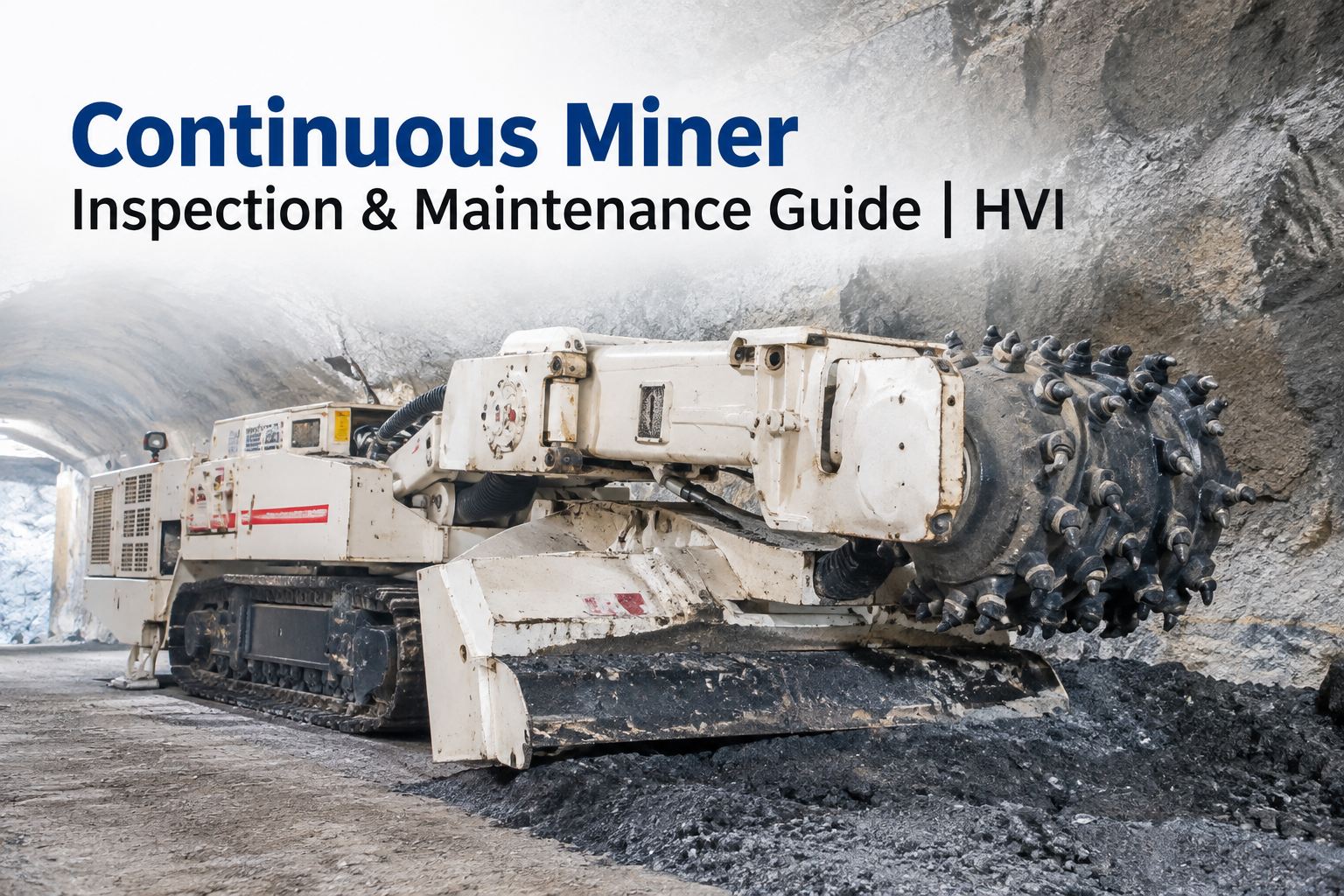
The cut stops mid-face, the conveyor backs up, and the crew's first guess is always hydraulics — because it usually is. A continuous miner inspection that catches a weeping hose before it lets go is the difference between a five-minute swap and a section sitting idle for the rest of the shift while a mechanic works in a cramped, dust-choked heading. Book a Demo
What a Continuous Miner Going Down Mid-Cut Actually Costsunderground, downtime isn't measured in shifts — it's measured in minutes
There's no pulling a continuous miner off to the side of the road while you wait for a part. When it stops, the whole section stops with it — the roof bolter, the shuttle cars, the crew standing around a machine wedged into a heading that was never designed for easy access to the failed component.
None of that requires a bad machine. It requires one worn hose fitting, one pick nobody rotated, one gathering-arm chain that ran past its wear limit — all things a real continuous miner maintenance programme catches during a shift, not during a failure. Book a Demo
The Systems a Real Continuous Miner Inspection Has to Covernine areas, one machine — skip any one of them and you have a gap, not a shortcut
A continuous miner inspection checklist that only looks at the cutting head is checking the part everyone already watches. The failures that shut a section down usually come from somewhere else on the machine entirely.
Cutting head & picks
Bit wear, pick rotation, and block condition on the drum — the component doing the actual cutting and the one most exposed to abrasive strata.
Gathering & conveyor
Chain tension, flight condition, and gathering-arm wear — the system moving cut material off the face and the one most prone to jams under load.
Hydraulic system
Cylinders, hoses, and fittings checked for weeping, chafe, and pressure loss — the single most common root cause of unplanned stoppages.
Traction & tramming
Crawler tracks, drive motors, and tram brakes — condition that determines whether the machine can reposition safely between cuts.
Water sprays & scrubber
Spray nozzle coverage on the cutting head and scrubber filter condition — the front line against respirable dust and ignition risk at the face.
Methane & gas monitoring
Methane monitor calibration, alarm function, and sensor placement — life-safety systems that get a check of their own, not a glance during the general walkaround.
Electrical & permissibility
Enclosure integrity, seals, and connections on permissible equipment — covered in more detail below, since this is where field decisions carry the most compliance weight.
Trailing cable & connections
Jacket condition, connector integrity, and cable-handling wear — a system with its own well-documented injury and damage history if left unchecked.
Guards, structure & lube
Physical guards in place, structural cracks or fatigue on the chassis, and lubrication points serviced on schedule — the basics that quietly prevent bigger failures.
Nine systems, one shift's worth of inspection time if it's built into a routine instead of reconstructed from memory every time. See a full continuous miner inspection checklist for the detailed point-by-point version of each system above.
Electrical & Permissibility: Where Field Decisions Carry the Most Weightthis is the section every maintenance manager needs to get right
Permissible equipment is built and approved to limit ignition risk in a methane atmosphere — enclosures, seals, and electrical components engineered to a specific approved design. Maintaining that condition matters as much as maintaining the machine's ability to cut coal.
What actually determines your requirements here
Exactly what counts as maintaining permissible or otherwise approved condition on a given machine depends on that machine's specific approval, the conditions of the mine it's operating in, and the applicable MSHA requirements for that equipment and site. It is not a generic checklist that applies identically to every continuous miner in every mine.
Not every field repair or component swap automatically compromises approved status — but every repair, seal replacement, or component change on applicable equipment needs to be done in a way that preserves that approved or permissible condition, following manufacturer procedures and the equipment's approval requirements. The safest posture for a maintenance team is treating that preservation as the goal of the repair, not an afterthought once the machine is running again, and documenting exactly what was done and by whom.
This is one of the clearest cases where a documented inspection and repair record isn't paperwork for its own sake — it's the evidence that the approved condition of the machine was maintained, not just assumed. See how HVI structures safety-critical checkpoints alongside the rest of your inspection programme.
From Defect to Work Order: Closing the Loop Undergroundmeter-based PM only works if the paper trail survives the trip back to the surface
Most underground maintenance programmes don't fail because nobody noticed the problem. They fail because the operator who noticed a weeping hose at 2am told someone verbally, and by the time the maintenance manager heard about it three shifts later, the hose had already let go.
Operator or maintenance crew logs it on the device underground, offline if needed, with a photo attached.
The moment the device finds signal, the defect and photo evidence sync automatically — no verbal handoff required.
Assigned to a technician automatically, with meter-based PM triggers tracked against the machine's actual cutting hours.
Parts, labor, and repair history attach to the machine's permanent record — audit-ready the moment an inspector asks for it.
That last step is the one most binders and radio calls quietly lose. Book a Demo to see defect capture, meter-based PM, and audit-ready records running as one connected workflow instead of three disconnected habits.
From a maintenance manager who got tired of guessing at availability
Every superintendent meeting used to start with someone asking why availability was down, and me pulling together numbers from three different sources that never quite agreed with each other.
Now every defect an operator logs underground turns into a work order with a timestamp and a photo, and I can pull hydraulic hose replacement history on a specific miner in about ten seconds. The conversation changed from "we think it was hydraulics again" to actually knowing.
Frequently asked questions
What should a continuous miner inspection checklist cover?
A complete continuous miner inspection checklist should cover the cutting head and pick condition, gathering arm and conveyor systems, hydraulic cylinders and hoses, traction and tramming systems, water sprays and scrubber filters, methane and gas monitoring equipment, electrical components and permissibility-related condition, trailing cables and connections, and structural guards and lubrication points. Skipping any one of these areas leaves a genuine gap rather than a reasonable shortcut, since each system has its own distinct failure mode.
What causes most continuous miner downtime?
Industry reliability studies and reported field data consistently point to hydraulic system failures, particularly hose and fitting failures, as the most common cause of unplanned continuous miner downtime. Cutting head and conveyor issues follow closely behind. This is why a routine hydraulic inspection focused on weeping seals, chafe points, and fitting torque tends to prevent more downtime than almost any other single maintenance task.
Does every repair on permissible equipment void its approval?
No. Not every field repair or component change automatically voids a machine's approved or permissible status. What matters is that any repair, seal replacement, or component swap on applicable equipment is carried out in a way that preserves the approved condition, following the manufacturer's procedures and the equipment's specific approval requirements. Exact requirements depend on the machine's approval, the conditions of the mine, and applicable MSHA requirements for that equipment and site, so this should be confirmed against the specific machine rather than assumed from a general rule.
How does meter-based PM work for continuous miners?
Meter-based preventive maintenance ties service intervals — pick rotation, hydraulic fluid changes, filter replacement — to actual cutting hours logged by the machine rather than calendar dates alone. Since utilization varies significantly between sections and shifts, a machine running heavy hours in a productive section reaches its next PM trigger sooner than one that saw lighter use, keeping maintenance aligned with actual wear instead of an arbitrary schedule.
Why does defect documentation matter for MSHA inspections?
Documented, audit-ready inspection and repair records are what allow a mine to demonstrate that equipment condition, including permissibility-related maintenance, was actively managed rather than assumed. A defect logged with a timestamp, a photo, and a resolved work order shows a functioning maintenance programme; a verbal report that never made it into a record shows a gap, even if the repair itself was done correctly. Consistent documentation protects the mine's compliance position and gives maintenance managers a defensible answer when equipment availability or safety practices are questioned.
Give every continuous miner an inspection record that holds up underground and on the surface
Custom inspection templates with permissibility and equipment-condition checkpoints, photo evidence, offline capture at depth, meter-based PM, and defect-to-work-order tracking — all in one audit-ready system. Live in under two weeks.
No credit card · Works fully offline underground · Audit-ready records on day one