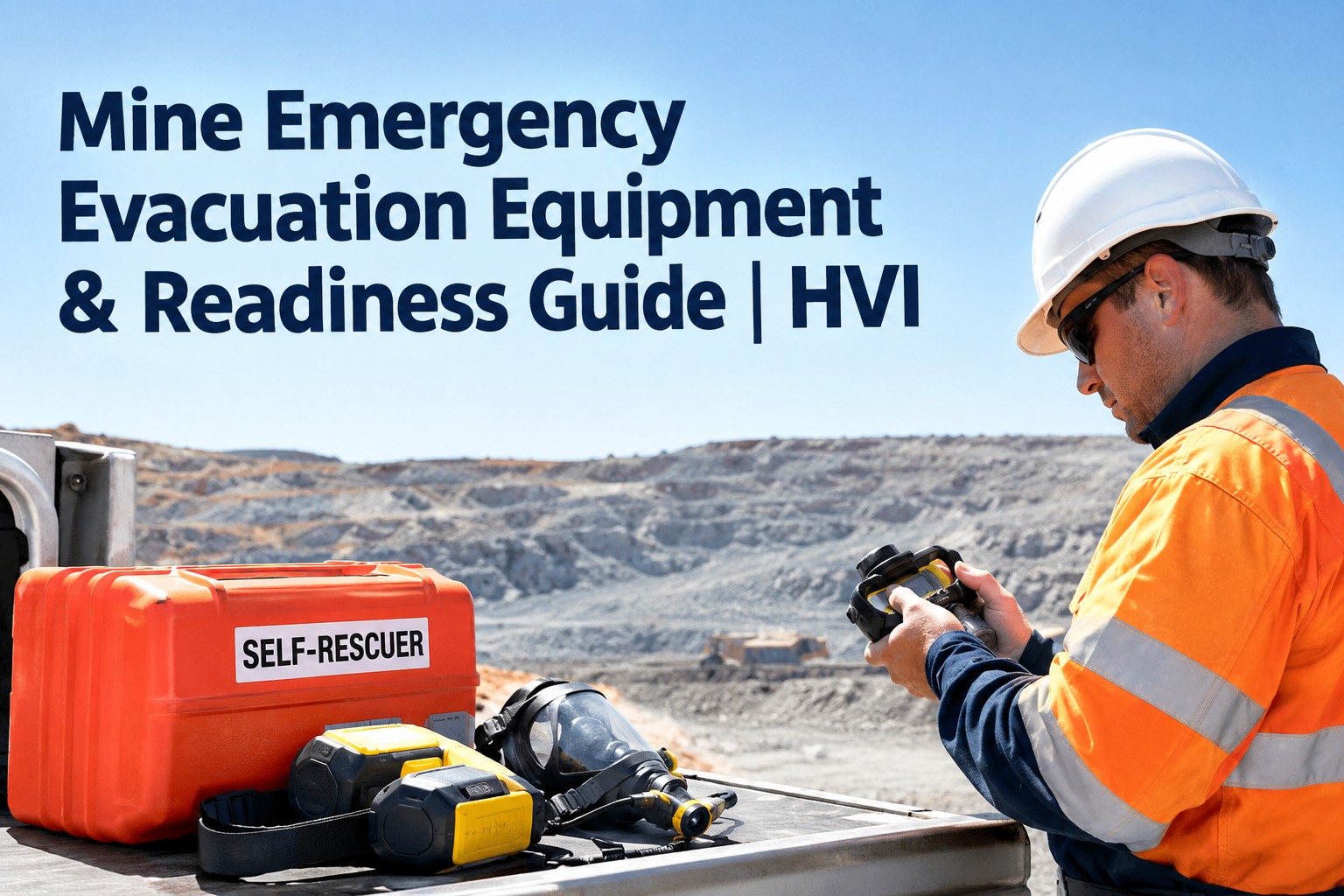
The drill goes fine right up until someone opens the SCSR cache and finds two units past their service date and one missing entirely. That's the moment mine emergency evacuation equipment stops being a line on last year's inspection form and becomes the question every safety manager dreads answering: how long has it been like this? Book a Demo
Why Emergency Equipment Readiness Isn't Just Paperworkthe difference between "present" and "ready" only shows up when it's needed
Every mine has self-rescuers, escapeways, and emergency lighting somewhere on site. Having them isn't the hard part. Knowing — on any given day, without a scramble — that every unit is present, inspected, within its service life, and exactly where the evacuation plan says it should be is what mine emergency evacuation programmes actually live or die on.
None of those numbers are dramatic on their own. They're exactly the kind of small gap — one expired unit, one skipped annual test, one cache short by a couple of units — that turns into the finding nobody wants to explain during an MSHA inspection or, worse, during an actual evacuation. Book a Demo
The Equipment a Readiness Programme Actually Has to Tracklocation, condition, and expiry — not just "is it on site somewhere"
A mine evacuation equipment list isn't one item, it's a system of systems, each with its own thing that can quietly go wrong. Being present in the building and being ready to work are two different facts, and a readiness programme has to check both.
| Equipment | What "ready" actually means | Typical check frequency |
|---|---|---|
| Self-rescuers / SCSRs | Present, within service life, undamaged seal, correct cache location and count | Daily / shift |
| Refuge alternatives | Sealed, stocked, breathable air supply and communication link functional | Weekly |
| Escapeways | Clear, marked, structurally sound, second route genuinely usable | Weekly |
| Lifelines & tethers | Continuous, correctly directional, reflective markers and cones intact | Weekly |
| Emergency communication | Tracking and comms devices powered, charged, and actually reach the surface | Weekly |
| Mine maps | Current version posted, matches actual workings, escape routes correctly marked | Monthly |
| Emergency lighting | Charged, functional, positioned along the actual escape route | Monthly |
| Firefighting equipment | Charged, pressure-tested where applicable, accessible and unobstructed | Monthly |
Site-specific resources belong on this same list too — anything named in your mine's written emergency response plan is, by definition, equipment your programme is responsible for keeping ready. Sign Up Free
What's Underground-Coal-Specific vs. What Varies by Minethe requirement set is not identical from one operation to the next
Verify against your own approved plan before treating any of this as a checklist
Self-contained self-rescuer requirements — minimum quantities, storage location and distance from miners, and required annual reliability testing on a representative sample — are established specifically for underground coal mines under federal mining regulations (30 CFR Part 75). Refuge alternative requirements were introduced for underground coal mines following the MINER Act of 2006 and are likewise coal-specific rather than universal across all mine types.
What applies to a given metal, nonmetal, or surface operation is a different question entirely, and depends on that mine's classification, its approved emergency response or evacuation plan, its specific equipment, and site conditions. This guide describes the general shape of an equipment-readiness programme; it is not a substitute for checking your mine's current, approved plan and the specific MSHA standards that apply to your operation. When in doubt, that verification should happen before an inspection, not during one.
This is also why a generic, one-size-fits-all inspection form is the wrong tool here — a coal mine's self-rescuer cache count and a surface operation's firefighting equipment schedule are answering completely different regulatory questions. See how HVI configures site-specific inspection templates around what your approved plan actually requires.
Turning a Defect Into a Documented Corrective Actiona critical safety finding needs a record, not just a fix
When an emergency equipment defect turns up — an expired SCSR, a lifeline with a broken section, an emergency light that doesn't hold a charge — treating it as a routine maintenance note undersells what it actually is. These findings deserve to be flagged as critical safety findings, tracked separately from general wear-and-tear items, with a corrective action assigned and closed out before anyone considers the equipment ready again.
What a defensible emergency-equipment record actually contains
- Asset identity & location — which specific unit, which cache or station, exactly where on site
- Date and condition found — what was wrong, in specific terms, not "needs attention"
- Photo evidence — attached at the moment of inspection, not reconstructed later from memory
- Severity flag — marked as a critical safety finding where it affects evacuation readiness
- Corrective action assigned — who is responsible, and by when
- Resolution & sign-off — confirmed closed, with the same photo-evidence standard applied on the fix
That full record is what turns "we fixed it" into evidence you can hand an internal reviewer or an MSHA inspector without having to reconstruct the timeline from memory. Book a Demo to see defect capture, corrective work tracking, and audit-ready records running as one workflow.
Connecting Equipment Readiness to the Written Plan and Drillsa checked SCSR means nothing if nobody's practiced using one
Equipment readiness and the written emergency response or evacuation plan aren't two separate programmes — the equipment exists to execute the plan, and the plan is only as credible as the equipment behind it. A refuge alternative that's fully stocked but that nobody has walked through during a drill is still an unknown quantity when it actually matters. Training and evacuation drills are what confirm the equipment works the way the plan assumes it does — not just that it's present and within its service life.
This is also where documentation earns its keep twice over: once as proof of equipment condition, and again as proof that the plan itself was actually exercised, not just filed away. Sign Up Free
From a safety manager who stopped relying on the annual audit to find out
We used to find our gaps once a year, during the formal audit, which meant anything wrong sat wrong for months before anyone caught it. That's not a readiness programme, that's an annual surprise.
Now every self-rescuer and refuge station has its own record with an expiry date that flags itself two months out, not two months late. When an inspector asks to see our emergency equipment history, I can pull it up in the same meeting instead of promising to send it over later.
Tara's programme didn't need more equipment — it needed a record nobody had to remember to check. Book a Demo
Frequently asked questions
What should a mine emergency evacuation equipment inspection cover?
A complete inspection should cover self-rescue and SCSR equipment, refuge alternatives where applicable, escapeway condition and clearance, directional lifelines and tethers, emergency communication and tracking systems, current mine maps, emergency lighting, firefighting equipment, and any other site-specific resources named in the mine's written emergency response plan. Each item needs its condition, location, and availability confirmed, not just its presence somewhere on site.
How often should self-rescuers (SCSRs) be inspected?
Self-rescue devices generally need a routine visual inspection on a regular schedule, along with documented reliability testing on a representative sample of units on an annual basis, consistent with manufacturer instructions and MSHA guidance. Field evaluation data has shown that a meaningful share of units can fail a visual inspection over time, which is why relying on the original purchase date alone, rather than ongoing inspection, is not sufficient.
Are refuge alternatives required at every underground mine?
Refuge alternative requirements were introduced specifically for underground coal mines following the MINER Act of 2006 and are not a universal requirement across every type of underground mine. What applies to a specific operation depends on its classification as a coal or metal/nonmetal mine, its approved emergency response plan, and the applicable MSHA standards for that site, so this should always be confirmed against the mine's own approved plan rather than assumed from general practice.
Why should an equipment defect be flagged as a "critical safety finding" instead of a routine maintenance item?
A defect on emergency evacuation equipment directly affects whether people can safely evacuate if something goes wrong, which puts it in a different risk category than routine wear on non-emergency equipment. Flagging it as a critical safety finding ensures it gets a documented corrective action, a responsible party, and a closeout record, rather than sitting in a general maintenance queue where it could be deprioritized against non-safety-critical work.
How does equipment readiness connect to evacuation drills and training?
Equipment readiness confirms that self-rescuers, refuge alternatives, lifelines, and communication systems are present, functional, and within their service life. Drills and training confirm that miners actually know how to use that equipment and follow the escape route under the written emergency response plan. Both are necessary and neither substitutes for the other — well-maintained equipment that nobody has practiced with, and well-trained miners with unready equipment, both represent an incomplete readiness programme.
Know your emergency equipment is ready before anyone has to ask
HVI tracks self-rescuers, refuge alternatives, lifelines and every other emergency asset with configurable inspection templates, photo evidence, expiry and service alerts, offline capture underground, and audit-ready corrective action records. Live in under two weeks.
No credit card · Works fully offline underground · Audit-ready records on day one