A miner can pick up the phone, describe a hazard at your mine, and trigger a mandatory MSHA inspection within hours — and you may never learn who called. That's a mine hazard complaint under Section 103(g), one of the strongest rights the Mine Act gives miners. For a safety manager, the goal isn't preventing complaints; it's running a mine where an inspector arriving on one finds the hazard already reported, examined, and documented. See how internal hazard reports build an audit-ready trail
Not Every Hazard Complaint Works the Same Way — or Tells You the Same Thing
Pick a complaint type. Each triggers a different MSHA response, and each reveals a different amount to you as the operator.
A miner or miners' representative with reasonable grounds to believe an imminent danger or a violation of a mandatory standard exists. Filed in writing and signed, it gives the right to an immediate MSHA inspection.
The same kind of allegation — imminent danger or a mandatory-standard violation — but from someone who can't be identified as a miner or who asks to stay anonymous. MSHA still investigates.
An allegation outside 103(g) — something other than a possible imminent danger or mandatory-standard violation. It's assessed, and may be referred elsewhere or not result in an inspection at all.
The hazard-complaint right sits at the heart of the Mine Act, and it's not something a mine can push back on — only prepare for. Below is what a 103(g) complaint actually requires, how MSHA responds, the anti-retaliation rules you must never cross, and how your own documented hazard reporting turns a complaint inspection from a threat into a record that speaks for you.
What Section 103(g) actually gives miners
Section 103(g)(1) of the Federal Mine Safety and Health Act is short but powerful: any miner or miners' representative who has reasonable grounds to believe a hazard exists can compel an MSHA inspection. It's a right, not a request — and understanding its exact shape is the first step to being ready for it.
Who can file
A miner or a miners' representative — and in practice MSHA also accepts complaints from non-miners and anonymous callers about the same conditions.
What it must allege
Reasonable grounds to believe there's an imminent danger, a Mine Act violation, or a violation of a mandatory safety or health standard.
How it's filed
A formal 103(g) request must be in writing and signed by the miner or representative — though anonymous hazard reports can also be filed, including online.
What it triggers
If the complaint identifies a location and hazard with enough detail, MSHA investigates promptly — an immediate inspection for a valid 103(g) request.
The threshold is deliberately low: "reasonable grounds," not proof. That's by design — the Mine Act wants hazards surfaced early, and it protects the miner's ability to raise them. For the operator, that means the smart posture is readiness, not resistance. Start free and log hazards internally before they become complaints.
How MSHA responds — and what it can issue
Once a valid complaint comes in, the process moves quickly and follows a defined path. Knowing the sequence takes the surprise out of an inspector showing up unannounced, and tells you what's at stake in the outcome.
- 1Complaint received
MSHA logs and assesses it against the 103(g) criteria. - 2Inspector dispatched
For a valid 103(g), an immediate inspection — the visit may look like a regular one to protect the complainant. - 3Inspection conducted
The inspector examines the alleged hazard and any violations observed in the process. - 4Outcome issued
Citation, withdrawal order, or written notice that no violation was found — the operator and rep are notified.
An inspector who finds a violation writes a citation naming the standard and grading its gravity. A condition judged "significant and substantial" or one caused by an operator's "unwarrantable failure" to comply carries heavier penalties and can lead to a withdrawal order. The outcome, in other words, turns heavily on what the inspector finds — and on whether your records show you were already on it. Book a demo to see examination and corrective-action records per hazard.
The line you cannot cross: no retaliation, no guessing
This is the part where good operators get into legal trouble by accident. The Mine Act protects a complaining miner absolutely, and the protections extend to things that feel harmless — like wondering aloud who called. Interfering with a miner's right to complain is itself a violation.
- Try to identify the complainant, or speculate about who called MSHA
- Approach, question, or discuss the complaint with a suspected complainant
- Take any adverse action against a miner believed to have complained
- Express disapproval of miners contacting MSHA, or discourage complaints
The right response is the opposite of investigation: cooperate with the inspector, address the hazard, and treat the identity of the complainant as something you neither know nor want to know. Retaliation claims are often costlier than the original citation — and entirely avoidable. Start free and give miners a documented internal channel to raise hazards.
Your real defense: documented internal hazard reporting
You can't control whether a complaint is filed, but you can control what an inspector finds when they act on one. The single strongest position is a documented internal hazard-reporting system — because it shows the condition wasn't ignored, it was already in your process.
Capture every internal report
A miner flags a hazard internally, it's logged with time, location, and detail — so a real channel exists before anyone feels the need to call MSHA.
Record the examination & fix
The workplace exam, the corrective action, and the sign-off attach to the hazard — the proof it was assessed and abated, not just noted.
Retrieve it on demand
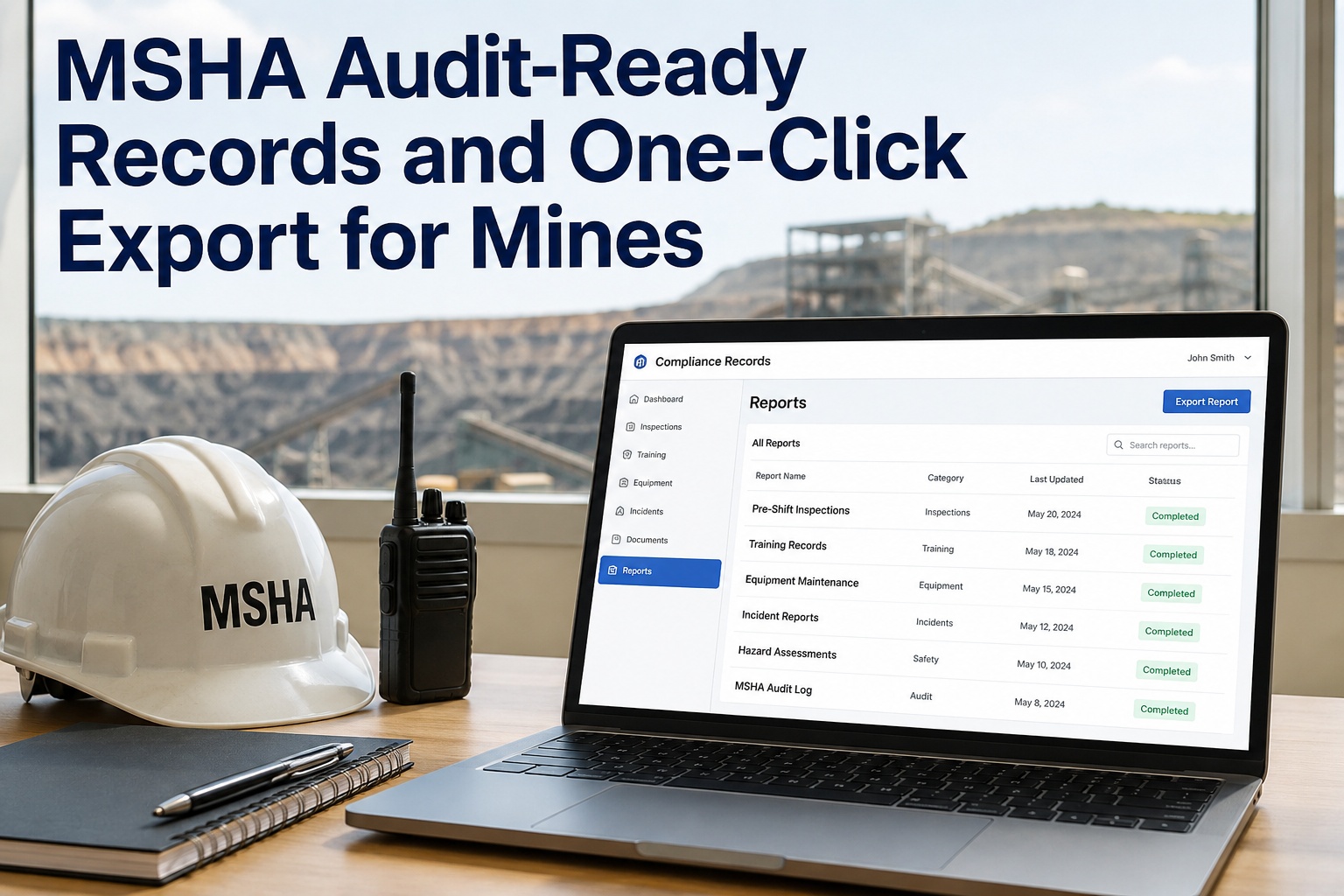
When the inspector asks, the full history — report, exam, correction — exports in minutes as an audit-ready record, not a scramble through paper.
A mine that documents hazards this way changes the whole dynamic of a complaint inspection. Instead of an inspector discovering an unaddressed hazard, they find a condition your own system already caught and handled — which is exactly the record that keeps a citation from becoming an "unwarrantable failure." Book a demo to see hazard reports and exams retrieved for an inspector.
The hazard-complaint readiness checklist
Use this to make sure a hazard complaint finds your mine prepared, not caught out. Use this hazard-reporting checklist online free, with every internal report, examination, and correction retained against the asset and area automatically.
Give miners an internal channel
A clear, documented way to report hazards internally — so concerns are captured before they escalate to MSHA.Log every report with detail
Time, location, hazard, and reporter captured on each internal hazard report — a real record, not a note.Document the exam and correction
Attach the workplace examination, corrective action, and sign-off to each hazard — the proof of abatement.Train managers on the no-retaliation rule
No identifying, discussing, or acting against a complainant — and no discouraging complaints, ever.Know the inspection sequence
Understand how a 103(g) inspection unfolds so an unannounced visit is routine, not a scramble.Keep records audit-ready
Hazard, exam, and correction history retrievable on demand for an inspector or an audit.
From a mine safety manager who welcomed the inspection
The first 103(g) inspection I dealt with early in my career was a bad day — the hazard was real, we hadn't documented anything, and the citation reflected it. What stung was that we'd actually talked about that condition in a toolbox meeting weeks earlier. We just had no record of it.
Now every hazard a miner raises gets logged, examined, and closed out in the system, with the sign-offs attached. When an inspector came in on a complaint last year, I pulled up the exact hazard — reported, inspected, corrected, dated. It didn't make the complaint go away, but it turned what could have been an unwarrantable-failure finding into a routine citation, because the record showed we were already on it.
Frequently asked questions
What is a Section 103(g) hazard complaint?
Section 103(g)(1) of the Federal Mine Safety and Health Act gives a miner or a miners' representative the right to an immediate MSHA inspection when they have reasonable grounds to believe an imminent danger, a Mine Act violation, or a violation of a mandatory safety or health standard exists. The formal request must be in writing and signed. If it identifies the location and hazard with enough detail, MSHA investigates promptly and can issue a citation or withdrawal order. It's a legal right, not a request the operator can refuse.
Can hazard complaints to MSHA be anonymous?
Yes. While a formal 103(g) complaint must be signed by a miner or their representative, MSHA also accepts hazard complaints from non-miners and from people who wish to remain anonymous, including through an online filing system. In those cases MSHA still investigates the alleged condition, but discloses less to the operator — typically it won't reveal the subject of the complaint unless a related citation is issued. Regardless of source, any complaint clearly within MSHA's jurisdiction is taken seriously and, if specific enough, promptly investigated.
Can a mine operator find out who filed a complaint?
No — and trying to is itself a violation. MSHA vigorously protects the confidentiality of complainants, and an inspector may even conduct a hazard-complaint inspection under the appearance of a regular inspection to shield the person's identity. Operators and management must do nothing to identify the complainant, must not speculate about who called, must not approach or discuss the complaint with a suspected complainant, and must never take adverse action against them. Interfering with a miner's right to complain, including expressing disapproval, is prohibited under the Mine Act.
What happens during a hazard-complaint inspection?
MSHA logs and assesses the complaint, and for a valid 103(g) request dispatches an inspector for an immediate inspection. The inspector examines the alleged hazard, along with any violations observed in the process, then issues the outcome: a citation naming the standard violated, a withdrawal order for serious cases, or written notice that no violation was found. Conditions judged "significant and substantial" or caused by an operator's "unwarrantable failure" to comply carry heavier penalties. The operator and any miners' representative are notified of the results.
How can documenting hazards help during an MSHA inspection?
A documented internal hazard-reporting system shows an inspector that a condition was already identified, examined, and being corrected rather than ignored. When each hazard report carries the time, location, workplace examination, corrective action, and sign-off, and can be retrieved on demand, it demonstrates good faith and diligence. That record can be the difference between a routine citation and an "unwarrantable failure" finding, and it gives miners an internal channel to raise concerns — which is the best way to address hazards before they ever become a complaint to MSHA.
Make your hazard record the first thing the inspector sees
HVI captures internal hazard reports, workplace examinations, and corrective actions against each asset and area — timestamped, signed, and exportable as audit-ready records. So a hazard complaint finds your mine already on the condition, with the report, the exam, and the fix a single search away, and gives your miners an internal channel to raise concerns before they ever call MSHA.
No credit card · Hazard reporting & workplace exams · Audit-ready record retrieval