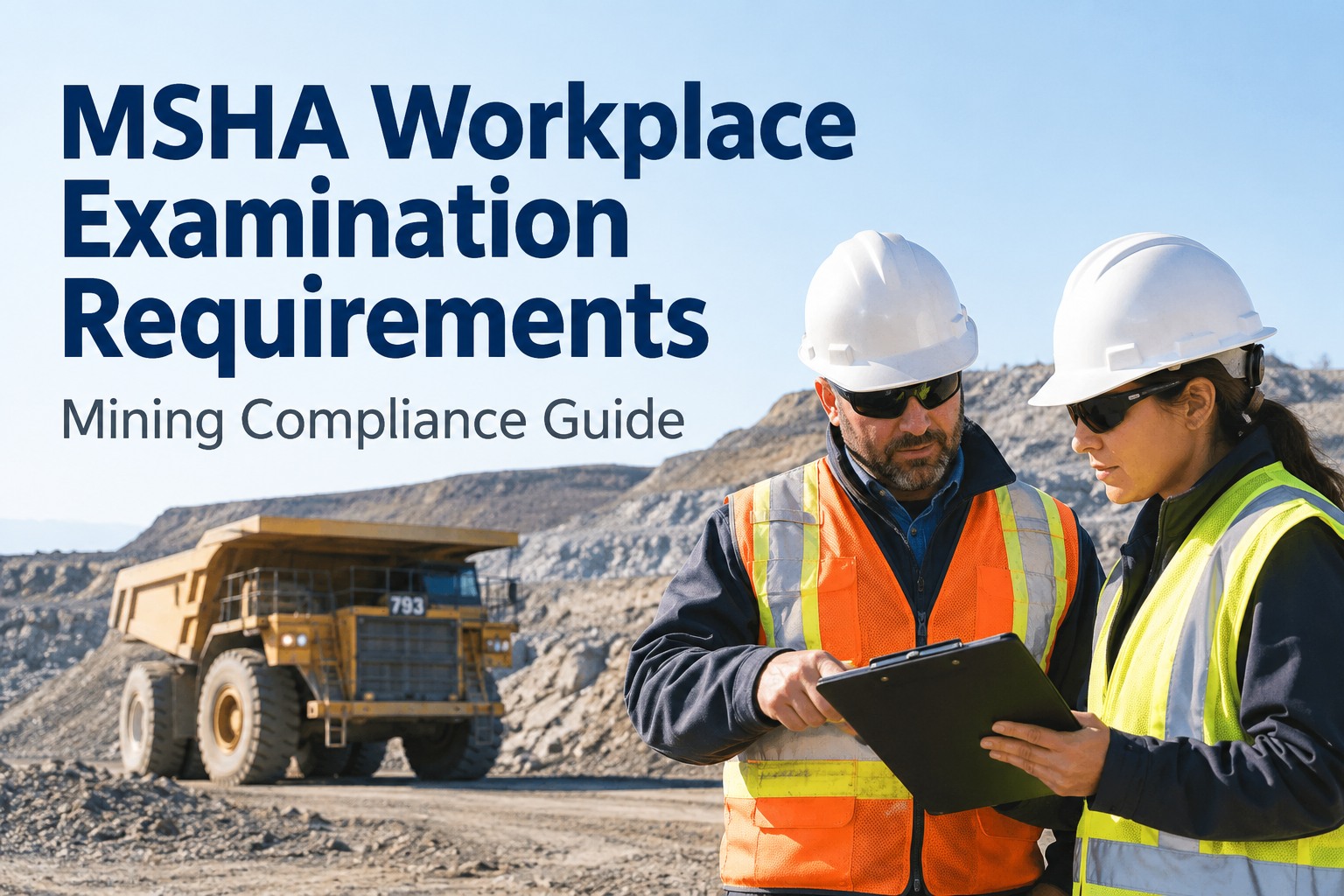
Every shift at every surface metal and nonmetal mine starts with a legal obligation: a competent person must examine each working place for hazards before miners begin work, and a record of that exam must exist before the shift ends. That's MSHA workplace examination requirements in one sentence — and it's one of the most frequently cited standards in mining, usually not because operators skip the exam, but because they can't prove it. This guide walks 30 CFR 56.18002 as it stands today: who counts as competent, when the exam must happen, what the record must contain, and how documentation keeps a good exam from becoming a citation.
Four Things the Rule Requires, Every Shift
The working-place examination standard breaks into four obligations. Miss any one — especially the record — and a compliant exam still becomes a citation.
If you're a mine operator, safety manager, EHS lead, or site supervisor at a metal or nonmetal operation, the working-place exam is a daily, non-negotiable duty under the Mine Act — and MSHA (a different agency from OSHA, under different law) enforces it hard. The frustrating part is that the failures are rarely about safety effort. Crews examine their areas; supervisors catch hazards. What trips operations up is the documentation: proving, on paper, that the right person examined the right places at the right time and that hazards were addressed. This guide covers the rule and the record equally, because compliance needs both.
What the Standard Actually Says30 CFR 56.18002, in plain terms
The core text is short. Under 30 CFR 56.18002(a), "a competent person designated by the operator shall examine each working place at least once each shift before miners begin work in that place, for conditions that may adversely affect safety or health." That single sentence carries four operative pieces: who (a competent person), what (each working place), when (each shift, before miners begin work), and why (conditions that may adversely affect safety or health).
The rule then adds the response and the record. The operator must promptly notify miners in affected areas of conditions found and promptly initiate corrective action; conditions that may present an imminent danger trigger immediate withdrawal until abated; and under 56.18002(b), a record of each examination must be made before the end of the shift. A note on accuracy: the standard was strengthened through rulemaking and litigation, and the version in force today requires the exam "before miners begin work" and a record documenting the areas examined and conditions found — so work from the current regulation text, not older summaries describing looser versions.
Who Is a "Competent Person"?a defined term, not just anyone available
"Competent person" isn't casual language — it's defined in 30 CFR 56.2 as "a person having abilities and experience that fully qualify him to perform the duty to which he is assigned." For the working-place exam, that means someone who can actually recognize the hazards and adverse conditions present or predictable in the area being examined.
In practice, MSHA guidance treats a foreman or supervisor as the best-practice examiner, though an experienced non-supervisory miner can also qualify. The line the agency draws: operators generally should not assign inexperienced miners to the exam, because someone who can't recognize a hazard can't examine for it. The designation matters legally — the operator must designate the competent person, a deliberate assignment, not whoever's free. On the record, the examiner's name isn't a formality; it's evidence a qualified, designated person did the work. Book a demo to tie each exam record to its designated competent person
What to Examine, and Whenevery working place, each shift, before work begins
Two words carry a lot of weight here: "working place" and "each shift." A working place is any location in the mine where miners work during a shift — so the exam has to cover all the places where work will actually happen, not a token walk of the main area. And "at least once each shift before miners begin work in that place" sets the timing: the exam has to be done before people start working in an area, and close enough in time to the start of work that conditions wouldn't reasonably be expected to change before work begins.
What counts as an adverse condition depends on the operation — ground and highwall stability, mobile equipment, guarding, housekeeping, electrical, berms, access, and site-specific risks a knowledgeable examiner would anticipate. The standard doesn't hand you a universal checklist, which is exactly why the examiner must be competent: they're expected to know what "adverse" looks like for that work in that place. Book a demo to run area-specific exam checklists per working place
Finding a Hazard: Notify, Correct, or Withdrawthe required response chain
Finding an adverse condition isn't the end of the exam — it triggers a required response, and the response depends on severity. The rule sets two tiers.
For a condition that may adversely affect safety or health, the operator must promptly notify miners in the affected areas and promptly initiate appropriate corrective action. "Promptly" is the operative word — the response can't wait, and miners in the area need to know about the hazard.
A condition that may present an imminent danger is a different level: it must be brought to the operator's immediate attention, and the operator must withdraw all persons from the affected area (with narrow exceptions under the Mine Act) until the danger is abated. No production continues in that area until it's safe.
This is where the exam does its real work — it's the mechanism that gets a hazard corrected or a crew pulled back before someone is hurt, not a paperwork ritual. And it's why the record includes corrective-action dates: the exam identifies the condition, the documentation proves the loop closed. An adverse condition found and left unaddressed is worse than one never recorded — it's evidence the operator knew and didn't act. Book a demo to track every found condition through to a dated correction
The Examination Record: Where Citations Livewhat 56.18002(b) requires in writing
Here's the part that generates most workplace-exam citations. Under 56.18002(b), a record of each examination must be made before the end of the shift it covers — with specific required contents. An exam done perfectly but recorded incompletely, or recorded after the shift ends, is a violation regardless of how thorough the examination was.
Two more requirements: the records must be retained and made available to MSHA's authorized representatives and to miners' representatives on request — so the record has to be findable and producible later, not create-it-and-forget. That "before the end of the shift" timing is a common failure point: a paper log written up from memory the next morning doesn't meet it. Start free and generate a complete, timestamped exam record every shift
Paper Exam Logs vs Digital Recordswhere the clipboard fails a 56.18002 audit
The working-place exam is a documentation-heavy obligation done on a strict daily clock across a whole site — exactly the kind of task paper handles badly and a digital system is built for. Here's the contrast when an inspector arrives.
- Records written from memory, sometimes after the shift
- Missing fields no one flags until the audit
- No photo evidence of conditions or corrections
- Corrective actions tracked separately, if at all
- Producing months of records means digging through binders
- Recorded in the field, timestamped before shift end
- Required fields enforced — nothing incomplete
- Photo evidence attached to each condition
- Corrective actions tracked to a dated closure
- Audit retrieval is a filtered search by date or area
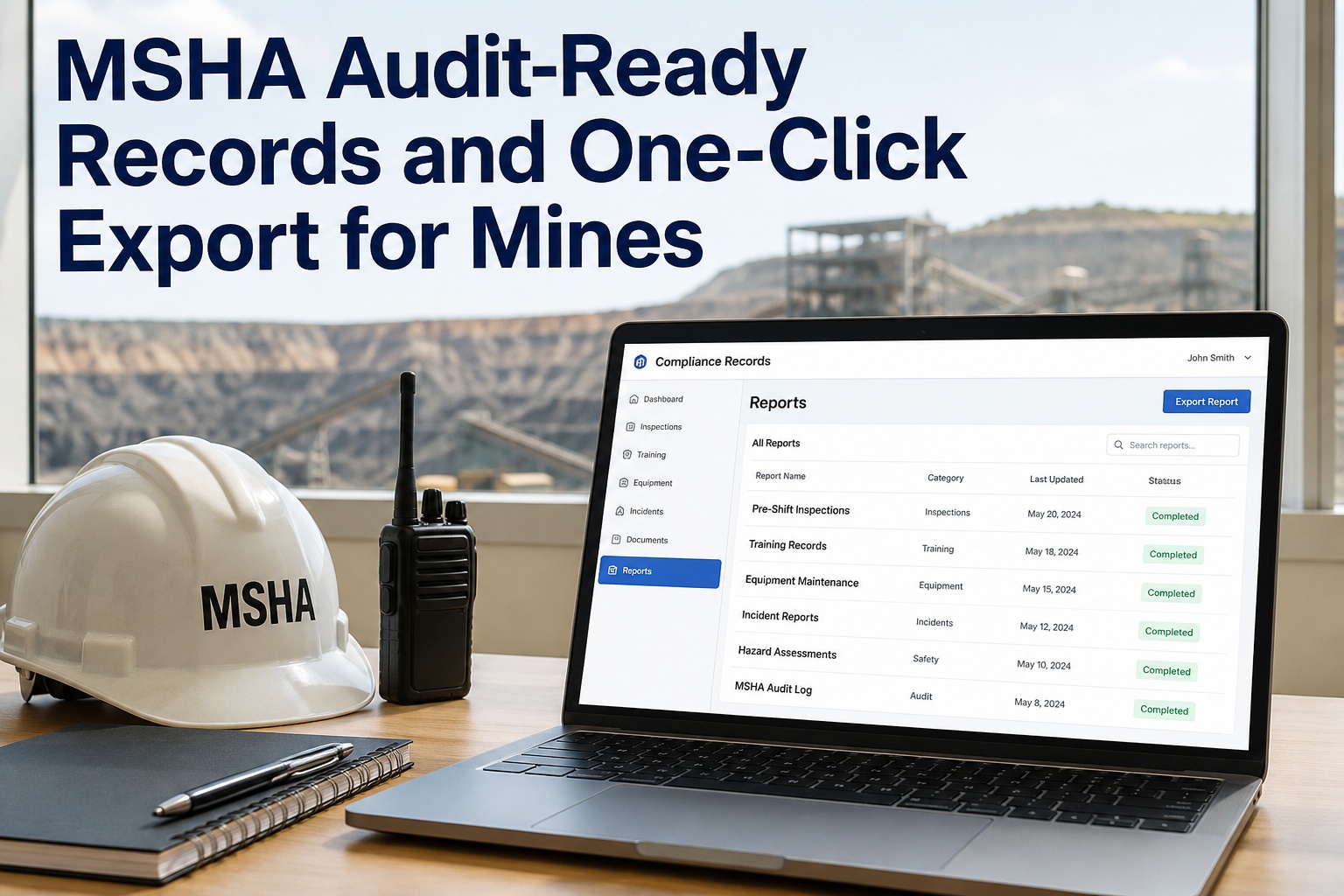
This is where compliance strategy gets concrete. A digital mining inspection and compliance platform handles the exact things that draw citations: it enforces the required record fields so nothing is missing, timestamps the record so the before-shift-end rule is met automatically, attaches photo evidence to prove both the condition and its correction, tracks corrective actions to closure with dates, applies the examiner's digital signature, and makes years of records producible in a filtered search. The competent person still performs the exam — the platform makes sure the proof of it is always complete and always findable. Start free and make every working-place exam audit-ready by default
From a mine safety manager who digitized exam records
Our examiners were good — they knew the ground, they caught the hazards. Every citation we took on workplace exams was a paperwork citation. An area not listed, a corrective-action date missing, a record the inspector said was written up too late. We were doing the safety work and failing the audit anyway. That's a maddening place to be.
Going digital took the record off the clipboard and onto the phone in the field. The examiner logs the area, describes the condition, snaps a photo, signs it — and it's timestamped before the shift ends, every field filled, because the system won't let them skip one. When MSHA asks for ninety days of exams now, it's a thirty-second export. The exams didn't get better — the proof did.
MSHA workplace examination requirements: the takeaway
MSHA workplace examination requirements come down to doing two things well, every shift: examine competently, and prove it completely. The exam itself keeps miners safe in real time; the record under 56.18002(b) is what stands between a good safety program and a citation. Because the enforcement failures are overwhelmingly about documentation — incomplete records, late records, missing corrective-action dates, records that can't be found — the highest-leverage improvement most operations can make isn't examining harder, it's capturing the exam completely and on time, every shift, in a form an inspector can verify instantly. Book a demo to run MSHA working-place exams and records end-to-end in HVI
Frequently asked questions
What are MSHA workplace examination requirements?
Under 30 CFR 56.18002 (and the parallel 57.18002 for underground metal and nonmetal mines), a competent person designated by the operator must examine each working place at least once each shift, before miners begin work in that place, for conditions that may adversely affect safety or health. If an adverse condition is found, the operator must promptly notify miners in the affected areas and promptly initiate corrective action; if a condition may present an imminent danger, all persons must be withdrawn from the affected area until the danger is abated. Separately, under 56.18002(b), a record of each examination must be made before the end of the shift for which it was conducted, and that record must include the examiner's name, the date, the location of all areas examined, a description of each condition found that may adversely affect safety or health, and the date of corrective action for conditions not immediately corrected. The records must be retained and made available to MSHA's authorized representatives and to miners' representatives. Both the examination and the record are required — a compliant exam that isn't properly recorded before the shift ends is still a violation.
Who can conduct a mine workplace examination?
The examination must be conducted by a "competent person" designated by the operator. "Competent person" is a defined term in 30 CFR 56.2, meaning a person having the abilities and experience that fully qualify them to perform the duty to which they are assigned. For a working-place examination, that means someone who can actually recognize the hazards and adverse conditions that are present or predictable in the area being examined. MSHA guidance identifies a foreman or other supervisor as a best-practice choice for the examiner, and an experienced non-supervisory miner may also qualify if they have the necessary abilities and experience. What operators generally should not do is assign an inexperienced miner to conduct the examination, because a person who cannot recognize a hazard cannot examine for it. The designation is also a deliberate act — the operator must designate the competent person, so it should be a planned assignment to a qualified individual, not simply whoever is available. Recording the examiner's name on the exam record is part of demonstrating that a qualified, designated person performed the examination.
When must a working place examination be conducted?
The examination must be conducted at least once each shift, before miners begin work in that place. This is a per-shift obligation, so a working place used across multiple shifts needs an examination for each shift. The timing requirement — before miners begin work — means the examination has to precede the start of work in the area, and MSHA's explanation is that the exam should be sufficiently close in time to the start of work that a mine operator would reasonably expect conditions not to adversely change before work begins in the examined area. In other words, you cannot examine an area days ahead and rely on that, nor can you let miners begin working before the area has been examined. The examination covers each working place, meaning all the locations where miners will actually perform work during that shift, not just a single representative spot. Getting the timing right is important both for miner safety, since the point is to identify hazards before anyone is exposed to them, and for compliance, since examining after work has begun does not meet the standard.
What must a workplace examination record include?
Under 30 CFR 56.18002(b), a record of each examination must be made before the end of the shift for which the examination was conducted, and it must contain specific information: the name of the person who conducted the examination (the designated competent person), the date of the examination, the location of all areas that were examined, a description of each condition found that may adversely affect safety or health, and the date of corrective action for any such condition that was not corrected promptly. The records must be maintained and made available for review by MSHA's authorized representatives and by miners' representatives. Several details cause compliance problems in practice: the record must be complete, with every required field present; it must be made before the shift ends rather than written up later from memory; corrective-action dates must be documented for conditions that were not immediately fixed; and the records must be retrievable when requested. Because an otherwise-thorough examination that is recorded incompletely or late is still a violation, the record itself is where a large share of workplace-examination citations originate, which is why complete, timely, well-organized documentation is central to compliance.
Is MSHA the same as OSHA for mine inspections?
No. MSHA, the Mine Safety and Health Administration, is a separate federal agency from OSHA, the Occupational Safety and Health Administration, and it operates under different law. Mines are regulated under the Federal Mine Safety and Health Act of 1977 (the Mine Act) and MSHA's standards in Title 30 of the Code of Federal Regulations, whereas general industry workplaces fall under OSHA and the Occupational Safety and Health Act with standards in Title 29. The requirements are different in important ways: MSHA mandates the specific working-place examination each shift under 30 CFR 56.18002 for surface metal and nonmetal mines, conducts frequent mandatory inspections of mines, and enforces mine-specific standards that have no direct OSHA equivalent. For workplace examinations specifically, the obligations, timing, record contents, and enforcement all come from MSHA's mining standards, not from OSHA, so a mine operation must comply with the MSHA rule regardless of any OSHA-style safety programs it also runs. Operators should always work from the current MSHA regulation text and guidance for their mine type, since surface metal/nonmetal, underground metal/nonmetal, and coal each have their own applicable standards.
Make every working-place exam provable, before the shift ends
Your competent person examines the working places — HVI makes the record bulletproof. Log the examiner, date, and areas examined in the field, describe each adverse condition with photo evidence, track corrective actions to a dated closure, apply a digital signature, and have a complete, timestamped record before the shift ends — retained and producible for MSHA in a filtered search. The exams keep miners safe; HVI keeps you out of the documentation citations.
No credit card · No hardware required to start · Audit-ready mining inspections on day one