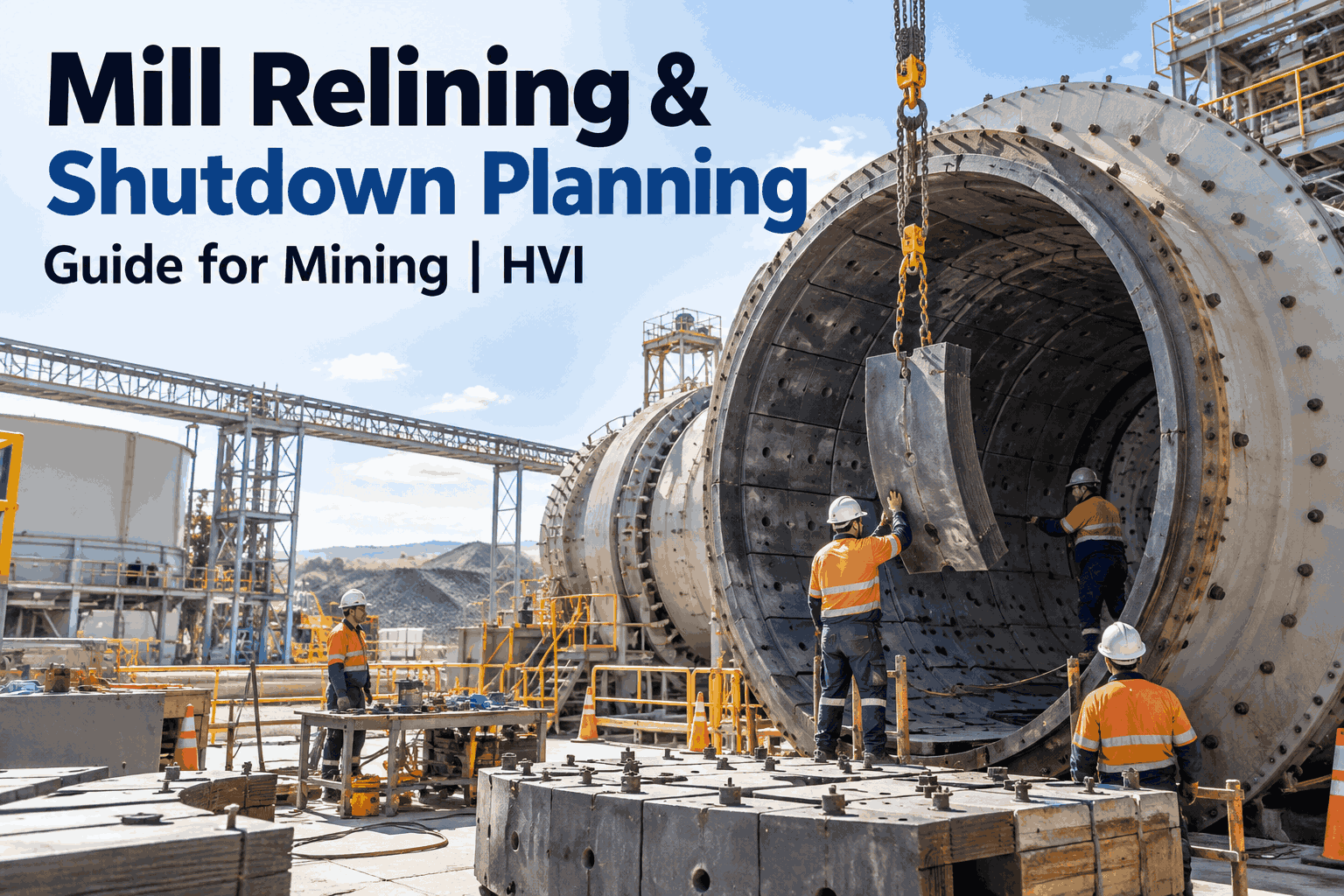
A mill reline isn't a maintenance task — it's a project run against a stopwatch, with the whole plant's production waiting on it. Mill relining pulls a crew, contractors, a machine, and pallets of liners into one fixed downtime window, and the gap between a reline that finishes on time and one that runs days over is almost never the wrench work. It's the planning — whether the crews, materials, and sequence were locked before the mill stopped. This page shows how to plan the reline shutdown so it comes back on schedule. Book a demo to see a reline run as one work-order package.
A Reline Is a Project, Not a Task
The mill's down and the whole plant is waiting. Whether the reline finishes on time comes down to planning — crews scheduled, materials staged, the critical path sequenced — locked before the mill ever stopped, not sorted out on the floor.
A grinding mill sets the pace for the whole plant, so a reline shutdown stops the money for as long as it runs. That's why the reline is measured in hours, not quality alone: the liners will get changed either way, but a well-planned reline hands the mill back a day sooner than a scrambled one — and on a mill-constrained circuit, a day of extra production is a very large number.
Where Relines Actually Overrun
Relines rarely blow out because the reline crew is slow. They blow out because of gaps in the plan that surface once the mill is already down — the most expensive moment to discover them. These are the usual culprits.
Crew & contractor coordination gaps
Scope gaps between the reline crew, internal trades, and contractors — and undersized crews — are the two most common causes of overrun. When no one owns a task, it waits.
Materials not staged
A missing liner, wrong bolts, or a consumable on a long lead stops the line mid-reline. Staging every part before the mill stops is basic, and still a top overrun cause.
A weak critical path
If the task sequence isn't planned, crews wait on each other — strip-out not clearing for install, torque held up for access. The path, not the people, sets the clock.
Late or emergency decisions
Deciding to reline late, without wear data, forces emergency contractor mobilization — several times the cost of a planned dispatch, and a scramble for crews and parts.
Notice what these share: none is a tool-time problem. They're all planning-and-coordination failures that a shutdown plan closes before the mill stops. The reline itself is the easy part; getting everything and everyone lined up to feed it is where the days are won or lost. Book a demo to see the coordination gaps closed in the plan.
The Reline Planning Timeline
A reline that runs on schedule is planned in phases, well before the mill stops. Big turnarounds start their planning months out; even a routine reline needs the sequence below locked before shutdown day.
Scope & plan
Define the work list from wear data, set the reline date, build the task plan and critical path, book crews and contractors, and order liners against lead time.
Stage & mobilize
Stage every liner, bolt, and consumable on site; confirm the reline machine is serviced and function-tested; brief crews; issue permits and isolation plans.
Execute the path
Isolate, strip out old liners, install and torque new ones in sequence, run planned parallel work — tracking each task against the timeline in real time.
Inspect & ramp up
Final inspection, torque checks, close permits, hand the mill back, and ramp production — with the reline's records closed against the shutdown work order.
The phase that decides the outcome is the first one. A reline planned weeks out — scope locked, crews booked, materials ordered against lead time — runs to a schedule; one thrown together when the liner finally fails runs to luck. The plan is the deliverable that matters most, long before the first liner comes out. Start free and build the reline plan in phases.
The Three Things to Lock Before the Mill Stops
Every on-time reline has the same three things settled before shutdown day. Miss any one and the downtime window stretches while the plant waits — so these are the non-negotiables of the pre-shutdown plan.
Crews & scope
The reline crew, internal trades, and contractors booked, with every task owned by a named party and a clear scope boundary — no gaps, no doubled-up work, no "I thought they had it."
Materials & spares staged
Every liner, bolt, seal, and consumable on site, checked against the work list and staged in sequence — ordered against lead time so nothing arrives after the mill's already open.
The reline machine ready
The MRM serviced out of its idle period and function-tested, so the machine feeding the whole reline is proven before day one — not discovered faulty when the crew powers it up.
These three are the foundation the critical path is built on — get them locked and the reline is a matter of executing a plan; leave any loose and the shutdown becomes improvisation while production waits. The pre-shutdown checklist exists to prove all three are green before the mill stops. Book a demo to see the pre-shutdown lock checklist.
Do Parallel Work Without Extending Downtime
The mill's open, the isolation's in place, the crews are on site — it's the one window all year to do work that otherwise needs its own shutdown. The trick is running it in parallel with the reline, not after it.
Inspection & NDT
Non-destructive testing, shell and structure inspection, and condition checks that need the mill stopped — done while the reline runs, off the critical path.
Adjacent repairs
Feed chute, trunnion, seal, and drive-end work that would each cost their own outage — folded into the reline window while access is already open.
Deferred small jobs
The backlog of small tasks that never justify a stop on their own — batched into the shutdown so they close without a single extra minute of downtime.
The catch is that parallel work only stays free if it's planned onto the schedule and kept off the reline's critical path. Bolt it on unplanned and it stops being a bonus and starts extending the very window you're trying to shrink. Planned right, one shutdown clears a season of work. Start free and schedule parallel work off the critical path.
How HVI Runs the Reline Shutdown
The whole reline succeeds or fails on coordination, and coordination fails when the plan lives in a spreadsheet, the tasks live in people's heads, and progress lives on a radio. Three capabilities put it all in one place.
One shutdown work-order package
The reline becomes a single work order with every task inside it — crew, trades, contractors, permits — each with a named owner and deadline, so nothing falls between parties.
Critical-path sequencing
Tasks are sequenced and dependencies mapped, so the planner sees what's on the path and what's holding it — and parallel work is scheduled off it, not on it.
Live progress & history
Each task closes with status and evidence in real time, so progress against the timeline is visible mid-shutdown — and the whole reline's record stays on the mill for next time.
The result is a reline you run to a plan instead of a radio: every task owned, the critical path visible, materials and machine confirmed before the stop, and parallel work folded in for free. That's the difference between handing the mill back on schedule and explaining why it's a day late. Book a demo to see it on your next reline. Start free and plan your shutdown on it.
From a shutdown planner who's run relines both ways
Our worst reline ran two days over — not because the crew was slow, but because a liner set was short and two contractor jobs overlapped with nobody owning the clash. All coordination, no wrench. Once we ran the whole shutdown as one work order with every task assigned and the critical path mapped, the overruns stopped. Now I can see mid-shutdown what's holding the path and fix it, instead of finding out at handback.
Frequently asked questions
What is mill relining?
Mill relining is the planned replacement of the worn liner plates inside a grinding mill — SAG, AG, ball, or rod — during a shutdown. Because the mill sets the pace for the whole plant and the reline stops production, it's run as a coordinated project against a fixed downtime window: a reline crew and machine strip out the old liners and install new ones in sequence, often alongside contractors and internal trades doing parallel work. The whole event is measured in downtime hours, so the planning around it matters as much as the liner change itself.
Why do mill relines run over schedule?
Almost always because of planning and coordination gaps, not slow work. The most common causes are scope gaps between the reline crew, internal trades, and contractors; undersized crews; materials not staged before the mill stops; and a weak critical path where crews wait on each other. Deciding to reline late, without wear data, adds emergency contractor mobilization at several times the cost of a planned dispatch. Each of these surfaces once the mill is already down — the most expensive moment — which is why they belong in the pre-shutdown plan.
How far in advance should a mill reline be planned?
It depends on scale, but the planning starts well before shutdown day. Major turnarounds are planned months out — scope definition, work-order development, crew and contractor booking, and material ordering against lead time. Even a routine reline needs the work list, critical path, crews, and materials locked weeks ahead. The single biggest predictor of an on-time reline is how early the plan was locked: a reline scoped and staged in advance runs to a schedule, while one assembled when the liner finally fails runs to luck.
What should be locked before a reline shutdown starts?
Three things: crews and scope (reline crew, trades, and contractors booked with every task owned and no scope gaps), materials and spares (every liner, bolt, and consumable staged on site, ordered against lead time), and the reline machine (serviced out of its idle period and function-tested). If any of the three is loose when the mill stops, the downtime window stretches while the plant waits. The pre-shutdown checklist exists to confirm all three are green before shutting the mill down.
How does software help plan a mill reline?
A platform like HVI runs the reline as a single shutdown work-order package, with every task — crew, contractor, trade, and permit — assigned to a named owner with a deadline and sequenced on the critical path. The planner sees live progress against the timeline, what's holding the path, and where parallel work can slot off it. Each task closes with evidence, and the whole reline's record stays on the mill for the next one. It replaces spreadsheets, tribal knowledge, and radios with one coordinated view of the shutdown.
Hand the Mill Back on Schedule, Not a Day Late
Run the reline as one shutdown work-order package — every task owned and deadlined, the critical path sequenced, materials and machine confirmed before the stop, parallel work folded in off the path, and live progress against the timeline. So the mill comes back when the plan said it would. Live in under two weeks, trusted by 25,000+ users worldwide.
No credit card · No hardware · Shutdown work-order templates ready on day one