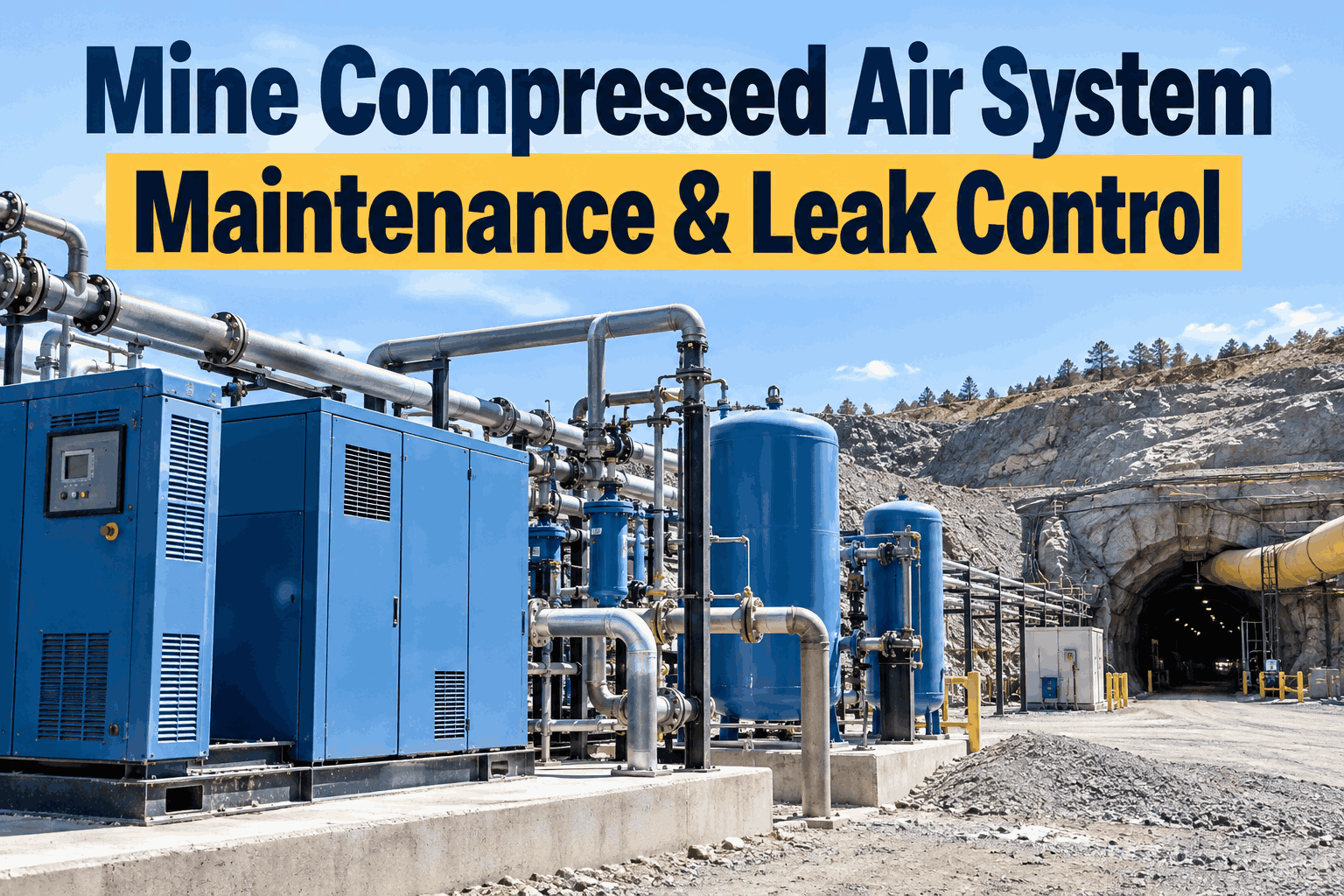
There's a hiss coming from a coupling in the main distribution line, and it's been there long enough that nobody hears it anymore. Meanwhile, three levels down, a rock drill is running soft — not broken, just underpowered — and the operator's compensating by leaning on it harder, wearing out a tool that was never the actual problem. A mine compressed air system doesn't fail all at once. It leaks itself into underperformance, one unnoticed hiss at a time, until the energy bill and the drilling rates both quietly tell the same story.
The Leak You Can't Hear Is the One Costing the Most
Compressed air is often the most expensive utility a mine runs — and most of what it pays for never reaches a drill. It escapes along the way, quietly, at a cost that adds up faster than it looks.
Multiply that single 1/4-inch leak figure by the dozens of smaller leaks most unmonitored systems actually carry, and the real number gets uncomfortable fast. Book a demo to see how HVI turns a leak survey into tracked, prioritized repair work instead of a finding that gets noted once and never followed up on.
What One Leak Actually Costs, By Size
A pinhole leak sounds trivial. The math says otherwise — leak cost scales with the square of the opening, so a leak twice as wide isn't twice as expensive, it's roughly four times as expensive. These figures assume continuous operation at 100 psi; your actual cost will vary with electricity rate and run hours, but the shape of the curve holds everywhere.
Now picture a typical mine's compressor room, main lines, branch lines, and dozens of point-of-use connections — the kind of system where a leak survey routinely finds twenty, thirty, forty leaks of varying size. Sign up free and log every leak found on a survey as a tracked defect, so the total cost is visible as a number, not scattered across dozens of individually small-sounding hisses.
Where the Pressure Actually Goes Missing
A compressor room reading 100 psi doesn't mean a drill underground is getting 100 psi. Every meter of pipe, every fitting, every leak along the way takes a small cut, and by the time air reaches the working face, the shortfall is often bigger than anyone tracking only the compressor's output gauge would expect.
That last drop is the one that costs production, not just electricity — a drill running on 72 psi instead of a specified 90 isn't broken, it's just slower, and an operator pushing it harder to compensate wears the tool out faster chasing performance the air supply isn't delivering.
Where Leaks Actually Hide
Compressor room
Shutoff valves, drains, and connection points right at the source.
Main distribution lines
Long pipe runs with fewer joints, but every joint still counts.
Branch lines & couplings
Every tee, elbow, and quick-connect is a potential leak point.
Point-of-use & hoses
The connections closest to the tool — flexed, dragged, and worn most often.
Compressor Health Checks That Actually Matter
Operating temperature
Running hot is often the first sign of a cooling or load problem.Vibration
A new vibration pattern usually means wear before it means failure.Oil condition
Degraded oil accelerates wear on everything downstream of it.Filter restriction
A clogged filter quietly throttles output long before an alarm trips.Cooling performance
Dirty mine air makes cooling systems work harder than spec assumes.Pressure output trend
A slow decline over weeks is easier to catch than a sudden drop.Not Every Leak Gets Fixed the Same Week
A leak survey that finds forty leaks and tries to fix all forty immediately usually fixes none of them well. Prioritizing by actual impact gets the expensive ones closed first.
Large leaks near production-critical equipment, or anywhere pressure loss is already affecting drilling performance. Repair this week.
Mid-size leaks in main or branch lines with a clear, calculable energy cost. Repair within the month.
Smaller leaks at point-of-use connections — real cost, lower urgency. Bundle into the next scheduled maintenance pass.
Records That Prove the Savings Are Real
"We did a leak survey" doesn't mean much to a budget conversation. Book a demo to see leak repair tracked from found to verified, with the before-and-after data to back up the energy savings claim.
Leak logged with location & size
Specific enough that a repair crew can find it without a second walk-through.Severity & priority assigned
Tied to a repair timeline, not left to whoever remembers it first.Repair work order & closure
Survey finding connected all the way through to a completed fix.Compressor service history
Operating hours and maintenance logged per unit, supporting PM scheduling.Recurring leak locations flagged
The same coupling failing repeatedly points to a fitting problem, not bad luck.Pressure trend by location
Meter readings over time, not a single point-in-time check.From an Energy Manager Who Put a Number on the Hiss
Everyone knew we had leaks. You could hear a few of them standing in the compressor room. What we didn't have was any sense of what they were actually costing us, so fixing them competed for budget against things with an obvious dollar figure attached — and leaks kept losing that argument.
Once we started logging leaks by size and location and running the cost numbers, the conversation changed completely. Thirty-some leaks added up to a number nobody could wave off anymore, and fixing them paid for itself faster than almost anything else on the maintenance list.
Frequently Asked Questions
How much compressed air is typically lost to leaks in a mine?
Mining compressed air systems commonly lose 30 to 50% of their output to leaks, and poorly maintained systems can lose as much as 80%, according to industry maintenance data. This makes leak detection and repair one of the highest-return maintenance activities available on a compressed air system, since compressed air is typically one of the most expensive utilities a site generates on-site.
How much does a single compressed air leak actually cost?
Cost scales with the square of the leak's equivalent orifice diameter, so a bigger leak costs disproportionately more than its size alone suggests. Based on U.S. Department of Energy figures, a single 1/4-inch leak running continuously at 100 psi can cost tens of thousands of dollars a year in electricity, while a small 1/16-inch leak costs a few thousand — actual cost depends on local electricity rates and how many hours the system runs.
Where do most compressed air leaks occur?
Leaks commonly occur at threaded connections, couplings, valves, and fittings throughout the compressor room, main distribution lines, branch lines, and point-of-use connections near tools and equipment. Flexible hoses and connections closest to the point of use tend to see the most mechanical wear and are frequently among the most common leak locations in a routine survey.
How often should a compressed air leak survey be done?
Routine leak surveys are generally recommended on a regular recurring schedule rather than as a one-time event, since new leaks develop continuously as fittings wear and connections flex. The right frequency depends on system size and age, but many maintenance programs run surveys at least a few times a year across compressor rooms, main lines, branches, and point-of-use connections, with underground sections surveyed as site access allows.
Why does low air pressure at the working face matter if the compressor reads normal?
Pressure drops progressively from the compressor discharge through main lines, branch lines, and finally to the point of use, and leaks or undersized piping along the way can create a meaningful shortfall underground even when the compressor itself shows normal output. Tools like rock drills generally need a minimum specified pressure to perform correctly, and running below that spec typically shows up as reduced performance and faster tool wear rather than an outright failure.
Manage Mine Compressed Air Maintenance With HVI
HVI gives your team recurring leak survey schedules, meter readings at every point that matters, defect tracking from found to repaired, and compressor service history scheduled from real operating hours — so the energy you pay for actually reaches the drill.
No credit card · Leak & pressure tracking · Equipment-level maintenance history