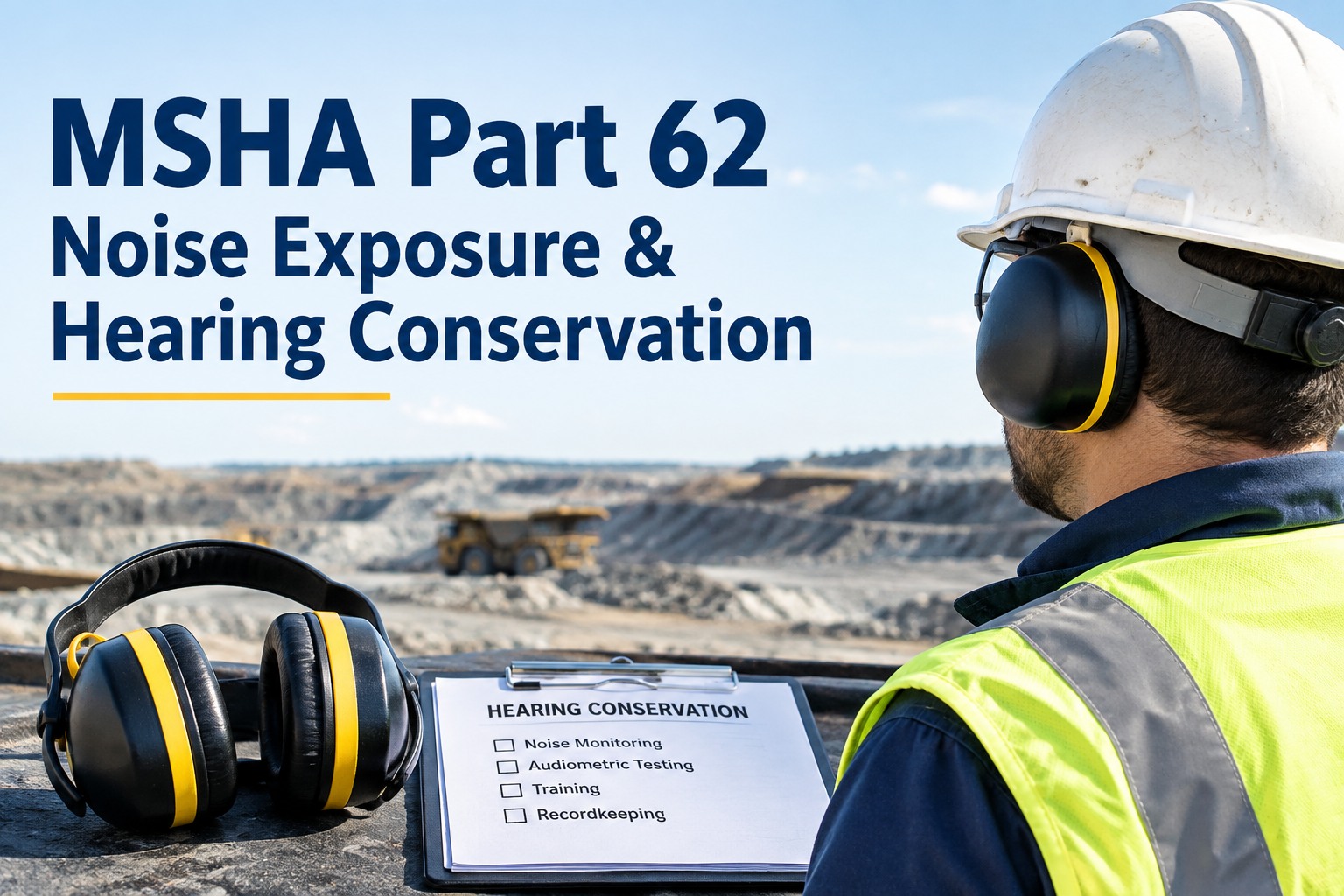
Noise is the mine hazard you can't see and can't undo — hearing loss is permanent, and it builds so gradually that a miner is often well down the road before anyone measures it. MSHA Part 62 noise rules exist to catch that early, and they turn on exposure thresholds that each trigger a different obligation. The most common miss isn't ignoring noise — it's not realising the hearing conservation program kicks in at the action level, not the permissible limit. See how hearing-conservation records stay audit-ready
Every 5 Decibels Changes What You're Required to Do About It
Part 62 sets four exposure thresholds on an 8-hour average. Tap a level to see what crossing it obligates the operator to do.
At a time-weighted average of 85 dBA — half the permissible dose — the operator must enrol the miner in a full hearing conservation program: monitoring, audiometric testing, hearing protectors, training, and recordkeeping. This is the threshold most operators underestimate.
At 90 dBA, the operator must use all feasible engineering and administrative controls to reduce exposure — and hearing protectors are not permitted as a substitute for those controls. Protectors are provided and worn only where controls can't get exposure below the PEL.
At 105 dBA — eight times the permissible dose — a single hearing protector isn't enough. The miner must wear earplugs and earmuffs concurrently, because one device alone can't attenuate exposure at this level.
No miner may be exposed to sound levels above 115 dBA — not even with dual hearing protection in place. It's an absolute ceiling, not a dose to be managed with more protection.
Part 62 replaced decades of patchwork noise rules with one standard for every mine, built on those tiered thresholds and a five-part program. Below is what each level obligates, how the hearing conservation program works, what audiometric testing must catch, and how the records tie it all together for an inspection.
The action level and the hearing conservation program
Here's the single most common Part 62 misunderstanding: the hearing conservation program starts at the action level of 85 dBA — not at the 90 dBA permissible limit. A miner exposed at 87 dBA is legally below the PEL but still requires a full HCP, and a mine running that exposure without a program is out of compliance. Once a miner hits the action level, five things become mandatory.
- 1
Noise monitoring
A system that evaluates each miner's exposure and identifies where it crosses the action, permissible, and dual-protection levels.
- 2
Audiometric testing
Baseline and annual hearing tests, at no cost to the miner, to catch changes in hearing sensitivity early.
- 3
Hearing protectors
Provided to enrolled miners, with the right attenuation for the exposure, and their use supported and enforced where required.
- 4
Training
Miners trained on noise hazards, the effects on hearing, the use and care of protectors, and the purpose of audiometric testing.
- 5
Recordkeeping
Exposure assessments, audiograms, training, and protector provision documented and retained — the proof the program actually ran.
Missing the action-level trigger is how mines end up with an unenrolled miner whose hearing is quietly degrading and no program to catch it. The fix is straightforward: monitor exposure, and the moment a miner reaches 85 dBA, the HCP switches on for them. Start free and track hearing-conservation enrolment and program tasks.
The permissible limit and the controls-first rule
At 90 dBA the obligation changes shape. This is the permissible exposure level, and Part 62 is emphatic about how you get below it: through engineering and administrative controls, not by handing out earplugs. Hearing protectors are a backstop, not a compliance strategy.
Feasible engineering & administrative controls
Isolate or quiet the source, modify equipment, or limit exposure time. The operator must use all feasible controls to bring exposure to the PEL — this is the primary obligation, and protectors can't substitute for it.
Hearing protectors
Where feasible controls still can't get exposure below the PEL, protectors are provided and their use ensured — with enough attenuation to close the remaining gap. A backstop for the residual, not a replacement for controls.
The distinction matters in an inspection: an operator relying solely on earplugs at a 90 dBA-plus exposure, with no attempt at feasible controls, is out of compliance even if every miner is wearing protection. The rule wants the noise reduced at the source first. Book a demo to see controls and protector use documented per exposure.
Dual protection and the absolute ceiling
The two highest thresholds are about the limits of protection itself. Some mining tasks — continuous miners, rock drills, high-speed machinery — generate exposures a single hearing protector simply can't handle, and Part 62 responds with escalating requirements.
Dual hearing protection
At this level — eight times the permissible dose — the miner must wear earplugs and earmuffs at the same time, because one device alone can't provide the attenuation needed to protect hearing.
The absolute ceiling
No miner may be exposed above 115 dBA under any circumstances — even with dual protection. Beyond this, more protection isn't the answer; the exposure itself has to be eliminated.
These thresholds are where noise stops being a program-management question and becomes a hard stop. Knowing which tasks routinely exceed them tells you where dual protection is non-negotiable and where an exposure has to be engineered down, not protected against. Start free and flag the tasks that cross the high thresholds.
Audiometric testing — catching loss before it's permanent
The heart of the hearing conservation program is measuring each miner's hearing over time, so a downward trend is caught while something can still be done. Part 62 is specific about the testing and what counts as a reportable change.
Baseline within 6 months
Each enrolled miner gets a baseline audiogram within six months of joining the HCP — the reference every future test is measured against.
Annual tests after
Testing repeats annually, at no cost to the miner, conducted by a qualified, certified technician under proper supervision.
Watch for a reportable shift
An average worsening of 25 dB or more at 2000, 3000, and 4000 Hz in either ear, versus baseline, is a reportable hearing loss that triggers follow-up.
The testing is only useful if the results are tracked against each miner's baseline over years — a single audiogram means little; the trend is everything. That's a records-and-scheduling problem as much as a medical one, and it's where programs quietly lapse. Book a demo to see audiogram scheduling and results tracked per miner.
The records that hold the program together
Every element of Part 62 generates a record, and the program is judged as much on its documentation as on its substance. Exposure assessments, audiograms, training, and protector provision all have to be retained and produced on demand — because an undocumented hearing conservation program is, to an inspector, an absent one.
A hearing conservation program you can't document is one you can't prove ran. Exposure data, baseline and annual audiograms, training completion, and protector records — retained per miner and retrievable — are what turn a Part 62 inspection into a matter of producing evidence, not defending a gap.
And because the program is recurring — annual audiograms, re-monitoring when equipment or processes change — the records only stay complete if they're captured as the work happens, against the miner and the exposure. Reconstructing a year of hearing-conservation compliance after the fact is exactly the scramble the standard is designed to expose. Start free and keep the whole HCP record retrievable.
The Part 62 noise compliance checklist
Use this to confirm your hearing conservation program covers every threshold and every required element. Use this Part 62 noise checklist online free, with exposure, audiogram, and training records tracked against each miner automatically.
Monitor exposure against all thresholds
Assess each miner's TWA8 against the 85, 90, 105, and 115 dBA levels and re-monitor when conditions change.Enrol at the action level
Start a full HCP for any miner at or above 85 dBA — not at the 90 dBA permissible limit.Apply controls before protectors at the PEL
Use feasible engineering and administrative controls at 90 dBA — protectors don't substitute for them.Enforce dual protection at 105 dBA
Earplugs and earmuffs worn concurrently — and never allow exposure above the 115 dBA ceiling.Run baseline and annual audiograms
Baseline within six months, annual tests after, and watch for a reportable shift against baseline.Keep every HCP record retrievable
Exposure, audiograms, training, and protector provision documented per miner and producible on demand.
From a safety manager who found the gap at 87 decibels
We assumed the hearing program only mattered where it got really loud — the drill areas over 90. Then a monitoring round showed a crew steady at 87 dBA, below the permissible limit but above the action level, with nobody enrolled in a conservation program. On paper we were fine; under Part 62 we had a compliance gap and miners whose hearing wasn't being tracked at all.
We enrolled them, backfilled baseline audiograms, and set the annual tests on a schedule with the records attached to each person. The lesson stuck: the action level is where the program starts, not the permissible limit. Now every exposure result flags enrolment automatically, and I can show a complete program for every miner who needs one — which is exactly what an inspector wants to see.
Frequently asked questions
What is MSHA Part 62?
30 CFR Part 62 is MSHA's occupational noise exposure standard, effective September 2000, that applies to all mines — coal, metal, and nonmetal. It replaced decades of separate noise rules with one standard built on tiered exposure thresholds measured as an 8-hour time-weighted average: an action level of 85 dBA, a permissible exposure level of 90 dBA, a dual hearing protection level of 105 dBA, and a 115 dBA ceiling. Crossing each threshold triggers a different operator obligation, from starting a hearing conservation program to requiring engineering controls and dual protection.
What is the difference between the action level and the PEL?
The action level is 85 dBA as an 8-hour time-weighted average — half the permissible dose — and it's where a full hearing conservation program becomes mandatory: monitoring, audiometric testing, hearing protectors, training, and recordkeeping. The permissible exposure level (PEL) is 90 dBA, where the operator must additionally use all feasible engineering and administrative controls. The common mistake is thinking the program starts at 90; it starts at 85. A miner at 87 dBA is below the PEL but still needs a full program.
Can hearing protectors replace engineering controls under Part 62?
No. At the permissible exposure level of 90 dBA, Part 62 requires operators to use all feasible engineering and administrative controls to reduce exposure — and hearing protectors are explicitly not permitted as a substitute for those controls. Protectors are provided and their use ensured only where feasible controls still can't bring exposure below the PEL, as a backstop for the residual noise. An operator relying solely on earplugs without attempting feasible controls at a 90 dBA-plus exposure is out of compliance even if every miner is wearing protection.
When is dual hearing protection required?
At the dual hearing protection level of 105 dBA (8-hour average) — eight times the permissible dose — a miner must wear earplugs and earmuffs concurrently, because a single protector can't provide enough attenuation. Tasks like continuous mining, rock drilling, and high-speed machinery commonly generate these exposures. Separately, no miner may be exposed above 115 dBA under any circumstances, even with dual protection — an absolute ceiling where the exposure itself has to be eliminated, not protected against.
What audiometric testing does Part 62 require?
Each enrolled miner gets a baseline audiogram within six months of enrolment, then annual audiograms, all at no cost to the miner and conducted by a qualified certified technician under supervision. The tests measure hearing sensitivity against the baseline over time. A reportable hearing loss under MSHA is an average worsening of 25 dB or more at 2000, 3000, and 4000 Hz in either ear versus baseline. Tracking results against baseline over years is what lets a program catch loss while intervention still matters.
Run a hearing conservation program you can prove, miner by miner
HVI tracks the recurring pieces of a Part 62 program — exposure assessments, action-level enrolment, annual audiograms, training, and protector provision — against each miner, and keeps every record retrievable for an inspection. So no exposed miner falls through the action-level gap, and a hearing-conservation audit becomes a record you produce rather than a program you scramble to reconstruct.
No credit card · Exposure, audiogram & training tracking · Audit-ready HCP records