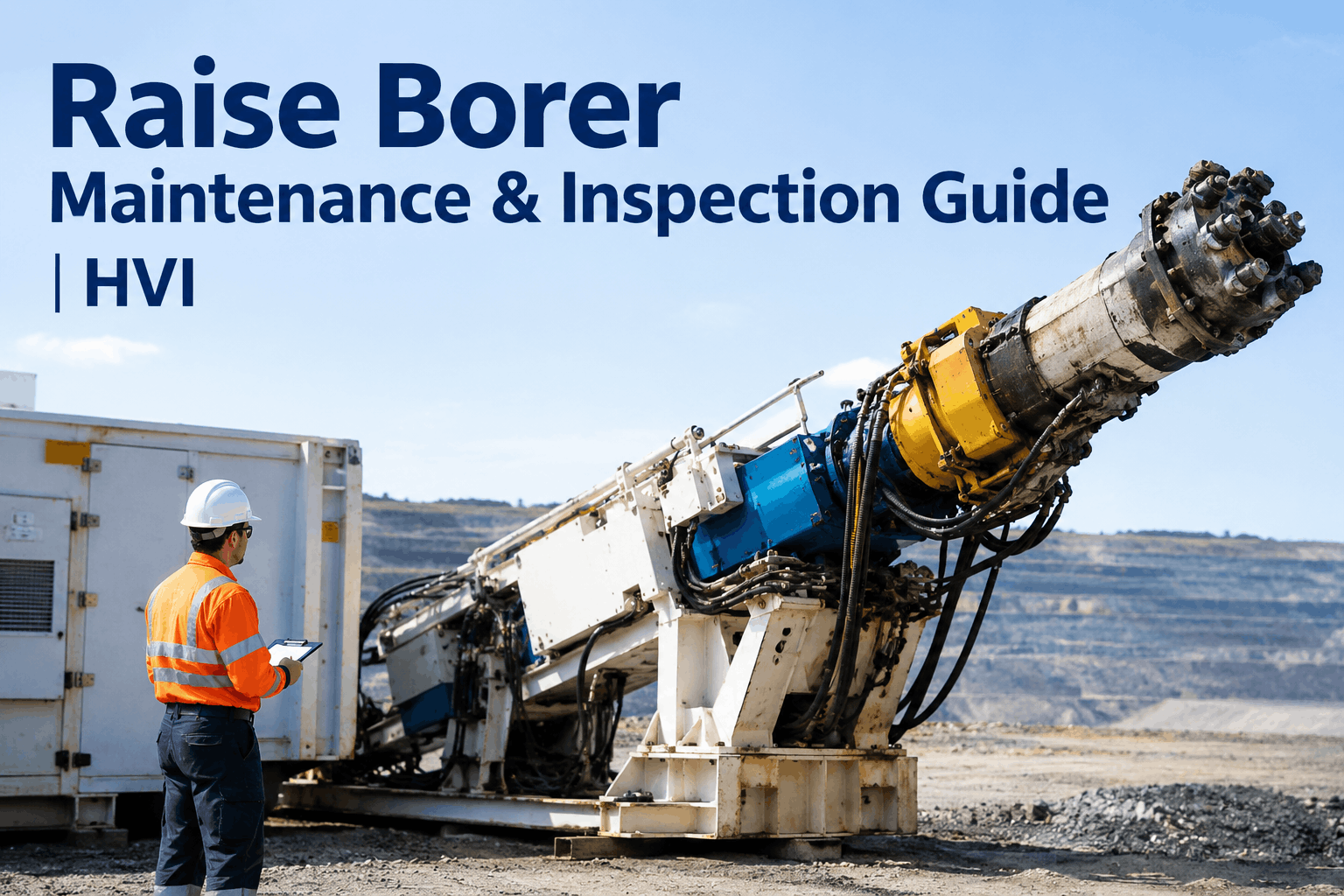
A raise boring machine does one job in two very different halves: it drills a slender pilot hole down between two levels, then swaps the bit for a reaming head and pulls it back up under enormous force to open the full raise. Both halves run on the same hydraulics, rotary head, and drill string — punishing them at torque and thrust figures in the hundreds of thousands of pounds. When something lets go mid-raise, you don't lose a shift; you can lose the hole. Raise borer maintenance is what keeps a slow, high-value, days-long bore from becoming a stuck string. See raise borer PM and inspections built per machine
A Raise Borer's Maintenance Splits the Way Its Work Does — Drill Down, Then Ream Up
Each phase loads the machine differently. Tap a phase to see what it demands and where it wears.
The machine is anchored on the upper level and drills a small-diameter pilot hole straight down to the level below, guided by stabilisers and flushed with water. Accuracy and flushing are everything — and the drill string, bit, and rotary head take the load.
The pilot bit comes off and a large reaming head goes on below, then rotates slowly — often just a couple of rpm — while being pulled up under hundreds of thousands of pounds of force. This is where torque, thrust, cutters, and the stem earn their keep, or fail.
Two forces define whether the machine is healthy
Everything a raise borer's maintenance protects comes down to keeping two enormous forces under control: the twist that turns the head, and the pull that draws the reamer up through rock. The operator watches both on the panel constantly — because a change in either is the machine telling you something is going wrong.
The rotational force through the rotary head and planetary gear reducers. Rising or erratic torque points to cutters, gearing, or ground — and a stall risks the string.
The axial force that hauls the reaming head upward, carried by the thrust cylinders, the stem, and every rod connection. It punishes the whole load path relentlessly.
These numbers are why raise borer maintenance can't be casual: components that see this kind of load fail catastrophically, not gently, and the failure happens hundreds of metres into a hole that took days to drill. Watching the forces during operation and maintaining the parts that carry them is the core of keeping a raise on plan. Book a demo to track torque-path components per machine.
The subsystem load map: what each part does, and how it fails
A raise borer isn't inspected as one machine — it's inspected as a chain of high-load subsystems, each with a job, a way it fails, and a check that catches it early. This is the heart of the maintenance program.
| Subsystem | Its job | How it fails | The check |
|---|---|---|---|
| Hydraulic system | Powers rotation, thrust, and pipe handling | Leaks, pressure loss, contamination, overheating | Pressure, fluid condition, hoses, cooling — every operation |
| Rotary head & gearing | Transmits torque to the string and reamer | Gear and bearing wear, oil breakdown | Gear-oil condition and level, temperature, backlash and noise |
| Thrust cylinders & stem | Carry the huge pull force up the load path | Seal failure, scoring, cracked or worn stem | Cylinder seals and rods, stem condition and connections |
| Drill pipe & connections | Make up the string, drill and pull the load | Thread wear, fatigue cracks, bent rods | Threads, straightness, torque of connections, crack checks |
| Reaming head & cutters | Cut the full-diameter raise | Cutter and bearing wear, saddle damage | Cutter wear and rotation, saddles, water ports before each ream |
Read down that list and the maintenance program writes itself: each row is a recurring inspection item with a limit, a frequency, and a consequence if skipped. The stem and thrust cylinders sit at the centre because they carry the reaming pull — the single most punishing load in the whole operation. Try HVI Free — Turn This Into a Checklist.
The rod handling nobody flags until it hurts
Between the two phases and all through them, one task repeats over and over: making up and breaking out drill rods as the string grows and shrinks. It's heavy, it's done at the work table over an open hole, and it's where both wear and injury quietly accumulate — yet it rarely gets its own place in a maintenance plan.
Threads & connections
Every make and break wears the threads that carry torque and thrust. Worn or cross-threaded connections are a fatigue and separation risk under load.
Wrenches & handling gear
The chucks, wrenches, and handling equipment take repeated shock loads. Worn or damaged handling gear is both a breakdown and a serious pinch-and-drop hazard.
The work-table zone
Handling rods over an open raise is a controlled-danger area. Inspected guarding, procedures, and gear are as much a part of maintenance as the drivetrain.
Building rod handling into the inspection — thread condition, handling-gear integrity, and the safety of the work-table area — closes the gap between a machine that's mechanically maintained and one that's actually safe to operate shift after shift. Book a demo to add rod-handling checks to the inspection.
From reactive to a real program
Most of the difference between a raise borer that finishes on plan and one that loses a hole isn't the machine — it's whether its upkeep is a program or a scramble. Here's the shift that changes the outcome.
- Checks from memory, different every operator
- Wear found when something fails mid-bore
- Gear-oil and seal service done "when there's time"
- No record of what was inspected before the raise
- Preventive maintenance on hours or interval, per subsystem
- Standard inspection before every bore, same for all crews
- Thrust, stem, and cutter service scheduled and assigned
- Records proving the machine was fit before the raise began
That's the whole HVI proposition on a machine like this: the subsystem load map becomes scheduled preventive maintenance, the pre-bore walkaround becomes a standard equipment inspection, and every check lands in a maintenance record against the machine. On equipment where a failure can cost the hole, that shift from memory to program is the difference between reliable raises and expensive surprises. Start Free — Build the Program.
From a raise boring supervisor
The nightmare on a raise borer isn't a slow day — it's a stuck string four hundred metres up a hole you've spent a week drilling. We had a stem let go once that should've been caught on inspection, and it nearly cost us the raise. After that I stopped trusting the walkaround to memory. Now the hydraulics, gear oil, thrust cylinders, and stem are scheduled tasks, the pre-bore inspection's the same whichever crew's on, and it's all on record. We haven't lost a hole since.
Frequently asked questions
What are the most important things to maintain on a raise boring machine?
The subsystems that carry the machine's torque and thrust: the hydraulic system that powers everything, the rotary head and gear reducers that transmit rotation, the thrust cylinders and stem that carry the reaming pull, the drill pipe and connections, and the reaming-head cutters. The stem and thrust cylinders deserve particular attention because they bear the most punishing load — the pull that hauls the reamer up, reaching hundreds of thousands of pounds. Each has its own failure mode and check, and together they form the core of a raise borer program, not one generic service.
Why does a raise borer need phase-specific attention?
Because it does two mechanically different jobs. In the pilot-drilling phase it spins relatively fast under lower thrust to bore a small hole downward, loading the drill string, bit, and rotary head. In the reaming phase it turns very slowly — often just a couple of rpm — while being pulled upward under massive force, loading the thrust cylinders, stem, cutters, and gearing far harder. The transition between phases, when the pilot bit is swapped for the reaming head, is itself a critical inspection point. Maintaining the machine well means recognising each phase stresses different components and checking accordingly.
What happens if a raise borer fails during a bore?
It can be far more than a repair delay. A raise takes days or weeks, and a failure deep in the hole — a jammed string, a seized head, or a dropped reamer — can be extremely hard or impossible to recover, potentially losing the hole entirely with all the time and cost in it. Drill-string jamming and shaft deviation are known risks. That's exactly why preventive maintenance and pre-bore inspection matter so much here: catch a worn stem, a failing seal, or a fatigued connection before the bore starts, not after the string is stuck.
How often should a raise boring machine be inspected?
On layered intervals. A thorough pre-operation inspection happens before each bore begins — hydraulics, rotary head, thrust cylinders and stem, drill string, and cutters — because once the reamer is in the ground, access is gone. During operation, torque and thrust are monitored continuously on the panel as live indicators of machine and ground condition. On top of that, preventive maintenance runs on hours or interval for gear-oil changes, seal and cylinder service, hydraulics, and wear parts. The pre-bore check catches immediate issues; scheduled PM prevents the slower failures, and both are most reliable when a system tracks them as due tasks.
Why keep detailed maintenance records for a raise borer?
Because it's a high-value, high-consequence machine where proving the maintenance history genuinely matters. Records of every pre-bore inspection, gear-oil and seal service, stem and cutter check, and hydraulic maintenance show the machine was fit before a raise that may run for weeks — which matters for accountability, audits, and after any incident. Records also make the program work: they track when wear parts were changed, reveal patterns in torque-path components before they fail, and keep the standard consistent across crews. Where a failure can cost an entire raise, a documented history is both a reliability tool and a defensible record.
Don't lose a raise to a failure you could have caught
HVI schedules raise borer maintenance by subsystem, standardises the pre-bore inspection for every crew, and retains every check against the machine. So the hydraulics, gearing, thrust cylinders, stem, and cutters that carry hundreds of thousands of pounds are verified before the string goes down — and a raise worth weeks of work never turns on a part nobody looked at.
No credit card · Pre-bore inspection & subsystem PM per machine · Audit-ready records