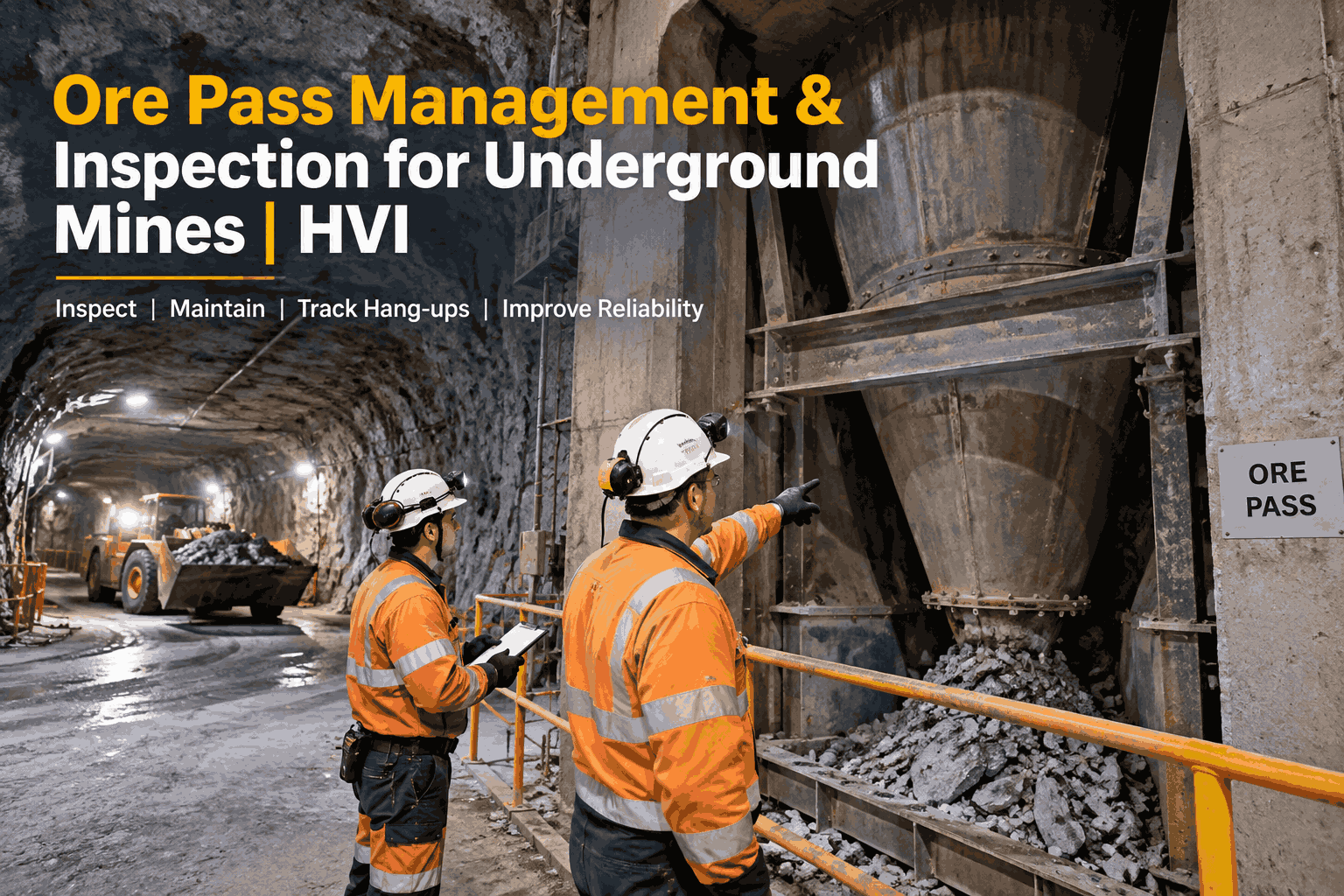
An ore pass is just a hole in the rock — until it blocks, and the whole mine's production stops with it. Ore pass management is the discipline most underground operations treat as an afterthought, right up to the day a hang-up arches across the pass and there's no way to move ore below. These are critical assets that degrade invisibly inside rock, are dangerous to inspect, and usually have no maintenance record. This page shows how to manage the pass, chute, and gate as tracked assets. Book a demo to see ore passes managed as assets.
When the Ore Pass Blocks, the Mine Stops
A near-vertical passage the whole mine depends on, degrading invisibly inside rock and dangerous to inspect. Hang-ups and wall wear don't announce themselves — they announce a production halt. Managing the pass as a tracked asset is how you see it coming.
Ore passes move material by gravity from upper levels to a loading point below, and in most underground mines the production plan runs straight through them. That makes them some of the highest-consequence assets in the operation — and among the least managed, because a passage carved into rock doesn't look like equipment, so it rarely gets treated like one until it fails.
The One Asset That Can Halt the Whole Mine
Most equipment failures cost you a machine. An ore pass failure costs you the production of every level that feeds it — because if ore can't move down, mining above it stops. And clearing a blocked pass isn't quick.
If the primary ore pass becomes inoperable, the levels it serves have nowhere to send material — and production above the blockage comes to a halt until it's cleared.
Removing a hang-up is slow, hazardous work. One documented case took a mine 14 months to clear a single large hang-up, at a cost measured in the thousands of lost days.
Clearing hang-ups exposes miners to in-rush of material, falls, and blast hazards. It's one of the most dangerous tasks underground — and it's the reactive end of poor management.
Put those together and the ore pass is the definition of a critical asset: rare to fail, catastrophic when it does, and brutal to recover. That's exactly the asset profile where "leave it alone until it breaks" is the most expensive and most dangerous policy possible. It has to be watched, not ignored. Book a demo to see the ore pass on the asset register.
The Two Ways an Ore Pass Fails
Nearly every ore pass problem is one of two failure modes — and they feed each other. Knowing both is the start of managing the pass instead of reacting to it.
Hang-ups
Material arches across the pass or the chute throat and stops flowing — from oversize rock, wet cohesive fines, or the pass run too full. A hang-up blocks the passage and, until it's cleared, no ore moves through.
Wall & structure wear
Impact from falling rock erodes and scabs the pass walls, enlarging the profile, weakening the rock, and worsening flow — which causes more hang-ups. Left unchecked it leads to structural failure of the pass itself.
The two compound: a worn, irregular pass hangs up more often, and every hang-up cleared by blasting damages the walls further. Break the cycle by tracking both — how often a pass hangs up and how its walls are degrading — and you can intervene before either forces a shutdown. Track neither, and you're always reacting. Start free and log hang-ups and wall wear per pass.
Why the Ore Pass Is the Hardest Asset to Manage
Even operators who know the ore pass matters struggle to manage it, for reasons that are baked into what it is. Understanding why is what makes a workable approach possible.
A near-vertical passage hundreds of feet deep hides its wall condition and any building hang-up from view — degradation happens where no one is looking.
Getting eyes on the pass means specialized access or camera systems, and the inspection itself carries risk — so it's done rarely, if at all.
A hole in the rock has no serial plate, no PM schedule, no asset record — so it falls outside the maintenance system that covers every pump and conveyor.
Wear and hang-up tendency creep for months, then present as a sudden total blockage — no gradual warning unless someone's tracking the pattern.
None of these makes the ore pass unmanageable — they make it a data problem. You can't stand inside it, but you can record every hang-up, every inspection, and every wall reading against it, and let the pattern do the watching that direct observation can't. That's the shift from a hole you hope holds to an asset you manage. Book a demo to see the ore pass turned into a tracked record.
The Ore Pass System Components to Track
An ore pass isn't just the passage — it's a system, and each part is its own asset with its own failure modes. A real management program covers all of them.
The pass walls
The rock passage itself — track wall wear, scabbing, profile enlargement, and any support or lining condition. This is the structural core of the asset.
The chute
The discharge point where material is drawn off. High-wear and hang-up-prone at the throat — track liner wear, structural condition, and hang-up frequency here.
The gate
The control gate or guillotine that opens and closes flow. Warping, binding, and frame distortion stop it working — track operation, wear, and alignment.
The grizzly & top
The grizzly screening oversize at the top controls what enters the pass. Track its condition and the oversize that gets through — the first defense against hang-ups.
Tracking these as separate but linked assets is what turns "the ore pass is playing up" into "the chute liner's worn and hang-ups are up 40% this quarter." Each component tells you something the others don't, and together they point to the fix before the whole system stops. Start free and track every part of the pass system.
The Ore Pass Inspection & Condition Routine
Managing the pass comes down to a repeatable routine that captures its condition and its behavior over time. This is what an ore pass program logs — run it on a schedule and after every significant event.
- Wall condition, scabbing, and profile where accessible
- Chute liner and structure for wear and damage
- Gate operation, alignment, and binding
- Grizzly condition and oversize control at the top
- Every hang-up, with location, cause, and clearing method
- Hang-up frequency trended per pass over time
- Flow condition — running full, flow-through, or erratic
- Wet or cohesive-material events that raise hang-up risk
- All findings against the pass and component asset IDs
- Photos or scan data of wall and chute condition
- A degrading pass flagged for planned intervention
- Full history retained for design and renovation decisions
The behavior log is the part most operations skip and the part that matters most: a pass whose hang-up frequency is climbing is telling you it's degrading, months before an inspection could confirm it. Trended per pass, that frequency becomes an early-warning signal you can act on — the closest thing to seeing inside the rock. Book a demo to see hang-up frequency trended per pass.
Managing Hang-Ups Is a Safety Decision, Not Just Uptime
There's a reason ore pass management deserves more than a production lens: clearing a hang-up is one of the most dangerous jobs in the mine, and every hang-up you prevent is a clear-out no one has to do.
Removing a blockage exposes crews to sudden in-rush of material, falls into the pass, and blasting hazards in a confined space. The safest hang-up is the one that never forms — and prevention comes from managing what enters the pass, how full it's run, and how worn it's allowed to get. Tracking hang-up frequency and wall condition per pass turns clear-outs from a routine hazard into a rare event, which is a safety outcome as much as a production one.
That reframe matters for how the ore pass gets resourced: it's not just a productivity asset, it's a safety-critical one. The same tracking that keeps the mine producing keeps people out of the pass — and both cases point to the same discipline of managing it as a monitored asset. Start free and manage hang-ups before they need clearing.
How HVI Manages Ore Passes as Assets
The whole approach depends on the pass being in the asset system, not outside it — with its history in one place instead of scattered across shift logs. Three capabilities do that.
Every pass on the asset register
Each ore pass, chute, gate, and grizzly gets an asset ID and record — so infrastructure that never had a maintenance identity now sits alongside every other tracked asset in the mine.
Hang-up & wear trending
Log every hang-up and inspection against the pass, and watch the frequency and wall condition trend — so a degrading pass surfaces as a pattern before it blocks.
Inspection scheduling & routing
Schedule pass inspections as PM, route a flagged defect to a work order, and keep the full history for renovation planning — the same rigor you apply to any critical asset.
The result is an ore pass that's no longer a blind spot: on the register, its behavior trended, its inspections scheduled, and its history kept. That's what lets you plan a renovation before a failure, prevent hang-ups before a clear-out, and keep the mine's production flowing. Book a demo to see it on your underground assets. Start free and register your ore passes.
From an underground maintenance manager who's cleared a bad one
We treated our ore passes like part of the rock — until one hung up solid and we lost weeks of production from three levels, plus a clear-out I'd never want a crew doing again. What we'd missed was that the pass had been hanging up more all year, and nobody was tracking it, so nobody saw it building. Now every pass is an asset with its hang-ups logged, and a rising frequency flags before it blocks.
Frequently asked questions
What is an ore pass and why does it need managing?
An ore pass is a near-vertical passage excavated between levels in an underground mine that moves ore and waste rock downward by gravity to a loading point. Because production for the levels it serves flows through it, a blocked or failed ore pass can halt mining above it — and clearing a blockage is slow and dangerous. That combination of high consequence and difficult recovery is exactly why it needs to be managed as a critical asset, with inspections and condition tracking, rather than left alone until it fails.
What causes ore pass hang-ups?
Hang-ups happen when material arches across the passage or the chute throat and stops flowing. Common causes are oversize rock that bridges the opening (an interlocking or mechanical hang-up), wet cohesive fines that stick together (a cohesive hang-up), and running the pass too full, which increases the chance of material arching. Worn, irregular pass walls make hang-ups more frequent. Controlling what enters the pass with a grizzly, managing how full it runs, and keeping the walls in good condition all reduce hang-up frequency.
How do you inspect an ore pass?
Because the passage is deep, near-vertical, and hazardous to enter, ore pass inspection typically uses specialized access or remote camera and scanning systems to assess wall condition, wear, and any building hang-up, alongside direct inspection of the accessible parts — the chute, gate, and grizzly. Just as important is logging the pass's behavior over time: recording every hang-up, its cause, and how it was cleared. Trending that data per pass gives an early-warning signal that direct inspection alone can't, since degradation happens where no one can easily see.
Why is clearing an ore pass hang-up dangerous?
Clearing a hang-up exposes crews to a sudden in-rush of material once the blockage releases, the risk of falling into the pass, and blasting hazards when explosives are used to break the arch in a confined space. Some hang-ups take days or far longer to clear safely. Because the task is so hazardous, prevention is the real goal: managing what enters the pass, how full it's run, and how worn it becomes reduces hang-up frequency, which means fewer of these dangerous clear-outs. Managing the pass is a safety strategy, not just an uptime one.
How does software help manage ore passes?
A platform like HVI puts each ore pass, chute, gate, and grizzly on the asset register with its own inspection history and a log of every hang-up and wear finding. Hang-up frequency and wall condition are trended per pass, so a degrading pass surfaces as a pattern before it blocks; inspections schedule as preventive maintenance, and flagged defects route to work orders. It turns infrastructure that usually has no maintenance record into a tracked, monitored asset — giving early warning of both production-halting blockages and the dangerous clear-outs that follow them.
Manage the Ore Pass Before It Manages Your Downtime
Every ore pass, chute, gate, and grizzly on the asset register — hang-ups and wall wear logged and trended per pass, inspections scheduled as PM, defects routed to work orders, and full history kept for renovation planning. So a degrading pass flags before it blocks the mine or forces a dangerous clear-out. Live in under two weeks, trusted by 25,000+ users worldwide.
No credit card · No hardware · Underground asset templates ready on day one