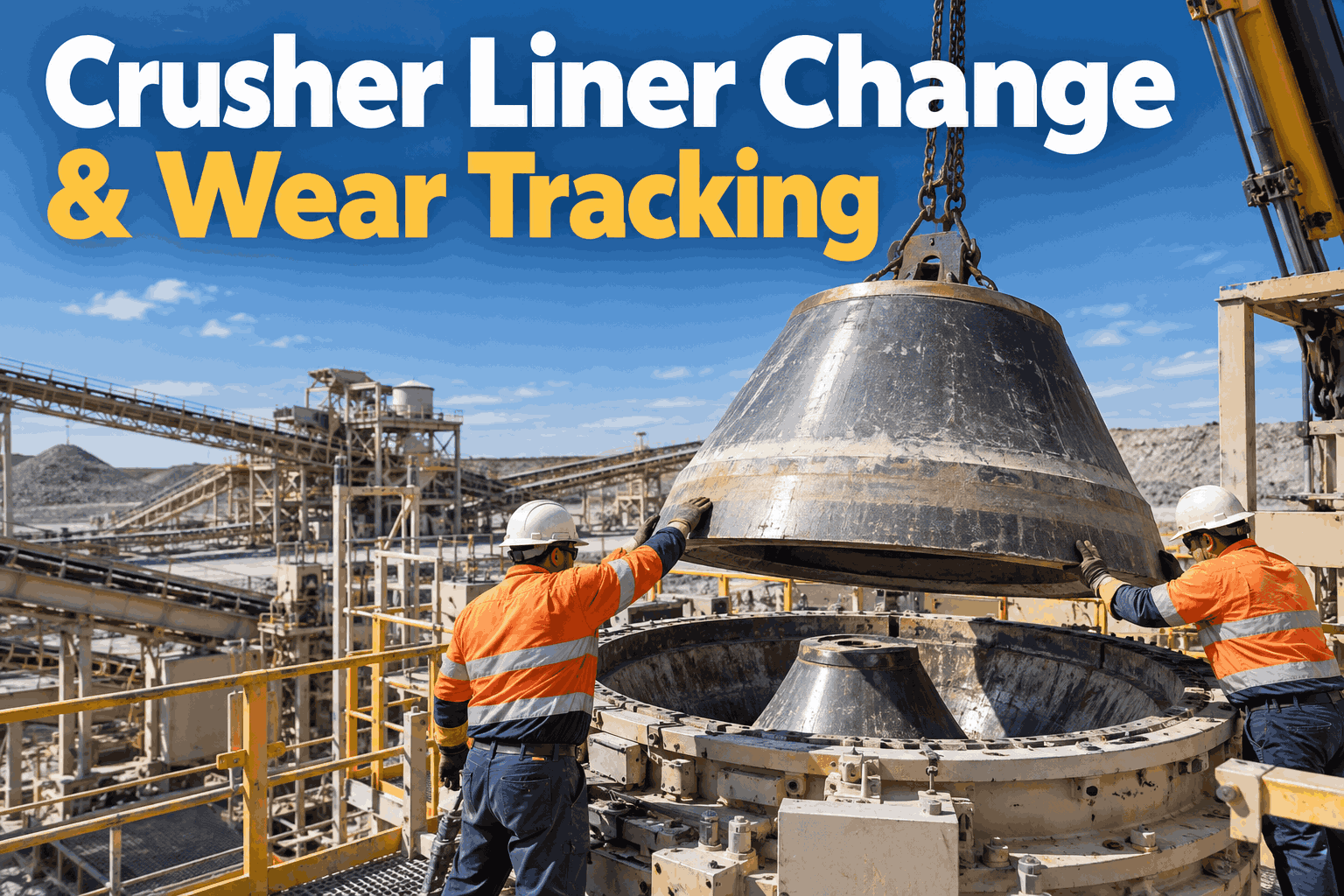
Crusher liner change planning works best when maintenance teams can see how wear is progressing before production forces the decision. Cone mantles and concaves, jaw plates and gyratory liners do not always wear evenly, so a calendar date alone cannot describe their condition. Consistent inspections, repeatable measurements, replacement history and spare-parts readiness turn liner change-outs into planned maintenance instead of a reaction to an unacceptable wear condition.
Measure the wear. See the trend. Plan the liner change.
Build crusher liner changes around repeatable measurements, equipment-specific limits, ready-to-use wear parts and a maintenance history that improves the next change-out.
A liner change should start with a measurement—not a surprise
Crusher liners are consumable wear components, but their useful life is influenced by far more than elapsed time. Feed characteristics, crusher configuration, throughput, operating practices and wear profile can all change how quickly a liner reaches its equipment-specific replacement condition. The useful maintenance question is therefore not simply “How old is this liner?” but “How is it wearing compared with its previous measurements?”
Record the new profile
Start the liner cycle with identified measurement locations and installation information.
Repeat the same measurements
Comparable readings are more useful than measurements taken at changing locations.
Watch the wear pattern
Compare readings over time and look for acceleration or uneven profile loss.
Prepare the change-out
Align parts, labor and shutdown access with the approved replacement criteria.
Measure the same locations if you want the readings to tell a story
Wear measurements become useful when technicians can compare like with like. Define repeatable points or profile locations for the crusher and liner design, then record readings against the correct asset and liner set. The actual measurement method and allowable limits should follow manufacturer guidance for that crusher.
Turn individual readings into a change-out planning signal
One measurement describes condition today. A sequence of comparable measurements shows direction. That history helps planners see whether wear is progressing steadily, changing faster than expected or becoming uneven enough to justify a closer inspection.
Rate of change
Is the condition progressing at a similar rate between inspections, or has wear accelerated?
Uneven profile
Are some measurement zones losing material significantly faster than others?
Shutdown preparation
Use the trend with OEM criteria and operating context to prepare the change-out window.
Do not invent a universal percentage or thickness limit. Crusher design, liner geometry and manufacturer requirements differ. Use the applicable OEM replacement criteria and site procedures to determine when a specific liner must be changed.
“Crusher liner” means different components on different machines
The maintenance program should identify the actual wear components installed on each crusher. Inspection points, measurement methods and replacement limits vary by equipment design, so the asset record needs enough detail to keep the correct liner history attached to the correct machine.
Mantle & concave
Track wear profile across the crushing chamber and watch for uneven wear, abnormal surface condition and changes that may affect the intended chamber geometry.
Jaw plates
Inspect fixed and moving jaw wear surfaces at repeatable locations and record uneven wear, damage and retention-related observations where applicable.
Mantle & concave system
Large gyratory liner systems require equipment-specific inspection, measurement and change-out planning coordinated with major plant shutdown requirements.
Wear condition is only half the decision
Knowing that a liner is approaching its replacement point does not mean the plant is ready to change it. A controlled change-out also needs the correct parts, work scope, competent resources, approved procedures and a coordinated shutdown window.
What to capture before deciding the next action
The exact inspection points depend on the crusher and liner design, but a repeatable checklist helps technicians capture enough context for planners and reliability teams to understand the condition rather than receiving a vague “liners worn” note.
Wear profile
Compare the visible profile with previous inspections and expected wear pattern.
Repeat measurements
Record readings at the defined equipment-specific measurement locations.
Uneven wear
Identify areas wearing faster than the rest of the liner or chamber.
Cracking or damage
Record abnormal visible damage and escalate it under the site's procedure.
Retention condition
Check applicable fastening, retention or seating observations defined by the OEM.
Feed condition
Note abnormal feed distribution or operating conditions that may explain the wear pattern.
Supporting evidence
Attach clear photos and identify the liner zone shown in each image.
Next action
Record whether the condition needs monitoring, planning or prompt escalation.
Digital inspections can keep these readings and observations attached to the correct crusher instead of separating measurements, photos and maintenance notes across different records. See how HVI handles fixed-plant inspections.
A planned liner change can still become a delay if the parts are not ready
Wear tracking should give the parts team time to act. The replacement set, associated hardware and any equipment-specific consumables should be identified against the planned job before the shutdown begins.
If the liner keeps wearing badly, changing it is not the whole fix
Uneven or unexpectedly rapid wear is useful reliability information. Instead of resetting the clock with another liner set, compare the wear pattern with feed distribution, operating conditions, chamber configuration and previous liner history to determine whether a recurring condition needs investigation.
What changed around the crusher?
Feed distribution
Is material entering the chamber consistently, or is one area carrying more of the load?
Feed characteristics
Have material hardness, abrasiveness, moisture or size distribution changed?
Crusher configuration
Review applicable chamber, setting and operating information against OEM guidance.
Liner selection
Confirm that the installed wear parts match the crusher and intended application.
Operating history
Compare the current liner cycle with previous sets on the same crusher.
Maintenance findings
Look for repeated inspection observations occurring alongside abnormal wear.
Reliability perspective: replacement history becomes more valuable when it includes the condition that drove the change. If successive liner sets show similar abnormal wear in the same zone, the history gives the team a reason to investigate the operating condition rather than simply shortening the replacement interval.
From the final wear reading to the next baseline
A good crusher liner change-out closes one wear cycle and starts the next. The work order should preserve what was removed, what was installed and the baseline information the next inspection team will need.
Review final condition
Verify the applicable replacement decision and change-out scope.
Stage parts & resources
Confirm liners, associated components, tools, labor and approved procedures.
Control hazardous energy
Follow site and equipment-specific isolation, lockout and blocking requirements.
Complete approved work
Perform the liner change according to the crusher manufacturer's procedure.
Inspect before return
Complete required post-maintenance checks before the crusher returns to service.
Create the new baseline
Record the new liner set, installation date and starting measurement references.
Crusher entry and liner change-outs require rigorous energy control. Follow applicable mine/site procedures, crusher manufacturer instructions, lockout/tagout requirements, stored-energy controls, lifting plans and competent-person requirements. This guide does not replace those procedures.
Do not close the work order until the next wear cycle can be understood
The best time to prepare for the next liner change is immediately after the current one. Capture the replacement details while the information is fresh so future measurements can be compared with a clear starting point.
See whether successive sets deliver similar service and wear patterns.
Identify repeated abnormal zones instead of treating each set independently.
Use replacement history to support future inventory and shutdown preparation.
A centralized maintenance record makes it easier to connect liner inspections, work orders, parts usage and completed change-outs to the crusher. Book an HVI demo to see the workflow on fixed-plant assets.
Crusher liner change FAQs
How do you know when crusher liners need to be changed?
Use the crusher manufacturer's replacement criteria together with repeatable liner measurements, wear profile, operating condition and inspection findings. Avoid applying one universal thickness or percentage to every crusher because liner geometry and approved limits vary by model and application.
How should crusher liner wear be tracked?
Define repeatable measurement locations using the applicable OEM procedure, record readings consistently and compare them over successive inspections. Keep the readings with the crusher and liner-set history so planners can see the wear pattern rather than relying on isolated measurements.
What can cause uneven crusher liner wear?
Uneven wear can be associated with feed distribution, material characteristics, operating conditions, crusher configuration, liner selection and other equipment-specific factors. When abnormal wear repeats, compare the current pattern with operating and maintenance history and investigate it using manufacturer guidance.
What should be prepared before a crusher liner change-out?
Confirm the approved work scope, correct replacement liners and associated parts, required labor and equipment, shutdown timing, manufacturer procedures, lifting requirements and site-specific hazardous-energy controls. Preparing these items before the shutdown reduces avoidable delays once the crusher is unavailable.
How can HVI support crusher liner replacement planning?
HVI can help teams record liner inspections and measurements, schedule preventive maintenance, create change-out work orders, connect replacement parts with maintenance work and retain completed replacement history against the crusher asset. This creates a traceable record for future liner planning.
Make the next liner change visible before the shutdown starts
Bring wear inspections, measurements, planned work, replacement parts and crusher maintenance history into one repeatable workflow.