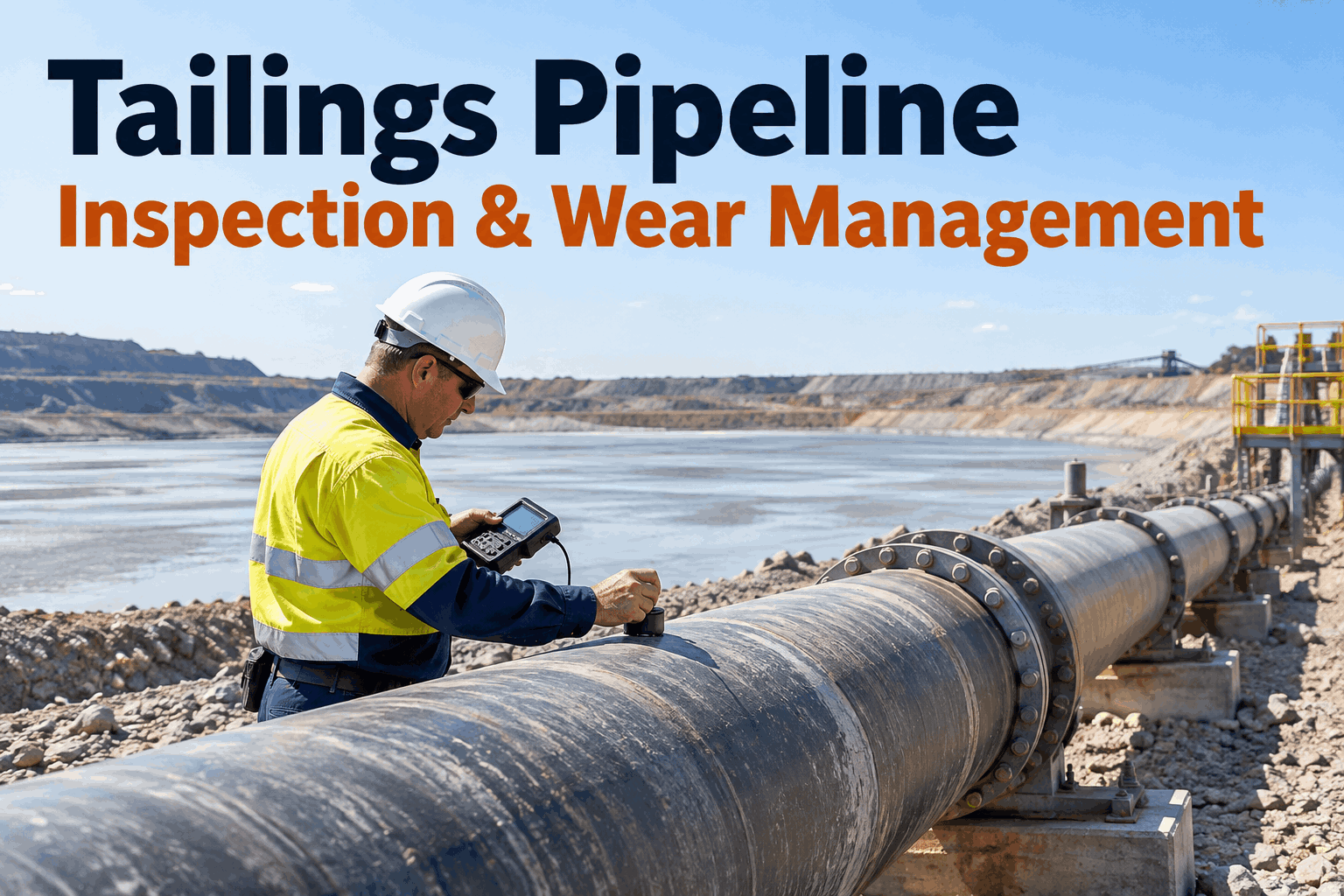
A tailings pipeline looks fine right up until it doesn't. Abrasive slurry scours the wall from the inside — hardest at every bend — thinning steel you can't see until a wall gives way and puts tailings on the ground. Tailings pipeline inspection is a numbers game: measure the remaining wall at the points that wear fastest, track the trend, and rotate or replace the pipe before thinning becomes a spill. See wall thickness trended toward the burst line.
Tailings pipeline inspection that measures ahead of the burst
Ultrasonic wall thickness at the bends that wear first, trended toward the minimum, with pipe rotation and spool swaps scheduled — so a slurry line never thins its way to a spill.
Pumps and valves fail where you can watch them. A tailings line fails inside a wall nobody can see, at a bend out on the line — so the only honest way to manage it is to measure the steel that's left and watch it drop.
Where a tailings pipeline wears, and why bends go first
Slurry wear isn't even. The abrasive load concentrates where the flow changes direction or drops to the bottom, so a few spots thin far faster than the rest of the line.
Knowing the hot spots tells your crew exactly where to put the thickness gauge — see thickness readings mapped to the high-wear points.
The measurement that runs a tailings pipeline inspection
Everything comes down to one number tracked over time: how much wall is left versus the minimum the line can safely run on. Here's the progression a reading walks through.
A reading alone is a dot; the trend across readings is what tells you the date it goes — see remaining wall trended to a replace-by date.
Rotate before you replace: getting more life from the same pipe
The wear is on one line of the pipe, not all of it. That's the opening — turn the worn spot off the wear path and the pipe keeps running on fresh wall.
Turning a joint so the worn invert or outer-radius moves off the high-wear line puts fresh wall in the firing position — often doubling the life of a spool before it's scrapped.
When a bend or section hits minimum, change just that spool on a planned outage. Tracking which spools are where means you replace the one that's done, not a guess.
Rubber or ceramic-lined bends where wear is worst outlast bare steel many times over. The inspection data tells you which locations earn the upgrade.
Each move is driven by the readings, not the calendar — put pipe rotation and spool history on the record free.
How HVI runs tailings pipeline inspection
The reading points, the thickness trend, the rotation history and the work orders live on one platform, so a thinning wall becomes a planned swap instead of a number lost in a spreadsheet.
Thickness captured at fixed points
Ultrasonic readings logged at the same bends and stations every round, so each point carries a real trend instead of a one-off number on a clipboard.
Trend to a replace-by date
Each point's wear rate projects remaining wall against its minimum, so the system tells you when a spool reaches the line, not after it's passed it.
Rotation & swaps as work orders
A near-minimum reading raises a rotation or spool-swap work order with the location, and each spool's history follows it so nothing gets changed twice or missed.
It runs on the same platform as your wider preventive maintenance scheduling and your crusher and conveyor maintenance, so the tailings line sits in the same record as the rest of the plant.
A tailings line doesn't give you a warning noise. It's fine, it's fine, and then it's a spill and a regulator on site. We'd take thickness readings but they lived in a spreadsheet nobody trended, so we were replacing pipe on gut feel — too early on the straights, too late on a bend once.
Putting every reading point on a trend changed the whole program. Now the bends tell us when they're close, we rotate what we can and swap what we can't, and we haven't had a surprise on the line since.
Frequently asked questions
What does a tailings pipeline inspection involve?
Measuring the pipe wall thickness at the points that wear fastest — mainly bends and the bottom of horizontal runs — usually by ultrasonic testing, and trending each reading toward the minimum allowable wall. Based on the trend, the pipe is rotated, a spool is swapped, or a hot spot is lined before it thins to a failure.
Why do tailings and slurry pipelines wear out at the bends?
Abrasive particles in the slurry slam into the outer radius every time the flow changes direction, so bends and elbows erode far faster than straight pipe. The bottom of horizontal runs also wears as heavier particles grind along the invert. That's why thickness readings concentrate at those points.
How is tailings pipeline wall thickness measured?
Usually with ultrasonic thickness testing at fixed, repeatable points, which reads the remaining steel without cutting into the pipe. Taking readings at the same spots each round builds a trend, so you can project remaining wall against the minimum allowable and predict when a section reaches it.
What is pipe rotation and why does it extend pipeline life?
Wear concentrates on one line of the pipe — the outer radius of a bend or the invert of a horizontal run. Rotating the joint turns that worn section off the high-wear path and puts fresh wall in its place, often significantly extending the life of a spool before it has to be replaced.
How does HVI help with tailings pipeline inspection?
HVI captures ultrasonic thickness readings at fixed points, trends each toward its minimum to project a replace-by date, and raises rotation or spool-swap work orders with the location and each spool's history. It turns scattered readings into an integrity program that calls the work before a wall bursts.
Make tailings pipeline inspection a trend, not a gut feel
Ultrasonic readings at the bends that wear first, each trended toward its minimum, with rotation and spool swaps raised as planned work. Change the pipe on a date you chose, not after it's on the ground.