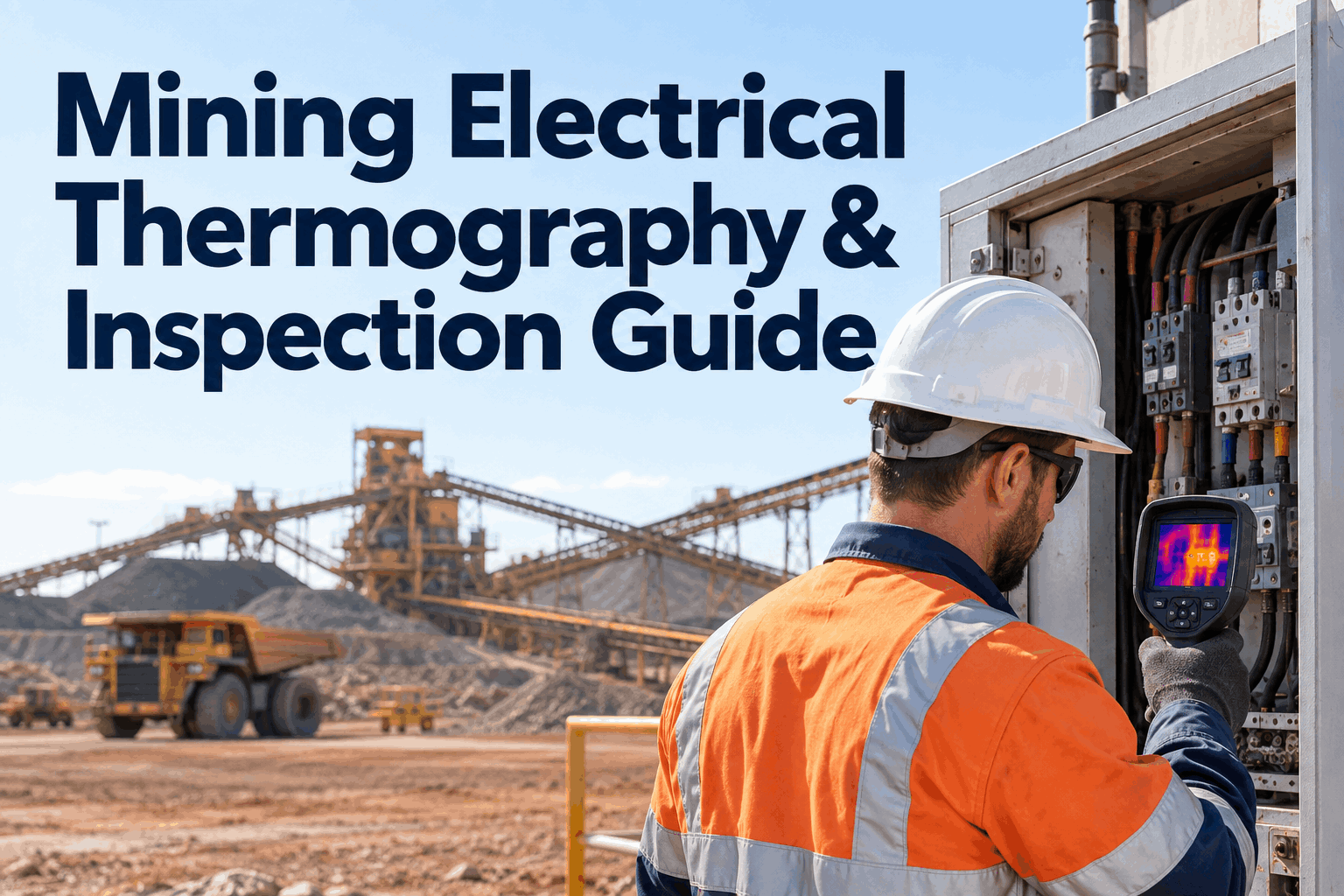
A loose busbar connection doesn't trip a breaker or throw a code — it just runs a little hotter every week until the day it arcs, drops a substation and takes a section of the mine down with it. You can't see that heat with your eyes, but an infrared camera sees it instantly. That's the whole case for mining thermography: a failing electrical connection announces itself as heat long before it fails, and a thermal scan catches it while it's still a cheap fix. This guide covers how an electrical thermography program works and how to turn each hot-spot finding into tracked, scheduled action — book a walkthrough to see it in HVI.
See the fault as heat, fix it before the arc.
Electrical thermography finds hot spots in panels, switchgear and connections weeks before failure. HVI is where each finding becomes a graded defect, a work order and a re-scan schedule — so the scan prevents the outage instead of filling a report.
Thermography is non-contact, fast and done while the equipment runs — a technician can scan a full switch room in minutes and flag every connection that's heating up under load. In a mine, where a single electrical outage stops production across a whole circuit, that early warning is worth a lot. But the scan is only step one. The finding has to be graded, recorded, repaired and re-checked, or the hot spot you photographed in March is the failure you're explaining in June. Here's how the program works, and how the findings turn into action.
What infrared thermography inspection findsthe electrical faults that show up as heat first
Almost every electrical fault wastes energy as heat before it fails outright. That's why a thermal imaging inspection is so broad — one scan surfaces a whole family of problems that are invisible to a visual check.
Loose & corroded connections
The most common finding — a loose or corroded terminal has high resistance, so it heats under load. The classic catch, and the cheapest to fix if caught early.
Overloaded circuits
A conductor or breaker carrying more than its rating runs hot across its length — thermography shows the overload before insulation breaks down.
Phase imbalance
When one phase runs hotter than the others on the same load, the scan reveals an imbalance that's stressing motors and transformers.
Failing switchgear & breakers
Worn contacts and degrading breakers develop hot spots inside the gear — switchgear thermography catches them before a nuisance trip or a flashover.
Busbar & joint faults
High-current busbar joints are prime hot-spot sites. A heating joint on a main bus is a top-severity find — an outage waiting to happen.
Transformers & MCCs
Motor control centers and transformers show cooling problems and internal faults as abnormal surface heat across the enclosure.
One scan, a whole fault family — which is why electrical thermography is a backbone of predictive maintenance in mining. It pairs with the other condition-monitoring techniques: motor current signature analysis reads the drive's electrical signature, while a quick walkthrough shows how every finding is tracked per asset.
Grading by ΔT — how a hot spot becomes a prioritytemperature rise decides what gets fixed, and how fast
A thermal image on its own is just a pretty picture. What makes it actionable is the temperature rise — the ΔT between the hot spot and a reference (ambient, or an identical component under the same load). The bigger the rise, the more urgent the repair. That grade is what turns a scan into a prioritized work list.
Grading criteria follow recognized standards (NETA and NFPA 70B style guidance), but the exact thresholds depend on your assets and insurer. The point is consistency: every finding graded the same way, so the urgent ones rise to the top and nothing sits in a drawer. That only works if the grade travels with the finding into the work system — book a walkthrough to see graded findings become a prioritized work list →
The one rule that makes or breaks the scana thermal imaging inspection only works under load
This is where thermography programs quietly fail: an electrical fault only makes heat when current is flowing. Scan a de-energized panel and the worst connection in the mine looks stone cold. The scan has to happen with the equipment running under meaningful load — ideally near normal operating current — or the finding is a false negative.
The fault hides
- No current means no heat — hot spots don't show
- A dangerous connection reads as "all clear"
- The report gives false confidence
- The failure still arrives, unwarned
The fault shows
- Real operating current drives real heat
- Hot spots stand out against healthy components
- ΔT can be measured and graded accurately
- Load condition recorded alongside the finding
Recording the load condition with each scan matters as much as the image — a finding without its load context can't be compared or trusted later. HVI keeps the load note, the ΔT and the severity together on the digital inspection record, so every scan in the history is comparable. Start free and record scans with full context →
Thermography findings, tracked in HVIthe electrical condition record a reliability team builds scan by scan
This is the payoff: each hot spot with its ΔT, severity grade, the work order against it and the re-scan date — so an infrared predictive maintenance program builds a trend instead of repeating the same route and losing the results between scans.
Instead of thermal images buried in survey PDFs, the team has every hot spot with its grade, action and trend — so the program compounds in value and an auditor or insurer can see the whole electrical-maintenance history at once. That record is what analytics and reporting draws from, and you can book a walkthrough to see this survey log on your own assets.
Electrical thermography route checklistthe mining electrical inspection routine that keeps the lights on
Thermography pays off as a repeatable route, not a one-off. Here's a baseline electrical infrared inspection checklist, grouped the way HVI loads it, each finding recorded against the asset.
- Equipment running under normal load
- Load condition noted for each circuit
- Same scan points as last route, for comparison
- Access & safe working distance confirmed
- Panels, switchgear, breakers, busbars scanned
- ΔT measured against a reference
- Each hot spot graded by severity
- Thermal image attached to the finding
- Graded findings raised as work orders
- Critical hot spots escalated the same day
- Re-scan scheduled to verify repairs
- Record kept for audit & insurer
On paper, the images scatter across survey files and the before/after comparison never happens; in HVI each finding is logged with its grade, a fault becomes a work order, and the re-scan is scheduled so repairs get verified. It runs the same way as the rest of your mining maintenance program. Book a walkthrough to load your IR route →
From a mine reliability engineer
The scans were never the problem — the contractor would hand us a binder of thermal images twice a year and we'd fix the two scary ones and lose the rest. The medium-grade finds just evaporated until they turned into the scary ones.
What changed it was putting every hot spot into the system with its ΔT and a work order, and a re-scan to prove the repair worked. Now the main-bus joint that heats up gets caught at "plan it," not at "the substation's down." The insurer likes the paper trail too.
Mining thermography — FAQs
What is electrical thermography inspection?
It's a condition-monitoring technique that uses an infrared camera to detect heat in electrical equipment under load. Faults like loose connections, overloads and phase imbalance waste energy as heat, so they appear as hot spots on a thermal image long before they fail — making thermography a core predictive-maintenance tool for mining electrical assets.
What does ΔT mean in thermography?
ΔT is the temperature rise between a hot spot and a reference — either ambient or an identical component under the same load. It's how findings are graded: a small ΔT means monitor, a large ΔT means repair urgently. Grading by ΔT turns a thermal image into a prioritized work list.
Why must equipment be under load during a scan?
Electrical faults only generate heat when current flows. A de-energized or lightly loaded panel hides even a dangerous connection, giving a false "all clear." Scanning under normal operating load — and recording that load with the finding — is what makes a thermal imaging inspection reliable.
How often should mining electrical thermography be done?
It's typically run as a scheduled route — often quarterly or annually, with critical substations scanned more frequently, and always a verification re-scan after a repair. Insurers and standards like NFPA 70B often drive the interval. The key is consistency: a fixed route, scanned the same way each time, so trends are comparable.
Does HVI do the thermal imaging itself?
No. HVI isn't a thermal camera or infrared analyzer — it's the maintenance system that records each hot-spot finding with its ΔT and severity grade, turns a graded fault into a work order, schedules the re-scan, and keeps the audit-ready history, so the thermography program actually prevents outages rather than filling a binder.
Turn every thermal scan into a prevented outage
HVI is where mining thermography becomes action — each hot spot logged with its ΔT and severity, raised as a work order, re-scanned to verify the repair and trended over time — so the heat you caught is the failure you avoided. Live on your plant in under two weeks.
See it on your own assets · Works offline in the plant · Audit-ready records from day one