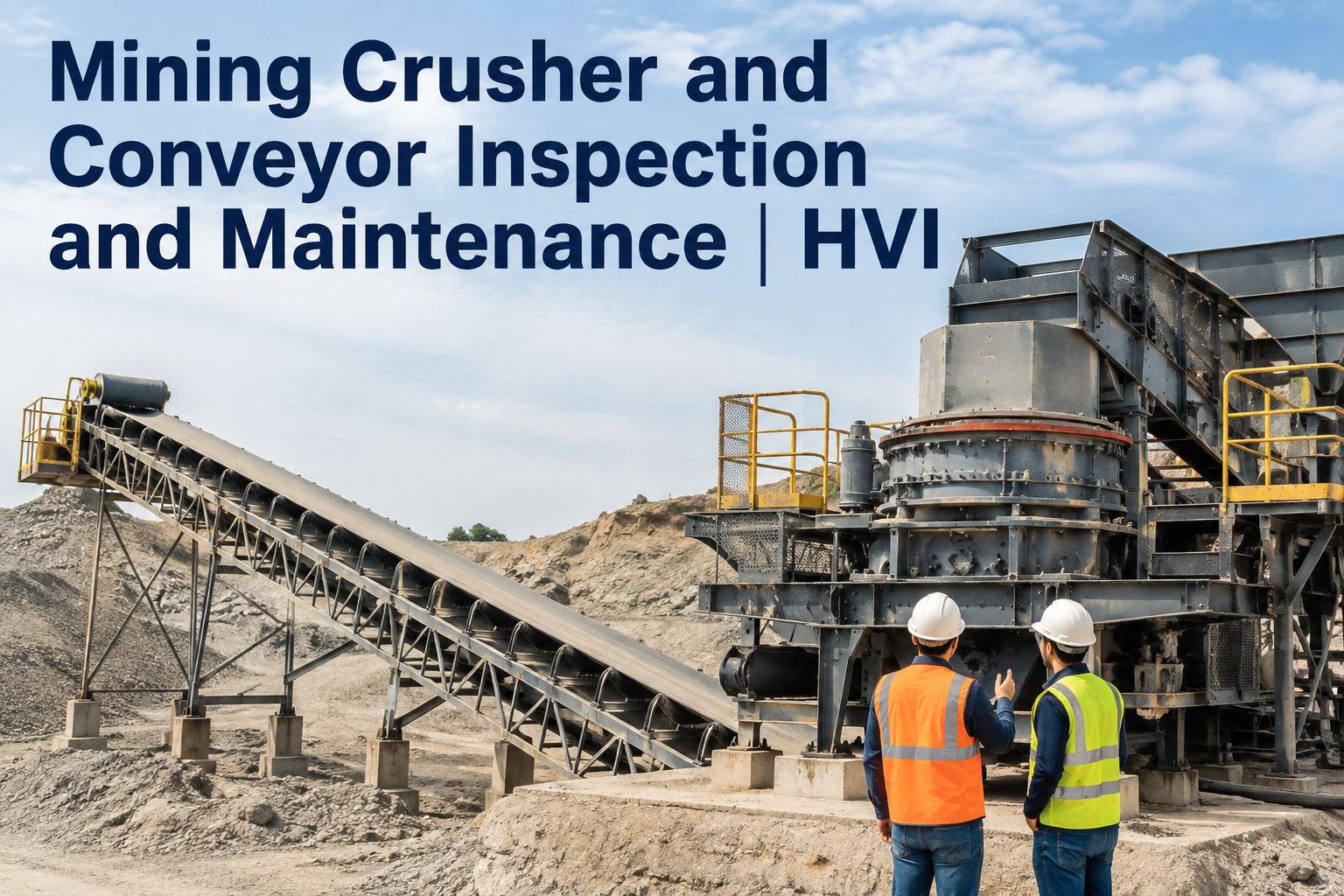
A crusher inspection in mining is not a nice-to-have on the schedule - it is the one thing standing between a running plant and a dead one. When the primary crusher trips or a conveyor belt lets go, every truck and loader upstream stops earning, and the fix is measured in days, not hours. The frustrating part is that most of these failures announce themselves weeks in advance: a worn liner, a seized idler, a splice starting to peel, a guard propped open for "quick access." This guide breaks down the fixed plant inspection and maintenance cycle that keeps crushers, conveyors and transfer points running - guarding, belt condition, liner wear, lubrication and the isolation discipline that decides whether your crew goes home. If you want to see this running digitally on your own plant rather than on paper, book a walkthrough of HVI's plant inspection templates and we will show it on a real crusher circuit.
One seized idler can burn down a kilometre of belt. Is your inspection cycle catching it first?
Mobile fleet gets all the attention, but fixed plant carries the whole production chain. A disciplined crusher and conveyor inspection program - with isolation before every entry - is what keeps tonnes moving.
The numbers behind crusher and conveyor downtime
Every figure below is money out of your pocket when the plant stops - or money saved when your inspection cycle catches the problem early.
When the primary crusher or main overland conveyor goes down, the entire chain behind it stops - trucks, loaders, everything.
A mid-size operation moving 1,500 tph at even modest margins loses five figures for every hour the belt is not turning.
A failed splice or longitudinal rip is not a quick patch - vulcanising crews, clamping, cure time. Days of lost production.
A stalled roller under a moving belt generates enough heat to ignite rubber and frass. One missed idler can cost you the whole conveyor.
What a crusher inspection in mining actually covers
Six zones, each with its own failure mode and its own cost when you miss it. This is the cycle that keeps comminution equipment alive.
Guarding Integrity
Guards are among the most frequently cited plant conditions in regulator inspections - and the most commonly defeated for access. Check every guard is present, pinned, and interlocked where required. A missing guard on a running nip point is a fatality waiting for a shift change.
Photo evidence on every guard checkBelt Condition & Tracking
Walk the belt looking for splice separation, edge damage, longitudinal scoring and mistracking. A belt running off-centre chews its own edges against the structure and turns a $40,000 asset into scrap in weeks. Catch splice peel early and it is a repair; miss it and it is a replacement.
Weekly walk-down, logged with photosIdler & Roller Function
A seized idler is both a wear point and a fire ignition source. The belt slides over the stalled roller, heat builds, rubber smoulders. Spin-test idlers on every inspection - by hand on a stopped belt, by ear and thermal check on a running one. Flag and replace before friction does the damage.
Defect-to-work-order in one tapTransfer Points & Chutes
Transfer points take the full impact of every tonne the plant moves. Check liner plates, skirt rubber condition, dust sealing and blockage buildup. A worn chute liner that punches through spills product onto the return belt and starts a tracking problem you will chase for days.
Wear measurements logged per pointCrusher Liner & Wear Parts
Mantle and concave wear decides your change-out schedule. Measure remaining liner thickness on a fixed cycle - not when throughput drops. Running liners past their wear limit costs you throughput, product gradation and eventually the crusher head itself. Planned change-outs take hours; unplanned ones take days.
Meter-triggered PM at wear thresholdsIsolation & Lockout
This is where fatalities occur. Before anyone enters a crusher cavity, a chute, or a belt take-up, the energy source must be isolated, locked and tested. Electrical, hydraulic, gravitational - all of it. No exceptions for "quick looks." This step is non-negotiable and must be documented every single time.
Isolation steps built into every work orderHow a fixed plant inspection cycle runs week to week
Not a once-a-quarter audit. A layered cycle - daily eyes, weekly hands, monthly measurements - that catches problems at the cheapest stage.
Daily Operator Walk-Around
Five minutes per area before startup. Guards in place, no visible belt damage, no unusual noise or smell, pull-cords intact, no material buildup at transfer points. Logged on a phone, not a clipboard. Anything flagged goes straight to the maintenance queue as a defect with a photo.
Weekly Maintenance Inspection
Hands-on. Spin-test idlers, check belt tracking and splice condition, inspect skirt rubbers and chute liners, grease points, check lubrication system pressures and flows. This is where you catch the seized idler before it becomes a fire and the peeling splice before it becomes a rip.
Monthly Wear Measurement
Crusher liner thickness, screen media condition, chute liner remaining life, belt thickness at known wear points. These numbers drive your change-out schedule and your parts ordering. When the mantle hits its wear limit, you already have the replacement on site and the shutdown window booked.
Planned Change-Out & Shutdown
Liner change, belt splice repair, idler replacement batch - all planned from wear data, all with isolation steps pre-built into the work order. No scrambling for parts, no surprise scope, no one entering a crusher without a documented lockout. This is what a real crusher maintenance schedule looks like.
Why paper-based plant inspections keep failing you
The problem is not that your crew does not inspect. It is that paper records cannot prove it, cannot trigger action and cannot hold anyone accountable.
Paper & Spreadsheet
- Guard check ticked on a sheet - no photo, no proof it was actually looked at
- Idler defect written in a logbook that the planner reads next week
- Liner measurements in a spreadsheet on one person's laptop
- Isolation steps verbal - "did you lock it out?" asked after the fact
- Audit request means digging through filing cabinets and hoping
- No alert when a PM interval is due - you find out when it fails
HVI Digital Inspection
- Every guard check requires a photo - timestamped, GPS-tagged, audit-ready
- Idler defect becomes a work order instantly, routed to the right crew
- Liner wear measurements logged per asset, trended, visible to the whole team
- Isolation and lockout steps are mandatory fields in the work order - no skip
- Any record pulled in seconds during a regulator, client or insurance audit
- Meter and calendar PM triggers fire alerts before intervals are missed
If you are still running plant inspections on paper and want to see the difference on your own crusher circuit, book a 30-minute demo and we will load your actual inspection points into a live template.
Your mobile fleet has a maintenance program. Does your fixed plant?
See HVI running crusher and conveyor inspections on a real plant - templates, photo evidence, isolation steps, PM triggers. Thirty minutes, your circuit, your data.
Four HVI capabilities built for fixed plant inspection
Not a generic CMMS bolted onto a mining problem. These are the specific tools that keep crushers, conveyors and transfer points inspected, maintained and documented.
Custom Plant Templates
Build inspection forms that match your actual plant - crusher, screen, conveyor, transfer point - with the exact checkpoints your operation needs. Guarding, belt condition, idler function, liner wear, lubrication. Configurable per asset type, not one-size-fits-all.
Outcome: every inspection covers every critical point, every timePhoto Evidence on Guarding
Every guard check requires a photo. Not optional - mandatory. When a regulator or client auditor asks for proof that guarding was inspected last Tuesday, you pull a timestamped, photo-backed record in seconds. No digging, no hoping.
Outcome: audit-ready guarding records, zero filing cabinetsMeter & Calendar PM Triggers
Set preventive maintenance by running hours, calendar date or both. When the crusher hits 500 hours since its last liner check, HVI fires the alert and generates the work order. No spreadsheet, no whiteboard, no "I thought someone was tracking that."
Outcome: no missed PM intervals, no surprise failuresWork Orders with Isolation Steps
Every work order for crusher or conveyor maintenance includes mandatory isolation and lockout steps. The technician cannot close the order without confirming each step. This is not a suggestion - it is built into the workflow, documented and timestamped.
Outcome: isolation discipline enforced by the system, not by memoryWant to see these running on your own plant? Sign up free and build your first crusher inspection template in under ten minutes, or book a demo and we will walk through it together.
What a missed inspection actually costs - a worked example
A mid-size aggregate operation running a 42-inch overland conveyor at 1,200 tph. One seized idler, missed on a weekly check, ignites the belt at 2 AM.
| Cost Item | Detail | Impact |
|---|---|---|
| Belt replacement (200m section) | Belt, splice kits, vulcanising crew, crane | $35,000 - $50,000 |
| Lost production (72 hours) | 1,200 tph x 72h at $8/tonne margin | $69,000+ |
| Structure & idler damage | Heat-warped stringers, burnt idlers, wiring | $12,000 - $18,000 |
| Regulator investigation | Reportable incident, site stand-down, documentation | 2-5 days additional |
| Insurance & reputation | Premium increase, client confidence damage | Ongoing |
| Total from one missed idler | vs. a $40 idler and 10 minutes of inspection time | $116,000+ |
That is the maths of conveyor inspection maintenance. A $40 roller and ten minutes on a phone versus six figures and a week of downtime. If you want to run these numbers on your own plant, book a demo and we will map your conveyor circuit into HVI with your actual wear points and PM intervals.
What to do Monday morning
Walk your guarding this week. Count how many guards are missing, propped open or pinned with wire. That number is your exposure. Every one of those is a citation and a potential fatality.
Spin-test every idler on your main conveyor. Mark the seized ones. Count them. Each one is a wear point and an ignition source. Replace them in a batch, not one at a time after failure.
Measure your crusher liners. If you do not know remaining thickness today, you are running blind. Set a measurement cycle and stick to it - monthly at minimum, more often on abrasive feed.
Audit your isolation records. Pull the last five crusher entries. Can you prove lockout was done, by whom, and when? If the answer is no, your documentation gap is as dangerous as the physical one.
Move the inspection cycle off paper. Paper cannot trigger a work order, cannot require a photo, cannot alert you when a PM is due. Start logging plant inspections free and see the difference in the first week.
I track one number every morning: how many idlers we replaced this week versus how many we found seized. If the replacement number is lower than the found number, we are falling behind and the belt is at risk. Before we went digital, I had no idea what either number was - the logbook was always a week behind and half the entries were illegible. Now I see it on my phone before I finish my coffee. The isolation sign-off alone is worth it. I used to lie awake wondering if someone had actually locked out before going into that chute.
Crusher and conveyor inspection FAQs
How often should you inspect a crusher in mining?
Daily operator walk-arounds for guarding, lubrication and visible damage. Weekly hands-on checks for wear parts, liners and lubrication system condition. Monthly liner thickness measurements to drive change-out planning. The exact cycle depends on throughput and abrasiveness of feed, but the layered approach - daily eyes, weekly hands, monthly measurements - is the standard that catches problems at the cheapest stage.
What causes most conveyor belt fires in mining?
Seized idlers are the most common ignition source. When a roller stalls and the belt slides over it, friction generates enough heat to ignite rubber and accumulated frass. Other causes include overheated bearings, electrical faults and hot work near the belt. Regular idler spin-testing and thermal checks on a running belt are the primary defence. A demo of HVI's conveyor inspection templates shows how to build idler checks into a weekly cycle with photo evidence.
What is plant isolation and lockout before crusher entry?
Isolation means physically disconnecting every energy source - electrical, hydraulic, pneumatic, gravitational - before anyone enters a crusher cavity, chute or confined space. Lockout means applying a personal lock and tag so the energy cannot be restored while someone is inside. Test-before-touch confirms zero energy. This is where fatalities occur in fixed plant maintenance, and it is non-negotiable. Every work order must include documented isolation steps.
How do you measure crusher liner wear?
Measure remaining liner thickness at fixed points using ultrasonic thickness gauges or physical measurement during shutdowns. Record the readings against the asset and track the wear rate over time. When the liner approaches its minimum safe thickness, schedule the change-out before throughput drops or the crusher head is damaged. HVI lets you log these measurements per asset and set meter-based PM triggers so the alert fires automatically when the wear threshold is reached.
Can HVI handle both mobile fleet and fixed plant inspections?
Yes. HVI is one platform across trucks, trailers, buses, off-road plant and fixed equipment like crushers, screens and conveyors. You build custom inspection templates for each asset type, set PM triggers by hours or calendar, and every defect flows into the same work order queue. Your mobile fleet DVIRs and your fixed plant inspections live in the same system with the same audit trail. Sign up free and build your first plant template in minutes.
Stop running your plant on paper and hope
Guarding photos, idler defects, liner measurements, isolation sign-offs - all timestamped, all audit-ready, all on one platform. See it on your own crusher circuit in a 30-minute demo.
Free to start - Works on any phone - No card needed