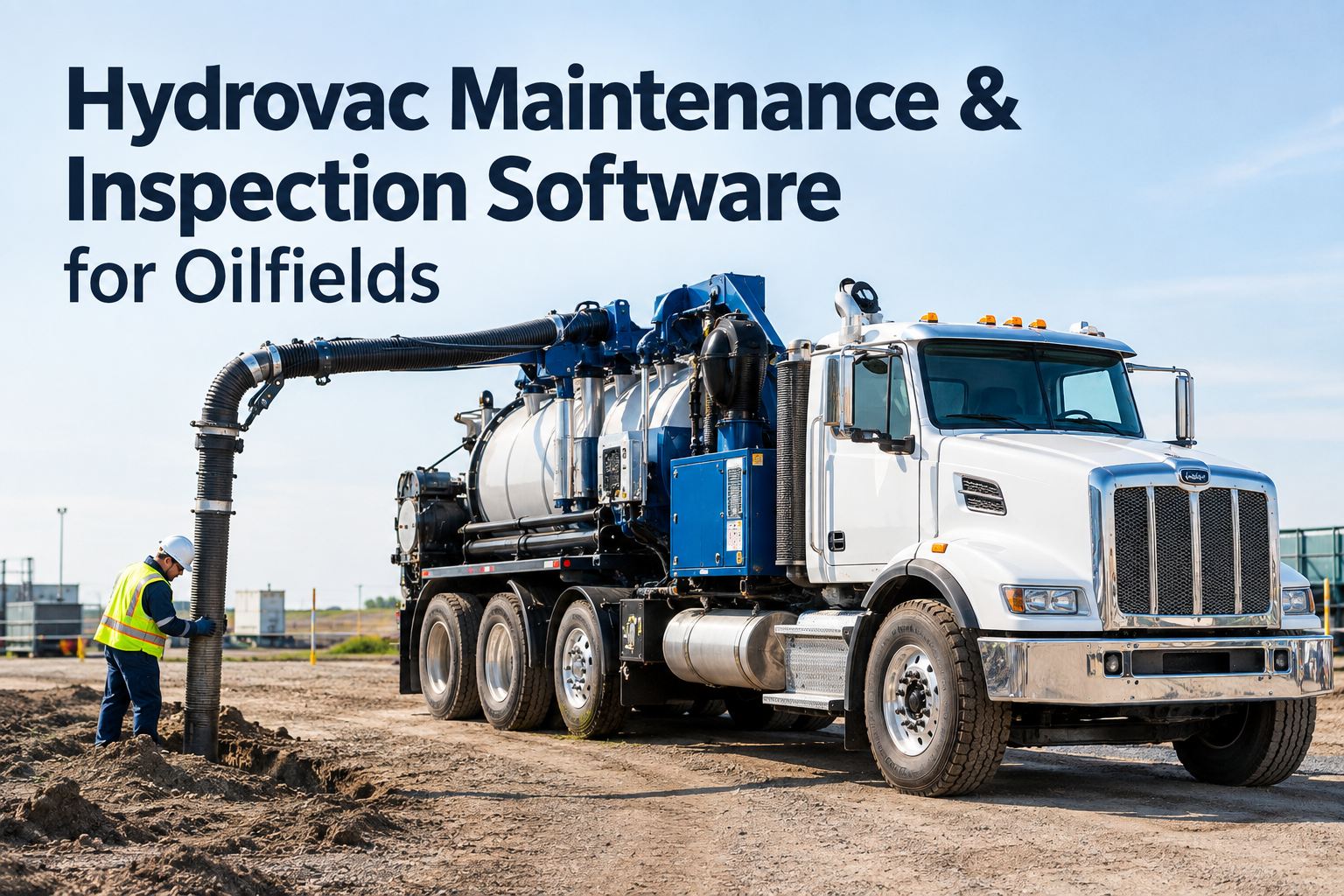
A hydrovac isn't one machine on a maintenance schedule — it's six, sharing a frame. The chassis, PTO, vacuum blower, water system, boom and hydraulics each wear on their own clock, and a failure in any one deadlines the whole truck. Book a demo to see how hydrovac maintenance software keeps all six on one asset record. A spreadsheet can track chassis mileage; it can't trigger a blower service on engine hours or push a pump-seal defect into a work order. This page covers the systems, the intervals and the workflow that keep a hydrovac earning.
One Truck, Six Systems, Six Different Maintenance Clocks
A hydrovac sits ready at 6 a.m. with a full water tank and a day of digging ahead. Two hours later it's deadlined because a blower threw a seal nobody scheduled around. The systems that stop the job have nothing to do with the chassis — and that's exactly what a chassis-only maintenance approach misses.
If you run hydrovacs, you know the truck can be road-legal and still useless on site because the vacuum's down or the boom won't swing. A purpose-built maintenance workflow closes that gap — treating the unit as the integrated asset it is, not a chassis with attachments. A note before the detail: intervals and inspection items vary by equipment configuration, manufacturer, jurisdiction, operator and client, so treat what follows as a framework and confirm the specifics against the sources that apply to your fleet.
One integrated assetwhat hydrovac maintenance software actually manages
Hydrovac maintenance software is a digital inspection and maintenance workflow built for the hydrovac as a single asset with multiple independent systems — not just its truck chassis. A vacuum excavator, or combo unit, uses high-pressure water to break up soil and a powerful vacuum to pull the slurry into a debris tank, all driven off the chassis engine through a PTO. So one unit carries a chassis, a PTO, a vacuum blower, a water system, a boom and hydraulics, and a web of safety interlocks and controls — each with its own wear pattern and service interval.
The reason a generic vehicle checklist falls short is structural: those systems don't fail on the odometer. A blower needs oil on engine hours, a boom pin needs grease weekly, hydraulic fluid runs on operating hours, and the chassis runs on miles. Managing all of that on one record — where a chassis oil change never crowds out a blower service — is the entire point. Book a demo to see every system on one asset record
The six systems on one unitwhat each one lives on — verify intervals against your OEM
Here's the hydrovac broken into the systems a crew inspects and services, each with the kind of interval it typically runs on. The intervals below are common industry reference points — your manufacturer's manual is the authority for your specific unit.
The road-going truck: engine, brakes, tires, lights, frame and fluids, on the standard commercial-vehicle schedule and its usual inspection obligations.
The power take-off that drives every excavation function. A PTO fault disables the whole vacuum-and-boom system even while the engine runs fine — inspect and grease the shaft on schedule.
The blower or positive-displacement pump that creates suction. Blower oil typically changes around every 250 hours; filter bags run longer with restriction testing. Listen for bearing noise and watch for suction loss.
High-pressure pump, tank, lines and nozzles. Run a weekly pressure check, service pump seals on schedule, and drain the system in freezing weather so the pump doesn't crack.
The boom, cylinders, pump, hoses and fittings. Grease boom pins weekly, check hydraulic fluid and filter around 500 hours, and watch for slow or jerky boom movement and leaks.
Interlocks, relief valves, gauges, in-cab controls and wiring. Interlocks like boom-won't-move-without-outriggers protect the crew; verify relief and gauge calibration and check the harness for chafing and corrosion.
Six systems, at least four different clocks. That's why configurable, unit-specific inspection templates matter — a hydrovac needs items and intervals a flatbed checklist never contains. Start free and build a hydrovac-specific template
Why one system deadlines the whole truckthe failures that turn a full day into a tow
A hydrovac is only as reliable as its weakest system, and the expensive lesson is that any single subsystem can stop the entire unit — regardless of how healthy the other five are. These are the failures that end a day on site, and each one is a scheduled service someone skipped.
A thrown seal or failed bearing kills suction mid-dig. Blower oil on schedule and listening for noise on the daily check is the cheap prevention; a rebuild plus lost days is the alternative.
The engine runs, but engage the PTO and nothing happens — no vacuum, no boom, no dig. A monthly shaft inspection and greasing catches wear before it strands a loaded truck.
A failed pump seal or a line that froze because the system wasn't drained stops the cutting jet cold. Weekly pressure checks and cold-weather draining prevent both.
A burst high-pressure hose or a boom moving slow and jerky halts excavation and creates a hazard. Hose inspection and fluid service on the hydraulic clock keep the boom working.
The common thread: a $50 seal caught in scheduled service prevents a five-figure emergency repair and the lost revenue behind it. None of these are surprises — they're clocks that ran out unwatched. Book a demo to see every system's next service due
One clock can't run six systemsmeter-based PM for hydrovac units
This is where spreadsheets and mileage-only schedules break down. A hydrovac's chassis wears on miles, but the blower, hydraulics and water pump wear on operating hours — and a unit can sit on site for hours running the excavation package while the odometer barely moves. Schedule the blower off mileage and you'll badly under-service the system most likely to deadline the truck. Meter-based preventive maintenance triggers each subsystem from the measure that actually reflects its wear.
All three trigger types live on one asset record, so nothing gets skipped because it wasn't on the same clock as the oil change — and your OEM's intervals, plus regulatory and operator requirements, take precedence over any generic figure. Start free and set meter-based PM per system
From site defect to closed repair
The hard part isn't spotting a soft blower or a weeping hose — it's not losing that observation between a remote jobsite and the shop. On paper, a noted defect rides around in the cab until someone remembers it. On a connected platform, a defect flagged on the pre-trip carries straight through to a work order and a documented fix.
-
1Operator flags it on siteOn the pre-shift, the operator fails the hydraulic item, photographs the seep and adds a voice note — the inspection works offline and syncs when there's signal.
-
2It becomes a tracked defectThe failed item lands on the unit record as an open defect visible to the maintenance lead, and a safety-critical one can block the unit from dispatch until it's resolved.
-
3One tap to a work orderThe defect converts into a work order with the photo, unit number and hour reading attached, and the hose and fittings pulled from inventory.
-
4Repaired, costed & documentedThe tech completes the repair, logs parts and labor against the unit, and the service history shows the fix — ready for the next dig and the next audit.
Every system runs the same loop, so a chassis brake defect and a vacuum-blower fault are handled identically — one workflow across the whole unit and the whole fleet. Book a demo to watch a defect become a work order
From a hydrovac fleet manager
We tracked our trucks like trucks — mileage, oil changes, the usual. Problem is a hydrovac doesn't break down like a truck. Ours were getting deadlined by blowers and water pumps and boom hydraulics, none of which the mileage schedule ever touched. We were basically running the most expensive part of the machine on hope.
Putting every system on one record with its own trigger changed the math. The blower's on hours, the boom greasing is on a weekly reminder, the chassis is on miles — and I can see all of it per unit across three districts. Deadline time on the vacuum side dropped hard, and the cost-per-unit view paid for the software by itself when it flagged two units we should've cycled out.
Hydrovac maintenance software FAQs
What is hydrovac maintenance?
Hydrovac maintenance is the inspection and upkeep of a vacuum excavation unit as an integrated asset with several independent systems, not just a truck. A hydrovac carries a chassis and engine, a PTO driving the excavation package, a vacuum blower, a high-pressure water system, a boom and its hydraulics, and safety interlocks and controls — each with its own wear pattern and service interval. Maintaining it well means inspecting all of those on a schedule suited to each: miles for the chassis, operating hours for the blower and hydraulics, and a weekly or monthly cadence for boom greasing and PTO checks. Specific tasks and intervals come from the manufacturer's documentation and the applicable regulations and operator requirements, not a generic checklist.
How do you maintain a hydrovac truck?
You maintain it system by system, because the parts that stop a hydrovac aren't the parts that stop a normal truck. The foundation is a daily pre-trip covering fluid levels, the vacuum and water systems, the boom and hydraulics, and the chassis, plus scheduled service on each system: blower oil on operating hours (commonly around 250), hydraulic fluid and filter on hours (often around 500), water pump seals and pressure checks on a weekly-to-annual cadence, boom pin greasing weekly, PTO shaft inspection monthly, and vacuum relief and gauge calibration periodically — with standard chassis maintenance on mileage. Draining the water system in freezing weather and running restriction tests on filter bags are easy-to-miss steps that prevent expensive failures. Always follow your unit's OEM schedule and the applicable operator and regulatory requirements rather than a single generic list.
What should be inspected on a hydrovac?
A thorough hydrovac inspection covers all six systems. Chassis: engine, brakes, tires, lights, frame and fluids. PTO: engagement and shaft condition, since a PTO fault disables all excavation functions even with a running engine. Vacuum: blower oil and bearings, suction, filter-bag restriction, hoses and the debris tank. Water: pump, seals, tank, lines and nozzles, plus a pressure check. Boom and hydraulics: cylinders, pump, hoses and fittings for leaks, and boom movement for slow or jerky operation. Safety and controls: interlocks such as boom-won't-operate-without-outriggers, relief valves, gauges, and wiring for chafing and corrosion. The exact checklist should be built for your specific unit configuration and reflect the OEM, regulatory and operator requirements that apply.
How often should a hydrovac be serviced?
There isn't one interval, because each system runs on its own clock. As common reference points, hydrovac fleets often run a daily pre-trip, a roughly 250-hour service for vacuum-pump and water-system checks, a roughly 500-hour service for deeper mechanical work including hydraulics, and an annual major service covering boom, tank and chassis. Layered on that are weekly items like boom greasing and water-pressure checks, monthly PTO shaft inspection, and quarterly vacuum-relief and gauge calibration, while the chassis follows its standard schedule. Because these intervals are driven by a mix of manufacturer recommendations, actual operating hours and operator requirements — and vary by unit and jurisdiction — confirm the current requirements for your specific equipment rather than relying on a fixed figure.
How does HVI help maintain a hydrovac fleet?
HVI puts every system of a hydrovac on one connected record per unit, across every district. Operators run a configurable, unit-specific inspection from a phone on site and document defects — a soft blower, a weeping hose, a failing water pump — with photos and voice notes, even offline. Any flagged defect becomes a tracked work order with the photo, unit number and meter reading attached, and a safety-critical defect can block dispatch until it's resolved. Preventive maintenance triggers on the right meter for each system: engine or operating hours for the blower and hydraulics, mileage for the chassis, and calendar cadence for boom greasing and calibration. Parts and cost are logged per unit, and a fleet dashboard shows status across the operation with records retrievable in seconds for an audit. HVI provides the workflow; the specific items and intervals should follow the OEM, regulatory and operator requirements.
Stop running the most expensive part of the machine on hope
HVI puts the chassis, PTO, vacuum, water, boom and hydraulics of every hydrovac on one connected record — configurable unit-specific inspections, on-site defect capture with photos and voice notes, one-tap work orders, meter-based PM that triggers each system on the clock it actually runs on, parts and cost tracking, and service history that travels across districts. Built for hydrovac contractors who can't afford a deadlined unit and a stalled dig.
No credit card · Meter-based PM by system · Records ready to pull on demand