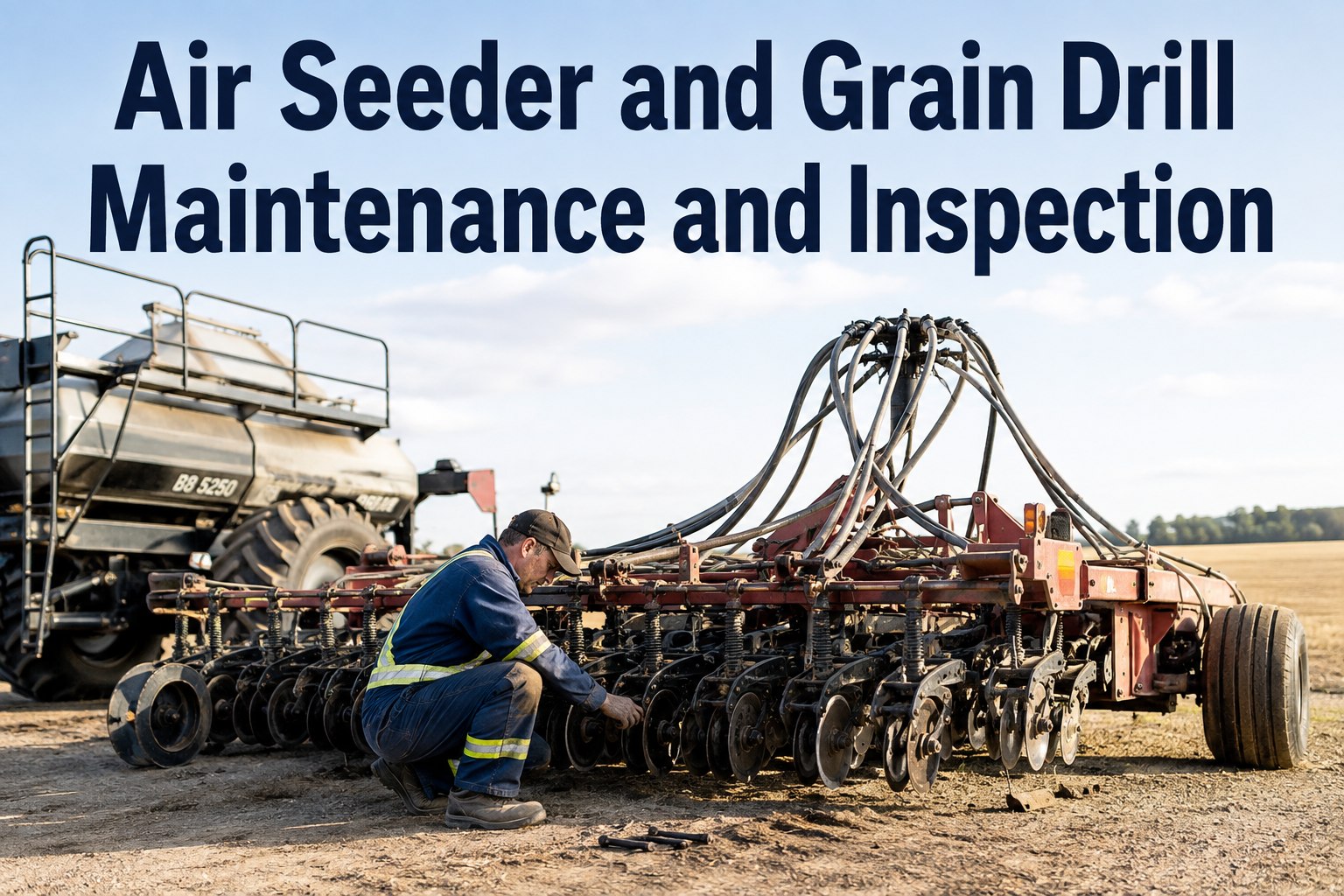
You walk the field three weeks after seeding and see it: stripes. Pale gaps where the stand never came up, running the full length of the pass, and every one of those stripes traces back to a blocked run, a worn opener or a metering roll that was out of calibration when the acres went in. Air seeder maintenance is the kind of work that pays or costs you months later, because the machine can look and sound fine in the yard while quietly distributing seed unevenly across a 60-foot toolbar. By the time the crop tells you, the seed, the fuel and the window are all spent. This guide walks through the systems that actually cause those stripes — fan and air delivery, metering and calibration, manifolds and hose runs, openers and depth control, tanks and augers — and the pre-season checks that catch problems while they are still cheap to fix. If you would rather see how this runs as a digital checklist on your own units, book a 30-minute walkthrough and we will show it on a real air cart template.
What if you could find the blocked run before the crop does?
Uneven distribution across the toolbar is invisible until emergence. A structured pre-season inspection — fan pressure, meter calibration, hose-by-hose flow checks, opener wear — turns a stripe-pattern surprise into a two-hour shop job in February.
Four numbers that justify a pre-season overhaul
Air seeder fan service: pressure and volume come first
Every downstream problem starts here. The fan has to move enough air at the right static pressure for the product you are carrying — canola at low rate needs a different setting than wheat at high rate with fertilizer in the same stream. A fan that is 10% down on rpm or leaking past worn seals still sounds healthy from the cab.
Check fan drive and rpm under load
Hydraulic drive motors wear and lose speed; belts glaze and slip. Verify fan rpm against spec with product actually flowing, not just at idle. A tach reading under load is the only number that matters.
Inspect seals, housing and intake screen
Air leaks before the manifold mean every run downstream is starved equally — the hardest pattern to diagnose because it looks like a calibration problem. Clean the intake screen; a choked screen quietly drops system pressure all day.
Verify air at the manifold, not the fan outlet
Static pressure at the distribution head tells you what the seed actually sees. Record it per product and per rate in your inspection history so next season's baseline is a fact, not a memory.
Blockages in the air system develop progressively — a bit of fertilizer dust, a cracked hose liner shedding material, condensation in a low spot. By the time a monitor alarms, the run has been under-delivering for acres. Logging pressure readings and blockage alarms per unit in a free HVI inspection log builds the trend line that catches the slow failures.
Seed metering on an air seeder: rate accuracy is money
Metering rolls wear, and they wear differently by product. A roll that has metered abrasive fertilizer for two seasons can be over-delivering canola by enough to matter at $15-plus per pound. Calibration is not a once-per-machine event — it is per product, per rate, per season.
Static calibration catch test
Run the meter at a set speed, catch output from each tank, weigh it, compare to target. Do it for every product you will seed this season and record the numbers. A 3% over-rate on canola across 3,000 acres is real money; a 3% under-rate is stand you never get back.
Inspect rolls, flutes and seals
Look for worn flute edges, cracked rolls and product leaking past meter seals into the air stream. Leakage past the meter shows up as rate drift that no calibration setting will fix — the fix is a roll or a seal, and it is cheap compared to the acres.
Verify the rate controller against reality
Ground-speed sensors and shaft encoders drift. Cross-check the controller's applied rate against a measured catch at field speed at least once per season per tank. Trust the scale, not the screen.
Distribution manifold checks: where the stripes are born
The manifold splits one air stream into dozens. If the split is uneven — a worn divider, a kinked hose, a partial blockage — the toolbar seeds unevenly, and the crop emerges in stripes weeks later. The checking method is simple, but almost nobody does it because it is tedious on paper.
Bag every hose at the opener
With product in the tank and the fan at operating pressure, run the meters for a timed interval and catch each run's output in a bag or bucket. Yes, all of them. On a 48-run machine this is the hour that saves the season.
Weigh and compare run to run
Any run more than roughly 10% off the average has a problem: a kink, a crack, a worn manifold port or a developing blockage. Mark it, fix it, re-test it. The pattern across the toolbar also tells you whether the issue is one hose or the whole head.
Photograph and file the results
A photo of the catch buckets beside each run number, filed against the unit, is your baseline for next year and your proof the check happened. This is exactly the kind of record that disappears on paper — and the kind HVI stores against the asset automatically when you see the inspection workflow in a demo.
Opener maintenance on a drill: wear varies by position
Openers on the wings wear faster than openers in the centre. Outside runs cut more turns, carry more residue and take more rock strikes. If you measure two openers and call the bar good, you have measured nothing. Depth control across a wide toolbar is only as good as its worst position.
| Component | Wear limit to check | What failure looks like | Fix window |
|---|---|---|---|
| Disc opener blades | Diameter vs. spec (often ½ in under new) | Shallow furrow, poor sidewall, uneven depth | Replace in off-season; cheap per row |
| Opener bearings | Play / roughness when spun by hand | Wobbling disc, ragged furrow, sudden seizure mid-field | Replace with disc; minutes per row |
| Seed boots & firmers | Cracks, wear-through, missing firmers | Seed placed loose or shallow, poor germination rows | Swap during hose check |
| Depth / press wheels | Tire cracks, bearing play, mud build-up points | Depth variation across the bar, open furrows | Pre-season; check again mid-season |
| Packer & closing systems | Spring tension, arm bushings, wheel alignment | Loose seedbed, moisture loss, striped emergence | Adjust per soil; log settings per field |
A practical sampling rule: measure disc diameter and boot condition on at least one opener per rank and both wing tips — that is usually 8–12 openers on a mid-size drill — and record the readings per position. When you track opener wear parts per unit in a parts-and-inventory walkthrough, you can see which positions eat parts season after season and stock accordingly.
Run this whole checklist from a phone in the shop
HVI air seeder and grain drill templates walk your crew through fan, meters, manifolds, hoses and openers — with photos, per-position readings and automatic work orders for anything that fails.
Tank and auger service on the air cart
The loading system fails in two expensive ways: contamination between products, and breakdowns during the narrow windows when the drill should be rolling. Both are preventable with boring, scheduled attention.
Tank lids, seals and screens
Perished lid seals let moisture in; wet fertilizer bridges over the meter and starves runs intermittently — the worst kind of fault to chase. Check tank screens for damage that lets lumps and tag ends through to the meter housing.
Auger and conveyor wear
Worn flighting slows loading and grinds seed. Check flight edges, tube wear at the inlet, and bearing play at both ends. A loading auger that fails on the first big day costs you the day, not the bearing.
Clean-out between products
Residual treated seed in a tank that next carries feed barley is a contamination claim waiting to happen. Build clean-out and verification into the inspection record — signed, dated, photographed — so there is never a question about what was in the tank last.
Hydraulics, hoses and drive lines
Fan motors, auger drives and meter drives all run on the same hydraulic supply. Weeping fittings and chafed hoses found in February are a ten-minute fix; found in the field they are a tow and a lost window.
The pre-season air seeder service that pays for itself
Six weeks before seeding is the sweet spot: parts still available, shop not yet slammed, and time to fix what the inspection finds. Here is the sequence that works.
Full unit inspection and defect list
Walk the whole machine with a structured checklist — air system, meters, manifold, hoses, openers, tanks, hydraulics. Every defect becomes a work order the same day, not a note on a whiteboard. Scheduling this per unit in a CMMS means it happens on the calendar, not when someone remembers.
Parts ordered and wear items replaced
Discs, boots, hoses, seals and meter rolls arrive and go on. This is where parts and inventory discipline pays: the opener wear parts you logged last season are already on the shelf instead of on backorder with half the country ordering the same week.
Calibration and hose-by-hose flow check
Static catch tests per product, then the bag test across every run. Record the numbers per unit. If a run is out, fix and re-test now — not at 10 pm on the second day of seeding with the planter crew waiting.
Field verification on the first pass
Stop after the first rounds. Dig across the bar — centre, wings, behind wheel tracks — and check depth and spacing at multiple positions. Log the readings and a photo. That record closes the loop and becomes next year's baseline.
Built for seeding equipment, not just trucks
HVI is a cloud and mobile inspection and maintenance work order platform. Your crew runs the whole pre-season program from any phone or tablet in the shop, and every record is timestamped, photo-backed and tied to the unit.
Configurable seeder & drill templates
Build inspection templates per equipment type — air cart, drill, planter — with per-position opener readings, pressure fields and pass/fail items. Failed items become work orders instantly, with the photo attached.
Pre-season overhaul scheduling
Preventive maintenance by date, season or engine hours, with due and overdue alerts. The week-minus-six inspection fires on the calendar for every unit, every year, without anyone remembering it.
Parts & inventory for wear items
Track discs, boots, hoses and meter rolls across shops, see which positions consume parts, and reorder before the pre-season rush. No more discovering an empty shelf the week you need forty disc openers.
Photo capture that proves the work
Catch-bucket photos, worn discs, cracked hoses — filed against the asset with date and technician. When a stand question comes up in June, you pull the February record in seconds instead of digging through a binder.
If you want to see these templates on your own equipment list, grab a demo slot and bring your unit count — or start a free account and build your first seeder checklist today.
Air seeder maintenance, in one paragraph and five habits
The crop is the inspection report you cannot argue with, and it arrives weeks too late to act on. Effective air seeder maintenance means checking the systems that fail silently — fan pressure, meter accuracy, distribution balance, opener wear — while they are still shop problems, and keeping the records that prove it.
- Verify air at the manifold, under load, per product — not at the fan outlet at idle.
- Calibrate meters per product, per season and trust the scale over the controller screen.
- Bag-test every run before seeding; any hose more than about 10% off average gets fixed and re-tested.
- Measure openers by position — wings and outside runs wear first, and two sample openers tell you nothing.
- Schedule the whole program in a CMMS so it fires on the calendar, with photos and readings filed against each unit.
Do these five things and the stripes stop appearing. Skip them, and the field will file its own report in June. When you are ready to run this as a digital program instead of a binder, walk through it on your own units in a demo.
The year I stopped trusting memory was the year we found a meter roll over-delivering canola by four percent — on paper it looked fine, on the scale it was burning money every pass. Now my rule is simple: nothing goes to the field without a calibration sheet and a hose test photo on file. I track one number — runs out of spec at the pre-season check — and I want it at zero before the first tank is filled.
— Dale Kowalski, Maintenance Manager, 9,000-acre mixed grain operation
Air seeder and grain drill maintenance questions
How often should you calibrate an air seeder?
What causes uneven seed distribution across the toolbar?
When should disc openers be replaced on a grain drill?
What should a pre-season air seeder inspection include?
Can maintenance software handle seeding equipment, or is it just for trucks?
Find the blocked run in February, not in June
Put your air seeders and drills on scheduled inspections, photo-backed records and automatic work orders — before the crop files its own report.
Free to start - Works on any phone - No card needed